
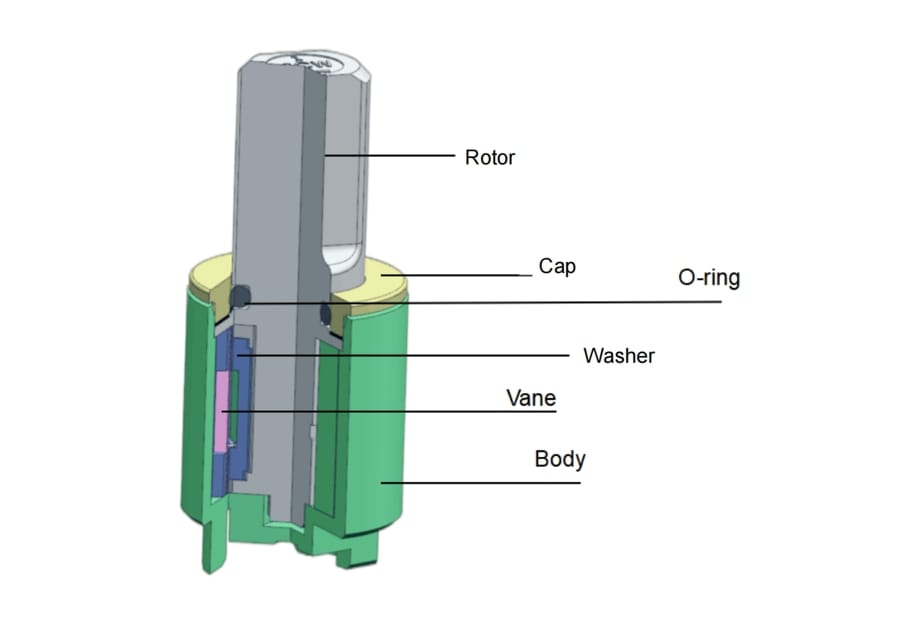
In 2026, the pursuit of “perceived quality” has transformed from luxurious aesthetics into a fundamental engineering requirement. Whether it’s the gentle close of a medical device panel or the safety damping of a high-end car’s center console, the sensory experience of motion defines brand value. At the heart of this “silent revolution” lies the rotary damper. This article will explore the technological changes, manufacturing challenges, and emerging applications that are redefining motion control this year.
1. Materials Science: The Foundation of Torque Stability
For decades, the primary failure point of rotary dampers has been torque inconsistency—their performance varies dramatically between frigid winter mornings and hot industrial environments. In 2026, innovation begins at the molecular level.
Nano-engineered Silicone Oil
Modern high-performance rotary dampers now utilize nano-engineered synthetic silicone oils. Unlike standard lubricants, these oils maintain a nearly constant viscosity index across a temperature range of -40°C to +90°C. For engineers, this means that the “cap-closing time” remains consistent whether the equipment is in a Nordic laboratory or a tropical manufacturing plant.
Advanced Sealing Structure
Multi-lip sealing technology solves the problem of “leakage.” 2026-grade dampers employ FKM (fluororubber) or advanced HNBR seals, combined with precision-machined housings, to achieve an airtight seal with a service life of 50,000 to 100,000 cycles. This reliability is no longer optional but a necessity for meeting IATF 16949 automotive standards.
2. Structural Evolution: Higher Torque, Smaller Footprint
As global product design trends toward miniaturization and “hidden technology,” the demand for ultra-compact dampers has surged.
Torque Density Optimization
The engineering challenge of 2026 is achieving high torque (e.g., 3.0N·m to 5.0N·m) within a diameter of less than 15mm. Through finite element analysis (FEA), internal vane structures and gear profiles have been optimized to maximize the shear area of the silicone oil. This allows designers to integrate damping into slim-profile electronics and compact automotive interiors without compromising on the “heaviness” or “premium feel” of the motion.
Involute Gear Precision
For gear dampers, noise is the enemy of quality. Current manufacturing utilizes micron-level injection molding and involute gear tooth profiles. This ensures that the engagement between the damper and the mating rack is seamless, eliminating the “clicking” or “backlash” often found in low-cost alternatives.ds toward miniaturization and “hidden technology,” the demand for ultra-compact dampers has surged.
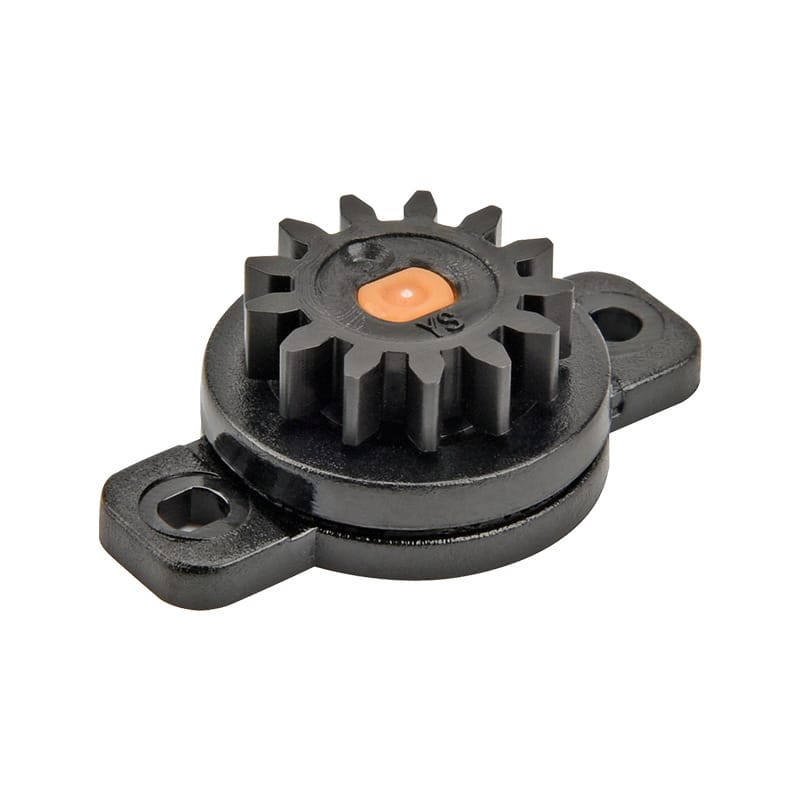
3. Jan Rotary Damper Manufacturing Excellence: Beyond the Assembly Line
A high-quality rotary damper is not just designed; it is manufactured through rigorous data-driven processes.
Rotary damper Automated Assembly & 100% Torque Testing
In 2026, manual assembly is a relic of the past for precision components. Automated production lines now integrate online torque sensors. Every single unit is tested during the assembly process. If a damper’s torque deviates by more than ±10% from the nominal specification, it is automatically rejected. This level of PPM (Parts Per Million) control is what separates Tier 1 suppliers from general hardware traders.
Durability and Environmental Validation
Quality assurance now involves accelerated life testing under combined loads—vibration, salt spray (for marine/outdoor use), and thermal cycling. A damper rated for 50,000 cycles at JAN means it has survived those cycles under its maximum rated load without a torque drop exceeding 20%.
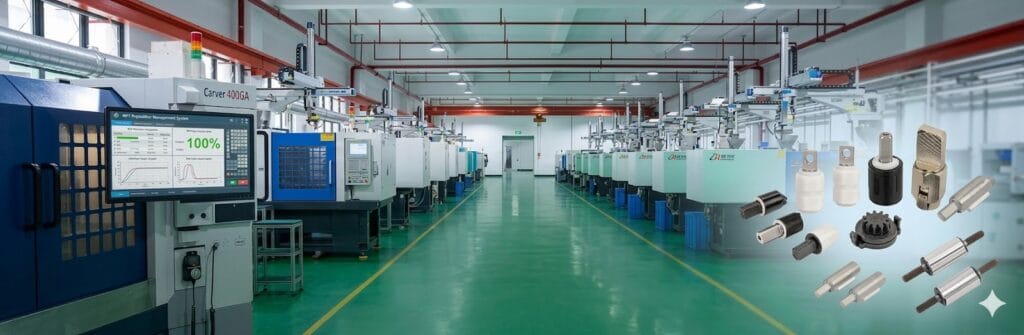
4. Rotary Damper Vertical Applications: Where Precision Meets Purpose
The application of rotary dampers has expanded far beyond the traditional “toilet seat” or “washing machine lid.”
Rotary damper Automotive Intelligence (The Smart Cabin)
The transition to EVs has made cabins quieter, making mechanical noise more noticeable. Rotary dampers are now essential for:
- Retractable Touchscreens: Providing fluid movement as screens emerge from the dashboard.
- Hidden Charging Ports: Ensuring the motorized cover opens with a consistent, premium resistance.
- Active Aerodynamics: Controlling the movement of grille shutters and spoilers.
Medical and Laboratory Equipment
In healthcare, sudden movements can be dangerous or damage sensitive calibration. High-viscosity vane dampers are used in:
- Ventilator Covers and Monitors: Ensuring they stay in position or close softly to maintain a sterile, quiet environment.
- Centrifuge Lids: Preventing accidental injury during high-speed operation.
High-End Home & Office Automation
The “Smart Home” is also a “Soft Home.” From the soft-close mechanisms in 5G routers’ hidden panels to the sophisticated friction hinges in ergonomic monitor arms, the goal is User Safety and Sound Suppression.
5. Rotary damper Engineering Selection: A Data-Driven Approach
Selecting a damper is a mathematical exercise, not a guessing game. To find the right solution, engineers must calculate the required torque (T) using the formula:
T (L .m) = L(m) * W(kg) * 0.5 * 9.8
(Where L is the length of the lid and W is the weight.)
Beyond the math, one must consider the Angular Velocity. A damper that performs perfectly at a slow close may exhibit different resistance during a forced rapid close. Working with a manufacturer that offers custom torque tuning ensures that the damping curve matches the specific ergonomics of your product.
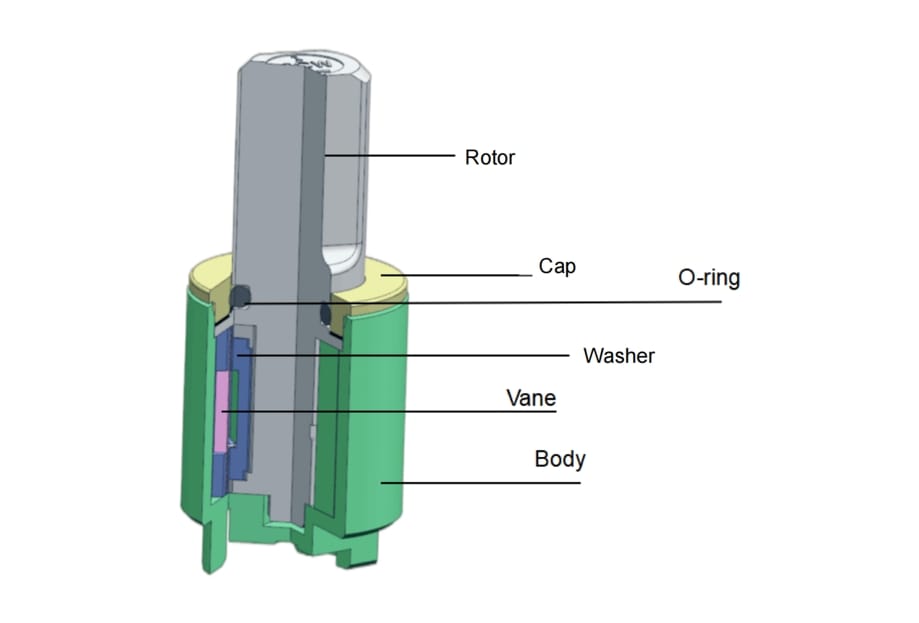
7. The Physics of Fluid Shear: Understanding the “Internal Resistance”
To truly appreciate the 2026 advancements in rotary dampers, one must look at the internal fluid dynamics. A rotary damper is essentially a kinetic energy absorber that converts mechanical energy into thermal energy through fluid shear.
The Newtonian vs. Non-Newtonian Debate
In high-precision motion control, the choice of silicone oil is critical. Most standard dampers use Newtonian fluids where viscosity remains constant regardless of the shear rate. However, for “smart” damping applications in 2026, we are seeing a shift toward dilatant or pseudoplastic fluids.
- Why it matters: If a user tries to force a lid shut quickly, a dilatant fluid increases resistance instantly to prevent structural damage. This “active-reactive” feedback loop is what gives modern high-end furniture and automotive glove boxes their “intelligent” feel.
Thermal Dissipation Architecture
When a heavy industrial lid is cycled frequently, the internal silicone oil generates heat. If the heat isn’t dissipated, the oil thins (viscosity drops), and the damping effect fails. 2026 designs at JAN incorporate heat-sink housing profiles—using aluminum alloy casings with micro-fins—to increase surface area for thermal cooling, ensuring torque stability even under high-frequency operation in factory automation.
8. Deep Dive: The Manufacturing Protocol of “Zero-Defect” Rotary Dampers
For a B2B procurement manager, the “About Us” section of a website is less important than the “Process Control” section. Here is how precision dampers are built to last a decade.
Micron-Level Tolerance in Injection Molding
The gap between the rotor and the stator in a high-torque vane damper is often less than 0.05mm. A deviation of just 0.01mm can result in a 20% change in torque.
- The 2026 Solution: We utilize electric high-speed injection molding machines with real-time pressure monitoring. This ensures that the plastic components (typically POM or PA66 with glass fiber reinforcement) have zero internal voiding and perfect dimensional stability.
The Degassing Process: Eliminating the “Vacuum Gap”
A common cause of “jerky” motion in low-quality dampers is air bubbles trapped in the silicone oil.
- The JAN Standard: Our assembly process includes a high-vacuum degassing chamber. Before the damper is sealed, it is subjected to a vacuum environment to pull every microscopic air bubble out of the fluid. This ensures that the damping force is “instant” and “continuous” from the first degree of rotation to the last.
9. Comparative Analysis: Vane Dampers vs. Gear Dampers
Choosing the right architecture is the first step in successful product integration.
| Feature | Vane Damper (Blade Type) | Gear Damper (Continuous) |
| Rotation Angle | Limited (usually < 180°) | 360° Continuous |
| Torque Range | High (up to 15N·m+) | Low to Medium (0.1 – 1.5N·m) |
| Primary Use | Toilet seats, heavy lids, medical arms | Car cup holders, CD trays, small electronics |
| Motion Profile | Highly consistent throughout the arc | Dependent on gear rack engagement |
10. The Interplay Between Friction Hinges and Rotary Dampers
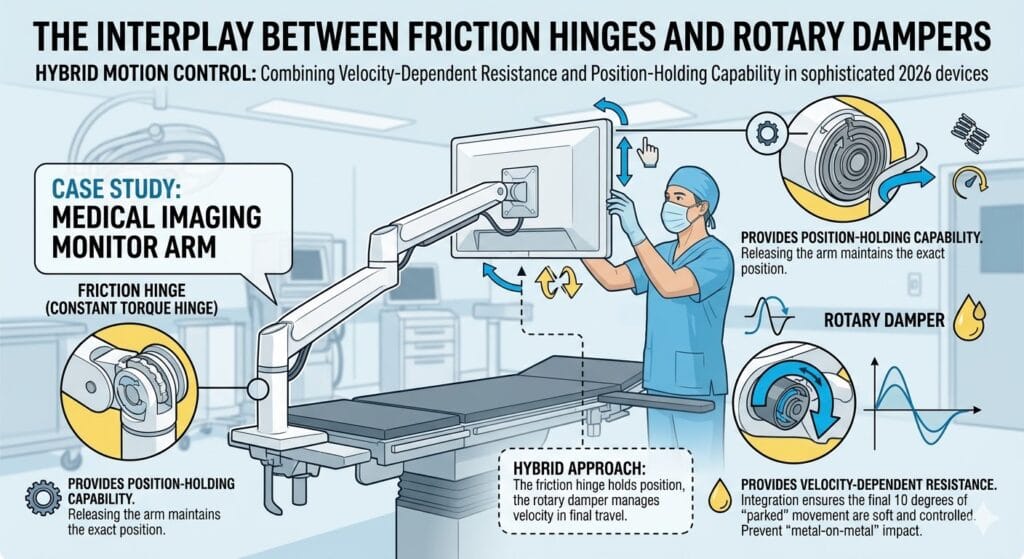
While the Rotary Damper provides velocity-dependent resistance, the Friction Hinge (Constant Torque Hinge) provides position-holding capability. In 2026, the most sophisticated devices use a hybrid approach.
- Case Study: The Medical Imaging Monitor: A monitor arm requires a friction hinge to stay in the exact position the surgeon moves it to. However, if the surgeon releases the arm too quickly, a rotary damper is integrated to ensure that the final 10 degrees of “parked” movement are soft and controlled. This prevents the “metal-on-metal” impact that can recalibrate sensitive medical sensors.
11. Environmental Compliance and Global Market Entry
For export-oriented manufacturers, compliance is the “passport” of the product.
REACH and RoHS 3.0
As of 2026, the restrictions on phthalates and specific flame retardants in plastics have tightened. Our dampers utilize Halogen-Free materials and Medical-Grade Silicone Oils that are biologically inert. This is crucial for products exported to the EU and North American markets where “off-gassing” in confined spaces (like car cabins) is strictly monitored.
The IATF 16949 Audit Trail
For our automotive partners, every batch of dampers comes with a PPAP (Production Part Approval Process) Level 3 package. This includes:
- FMEA (Failure Mode and Effects Analysis): Predicting every possible way a damper could fail and designing it out.
- CPK (Process Capability Index): Statistical proof that our machines are operating within tolerance.
- MSDS (Material Safety Data Sheet): Verification of chemical safety.
12. Rotary Damper Troubleshooting Common Motion Control Issues
Engineers often face three main problems during the prototyping phase. Here is the 2026 “Field Guide” to solving them:
- The “Spring-Back” Effect: * Problem: The lid closes, but then slightly bounces open.
- Solution: This is often due to air compression inside the damper. Check the degassing quality or adjust the clearance between the damper shaft and the housing.
- Temperature Softening:
- Problem: The damper works perfectly at room temperature but fails in a hot car.
- Solution: Switch to a High-VI (Viscosity Index) silicone oil. Standard oils thin out; high-VI oils use polymer chains that maintain structure under heat.
- Oil Migration:
- Problem: A “greasy” film appears on the outside of the component after 10,000 cycles.
- Solution: This indicates seal wear. In 2026, we recommend Ultrasonic Welding of the damper cap rather than snap-fits, combined with an O-ring made of Nitrile or Viton.
13. Future Outlook: Beyond 2026
The next frontier for JAN and the damping industry is the Active Electrorheological (ER) Damper. Imagine a damper where the torque can be changed instantly via an electric signal. While still in the high-cost development phase, these will eventually allow users to customize the “feel” of their furniture or car interior via an app.
Until then, the Passive Precision Rotary Damper remains the most cost-effective, reliable, and elegant solution for motion control.
Summary for Procurement Managers
When you choose a damping partner, you aren’t just buying a plastic part; you are buying the Calculated Silence of your product. At janhinge.com, our 11-year legacy in Qiaotou, Dongguan, is built on the philosophy that Precision is Invisible.
- Customization: We offer torque tuning from 0.1N·cm to 15N·m.
- Speed: Prototyping in 7 days, mass production in 21 days.
- Trust: ISO 9001 and IATF 16949 certified manufacturing.