
Introduction
In global B2B hardware manufacturing, mechanical engineers and procurement teams face constant pressure to streamline production budgets. During component sourcing for medical devices, industrial machinery, automotive electronics, and commercial hardware, the initial unit purchase price is often treated as the primary benchmark. On a bill of materials (BOM), selecting a friction hinge or positioning hinge that costs 20% to 30% less appears to offer immediate financial efficiency. However, experienced structural designers, operations leaders, and supply chain managers recognize that purchase price represents only a small fragment of a component’s real financial impact, making Total Cost of Ownership the ultimate metric for long-term profitability.
In mechanical system design, the financial viability of any component is determined by its Total Cost of Ownership. The Total Cost of Ownership framework operates like an iceberg. The unit purchase price is merely the visible tip above the surface. Hidden beneath the surface lies a substantial volume of indirect costs: factory assembly line slowdowns, elevated scrap rates, premature torque decay, field service labor, international freight logistics, warranty claims, and brand reputation loss. When low-cost components fail, these hidden expenses quickly inflate the overall Total Cost of Ownership far beyond any initial savings achieved at the purchase order stage.
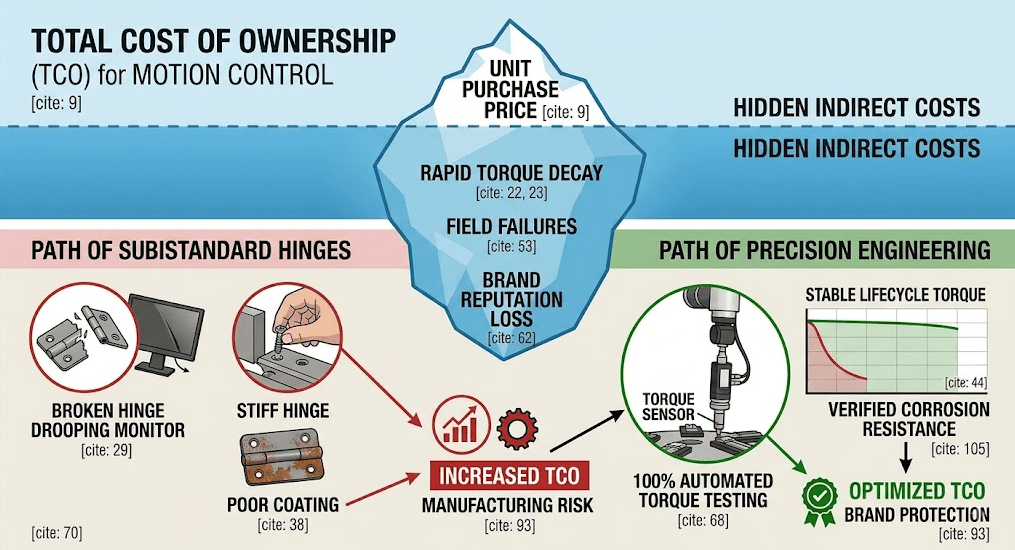
Friction hinges—frequently referred to as constant torque hinges, positioning hinges, or torque hinges—are fundamental motion control elements engineered to deliver smooth, controlled movement and hold covers, displays, or panels securely at desired angles. Because of their compact size, buyers often miscategorize them as simple commodities. This article analyzes the technical and commercial mechanisms of friction hinge performance according to standardized engineering practices referenced by global industry organizations like the Society of Manufacturing Engineers (SME), demonstrating why low-cost hinges increase total manufacturing expenses and how precision manufacturing protects your Total Cost of Ownership.
The Technical Anatomy of a Substandard Hinge
Understanding why low-cost hinges increase your Total Cost of Ownership requires examining how budget manufacturing compromises mechanical design. A high-performance friction hinge relies on controlled interference fits between precision-machined shafts, clip bands, or disc packs, separated by specialized lubricant films, to generate consistent holding torque across thousands of rotation cycles.
Rapid Torque Decay Elevates Total Cost of Ownership
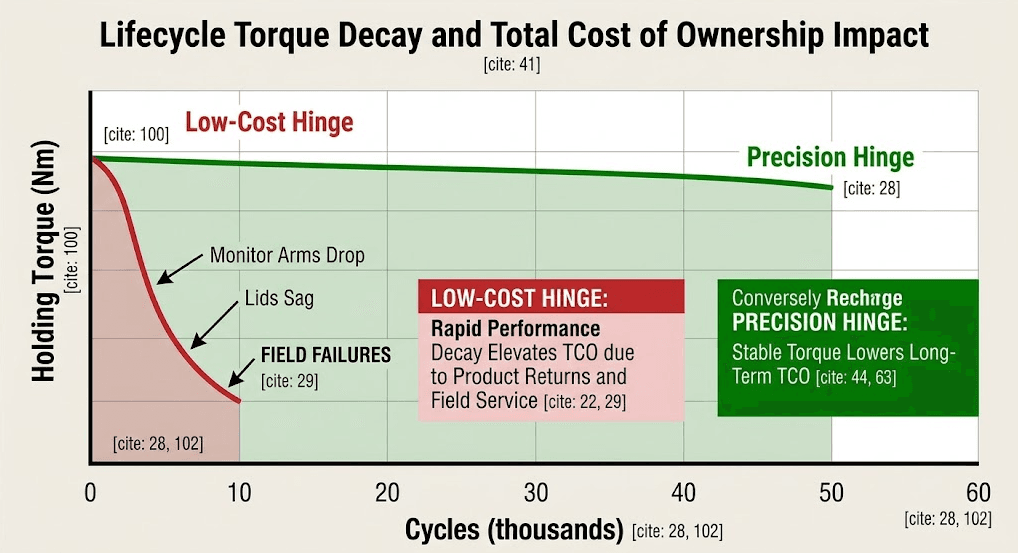
The primary weakness of low-cost friction hinges is rapid performance decay over time. To minimize production costs, budget manufacturers typically substitute high-grade spring steel (such as SK5 or 65Mn) with standard carbon steel or unrefined alloys for internal friction bands. Under repeated cyclic stress, substandard alloys undergo micro-plastic deformation and premature fatigue, causing the hinge to lose holding force and drastically reducing the product’s effective lifecycle.
Furthermore, budget manufacturers often utilize low-grade synthetic or mineral grease that breaks down under friction-induced heat or ambient temperature fluctuations. As oil separation occurs, the internal friction mechanism experiences direct metal-to-metal contact. This accelerated wear leads to severe torque decay within hundreds of cycles instead of maintaining stability over 20,000 to 50,000 cycles. As a result, monitor arms drop, enclosure lids sag, and equipment panels fail to hold position, escalating the Total Cost of Ownership through product returns.
Wide Torque Tolerance Impacts Total Cost of Ownership
In high-precision assembly, consistency across production batches is essential for maintaining a predictable Total Cost of Ownership. Reputable motion control suppliers maintain strict torque tolerance limits—typically within ±5% or ±10% of nominal specifications. Low-cost manufacturers, lacking automated testing and tight machining controls, frequently supply component lots with torque variances exceeding ±25% to ±40%.
These wide variances introduce unpredictable assembly problems. When a hinge is too loose, the panel or display fails to hold its position. When a hinge is too stiff, operators must apply excessive force, which increases user fatigue and risks structural cracking or thread stripping in mating plastic or aluminum housings.
Substandard Plating and Environmental Vulnerability
Corrosion resistance is another area where low-cost hinges compromise long-term value. Budget manufacturers often apply thin, uneven zinc or nickel plating that fails basic salt spray tests (e.g., failing before 24 or 48 hours). When exposed to humidity, industrial chemicals, or outdoor environments, these coatings degrade quickly. Corrosion increases internal friction unpredictably, leading to mechanical binding, squeaking, or complete seizure of the hinge pivot, further damaging your calculated Total Cost of Ownership.
Quantifying the 5 Hidden Costs That Inflate Total Cost of Ownership
Selecting low-cost components sets off a chain reaction across manufacturing, quality control, customer service, and brand management. Below is a detailed breakdown of 5 hidden cost centers that directly inflate your Total Cost of Ownership across the product life cycle.
1. Assembly Line Bottlenecks and High Scrap Rates
Substandard components directly reduce assembly efficiency on the factory floor, multiplying your operational Total Cost of Ownership. When workers encounter hinges with inconsistent torque or misaligned mounting holes, manual adjustment and sorting become necessary, slowing assembly throughput. In automated assembly lines, out-of-spec torque resistance causes automated screwdrivers to fault or strip threaded inserts during installation, raising overall scrap rates during Final Quality Control (FQC).
2. The Multiplier Effect of Field Failures and Warranty Claims
The most significant inflation of your Total Cost of Ownership occurs when a component fails after products are delivered to end customers. Field replacement of a failed $1.00 hinge creates compounding financial liabilities:
- Customer Service Processing: Support line intake, technical documentation, and order administration.
- Logistics and Express Freight: Air-freighting replacement parts or sub-assemblies to international customer sites.
- On-Site Service Labor: Field service technician rates often range from $100 to $250 per hour.
- System Recall Exposure: In regulated sectors like medical technology or industrial safety, widespread hinge degradation can force official product recalls, incurring major financial liabilities.
3. Brand Reputation and Lifetime Customer Value (LTV) Loss
Motion control elements serve as direct tactile touchpoints between users and machinery. Whether opening a laptop, positioning a medical diagnostic monitor, or opening an industrial control box, tactile feedback influences user perception of overall product quality. Loose, jerky, or noisy hinge movement creates an impression of poor craftsmanship, damaging brand perception and inflating the true Total Cost of Ownership through lost repeat sales.
How Precision Engineering Lowers Your Total Cost of Ownership
Reducing Total Cost of Ownership requires moving away from pure unit-price purchasing and adopting a lifecycle value model. Precision hinge manufacturers achieve low long-term costs through vertical manufacturing integration and rigorous quality control.
100% Torque Testing and Automotive-Grade Quality Systems
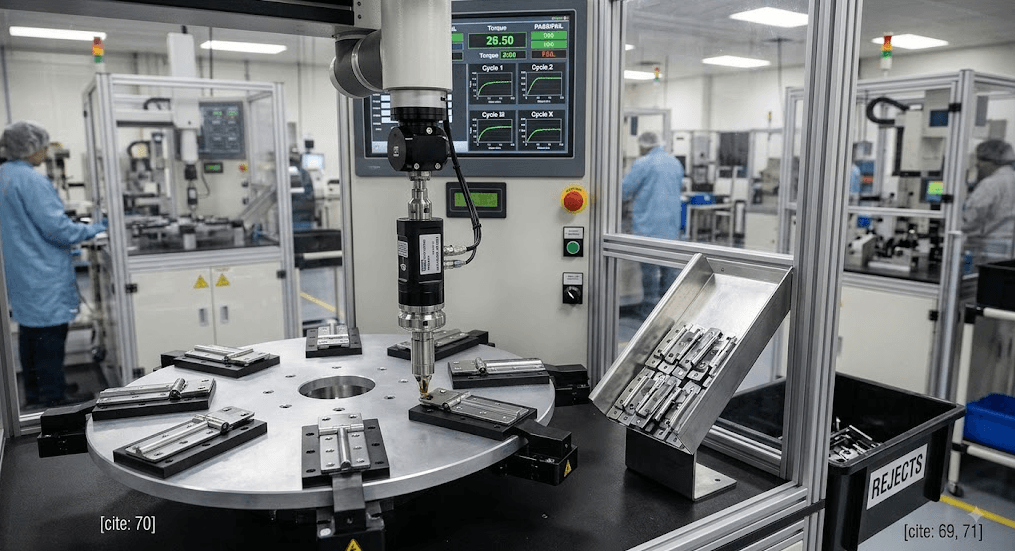
High-quality hinge manufacturers operate under certified quality management systems, adhering strictly to global industrial frameworks such as ISO 9001 Quality Standards and IATF 16949 automotive specifications. Rather than relying on periodic batch sampling, advanced facilities use automated, 100% torque inspection systems to test every hinge before shipping. Non-conforming units are automatically rejected, ensuring zero defect arrivals and protecting your Total Cost of Ownership.
Vertical Integration and In-House Manufacturing Control
Achieving tight torque tolerances requires strict control over every stage of production. Manufacturers that manage toolmaking, stamping, die-casting, injection molding, heat treatment, and final assembly in-house eliminate third-party supplier variations. In-house processing ensures traceable material composition, consistent spring tempering, and precise grease application, protecting your Total Cost of Ownership across large production volumes.
Design Integration for BOM Optimization
Precision component suppliers work alongside client engineering teams during early product development. By customizing hinge geometry, integrating mounting brackets into the pivot body, or incorporating internal wire-routing channels, hinge manufacturers can reduce overall component counts (BOM simplification), lower assembly labor times, and significantly decrease the total system Total Cost of Ownership.
Practical Checklist: Calculating Your Total Cost of Ownership
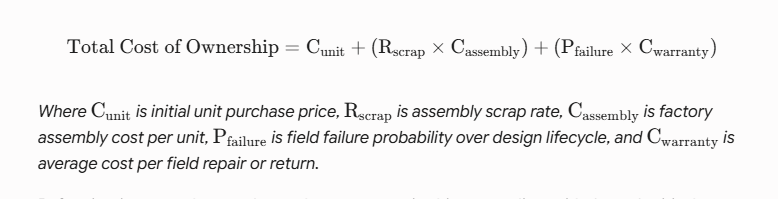
To evaluate the real financial impact of a friction hinge, procurement managers and structural engineers can apply the following Total Cost of Ownership formula during vendor evaluations:
Before issuing a purchase order, evaluate prospective hinge suppliers with these 4 critical questions:
- What are your standard torque tolerance limits, and can you provide lab-verified cycle-life decay curves proving low Total Cost of Ownership?
- Do you perform 100% automated torque testing on every production lot prior to dispatch?
- Are your raw material batches, spring steel heat treatments, and grease formulations fully traceable?
- Can your engineering team optimize bracket geometry to reduce assembly steps and lower our overall Total Cost of Ownership?
Conclusion
In motion control applications, low-cost hinges represent an expensive compromise. Minor upfront savings on unit purchase price are quickly offset by assembly line slowdowns, elevated scrap rates, field service expenses, and brand degradation. Partnering with a precision manufacturer that prioritizes IATF 16949 quality standards, tight torque tolerances, and vertically integrated production allows OEMs to eliminate hidden manufacturing risks, protect brand reputation, and achieve a drastically lower Total Cost of Ownership.
FAQ
Q1: What is Total Cost of Ownership in motion control component sourcing?
A1: Total Cost of Ownership in motion control includes the initial component unit price plus all hidden lifecycle expenses, such as factory assembly line downtime, scrap waste, warranty repair claims, international freight logistics, and brand reputation loss caused by component failures.
Q2: How does a cheap friction hinge increase Total Cost of Ownership during assembly?
A2: Low-cost hinges often suffer from wide torque tolerances and dimensional inconsistencies. This forces assembly line operators to manually inspect, adjust, or strip out-of-spec components, slowing line throughput and increasing housing scrap rates, directly elevating the Total Cost of Ownership.
Q3: Why do low-cost friction hinges lose holding torque quickly over time?
A3: Low-cost hinges typically use inferior carbon steel bands and low-grade grease. Under cyclic stress, the internal metals undergo plastic deformation and heat-induced oil breakdown, resulting in rapid torque decay within a few thousand cycles and increasing field failure risks.
Q4: How does JAN optimize Total Cost of Ownership for global buyers?
A4: JAN operates under IATF 16949 and ISO 9001 certified quality systems, utilizing fully automated 100% torque inspection equipment. Every friction hinge batch undergoes rigorous testing for torque tolerance, cyclic endurance, and corrosion resistance to guarantee a low Total Cost of Ownership.