
When sourcing custom torque hinges or standard motion control components for a new hardware product, procurement managers and design engineers face a classic fork in the road: Should we buy a standard, off-the-shelf catalog part or invest in a custom-engineered solution?
At first glance, the choice seems obvious. Standard off-the-shelf (OTS) hinges have zero upfront tooling costs, no minimum order quantity (MOQ) headaches, and can be shipped in days. Custom hinges, on the other hand, require engineering reviews, tooling lead times, and upfront Non-Recurring Engineering (NRE) investment.
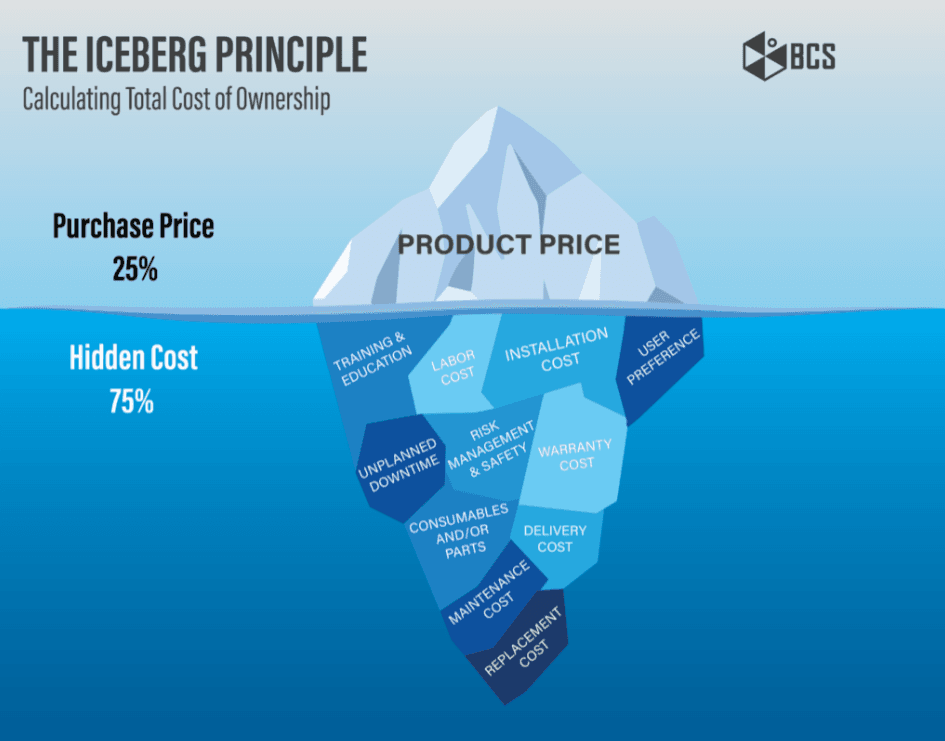
However, in medium-to-high volume hardware manufacturing—whether you are building medical diagnostic carts, industrial control consoles, automotive interiors, or commercial display terminals—piece-part price is only a fraction of the real cost.
If a standard catalog hinge forces your design team to add custom adapter brackets, increases assembly line labor by two minutes per unit, or fails in the field due to broad torque tolerances, that “cheap” standard hinge suddenly becomes extraordinarily expensive.
This article provides a comprehensive Total Cost of Ownership (TCO) breakdown to help sourcing leads and engineering directors make a data-driven choice between custom torque hinges and off-the-shelf friction hinges.
1. Direct Purchasing Cost: CAPEX vs. Unit Economics
To evaluate TCO accurately, we must break down the financial equation into four core categories:
Let’s begin with the most visible expense: Direct Unit Cost.
1.1 Off-the-Shelf (OTS) Catalog Hinges
Standard hinges sold through global distributors carry high gross margins and catalog markups.
- Tooling / NRE: $0.
- Minimum Order Quantity: Low (1 to 50 units).
- Piece-Part Price: High ($8.00 to $25.00+ per unit depending on size).
Catalog suppliers price their items to absorb warehouse holding costs and distribution channel margins. While this model works brilliantly for rapid prototyping or short production runs under 1,000 units, scaling production on catalog parts creates an unnecessary margin tax on your Bill of Materials (BOM).
1.2 Custom Torque Hinges
Working directly with a specialized torque hinge manufacturer changes the economic structure.
- Tooling / NRE: $1,500 to $6,000 (one-time investment for custom stamping dies or friction clip tooling).
- Minimum Order Quantity: Moderate (typically 500 to 1,000 units).
- Piece-Part Price: Low ($2.50 to $6.00 per unit for identical or superior mechanical specifications).
1.3 The Break-Even Volume Calculation
Consider a project requiring 3,000 units annually with two hinges per device (6,000 hinges total per year):
- Catalog Option: 6,000 units multiplied by $12.00 equals $72,000 in annual hinge spend.
- Custom OEM Option: $3,500 tooling plus 6,000 units at $4.20 equals $28,700 total first-year spend.
In this realistic scenario, the custom hinge saves over $43,000 in Year 1 alone, fully amortizing the initial tooling cost within the first few hundred units shipped.
2. Engineering & Integration Costs: The Hidden “Mod-Costs”
A common mistake in component sourcing is evaluating a part in isolation rather than as an integrated element of the larger assembly. When you choose a fixed-dimension catalog hinge, your engineering team is forced to design the product around the hinge.
2.1 Secondary Parts and BOM Inflation
When standard hinge mounting holes do not align with your structural ribs or aluminum extrusions, your engineers must create workarounds:
- Adapter Brackets: Adding custom sheet-metal brackets or CNC plates to bridge the gap.
- Extra Fasteners: Every additional screw, nut, or thread-locking insert adds procurement line items and assembly steps.
- Cable Routing Complexity: If you are running display cables through a rotating joint, standard solid-shaft hinges force wires outside the housing, requiring external conduit wraps or clip guides.
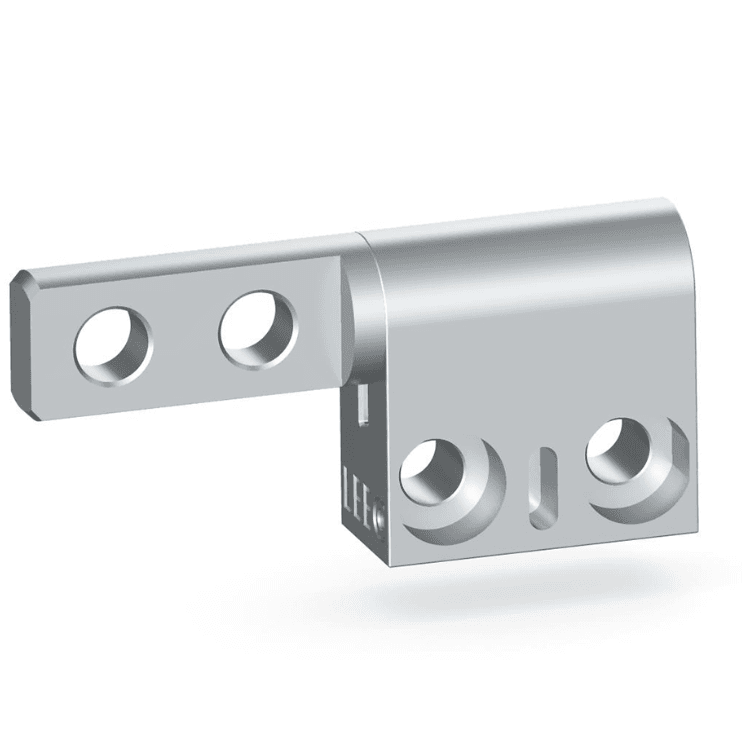
A custom positioning hinge design can incorporate mounting ears, positioning pins, grounding tabs, or a hollow center bore directly into the hinge leaves. By consolidating three or four distinct components into a single engineered hinge assembly, you reduce inventory management costs and eliminate extra assembly steps on the line.
2.2 Assembly Line Labor & Ergonomics
On a high-volume manufacturing floor, time is money. Standard catalog hinges often come with broad torque variation. Assembly technicians may find that one hinge feels too loose while another feels too tight, requiring manual adjustment or sorting on the factory floor.
Custom hinges, pre-tuned to exact torque specs with tight tolerance bands (±10%), offer “plug-and-play” installation, reducing assembly labor time per unit.
3. Quality, Reliability, and Field Warranty Risks
The cost of a mechanical part isn’t finalized when it leaves the factory—it’s finalized after years of customer use in the field.
3.1 Torque Degradation and Panel Sag
Off-the-shelf hinges are built using generic spring steel clips and multi-purpose lubricants designed for broad ambient conditions. However, if your enclosure operates in harsh industrial environments or under high thermal variation (e.g., +60℃ inside an outdoor kiosk or -10℃ in a medical transport vehicle), standard grease can breakdown or thin out.
When lubrication fails or spring steel loses elasticity:
- The screen or lid begins to sag or “nod”, refusing to hold its position.
- Users exert extra force, causing fatigue cracks in surrounding plastic housings.
3.2 The Real Cost of a Field Claim
Replacing a failed hinge under warranty doesn’t just cost the price of the replacement hinge ($10). It involves two-way international freight, dispatching a service technician ($150 to $300), customer dissatisfaction, brand damage, and engineering root-cause analysis time.
Specifying heavy-duty custom friction hinges with application-tailored grease formulations, SUS304/SUS316 stainless steel components, and certified cycle life (e.g., 30,000+ cycles) insulates your business from warranty exposure.
4. Supply Chain Resilience and Lifecycle Management
Beyond technical specifications, procurement heads must consider long-term supply chain security.
4.1 Obsolescence and EOL (End-of-Life) Risks
Catalog distributors regularly update their product portfolios. If a distributor decides to discontinue a standard hinge part number midway through your product’s 7-year lifespan, your team is forced into an emergency re-design, recertification, and re-tooling cycle.
When you invest in custom torque hinges, you own the dedicated tooling and design specifications. An OEM manufacturing partner holds your tooling, maintaining guaranteed part availability and exact material consistency across multi-year production runs.
4.2 Factory-Direct Quality Oversight
Working with a direct OEM manufacturer operating under IATF 16949 and ISO 9001 standards provides transparency that catalog distributors cannot match:
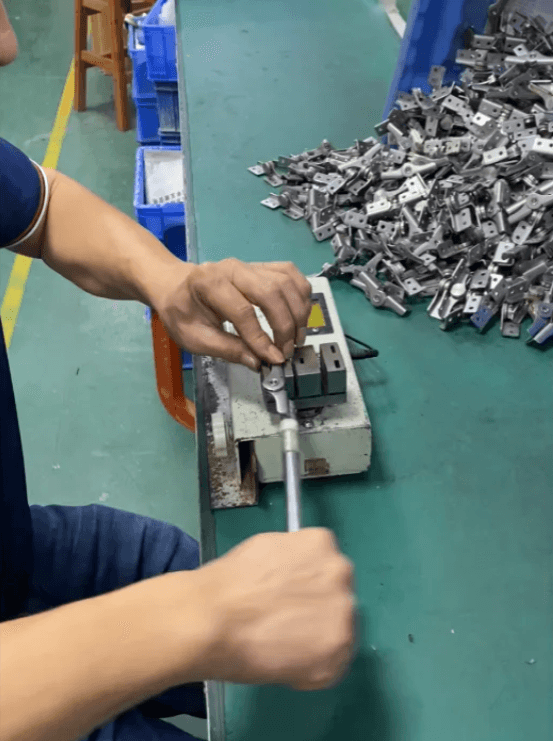
- 100% In-Line Torque Testing: Every single hinge is tested on automated force-displacement sensors before packaging.
- Full Material Traceability: Mill test certificates for spring steel, zinc/aluminum alloys, and synthetic lubricants.
- Custom Torque Micro-Tuning: The ability to adjust holding torque in precise 0.1N·m increments during pre-production runs.
5. Comprehensive Decision Matrix: Custom vs. Off-the-Shelf
| Financial & Technical Metric | Off-the-Shelf Catalog Hinges | Custom OEM Torque Hinges |
| Upfront Tooling / NRE Costs | $0 | $1,500 – $6,000 (One-time investment) |
| Piece-Part Price at Scale (>1k units) | High ($8.00 – $25.00+) | Low ($2.50 – $6.00) |
| Prototyping & Sample Lead Time | 1 – 3 Days | 7 – 10 Days |
| Production Lead Time | Subject to distributor inventory | 3 – 4 Weeks (Guaranteed batch consistency) |
| Secondary Brackets & BOM Count | Requires custom adapter plates / extra screws | Integrated brackets, mounting pins & ground tabs |
| Torque Precision & Customization | Standard broad tolerance (± 20%) | Micro-tuned precision (±10%) |
| Environmental Adaptation | Standard commercial grease | Custom synthetic grease & SUS304/SUS316 alloys |
6. Conclusion
Choosing between custom and off-the-shelf torque hinges comes down to your production volume, product lifespan, and tactile quality expectations:
- Select Off-the-Shelf Hinges if: You are building early proof-of-concept prototypes, manufacturing a short batch of fewer than 500 units, or working with an enclosure that has zero space constraints and flexible torque requirements.
- Select Custom Torque Hinges if: Your annual volume exceeds 1,000 units, your device features a premium screen or lid where tactile movement defines brand quality, your space is tight, or your product operates in demanding outdoor or medical environments.
By taking a holistic Total Cost of Ownership approach, you transform motion control sourcing from a potential cost center into a competitive advantage for your product.
7. FAQ
Q1: At what annual production volume does custom torque hinge tooling become cost-effective?
For most industrial and commercial hardware applications, custom torque hinge tooling becomes cost-effective at annual volumes between 1,000 and 2,000 units. Because catalog distributor markups are so high, savings on the lower piece-part price usually offset the one-time NRE tooling cost within the first 6 to 12 months of production.
Q2: How long does the custom torque hinge prototyping and tooling process take?
Initial 3D-printed metal or CNC-machined prototype samples can be delivered in 7 to 10 days for preliminary mechanical fit testing. Production-grade tooling for stamping dies, zinc/aluminum die casting, and custom spring clips typically takes 3 to 4 weeks, followed by sample validation and first-article inspection (FAI) reports.
Q3: Can custom friction hinges be tuned for asymmetrical operating forces?
Yes. Custom manufacturing allows friction clips to be designed with asymmetric torque profiles. This means a hinge can provide high holding torque in one direction (for example, holding a heavy panel open against gravity) while offering up to 50% lower resistance in the opposite direction for effortless closing or lifting.
Q4: How do custom hinge suppliers guarantee torque consistency across high-volume production lots?
Reputable OEM suppliers utilize automated in-line force testing where 100% of manufactured hinges are articulated through their full range of motion. Force-displacement curve data is recorded automatically, ensuring every hinge falls strictly within the specified ±10\%$ torque window before leaving the factory floor.