
In the world of precision manufacturing, the “premium feel” of a product is rarely an accident. It is a deliberate engineering choice. Whether it is the soft-opening glove box of a luxury sedan or the silent, controlled descent of a high-end medical device cover, the invisible force at work is the Rotary Damper.
For Product Engineers and International Procurement Managers, the rotary damper is more than just a component; it is a critical interface between the machine and the human user. This guide explores the mechanical physics, design variables, and supply chain strategies necessary to master motion control.
Chapter 1: The Physics of Motion Control — How It Actually Works
A rotary damper’s primary mission is to dissipate kinetic energy. In physics, a moving object possesses energy that, if left uncontrolled, results in impact, noise, and mechanical stress. The damper converts this kinetic energy into thermal energy through fluid dynamics.
1. The Principle of Viscous Shear Stress
The most common medium inside a rotary damper is Silicone Oil. Silicone is chosen for its chemical stability and its ability to maintain a specific viscosity over a wide temperature range.
The working principle can be simplified as “stirring a paddle in thick honey.” When an external force turns the damper’s shaft, an internal rotor churns the silicone oil within a sealed housing. Because of the oil’s internal friction (viscosity), it resists the shearing action. This resistance is velocity-dependent: the faster you try to turn it, the more resistance the fluid provides. This characteristic allows for a perfectly “soft-close” effect that feels natural to the human touch.
2. Energy Conversion Without Wear
Unlike traditional mechanical friction brakes (like those in a car), rotary dampers are non-direct contact. The rotor and the stator (housing) are always separated by a thin film of oil. This provides two massive advantages:
- Zero Mechanical Wear: Theoretically, as long as the seal remains intact, the internal parts do not wear down from friction.
- Smooth Deceleration: Since there is no “stiction” (static friction), the movement starts and stops without the jerking motion typical of dry friction components.
Chapter 2: Internal Architectures — Vane Type vs. Gear Type
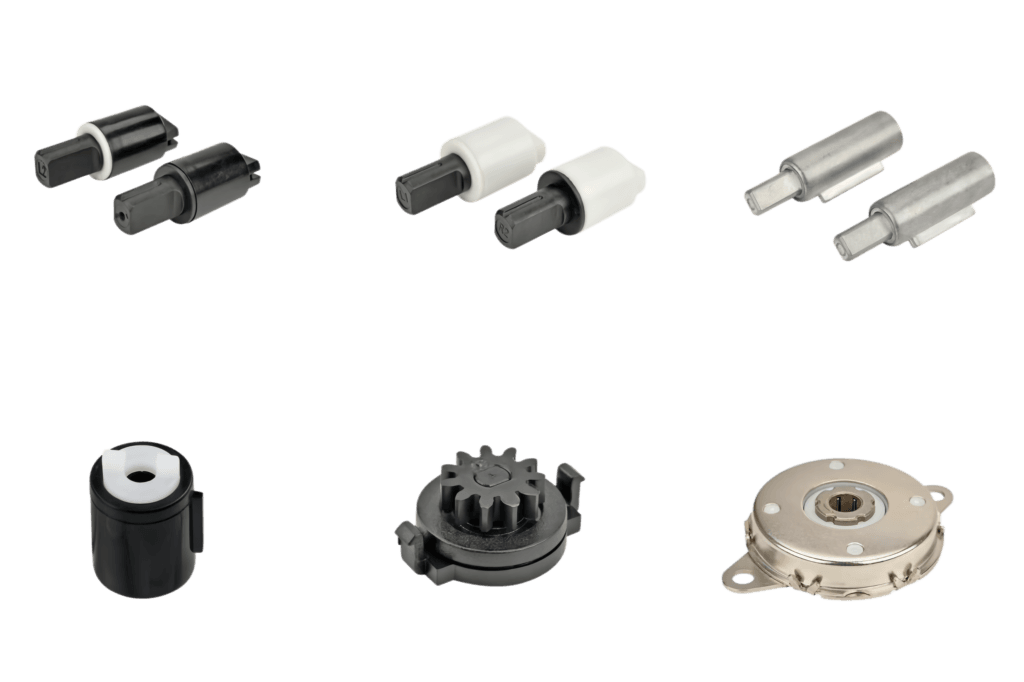
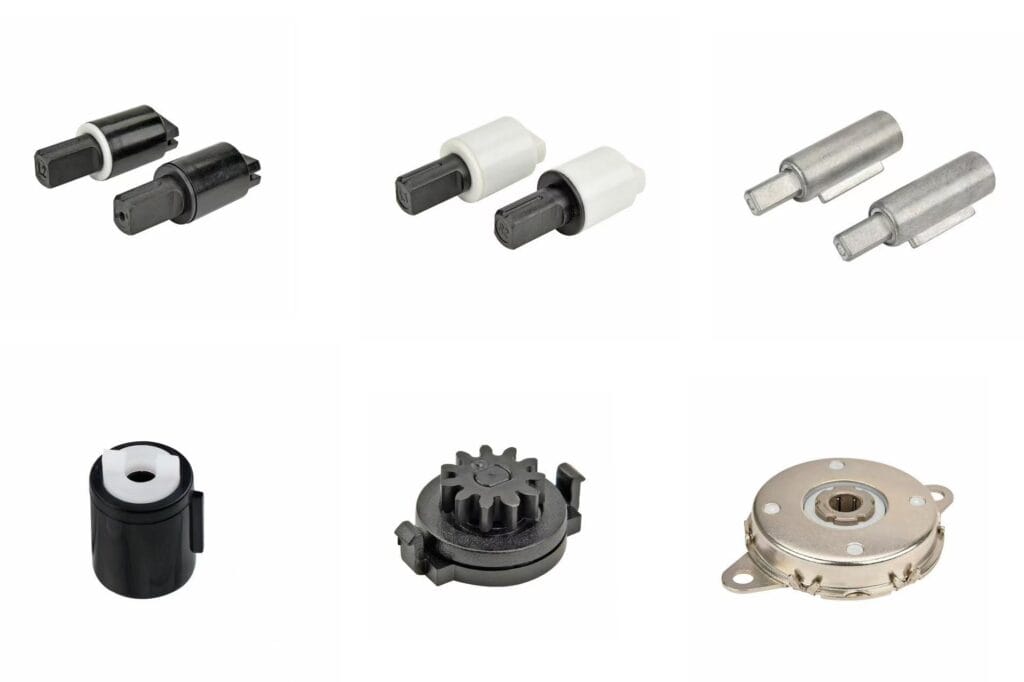
Depending on the motion required, rotary dampers generally fall into two structural categories.
1. Vane Type Dampers
The internal structure of a vane damper resembles a wing or paddle swinging within a confined, oil-filled chamber.
- Rotation Angle: Typically limited to between 110 and 180.
- Working Logic: As the vane rotates, it forces silicone oil from one pressure chamber to another through a small orifice or a “one-way valve” mechanism.
- Best For: Applications requiring limited movement, such as toilet seats, piano lids, or furniture flaps.
2. Gear / Disk Type Dampers
These allow for 360 degree continuous rotation.
- Working Logic: The rotor is usually a disk or a gear that turns within the oil. The outer edge of the damper features a gear that meshes with a rack or a larger gear on the product.
- Best For: Applications with long travel distances, such as automotive ash trays, sliding drawers, or high-fidelity audio knobs. Their small footprint (often less than 15mm in diameter) makes them ideal for tight spaces.
Chapter 3: The Engineer’s Toolkit — Torque Calculation and Selection
An engineer must never “guess” the required damping force. Precision selection is the difference between a lid that won’t close and one that slams shut.
1. Defining Torque (T)
The performance of a damper is measured by Torque, typically in N.m o ro ro r r 9 r ro ror N.cm.
2. The Gravity Moment Formula
For a lid or flap, the maximum torque is generated when the lid is in a horizontal position (where the lever arm is longest).
The calculation is:
T = L \ W
- L(Length): Distance from the rotation axis to the center of gravity (usually half the length of the lid).
- W (Weight): The force of gravity acting on the lid (Weight in kg $\times 9.8$).
- the angle: The angle relative to the horizontal plane.
Pro Tip: Always select a damper with a rated torque slightly higher (10-20%) than your maximum calculated torque. This “safety buffer” ensures the damper can handle the weight even as the oil thins slightly in warmer environments.
3. The Temperature Variable
Silicone oil viscosity decreases as temperature increases.
- The Scenario: An automotive handle might face 60 degrees in a summer parking lot and -30 degrees in a winter storm.
- The Solution: Request a “Torque-Temperature Curve” from your supplier. A high-quality damper should maintain its performance within a 15% deviation across its specified operating range.

Chapter 4: Advanced Features — One-Way Damping and Adjustability
Modern product requirements often demand more than just a “slow” movement.
1. One-Way Damping Technology
This is the most sought-after feature in premium goods. For example, when opening a laptop or a car glove box, we want the lid to feel light (no resistance). However, when closing or dropping, we want it to move slowly (high resistance).
This is achieved via an internal check-valve mechanism. When rotating in the “free” direction, the valve opens, allowing oil to bypass the restriction. When rotating in the “damped” direction, the valve closes, forcing the oil through the narrow shearing gap.
2. Adjustable Rotary Dampers
In industrial equipment or high-precision arms where the load might change, adjustable dampers are used. These allow the user to manually turn a knob on the housing to change the size of the internal orifice, effectively fine-tuning the torque. While more expensive, they significantly reduce the number of SKUs a company needs to stock for different products.
Chapter 5: The Procurement Perspective — Sourcing for Quality
For a Procurement Manager, the rotary damper is a “hidden risk” component. Failure—typically in the form of oil leakage—usually happens 3 to 6 months after the product is in the consumer’s hands, leading to massive warranty costs.
1. Sealing Technology: Preventing the “Oil Leak”
The life of a damper ends when the oil leaves the housing.
- Manufacturing Observation: Check the supplier’s housing closure method. Ultrasonic Welding is the industry gold standard, as it fuses the plastic parts at a molecular level.
- Seal Material: Ask if they use EPDM or Silicone Rubber for O-rings. These materials offer the best resistance to silicone oil and maintain their elasticity over years of compression.
2. Silicone Oil Purity
Not all silicone oils are created equal. Cheap oils suffer from “molecular shearing,” where the polymer chains break down after repeated use, causing the torque to drop sharply after just a few thousand cycles.
- The Litmus Test: Ask, “Who is your oil supplier?” Brands like Dow Corning or Shin-Etsu are indicators of high-tier quality.
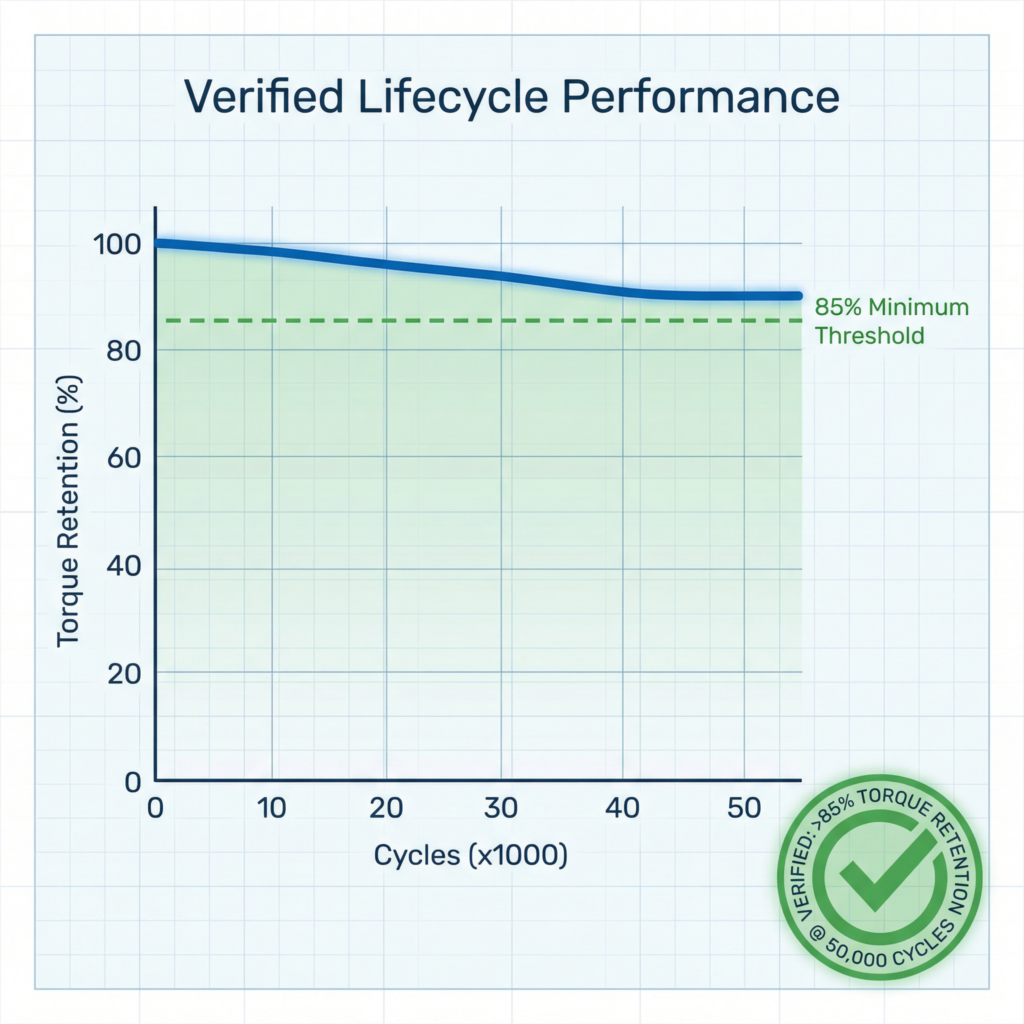
3. Cycle Life Testing Standards
- Consumer Grade: 10,000 – 30,000 cycles.
- Automotive/Industrial Grade: 50,000 – 100,000+ cycles.Always demand a “Cycle Life Test Report” conducted at both room temperature and the application’s maximum rated temperature.
Chapter 6: Troubleshooting Common Failures
Engineers should be able to diagnose these three common issues during the prototyping or assembly phase:
- Jumpy or “Stuttering” Motion:
- Cause: Air bubbles trapped inside the damper or insufficient oil filling.
- Fix: Verify that the manufacturer uses a vacuum filling process to ensure zero air pockets.
- Sudden Loss of Torque:
- Cause: Internal vane fracture or a stuck check-valve due to debris.
- Fix: Check if the impact force (dynamic load) on the damper exceeds its rated limit.
- Mechanical Noise:
- Cause: Excessive backlash in the gears or lack of external grease.
- Fix: Optimize the gear module and ensure a high-quality damping grease is applied to the external meshing gears.
Chapter 7: Global Market Trends — Miniaturization and Integration
The industry is moving toward two major extremes:
- Miniaturization: With the rise of foldable smartphones and precision camera tech, there is a booming demand for micro-dampers with diameters under 5mm.
- Module Integration: Instead of being a standalone part, dampers are increasingly being integrated directly into the hinge or latch assembly. This simplifies the assembly line for the end manufacturer and ensures better mechanical alignment.
Conclusion: Quality is in the Details
The rotary damper is the “unsung hero” of industrial design. It doesn’t perform calculations or provide structural strength, but it defines the tactile soul of a product.
For the engineer, rigorous torque calculation is the baseline. For the procurement manager, deep insight into the supplier’s sealing and oil quality is the ceiling. By mastering these details, you ensure that your product doesn’t just work—it feels world-class.