
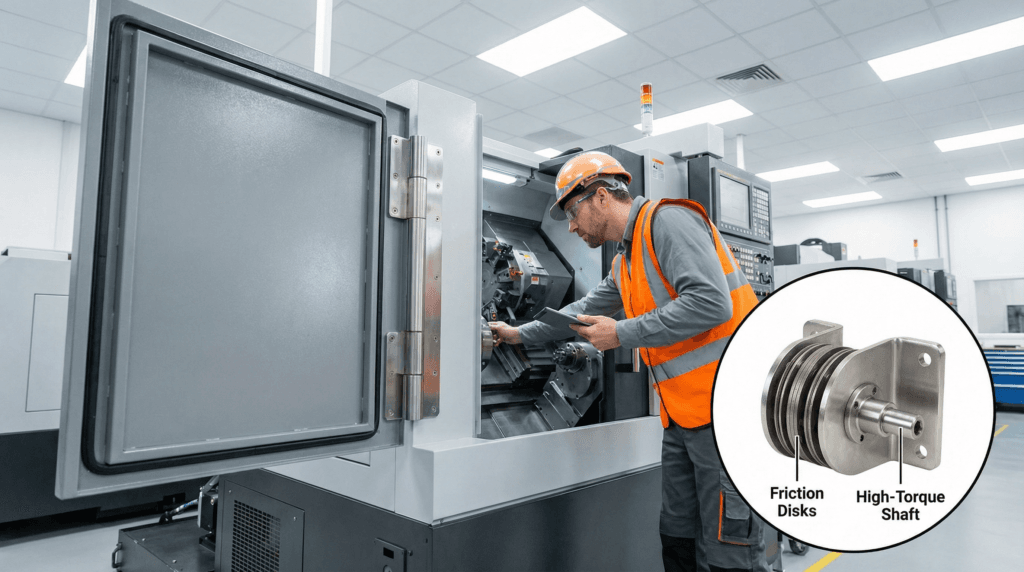
In today’s harsh environments such as manufacturing, automation, and heavy machinery, motion control components are more than just a matter of user experience; they are critical to operational safety, equipment lifespan, and ergonomic efficiency. Industrial control panels, heavy-duty protective covers on CNC machine tools, and the articulated arms of rugged displays all require robust mechanisms to control their movement. For design engineers and procurement experts, selecting the right heavy-duty friction hinges and industrial rotary dampers is a key step in building reliable machinery.
This technical guide, provided by engineering experts at JAN Hinge Damper, delves into the principles, calculation methods, and strategic procurement strategies for high-torque motion control solutions in industrial applications.
The Demands of Industrial Environments
Unlike consumer products, industrial equipment operates under extreme conditions. Components are subjected to constant vibration, exposure to harsh chemicals, significant temperature fluctuations, and the necessity to manage substantial weight. A standard friction hinge or rotary damper will quickly fail under these stresses, leading to equipment downtime or, worse, operator injury from a falling access panel.
Heavy-Duty Friction Hinges (Position Hinges)
In industrial settings, friction hinges are primarily used to hold heavy control panels, protective guards, or diagnostic screens at specific angles. An operator must be able to position a 15 kg (33 lb) stainless steel cover open with one hand to perform maintenance, and trust that it will not slam shut unexpectedly.
These heavy-duty position hinges rely on multiple large-diameter friction disks or robust band-on-shaft designs to generate high holding torque, often exceeding 10 N·m (88 in-lbs). The materials used—typically high-grade stainless steel or zinc alloys—must resist corrosion from cutting fluids and withstand the mechanical shock of the factory floor.
Industrial Rotary Dampers (Vane and Disk Types)
When a heavy lid or access hatch needs to be closed, gravity takes over. Without damping, a heavy metal cover can act like a guillotine. Industrial rotary dampers, particularly vane and disk types, are employed to absorb this massive kinetic energy.
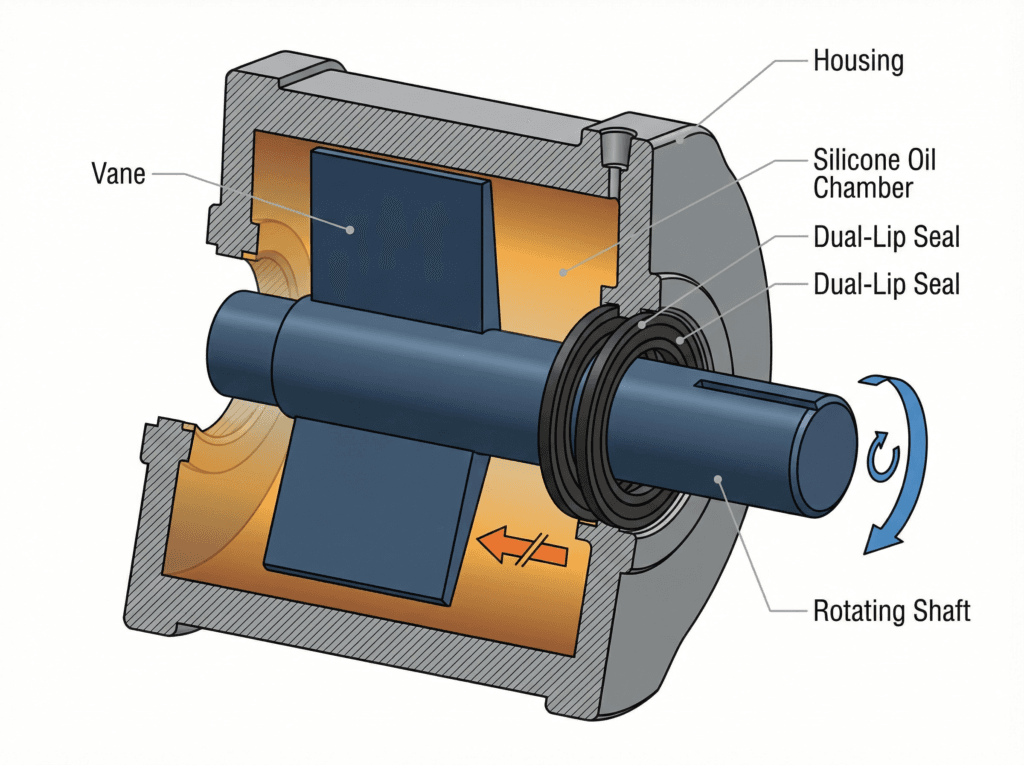
These dampers use high-viscosity silicone oil forced through precision-engineered orifices within the damper housing. As the lid falls, the resistance of the oil converts the kinetic energy into heat, slowing the lid to a safe, controlled soft-close. The challenge for engineers is specifying a damper that can handle the high initial impact force without blowing its internal seals.
Critical Technical Specifications for Engineers
When designing motion control for heavy machinery, engineers must carefully calculate and specify several key parameters to ensure safety and durability.
1. Torque Calculation for Heavy Loads
Selecting a damper or hinge based on guesswork is dangerous. The required torque must be calculated accurately based on the weight and center of gravity of the moving part.
Engineering Best Practice: The maximum torque (T) required to hold a lid horizontal is calculated as T = (L/2) × W × 9.8, where L is the length of the lid from the hinge axis (in meters) and W is the weight (in kg). For industrial applications, a safety factor of at least 1.5× should always be applied to account for dynamic loading—such as an operator leaning on an open cover or the vibration from nearby machinery.
2. High-Torque Capacity and Asymmetry
Industrial covers are often heavy to lift but dangerous if they fall. A symmetric friction hinge that provides enough resistance to hold a 20 kg cover open might require an operator to exert 20 kg of force just to lift it, leading to ergonomic strain and potential workplace injury.
Engineering Best Practice: Specify asymmetric heavy-duty friction hinges. These are designed to provide low resistance when opening (lifting against gravity) and high resistance when closing (holding against gravity). This allows for easy, one-handed operation of heavy panels while maintaining secure positioning.
3. Environmental Resilience and Sealing
Industrial dampers are exposed to dust, metal shavings, and varying temperatures. If a damper’s seals fail, the silicone oil leaks out, and the heavy lid becomes a safety hazard.
Engineering Best Practice: Specify dampers with robust, dual-lip seals and housings made from durable materials like die-cast zinc or reinforced engineering plastics. Ensure the supplier provides a Torque-Temperature Curve, demonstrating that the silicone oil maintains its viscosity and damping force across the expected operating temperature range (e.g., -20°C to +80°C).
4. Cycle Life Under High Stress
While consumer devices might see 30,000 cycles over their lifetime, a CNC machine door might be opened and closed hundreds of times a day, accumulating cycles rapidly.
Engineering Best Practice: Industrial motion control components must be rated for high cycle life under maximum load. JAN Hinge Damper’s heavy-duty industrial series is tested to withstand 50,000 to 100,000 cycles without significant torque degradation or seal failure, ensuring years of reliable operation.
| Parameter | Standard Industrial | JAN Heavy-Duty Industrial |
| Max Holding Torque | Up to 5 N·m | Up to 15+ N·m (customizable) |
| Lifecycle at Full Load | 30,000 cycles | 50,000–100,000 cycles |
| Operating Temperature | -10°C to 70°C | -20°C to 80°C |
| Chemical Resistance | Standard seals | Dual-lip seals, corrosion-resistant housing |
| Safety Factor Applied | 1.0× | 1.5× (recommended) |
Strategic Sourcing for Procurement Managers
Procuring heavy-duty motion control components requires partnering with a manufacturer capable of delivering consistent quality and robust engineering support.
Engineering and Customization Support: Industrial applications rarely use off-the-shelf solutions. Does the supplier have an engineering team that can review your CAD models, perform torque calculations, and recommend the exact damper or hinge required? JAN Hinge Damper offers comprehensive technical consulting and can customize torque specifications to match your exact load requirements.
Quality Assurance and Testing: The cost of a failed hinge on a $500,000 piece of machinery is immense. Ensure your supplier performs 100% online torque inspection and rigorous lifecycle testing. Ask for their quality control documentation and testing protocols before placing a bulk order.
Global Supply Chain and Lead Times: Industrial OEMs need reliable delivery schedules. JAN Hinge Damper can deliver standard industrial samples in 1 day and fulfill bulk orders of 5,000+ pieces within 5 days, ensuring your production line never stops.
Frequently Asked Questions (FAQ)
Q1: How do I choose between a friction hinge and a rotary damper for a heavy machine cover?
Use a heavy-duty friction hinge if the operator needs the cover to stay open at various, adjustable angles during maintenance. Use a rotary damper (combined with a standard free-swinging hinge) if the cover only needs to be fully open or fully closed, and the primary goal is to prevent it from slamming shut dangerously.
Q2: What is the maximum weight a single heavy-duty friction hinge can support?
This depends on the length of the cover (the lever arm). Our highest-torque industrial position hinges can generate over 15 N·m of resistance. For a cover with a 0.3 m lever arm, this translates to safely holding approximately 10 kg. Multiple hinges can be used in parallel for extreme loads, and our engineers can calculate the exact configuration for your application.
Q3: Are your industrial dampers resistant to cutting fluids and machine oils?
Yes. We offer heavy-duty dampers with specialized housing materials and advanced dual-lip sealing technologies designed to withstand exposure to common industrial chemicals, cutting fluids, and coolants, preventing both ingress of contaminants and egress of silicone oil.
Q4: How does temperature affect the performance of a rotary damper in a factory setting?
Standard silicone oil thins out at high temperatures (reducing damping force) and thickens at low temperatures (increasing resistance, making the lid harder to open). We use temperature-stable silicone fluids that minimize this variance, ensuring consistent soft-close performance from -20°C to +80°C. We provide Torque-Temperature Curves upon request.
Q5: Can you provide asymmetric friction hinges for heavy lids to improve operator ergonomics?
Absolutely. We engineer asymmetric hinges that provide high holding torque against gravity (preventing the lid from falling) but significantly lower resistance when the operator is lifting the lid. This dramatically improves ergonomics and reduces the risk of repetitive strain injuries for maintenance personnel.
Q6: What is the typical lead time for a custom high-torque industrial damper?
For custom torque settings within our existing heavy-duty housings (e.g., adjusting the silicone oil viscosity), we can often provide samples within 3–5 business days. If a completely new OEM/ODM design with new tooling is required, prototype delivery is typically 20 days from CAD approval.
Designing the next generation of industrial machinery?
Contact the JAN Engineering Team today for expert torque calculations and to request heavy-duty motion control samples for your equipment.