
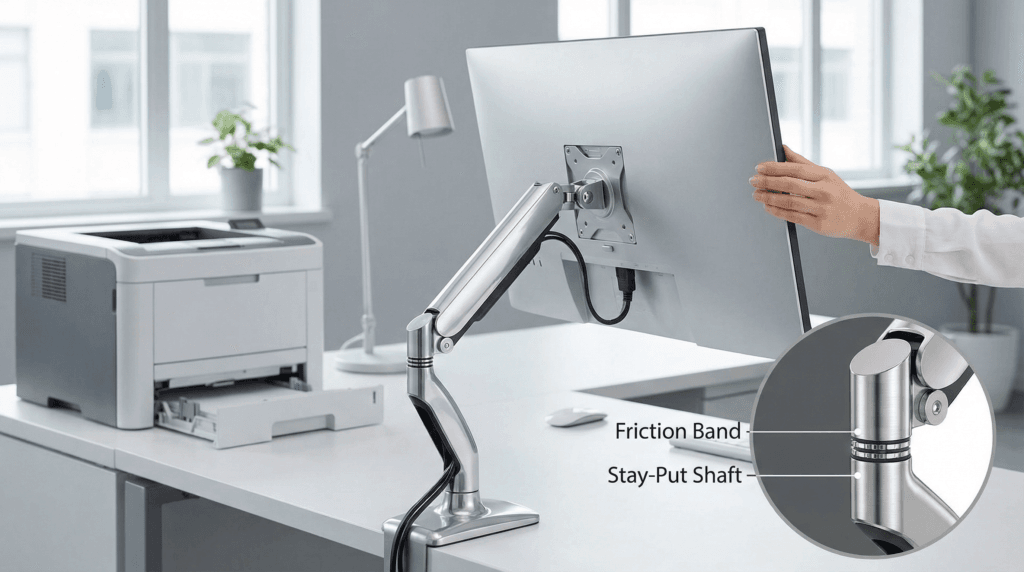
Modern office spaces are characterized by flexibility, seamless integration of ergonomics, and technology. From height-adjustable monitor stands and swivel tablet stands to smoothly operating business printers and copiers, user interaction with office equipment relies heavily on sophisticated motion control components, such as damped hinges. For product engineers and purchasing professionals designing these systems, the selection of friction hinges (torque hinges) and rotary dampers is crucial, helping users achieve the ideal balance between stability, adjustability, and superior tactile feedback.
This technical guide, written by JAN Hinge Damper’s engineering team, explores the application of these components in office and display devices, detailing the engineering challenges, key specifications, and sourcing strategies required to deliver high-quality, ergonomic products.
The Ergonomics of Display Positioning
In the realm of display equipment—monitors, tablets, point-of-sale (POS) terminals, and interactive kiosks—the primary objective is ergonomic positioning. Users must be able to adjust the screen angle effortlessly to reduce glare and neck strain, and the screen must remain firmly in that position once adjusted. This is the domain of the friction hinge.
Friction Torque Hinges for Infinite Adjustability
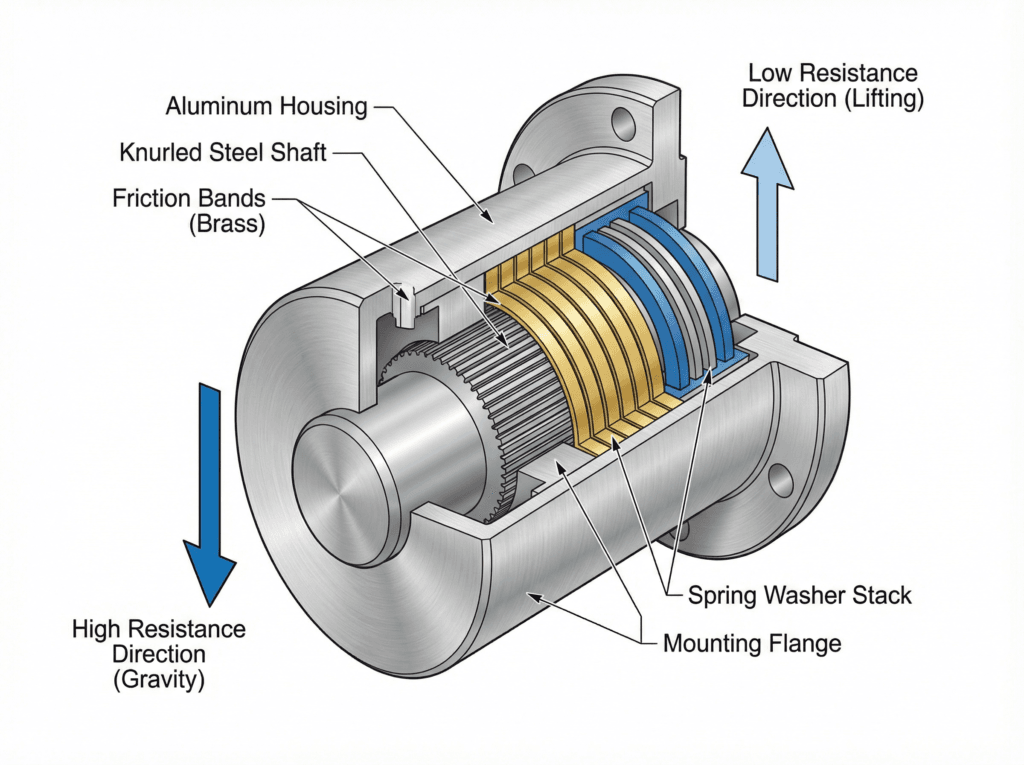
Friction hinges rely on controlled interference between the shaft and a friction element to generate a stable holding torque. Unlike standard hinges that allow free movement, friction hinges resist motion until a specific force is applied. For example, in a monitor stand, the hinge must provide sufficient torque to counteract the monitor’s weight and prevent it from sagging. At the same time, the torque cannot be too large, making it difficult for the user to adjust the angle. This requires sophisticated engineering to achieve a delicate balance known as “free stop” or “hold position.”A friction hinge relies on the controlled interference between a shaft and a friction element (such as bands, disks, or clips) to generate a consistent holding torque. Unlike a standard hinge, which allows free movement, a friction hinge resists motion until a specific force is applied. In a monitor arm, for example, the hinge must provide enough torque to counteract the weight of the display, preventing it from drooping. Simultaneously, the torque must not be so high that the user struggles to adjust the angle. This requires precise engineering to achieve a delicate balance known as “free-stop” or “stay-put” functionality.
Key Engineering Challenges in Display Torque Hinges
Designing friction hinges for display equipment presents three specific challenges. The first is torque degradation: the constant friction generates heat and wears down the mating surfaces over time. If the torque degrades significantly, the hinge will no longer support the weight of the display, leading to the dreaded “screen droop” that is a common warranty complaint. The second challenge is spring-back: when a user adjusts a screen to a specific angle and releases it, the hinge must hold that exact position without springing back slightly, which requires minimizing the elasticity of the internal components. The third is asymmetric loading: a heavy monitor exerts a constant downward force (gravity), making an asymmetric friction hinge—which provides higher resistance against gravity and lower resistance when lifting the screen—often necessary to optimize the user experience.
The Tactile Feel of Office Machinery
Beyond displays, office equipment such as printers, copiers, scanners, and paper shredders rely heavily on rotary dampers to control the motion of lids, paper trays, and access panels. When a user closes a heavy scanner lid, the damper absorbs the kinetic energy, converting a potentially loud and damaging slam into a slow, controlled, and silent closure. In office machinery, dampers serve two primary functions: protecting delicate optical sensors and glass platens from shock damage, and enhancing the perceived quality of the product by conveying a sense of premium engineering and durability.
Critical Specifications for Procurement and Engineering
1. Holding Torque and Damping Force
The most critical specification is the torque rating. For friction hinges, this is the holding torque required to support the display. For rotary dampers, this is the damping torque required to control the closing speed of a lid.
Engineering Best Practice: Accurate torque calculation is essential. For a friction hinge supporting a monitor, the formula is T = W × L × cos(θ), where W is the weight of the monitor, L is the distance from the hinge axis to the center of gravity, and θ is the tilt angle from vertical. It is highly recommended to consult with the JAN Engineering Team to verify these calculations and select the appropriate component, as real-world factors such as cable tension and user force must also be considered.
2. Lifecycle and Durability
Office equipment is subjected to frequent, daily use. A monitor arm might be adjusted dozens of times a day, and a printer lid opened and closed hundreds of times. Over a standard 5-year product lifecycle, this can easily accumulate to 20,000 or more cycles.
Engineering Best Practice: Specify components with a high lifecycle rating. JAN Hinge Damper’s friction hinges are tested to withstand 20,000 to 30,000 cycles with minimal torque degradation (less than 15%), while our rotary dampers typically exceed 50,000 to 100,000 cycles without leakage or loss of damping force.
3. Torque Tolerance
In mass production, consistency is key. A wide torque tolerance means some hinges will be too stiff, making adjustment difficult, while others will be too loose, failing to hold the screen in position.
Engineering Best Practice: Demand a tight torque tolerance, typically ±10% or better. JAN Hinge Damper achieves this through automated manufacturing and 100% online torque inspection, ensuring every component performs identically across a production run of thousands or hundreds of thousands of units.
| Products Specification | Typical Market Requirement | JAN Hinge Damper Standard |
| Friction Hinge Torque Tolerance | ±15% to ±20% | ±10% (100% online inspection) |
| Rotary Damper Lifecycle | 30,000 cycles | 50,000 to 100,000+ cycles |
| Friction Hinge Lifecycle (Wear < 15%) | 15,000 cycles | 20,000 to 30,000 cycles |
| Customization Lead Time | 4 to 6 weeks | 20 days for custom OEM/ODM |
Strategic Sourcing Considerations
Procurement managers must look beyond the unit price and consider the total cost of ownership, which includes reliability, engineering support, and supply chain resilience. Does the supplier offer technical consultation and custom design services? Office equipment often requires bespoke hinge or damper designs to fit specific space constraints or load profiles. Ensure the supplier has a robust quality control infrastructure, including automated testing and comprehensive documentation. The supplier must also be able to scale production rapidly to meet demand, delivering bulk orders reliably within a standard lead time.
Frequently Asked Questions (FAQ)
Q1: How do I choose between a symmetric and an asymmetric friction hinge for a monitor arm?
If the monitor is heavy and the user primarily adjusts it vertically (tilting up and down), an asymmetric hinge is strongly recommended. It provides high resistance against gravity (preventing the screen from falling) but lower resistance when lifting the screen, making one-finger adjustment possible. If the adjustment is primarily horizontal (panning left and right), a symmetric hinge is usually sufficient since gravity acts equally in both directions.
Q2: What is the maximum weight a friction hinge can support?
This depends on the specific hinge design and the length of the lever arm (the distance from the hinge axis to the center of gravity of the load). JAN Hinge Damper manufactures a wide range of hinges, from miniature models for lightweight tablets to heavy-duty models capable of supporting large commercial displays weighing over 15 kg. Our engineers can help you select the right hinge based on your specific load requirements and available installation space.
Q3: Can rotary dampers be used in environments with significant temperature fluctuations, such as near a printer’s fuser unit?
Yes, provided the damper is specified correctly. Standard silicone oil changes viscosity with temperature, which can affect damping performance. For high-temperature environments (up to 80°C), we utilize specialized, temperature-stable silicone fluids and heat-resistant housing materials (such as PC or PBT) to ensure consistent soft-close operation regardless of the thermal environment.
Q4: How do you test the lifecycle of your friction hinges to ensure they will not wear out prematurely?
We utilize automated, computer-controlled testing rigs that repeatedly cycle the hinges through their full range of motion while continuously monitoring the holding torque. This allows us to guarantee that our hinges will meet or exceed the specified cycle life (e.g., 20,000 cycles) with less than a 15% drop in torque, providing confidence in the long-term reliability of the component.
Q5: We need a custom hinge design to fit within a very tight space in our new POS terminal. What is your process for custom OEM/ODM projects?
Our process begins with a review of your CAD models and load requirements. Our engineering team will then design a custom hinge to meet your specifications, including torque profile, dimensions, and mounting interface. Once the design is approved, we can typically produce functional, testable prototypes within 20 days. Standard samples for off-the-shelf designs are available in as little as 1 day.
Optimize the ergonomics and feel of your office equipment. Chat on Whatsapp
Contact the JAN Engineering Team today to discuss your motion control requirements and request technical samples for evaluation.