
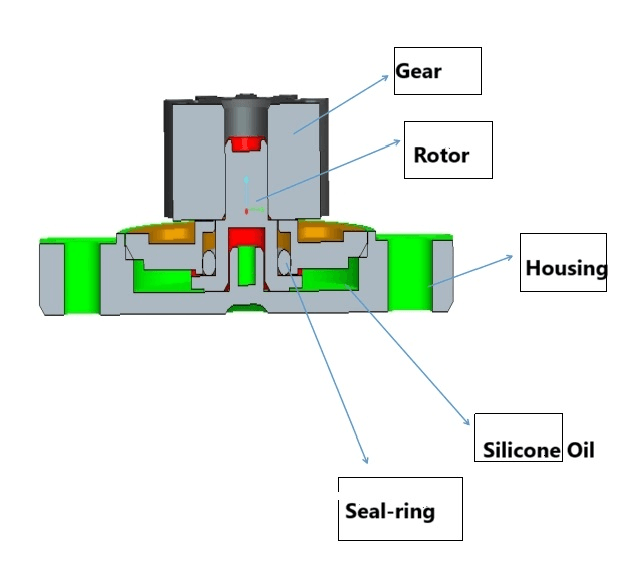
You’ve probably used products with rotary dampers hundreds of times without even realizing it. Think about the soft-close toilet seat in your bathroom, the smooth-opening lid on your kitchen dishwasher, or the gentle glide of your laptop screen when you open it—all of these rely on a small but powerful component called a rotary damper. When I first started researching rotary dampers for my own product design, I was overwhelmed by technical jargon and complicated diagrams. So I decided to break it down in the way I wish someone had explained it to me: simply, clearly, and from a customer’s perspective.
First, let’s get one thing straight: rotary dampers aren’t fancy or overly complex. At their core, they’re designed to do one simple but crucial job—control rotational movement. They slow down motion, prevent sudden slams, reduce noise, and make the products we use every day feel more high-quality and safe. Whether you’re a product designer, a small business owner looking to upgrade your products, or just someone curious about how things work, understanding the basics of how rotary dampers operate will help you make better choices (and impress your team with your newfound knowledge!).
The Core Principle: Viscous Fluid Resistance
A rotary damper is essentially an energy conversion device. It takes the kinetic energy of a moving object (like a falling lid) and converts it into a tiny amount of thermal energy (heat) through fluid friction.
Inside the sealed housing of the damper is a highly viscous fluid—almost universally silicone oil. When the damper’s shaft is rotated by an external force, an internal rotor (or vane) moves through this oil. Because the oil is thick and sticky, it resists the movement of the rotor. This resistance is called viscous drag or fluid shear.
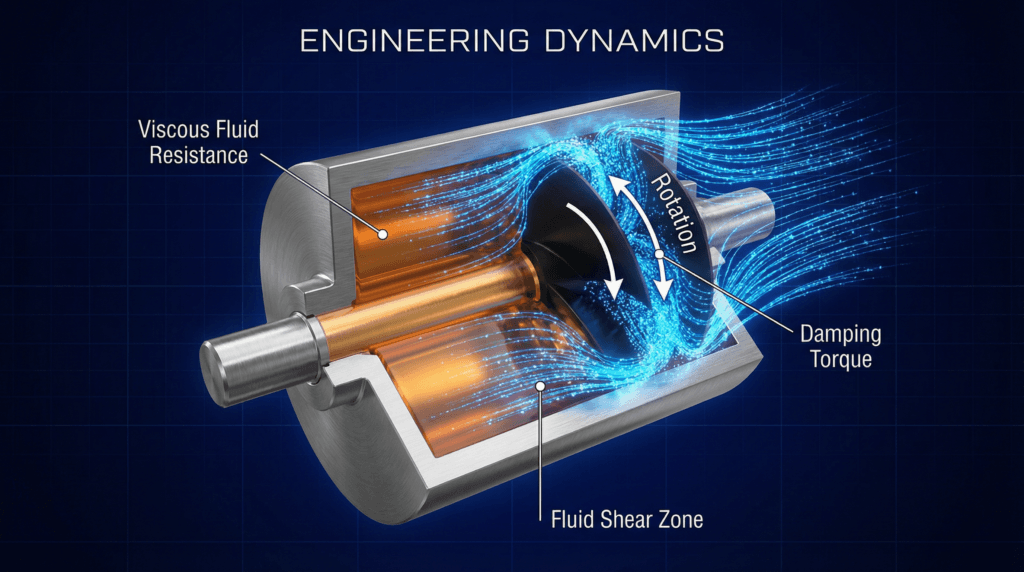
The Anatomy of a Rotary Damper
To understand how it works, let’s break down the three main components:
1.The Stator (Housing): The outer shell, usually made of high-strength plastic (like POM or PBT) or zinc alloy, which holds the fluid and remains stationary.
2.The Rotor (Vane/Gear): The internal moving part connected to the external shaft. As the shaft turns, the rotor shears through the fluid.
3.The Viscous Fluid: The silicone oil that fills the microscopic gaps between the rotor and the stator.
The Physics of Fluid Shear
The resistance generated by a rotary damper is speed-dependent. This is a crucial characteristic.
According to the principles of fluid dynamics, the faster you try to force an object through a viscous fluid, the exponentially greater the resistance becomes.
•If a lid falls quickly, the damper pushes back with high torque, slowing it down immediately.
•As the lid slows down, the resistance decreases proportionally, resulting in a smooth, elegant “soft-close” motion rather than an abrupt stop. let‘s talk on Whatsapp
Why Silicone Oil?
Not just any oil will work. Silicone oil is chosen for its unique properties:
•High Viscosity Index: Unlike motor oil, which thins out when hot and thickens when cold, silicone oil maintains a relatively stable viscosity across a broad temperature range (-20°C to 80°C). This ensures your car’s glove box opens smoothly in both winter and summer.
•Shear Stability: The long polymer chains in silicone oil can withstand being sliced by the rotor hundreds of thousands of times without breaking down and losing their viscosity.
Symmetric vs. Asymmetric Damping
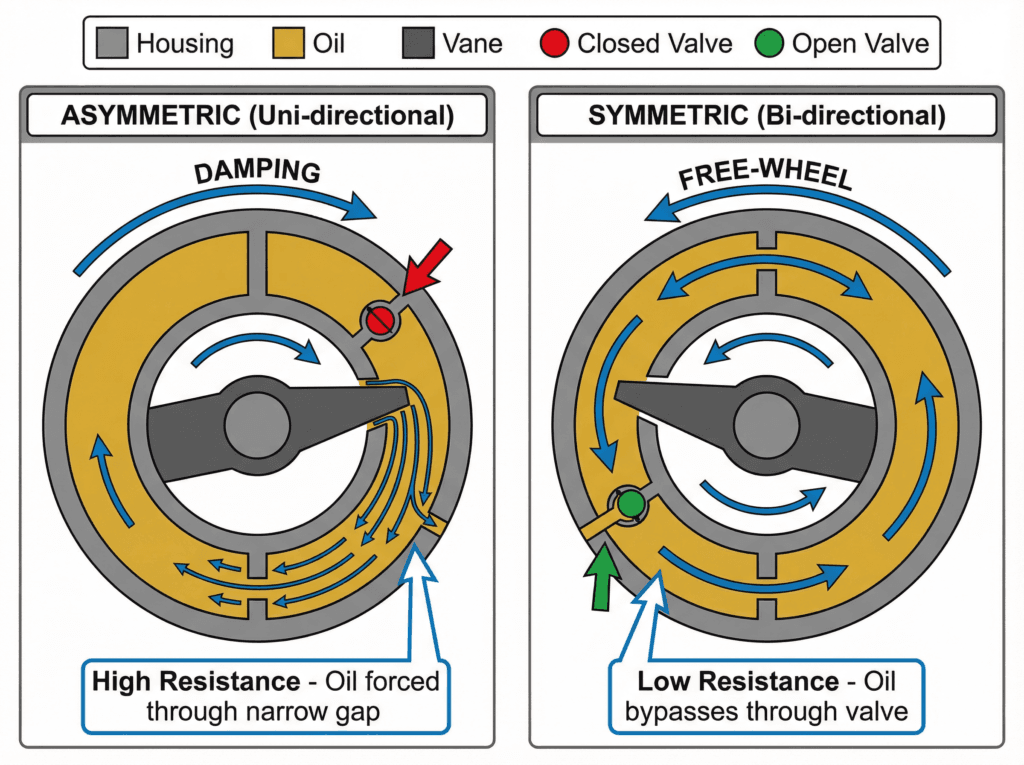
Rotary dampers can be designed to provide resistance in one direction or both directions.
Symmetric (Bi-directional) Damping
The rotor is a solid piece. It encounters the same fluid resistance whether turning clockwise or counter-clockwise. Used in applications where controlled motion is needed in both directions, like a volume knob on an amplifier.
Asymmetric (Uni-directional) Damping
This is the magic behind the toilet seat. You want the seat to be easy to lift (low resistance) but slow to fall (high resistance).
This is achieved using a one-way bypass valve built into the rotor vane.
•Opening (Lifting): The fluid pressure pushes the valve open, allowing the silicone oil to flow freely through a large channel in the vane. Resistance is minimal.
•Closing (Falling): The fluid pressure pushes the valve shut. The oil is forced to squeeze through a microscopic gap (often just 0.01mm) between the vane and the housing wall. This creates massive fluid shear and high damping torque.
Precision Manufacturing
Because the damping torque is determined by the clearance between the moving rotor and the stationary housing, manufacturing tolerances must be incredibly tight. A difference of just a few microns can drastically alter the closing speed. This is why top-tier manufacturers like JAN Hinge Damper use automated assembly and 100% inline torque testing.
How It All Comes Together: A Step-by-Step Breakdown
Let’s walk through a real-life example to make this concrete—let’s say we’re talking about a soft-close toilet seat (one of the most common uses for rotary dampers). Here’s exactly what happens when you close the lid:
- You lift the toilet seat lid, which rotates the damper’s shaft. Since most toilet seat dampers are one-way (meaning they only provide resistance in one direction), lifting the lid feels easy—there’s almost no resistance because the oil flows freely in that direction.
- When you let go of the lid, gravity pulls it down, and the shaft starts rotating in the opposite direction. Now, the damper kicks in: the vane inside the oil chamber moves against the damping oil, and the oil has to squeeze through tiny gaps in the chamber.
- The friction from the oil flowing creates a damping force that slows down the lid’s rotation. Instead of slamming shut (and making a loud noise or damaging the toilet), the lid glides gently down, coming to a stop without any impact.
- And that’s it! The damper resets automatically, so the next time you lift the lid, it’s ready to work again. No maintenance, no extra effort—just consistent, smooth motion every time.
This same principle applies to all kinds of products: dishwashers (where dampers prevent lid slamming in high-humidity environments), industrial machinery (where they stabilize rotating parts), even toys and electronics (where they protect delicate components from sudden motion). The core idea is always the same: use damping oil to create controlled resistance, making motion smoother, quieter, and safer.
Frequently Asked Questions (FAQ)
Q1: Does the damper wear out over time?
A: High-quality rotary dampers are designed for 50,000 to 100,000 cycles. Over years of heavy use, the silicone oil may eventually shear down, slightly reducing the damping torque, but sudden failure is rare unless the housing is physically broken.
Q2: Can I adjust the torque of a rotary damper myself?
A: No. Rotary dampers are sealed units. The torque is permanently set at the factory by the internal geometry and the specific viscosity of the oil used.
Q3: Why does my soft-close lid drop quickly for the first few inches before slowing down?
A: This is called the “free-fall” angle. When a lid is fully upright (90 degrees), gravity exerts very little rotational force. The damper’s internal vane needs a few degrees of rotation to engage the fluid and build up pressure.
Q4: What happens if I force a soft-close lid shut?
A: Forcing a lid shut forces the rotor through the oil faster than intended, creating immense internal pressure. This can blow the seals and cause oil leakage, or snap the plastic shaft. Heavy-duty dampers include overload valves to prevent this.
Q5: How does temperature affect the closing speed?
A: While silicone oil is stable, it isn’t perfect. In extreme cold (e.g., -10°C), the oil thickens slightly, making the lid close slower. In high heat (e.g., 60°C), it thins slightly, making the lid close faster.