
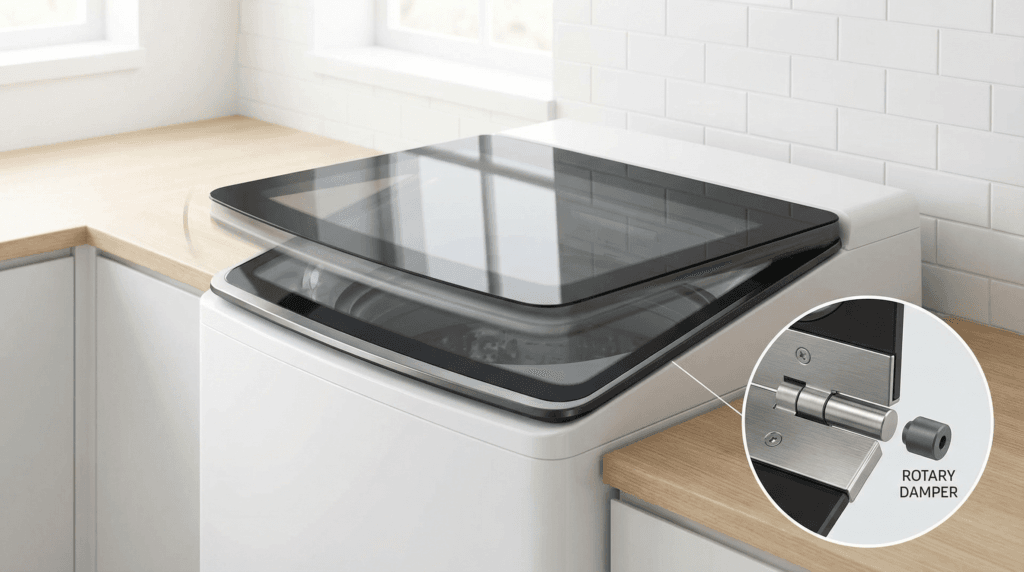
If you’ve ever used an older top-load washing machine, you probably remember the distinct—and often startling—sound of the lid slamming shut. It was just an accepted part of doing laundry. But over the past decade, as appliance designs have evolved to include heavy tempered glass lids and smarter interfaces, that “slam” is no longer acceptable.
Today, consumers expect their appliances to feel premium, safe, and silent. As engineers and procurement specialists, you know that achieving this tactile “soft-close” experience doesn’t happen by magic. It relies entirely on a small, unassuming component hidden inside the hinge assembly: the rotary damper.
In this article, we’re going to walk through exactly why rotary dampers have become indispensable in modern washing machines, the engineering challenges involved in designing them, and what you need to look for when sourcing them for your next appliance project. Talk on Whatsapp
Why Top-Load Washers Need Rotary Dampers
The shift toward rotary dampers in washing machines wasn’t just an aesthetic choice; it was driven by a combination of safety regulations, material changes, and consumer expectations.
Preventing Finger-Trap Accidents. The most critical function of a lid damper is safety. Modern top-load washers frequently feature large, transparent lids made from tempered glass. These lids can easily weigh between 2 kg and 4 kg. If a lid of that weight falls freely from an 80-degree open position, the kinetic energy at the point of impact is substantial. A high-quality rotary damper slows this descent to a controlled glide, completely eliminating the risk of crushed fingers—a vital consideration for households with children.
Protecting Internal Components. Washing machines are packed with sensitive electronics. The lid lock mechanism, safety switches, and the digital control panel are all located near the top of the machine. Repeated shockwaves from a slamming lid can cause micro-fractures in circuit boards and premature failure of mechanical latches. By absorbing the kinetic energy of the falling lid, the damper acts as a shock absorber for the entire machine, significantly extending its operational lifespan.
The “Premium” Hand-Feel. In a highly competitive appliance market, the tactile feedback of a product often dictates its perceived value. When a user pushes a heavy glass lid and watches it silently and smoothly lower itself into place, it communicates a level of engineering sophistication that justifies a higher price point. This noise-free operation is particularly valued in modern open-plan homes where the laundry area might be adjacent to living spaces.
The Engineering Behind the Soft-Close rotary dampers
So, how does a component roughly the size of a D-cell battery control a heavy glass lid? The answer lies in fluid dynamics.
Most washing machine lid dampers are uni-directional (one-way) rotary vane dampers. This means they provide strong resistance in one direction (closing) but allow almost zero resistance in the opposite direction (opening). You certainly don’t want the user fighting against hydraulic pressure just to open the machine to load their laundry.
Inside the damper’s sealed polycarbonate (PC) housing sits a rotor connected to the hinge axis. The remaining cavity is filled with high-viscosity silicone oil. When the lid begins to fall, the rotor turns, forcing the silicone oil through a precisely calibrated microscopic orifice (or bypass valve). The shear friction of the fluid being forced through this tiny gap generates the braking torque.

Overcoming Design Challenges in the Laundry Room
Designing a damper for a kitchen drawer is relatively straightforward. Designing one for a washing machine is a completely different challenge due to the harsh operating environment.
| Engineering Challenge | The Rotary Damper Solution |
| High Humidity & Moisture | The laundry environment is inherently wet. Premium dampers utilize double-seal hermetic technology (often ultrasonic welding) to ensure zero water ingress and zero oil leakage over the product’s lifetime. |
| Temperature Fluctuations | Washers operate in cold basements and generate internal heat during hot wash cycles. Standard oils thin out when hot, causing the lid to slam. JAN uses High-Viscosity Index (HVI) silicone oil that maintains a stable torque curve from -20°C to +80°C. |
| High Cycle Counts | A typical washer lid might be opened 10 times a week. Over a 10-year lifespan, that’s over 5,000 cycles. Quality dampers use wear-resistant POM (Polyoxymethylene) rotors to ensure torque doesn’t degrade even after 50,000 cycles. |
How to Calculate Torque for a Washer Lid
For engineers sizing a damper for a new washing machine prototype, getting the torque right is the most critical step. If the torque is too low, the lid still slams. If it’s too high, the lid might stop halfway down and refuse to close entirely.
The baseline calculation for required torque (T) is straightforward:
T (Nm) = (L / 2) × 9.8 × M
Where L is the length of the lid from the hinge pivot point to the front edge (in meters), and M is the total weight of the lid (in kilograms).
Example: If your tempered glass lid weighs 2.5 kg and is 0.45 meters long: T = (0.45 / 2) × 9.8 × 2.5 = 5.51 Nm
However, this formula only calculates the maximum holding torque when the lid is perfectly horizontal. Because washing machine lids open to varying angles (usually 80 to 100 degrees), the gravitational force changes dynamically. The chart below shows how the gravitational load torque changes across the full arc of motion, and how a well-matched damper torque profile should track it.

At Janhinge, our engineering team uses proprietary software to map the entire torque curve, ensuring the damping profile matches the gravitational curve perfectly. This results in a smooth, continuous motion from the moment the user lets go until the lid gently kisses the rubber bumpers.
Sourcing Advice for Procurement Professionals
If you are a purchasing manager sourcing components for a new line of top-load washers, there are three things you should always demand from your damper supplier. First, ask to see the raw data from their 50,000-cycle durability tests—don’t just accept a stated lifespan. Second, verify that the silicone oil is RoHS and REACH compliant, non-toxic, and has a stated temperature stability range suitable for appliance environments. Third, avoid off-the-shelf “one size fits all” dampers for heavy lids; your supplier should be willing to adjust the internal oil viscosity and valve geometry to perfectly match your specific lid weight and center of gravity.

At Janhinge, we specialize in partnering with appliance manufacturers to develop custom motion control solutions that elevate the end-user experience. Contact us today to discuss your project requirements.
Frequently Asked Questions (FAQ)
Q1: Can a washing machine lid damper be repaired if it starts slamming?
No, rotary dampers are sealed, self-contained units. If a damper fails—usually due to internal seal degradation causing silicone oil leakage—the entire damper or the hinge assembly must be replaced. They are not serviceable components. This is why sourcing a damper with a verified 50,000+ cycle lifespan from the outset is so important.
Q2: Why does the lid feel slightly heavier to lift when a new damper is installed?
While modern washing machine dampers are uni-directional (designed to provide resistance only when closing), there is always a minimal amount of “return torque” caused by the baseline friction of the seals and the rotor moving through the fluid. In high-quality dampers, this return torque is usually kept below 0.4 Nm, making it barely noticeable to the user during normal operation.
Q3: What is the difference between a vane damper and a gear damper for appliances?
Vane dampers are typically used directly on the hinge pivot point of heavy doors (like washer lids or oven doors) because they can handle high torque loads (1 Nm to 10 Nm) over a limited rotation angle (usually 0 to 110 degrees). Gear dampers are smaller, provide lower torque, and allow continuous 360-degree rotation, making them better suited for small, light applications like coffee machine water tank lids or bread maker covers.
Q4: Do we need a damper on both the left and right hinges of the washer lid?
It depends on the weight and rigidity of the lid. For lighter plastic lids, a single damper on one side is often sufficient. However, for heavy tempered glass lids, using a single damper can cause the lid to twist or warp over time due to uneven stress distribution. In these cases, engineers typically specify a matched pair of dampers—one clockwise and one counter-clockwise—to distribute the load evenly across both hinge points.
Q5: How does ambient temperature affect the closing speed of the washer lid?
Even with high-quality silicone oil, extreme temperatures can cause slight variations in viscosity. In a very cold laundry room (e.g., 5°C), the oil thickens slightly, causing the lid to close a bit more slowly. In a hot environment (e.g., 40°C), the oil thins, and the lid will close slightly faster. However, premium dampers engineered with HVI silicone oil are designed so that this variance remains within acceptable, safe limits across the entire operating temperature range.
To discuss custom rotary damper solutions for your home appliance manufacturing needs, contact the engineering team at www.janhinge.com.