
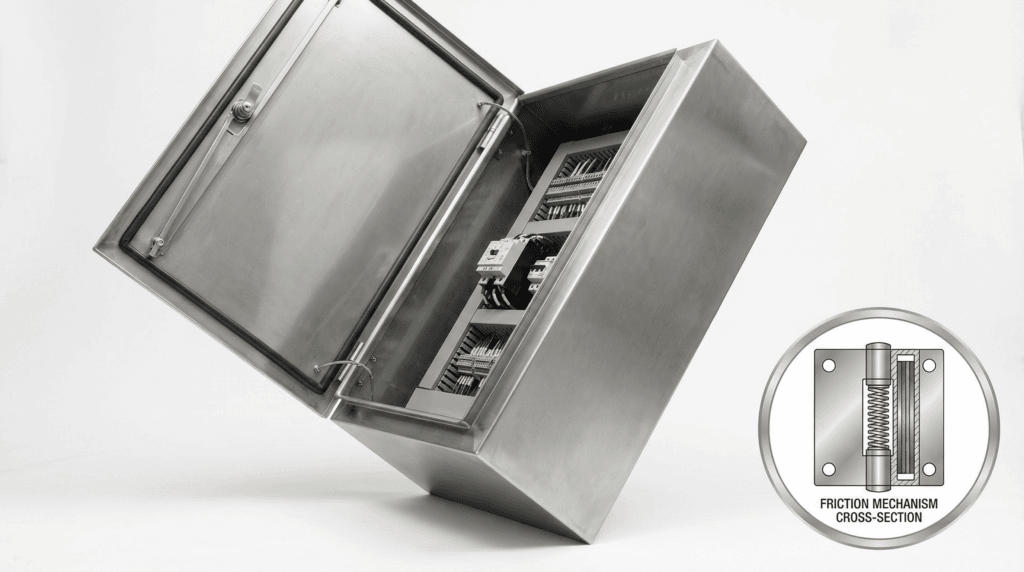
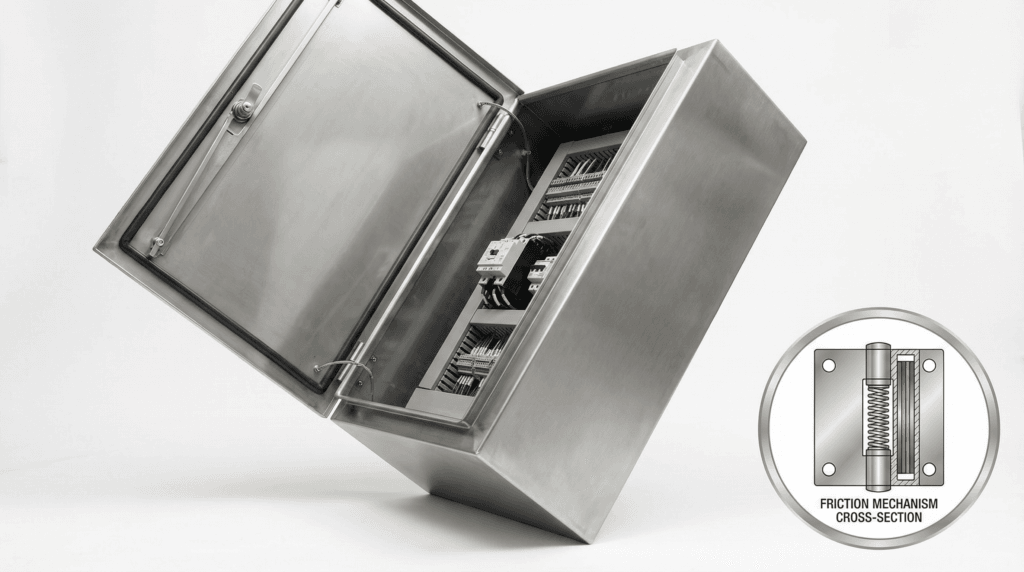
We have all experienced the frustration of a poorly designed hinge. You open an equipment access panel, reach inside with both hands, and suddenly the heavy metal lid comes crashing down on your arms. Or, on the flip side, you try to adjust a monitor arm, and it requires so much brute force that you feel like you are going to snap the screen in half.
As engineers and procurement specialists, you know that the difference between a frustrating user experience and a premium, effortless one often comes down to a single, unassuming component: the friction hinge.
Also known as torque hinges or position control hinges, these specialized mechanical devices do something standard hinges cannot do — they hold a door, lid, or panel solidly in position at any given angle. In this article, we will break down exactly how friction hinges work, the internal mechanics that generate that “magic” resistance, and how to select the right one for your next hardware project.
The Core Principle: Overcoming Gravity with Friction
If you want to understand how a friction hinge works, look no further than the laptop you might be reading this on. When you open your laptop screen, it stays exactly where you leave it. It does not flop backward, and it does not slam shut.
Unlike ordinary free-swinging butt hinges, friction hinges are engineered to provide rotational resistance. The core physical principle is simple: the internal resistive torque of the hinge must be greater than the torque exerted by the object it is holding.
When a user pushes or pulls on the panel, they add their physical force to the gravitational force. Once that combined force exceeds the hinge’s built-in resistance, the friction mechanism is overcome, allowing smooth, predictable movement. The moment the user lets go, the hinge’s resistance takes over again, locking the panel in place at whatever angle it was released.
Inside the Hinge: How is the Friction Generated?
So, what is actually happening inside that small metal barrel? While the exterior might look like a standard hinge, the interior is packed with precision-engineered components designed to generate consistent, reliable friction over tens of thousands of cycles.
While different manufacturers use proprietary designs, almost all friction hinges rely on one of three fundamental internal structures to generate torque:
| Internal Structure | How It Works | Best Used For |
| Disc / Washer System | Alternating stationary and rotating friction discs (often separated by polymer washers) are tightly compressed together along a central shaft. The friction between the faces of the discs creates the resistance. | Heavy-duty industrial applications, large access panels, and high-torque requirements. |
| Curl / Spring Band | A precision-machined shaft is tightly wrapped inside a rolled spring-steel sheet. As the shaft turns, it grinds against the inner surface of the spring band. | Thin-profile applications like laptop screens, tablet kickstands, and lightweight medical displays. |
| Pipe / Interference Fit | A metal shaft is press-fitted into a slightly undersized plastic or polymer pipe. The interference fit creates constant, uniform friction. | Cost-sensitive, lighter-load applications like small plastic lids or lightweight electronics. |

Types of Friction Hinges
Not all position control challenges are the same, which is why friction hinges come in several distinct variations to suit different ergonomic needs.
Constant Torque Hinges are the most common type. They provide the exact same amount of resistance in both the opening and closing directions, regardless of the angle. Once you specify the correct torque, they simply work — no adjustments needed.
Adjustable Torque Hinges feature a small set screw (usually adjusted with a hex key) that allows you to increase or decrease the compression on the internal friction elements. These are incredibly useful during the prototyping phase when the final weight of your panel might still change, or in applications where different users might prefer a “stiffer” or “looser” feel.
One-Way (Uni-Directional) Hinges are engineered to provide high friction in one direction (usually closing, to prevent slamming) and near-zero friction in the opposite direction (opening). This allows a heavy lid to be lifted effortlessly but holds it securely in place once released.
Detent Hinges feature a mechanical “catch” at a specific angle (often at 0 degrees). This eliminates spring-back and ensures a door or lid remains tightly snapped shut without requiring a separate magnetic or mechanical latch.

How to Select the Right Hinge for Your Project
As a procurement professional or design engineer, sourcing the right friction hinge requires more than just picking a size that fits your CAD model. You must calculate the exact torque requirements of your application.
The Torque Calculation Formula
To ensure your lid stays open, you must calculate the maximum torque it will exert on the hinge. The basic formula is:
Torque (Nm) = (L / 2) × W × 9.8
•L = The length of the door/panel from the hinge pivot to the opposite edge (in meters)
•W = The weight of the door/panel (in kilograms)
•9.8 = The standard acceleration of gravity
Example: If you have an industrial control panel lid that weighs 4 kg and is 0.6 meters long, the torque is:
(0.6 / 2) × 4 × 9.8 = 11.76 Nm
If you are using two hinges, each hinge must support half the load (5.88 Nm). However, you should never run a hinge at its absolute maximum limit. Best engineering practice dictates adding a 20% safety margin to account for manufacturing tolerances and the possibility of a user resting their hand heavily on the open panel. Therefore, you should source two hinges rated for at least 7.0 Nm each.

Material Selection
Finally, consider the environment. If your product will live indoors in a climate-controlled room, zinc alloy or glass-filled nylon hinges offer excellent strength-to-cost ratios. However, if you are designing a marine electrical enclosure, outdoor telecom cabinet, or medical device subjected to harsh chemical cleaners, 304 or 316 stainless steel is absolutely mandatory to prevent the internal friction plates from corroding and seizing up.
At Janhinge, we specialize in helping OEMs and industrial designers find the perfect motion control solutions. Whether you need a standard constant-torque hinge or a custom-engineered adjustable mechanism, our team is here to help you calculate, select, and source the right hardware. Contact us today to request CAD files or physical samples.
Frequently Asked Questions (FAQ)
Q1: What is the difference between a friction hinge and a rotary damper?
While both control motion, their purposes are entirely different. A friction hinge relies on dry mechanical friction to hold an object statically in place at any angle (like a laptop screen). A rotary damper uses fluid resistance (silicone oil) to control the speed of a moving object (like a soft-closing toilet seat), but it cannot hold a heavy object in mid-air against gravity. Some premium products combine both technologies: a friction hinge holds the panel open, while an integrated rotary damper provides a soft-close cushion in the final 15 degrees of travel.
Q2: Do friction hinges lose their holding power over time?
All mechanical friction components experience some degree of wear, known as “torque decay.” Cheap, low-quality hinges may lose their holding power after just a few hundred cycles. However, premium friction hinges engineered with hardened steel discs or proprietary spring bands are rated to maintain their specified torque within a ±15% tolerance for 20,000 to 50,000 cycles. Always ask your supplier for a cycle life test report, not just a stated number.
Q3: Can I lubricate a friction hinge if it starts squeaking?
Absolutely not. Applying oil, WD-40, or grease to a friction hinge will immediately destroy its holding power. The hinge relies on dry friction to work. If a hinge is squeaking or binding, it has likely reached the end of its cycle life or has been contaminated by dirt or corrosion, and the entire unit should be replaced. This is why material selection and environmental sealing are so critical at the design stage.
Q4: Why does my panel slowly drift downward even though I calculated the torque correctly?
This usually happens for one of two reasons. First, you may not have factored in the 20% safety margin, and the hinge is operating exactly at its failure threshold. Second, the center of gravity of your panel might not be perfectly in the middle — for example, if a heavy display screen is mounted near the top edge of the lid. You must calculate torque based on the actual center of gravity, not just the geometric center. If in doubt, send us your CAD file and our engineers will verify the calculation for you.
Q5: Can I use just one friction hinge and one standard free-swinging hinge to save costs?
Yes, this is a common cost-saving technique in consumer electronics and lightweight cabinetry, provided the single friction hinge is rated high enough to handle the entire torque load of the panel. However, for wide or heavy industrial doors, using asymmetrical hinges can cause the door to warp or twist over time due to uneven stress distribution at the pivot points. For heavy applications, always use matched pairs of friction hinges to distribute the load evenly and extend the service life of both the hinges and the panel structure.
To discuss custom friction hinge solutions for your manufacturing needs, contact the engineering team at www.janhinge.com.