
You must have ever opened and closed a laptop screen to exactly the angle you want and watched it stay there without drifting — that is a torque hinge at work. If you have opened a heavy industrial control panel and had it hold itself at 90 degrees without a prop rod — that is also a torque hinge. They are one of the most quietly essential components in modern mechanical design, yet many engineers and procurement teams only discover them when a standard free-swinging hinge fails to meet their application requirements.
So what exactly is a torque hinge, and we explore why should it be on your shortlist for your next design projects?
The Core Definition
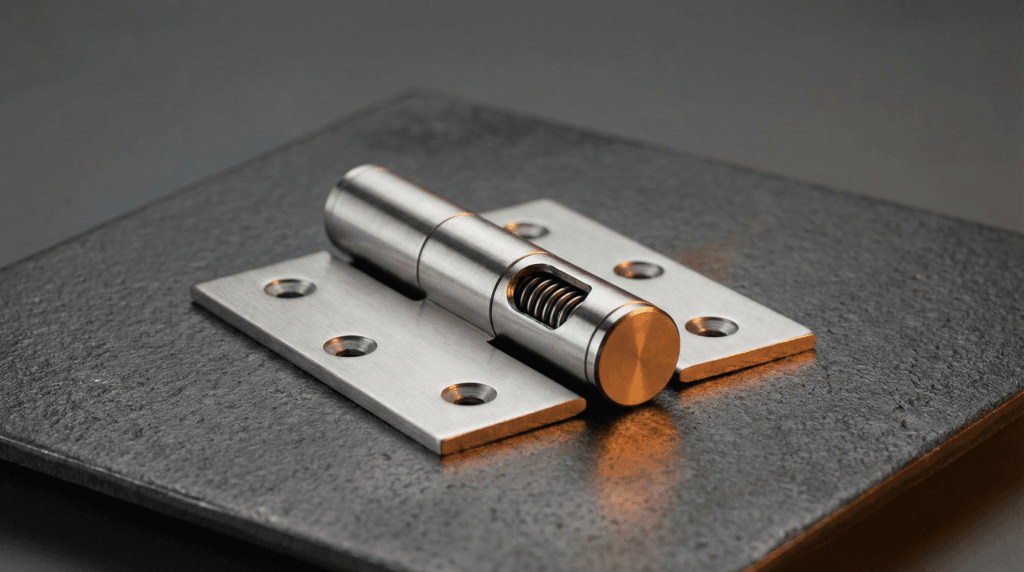
A torque hinge — also known as a friction hinge, position control hinge, or stay hinge — is a hinge engineered to provide a controlled, consistent resistance to rotational motion . Unlike a conventional door hinge that swings freely in both directions, a torque hinge uses calibrated internal friction to hold a panel, lid, screen, or door at any angle within its range of travel, without any external locking mechanism.
The defining characteristic is holding torque: the amount of rotational force (measured in Newton-meters or inch-pounds) that the hinge continuously exerts to resist movement. When you apply a force greater than the holding torque, the panel moves. When you release it, the friction immediately locks it in place again. This “set it and forget it” behavior is what makes torque hinges indispensable in applications where hands-free positioning is critical.
How Do They Work?
Inside a torque hinge, the magic happens through engineered friction elements. The most common designs use one of three mechanisms:
| Mechanism | How It Works | Best For |
| Coiled Spring Band | A pre-tensioned steel spring wraps around the pivot shaft. Friction between the spring and shaft creates holding torque. | Compact designs, consumer electronics, thin profiles |
| Disc Stack (Belleville) | A stack of precision-stamped metal or composite discs is compressed against the pivot shaft. Torque is set by the compression level. | Heavy-duty industrial panels, high-torque applications |
| Leaf Spring Clip | A curved leaf spring grips the pivot barrel. Adjustable versions allow field torque modification via a hex key. | Applications requiring on-site torque adjustment |
The key engineering insight is that none of these mechanisms require hydraulic fluid, electrical power, or external locking pins. They are entirely mechanical, passive, and maintenance-free — which is precisely why they are so widely adopted across industries . Explore your solutions on Whatsapp.
Where Are Torque Hinges Used?
The application range of torque hinges is broader than most people initially realize. Once you start looking, you will find them in almost every industry that involves a panel, lid, or screen that needs to stay in any position.
Hinges for Consumer Electronics
This is where most people first encounter torque hinges without knowing it. Every laptop computer relies on a pair of torque hinges to hold the screen at the user’s preferred viewing angle. The same applies to 2-in-1 convertible tablets, e-readers with adjustable stands, and point-of-sale terminal displays. The torque specification here is typically low (0.2 to 2 Nm) to allow easy one-finger adjustment, while still holding a lightweight screen against gravity.
Hinges for Industrial Enclosures and Control Panels
Heavy electrical enclosures, junction boxes, and machine control panels frequently use high-torque friction hinges (5 to 50 Nm or more) to hold heavy steel doors open during maintenance. This eliminates the need for prop rods, which can fall and injure technicians, and ensures the door stays exactly where the engineer positioned it, even in vibrating environments.
Hinges for Medical Equipment
Hospital equipment designers rely on torque hinges for monitor arms, adjustable bed rails, surgical light positioning arms, and diagnostic device panels. In medical environments, the ability to hold a display at a precise angle without drift is not just a convenience — it is a patient safety requirement. Medical-grade torque hinges must also withstand repeated chemical disinfection without torque degradation.
Position Control Hinges for Automotive and Aerospace
Glove compartment lids, center console covers, and aircraft overhead panel doors all use friction hinges to prevent slamming and provide a premium, controlled feel. In aerospace applications, the hinges must maintain consistent torque across extreme temperature ranges (-55°C to +85°C).
Torque Hinges in Furniture and Architectural Hardware
Fold-out shelves, retractable worktops, display case lids, and piano key covers all benefit from torque hinges. The furniture industry particularly values the ability to specify exact opening forces to match the ergonomic requirements of different user demographics.
The Applications at a Glance

Why Not Just Use a Standard Hinge?
This is a question we hear regularly from procurement teams trying to reduce component costs. The answer comes down to what happens when a standard hinge is used in a position-control application.
A free-swinging hinge has zero holding torque. If you mount it on a heavy lid, gravity will slam the lid shut the moment you release it. Engineers then add gas springs, prop rods, or mechanical latches to compensate — each of which adds cost, weight, complexity, and potential failure points. A single torque hinge, correctly specified, eliminates all of these secondary components in one elegant solution.
Furthermore, standard hinges in high-cycle applications (such as industrial equipment accessed dozens of times per day) develop play and rattle over time. Torque hinges maintain their friction profile for tens of thousands of cycles, providing consistent performance throughout the product’s service life .
Choosing the Right Torque Hinge
The most critical specification is matching the holding torque to the weight and geometry of your panel. The basic formula is:
Required Torque (Nm) = Panel Weight (kg) × 9.8 × Distance from Hinge to Panel Center of Gravity (m)
For a 3 kg panel with its center of gravity 0.4 m from the hinge axis, you need at least 11.76 Nm of holding torque. We recommend adding a 20–30% safety margin to account for vibration, temperature variation, and torque decay over the product’s lifecycle.
If you are unsure about the right specification for your application, the engineering team at Janhinge is happy to help you calculate the required torque and recommend the appropriate hinge model. Contact us here or request a free sample to evaluate in your design.
Frequently Asked Questions (FAQ)
Q1: What is the difference between a torque hinge and a friction hinge?
They are the same thing. “Torque hinge,” “friction hinge,” “position control hinge,” and “stay hinge” are all industry terms for the same category of component — a hinge that uses internal friction to hold a panel at a fixed angle. Different manufacturers and regions prefer different terminology, but the underlying engineering principle is identical.
Q2: Can a torque hinge hold a panel completely vertically (at 90°)?
Yes, provided the holding torque is correctly specified for the panel weight and geometry. A torque hinge holds a panel at any angle within its range of travel, including vertical. This is one of the most common use cases in industrial enclosures, where the door must stay open at 90° or 180° during maintenance.
Q3: How long does a torque hinge last?
High-quality torque hinges are typically rated for 20,000 to 50,000 open-close cycles, depending on the design and material. At Janhinge, our standard industrial torque hinges are tested to 30,000 cycles with less than 15% torque decay. For high-frequency applications, we offer enhanced-durability models rated to 100,000 cycles.
Q4: Does temperature affect the holding torque?
Yes. Most torque hinges experience a slight increase in torque at low temperatures and a slight decrease at high temperatures, because the friction coefficient of the internal elements changes with temperature. For applications in extreme environments (below -20°C or above 80°C), always specify a hinge that has been tested and rated for your operating temperature range.
Q5: Can I use one torque hinge instead of two to save cost?
In some lightweight applications, a single central torque hinge is sufficient. However, for panels wider than approximately 300 mm, using a single hinge creates significant bending stress on the hinge barrel and mounting structure, which accelerates wear and can cause misalignment. Two hinges distribute the load evenly and provide a much longer service life. For most industrial and commercial applications, two hinges is the correct specification.
To discuss torque hinge solutions for your specific application, contact the engineering team at www.janhinge.com.