
If you’ve ever been involved in the design of heavy industrial equipment, outdoor telecommunications cabinets, or marine hatches, you’ll understand. You spend weeks selecting the perfect enclosure to meet NEMA protection standards, sourcing high-quality latches, and calculating heat loads. Yet, six months after deployment, complaints flood in.
“The control panel door won’t close.”
“The hatch slams shut, trapping the operator’s arm.”
“The hinges are starting to rust.”
Sound familiar? Based on our experience working with purchasing teams and design engineers in the manufacturing, marine, and energy industries, the root cause of these failures is almost always the same: a flawed understanding of heavy-duty friction hinges.
Also known as torque hinges or position control hinges, these specialized components are supposed to hold heavy doors and lids securely at any angle — no prop rods, no gas struts, no second pair of hands. But when you move from lightweight consumer electronics into the brutal world of industrial manufacturing and marine environments, the rules change completely.
Let’s talk about why your current hinge setup might be failing, and how to select a friction hinge that actually survives in the real world.
The Reality of Torque Decay in Heavy Applications
The most common complaint we hear from OEM engineers is, “The hinge worked perfectly in the prototype, but now the door droops.” This is a textbook case of torque decay — and it’s almost always caused by undersizing the hinge for the actual load.
All friction hinges rely on internal mechanical resistance — usually a series of compressed discs or a tightly wrapped spring band around a precision-machined shaft. Every time the door opens and closes, those internal components wear down slightly. In a laptop, a hinge only needs to support a few hundred grams. But when you are dealing with a 15-kilogram stainless steel electrical cabinet door, the sheer physics of the load accelerates that wear exponentially. If you specify a standard commercial-grade torque hinge for a heavy industrial panel, the internal friction bands will literally grind themselves smooth within a few thousand cycles.
The fix is not complicated, but it requires the right data. For heavy-duty applications, you need to look beyond the basic torque rating on a datasheet. You need to ask your supplier for the full cycle life torque decay curve — a graph that shows exactly how much holding torque the hinge retains after 5,000, 10,000, and 30,000 cycles under your specific load. A true heavy-duty friction hinge, engineered with hardened steel disc stacks and proprietary high-temperature lubricants, should maintain its specified torque within a strict ±15% tolerance even after 30,000 cycles.
The Material Mismatch: Why Zinc Alloy Isn’t Always Enough
The second major failure point is environmental degradation, and it is one of the most expensive mistakes to fix after the fact. We frequently see engineers specify zinc alloy friction hinges for outdoor enclosures simply because they are cost-effective and look robust enough on paper.
Here is the harsh reality: zinc alloy is a perfectly good material for indoor, climate-controlled environments like server racks or indoor medical carts. But the moment you expose it to sustained high humidity, coastal salt spray, or harsh chemical washdowns in a food processing plant, it becomes a liability. The internal friction mechanism can corrode, causing the hinge to either seize up completely — making the door impossible to open — or lose all its friction, turning it into a dangerous free-swinging hinge.
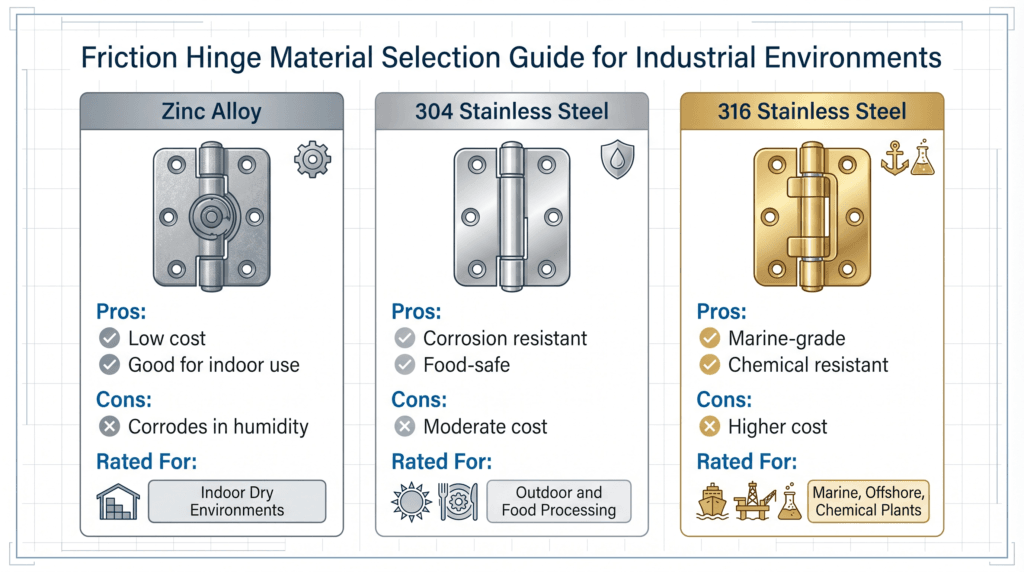
Matching hinge material to the deployment environment is the single most impactful decision in preventing premature failure.
Selecting the Right Material for the Environment
| Material | Best Environment | Key Advantage | Limitation |
| Zinc Alloy | Indoor, dry, climate-controlled | Low cost, good dimensional accuracy | Corrodes in humidity; not suitable outdoors |
| 304 Stainless Steel | Outdoor enclosures, food processing | Excellent corrosion resistance, food-safe | Can pit in high-chloride (marine) environments |
| 316 Stainless Steel | Marine, offshore, chemical plants | Superior chloride resistance (molybdenum content) | Higher unit cost |
| Glass-Filled Nylon | Lightweight electronics, indoor panels | Non-conductive, lightweight, low cost | Lower torque capacity; degrades in UV |
If your application involves marine vessels, offshore oil rigs, or facilities using chlorine-based cleaning agents, 316 stainless steel is non-negotiable. The added molybdenum in 316 provides a level of resistance to pitting and crevice corrosion that 304 simply cannot match in saltwater environments. Discuss more on Whatsapp.
The “Wind Load” Factor on Outdoor Enclosures
Here is a scenario that catches many designers off guard. You calculate the exact torque needed to hold a 10 kg outdoor telecom cabinet door open. You install the hinges, test it in the factory, and it works perfectly. Then it gets installed on a cell tower, a strong gust of wind hits the open door, overcomes the hinge friction, and slams it shut — potentially injuring the technician working inside.
When calculating torque for outdoor applications, you cannot just account for the static weight of the door. An open panel acts like a sail. The larger the door surface area and the more exposed the installation site, the greater the wind-induced torque that can work against your hinge.
The practical rule of thumb: While a 20% safety margin over your calculated torque is standard for indoor applications, outdoor panels in exposed locations often require a 50% to 100% torque buffer depending on the door’s surface area and the site’s expected wind conditions. In extreme environments — think rooftop telecom installations or coastal substations — combining a heavy-duty constant torque hinge with a mechanical locking stay arm is the safest engineering approach.
Real-World Applications: Where Heavy-Duty Torque Hinges Excel
Understanding the theory is one thing; seeing it applied in real products is another. Here are four industrial scenarios where getting the friction hinge specification right is directly tied to operator safety and equipment reliability.
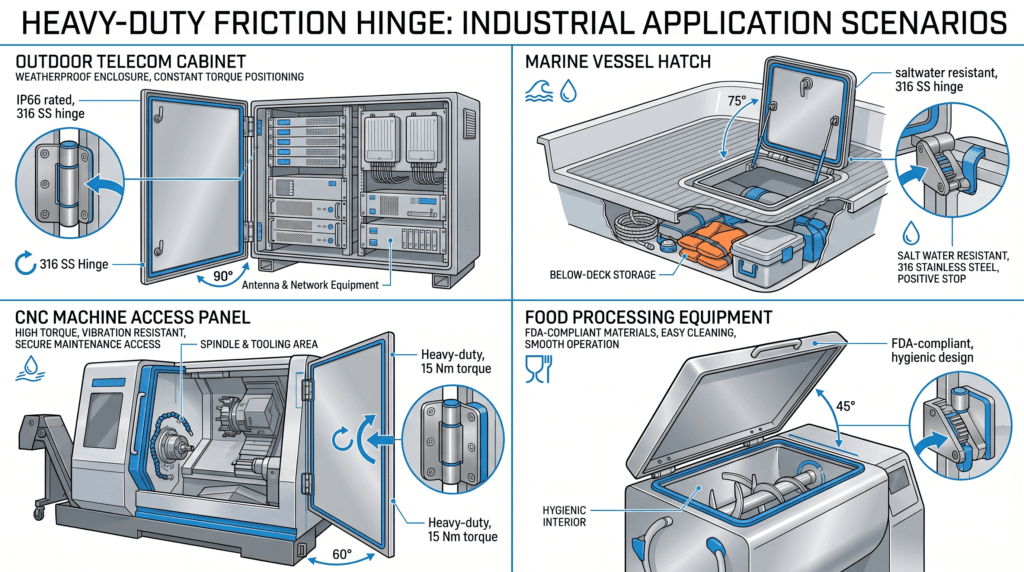
From marine hatches to CNC machine guards, heavy-duty friction hinges provide essential hands-free position control in demanding environments.
Outdoor Telecom & Electrical Cabinets: Maintenance technicians need both hands free to work on live wiring. A weatherproof 304 or 316 stainless steel friction hinge ensures the heavy, gasketed door stays exactly where they leave it — even in a crosswind — preventing accidental closures that could cause injury or damage sensitive equipment.
Marine Vessel Hatches: Boat hatches are heavy, constantly exposed to saltwater, and subjected to the rolling motion of the vessel. A marine-grade 316 stainless steel constant torque hinge allows a passenger to open a storage locker or engine hatch with one hand and release it at any angle, without needing gas struts or prop rods that take up valuable below-deck space.
CNC Machine Access Panels: Industrial machine tools generate significant vibration. A standard butt hinge will quickly rattle loose, but a heavy-duty friction hinge with a high torque rating (typically 10 Nm to 15 Nm) holds protective shielding securely in place during tool changes, resisting both the weight of the panel and the constant ambient vibration of the factory floor.
Food Processing & Pharmaceutical Equipment: In these environments, hygiene is as important as mechanical performance. Stainless steel friction hinges are chosen not just for their holding power, but because they can withstand daily high-pressure, high-temperature chemical washdowns without rusting or degrading the internal friction mechanism — a critical requirement for FDA-compliant equipment design.
Stop Treating the Hinge as an Afterthought
The friction hinge is arguably the most interactive mechanical component on your industrial enclosure. It is the first thing the operator touches and the mechanism that keeps them safe while they work. Yet it is consistently one of the last components to be specified, often chosen from a generic catalog at the lowest available price point.
If you are tired of dealing with drooping doors, rusted joints, and costly field warranty repairs, it is time to rethink your approach. The difference between a hinge that fails at 3,000 cycles and one that performs reliably at 30,000 cycles is not always a significant cost difference — but it is always a significant engineering decision.
At JAN Hinge, we specialize in engineering motion control solutions for demanding industrial, marine, and outdoor applications. Whether you need a custom torque profile for a large electrical panel door or a marine-grade stainless steel hinge for an offshore installation, our engineering team can help you calculate, specify, and source the right component. Contact us today to request samples and cycle-life test data for your specific application.
Frequently Asked Questions
Q1: How do I calculate the correct torque for a heavy industrial enclosure door?
The standard formula is: Torque (Nm) = (Door Length ÷ 2) × Door Weight (kg) × 9.8. However, for heavy industrial doors, you must also account for the actual center of gravity — which may not be the geometric center if heavy components like displays or terminal blocks are mounted to the door — and apply a safety margin. For indoor applications, add 20%. For outdoor panels exposed to wind, add 50% to 100% depending on the door’s surface area and site conditions.
Q2: Can I use an adjustable friction hinge on a heavy electrical cabinet?
Yes, and in many cases it is the smarter choice, particularly during the product development phase when the final panel weight may still change. Adjustable torque hinges feature a set screw that lets you dial in the exact resistance you need. For final mass production, many engineers prefer factory-calibrated constant torque hinges to prevent field personnel from inadvertently changing the tension setting.
Q3: Are stainless steel friction hinges waterproof?
The stainless steel body of a 304 or 316 hinge is highly resistant to water and corrosion, but the hinge itself is a mechanical pivot joint — not a hermetic seal. Water will not damage a quality stainless steel friction hinge, but the hinge will not prevent water from entering your enclosure. You still need proper NEMA-rated or IP-rated gasketing around the door perimeter to maintain your enclosure’s ingress protection rating.
Q4: Why is my heavy-duty friction hinge making a grinding noise after a few months of use?
A grinding or squeaking noise in an industrial setting almost always indicates one of two things: either the hinge has been contaminated with abrasive particles (metal shavings, concrete dust, or sand), or the internal lubrication has failed due to extreme operating temperatures. If the hinge is binding or grinding, it should be replaced. Never apply oil, WD-40, or grease to a friction hinge in an attempt to fix the noise — doing so will permanently destroy the internal friction mechanism and eliminate all holding torque.
Q5: Can a heavy-duty friction hinge replace a gas spring on a large hatch or panel?
In many applications, yes — and friction hinges are often the preferred solution. Unlike gas springs, friction hinges hold a panel at any angle (not just fully open), never lose pressure over time, and are significantly more compact. However, friction hinges do not provide lift assistance. If the hatch is exceptionally heavy (generally over 25–30 kg), a gas spring or counterbalance mechanism may still be needed to help the operator lift the initial weight, while a friction hinge can be used in tandem to provide precise, hands-free position control at any intermediate angle.
Need help specifying the right friction hinge for your industrial project? Talk to our engineering team — we provide free torque calculations and sample testing for OEM customers. Discuss more on Whatsapp.