
The self-service revolution is moving outdoors. From EV charging stations and smart parcel lockers to drive-thru restaurant kiosks and ticketing machines, hardware designers are being asked to build complex electronic systems that can survive on a city sidewalk.
When designing these machines, engineering teams obsess over the brightness of the touchscreen, the speed of the payment processor, and the thermal management of the CPU. But there is one mechanical component that is almost universally overlooked until the prototype hits the field: the hinge on the maintenance access panel.
If you use a standard free-swinging hinge on an outdoor kiosk, you are asking for trouble. A sudden gust of wind can slam a heavy metal door onto a technician’s hand, or swing it open so violently that it damages the chassis. Gas struts are bulky, take up valuable internal space, and eventually lose pressure.
This is where the friction hinge (or constant torque hinge) becomes the unsung hero of outdoor kiosk design. Let’s explore why this specific piece of hardware is critical for self-service terminals, and how to specify the right one for your next project. Discuss more on Whatsapp
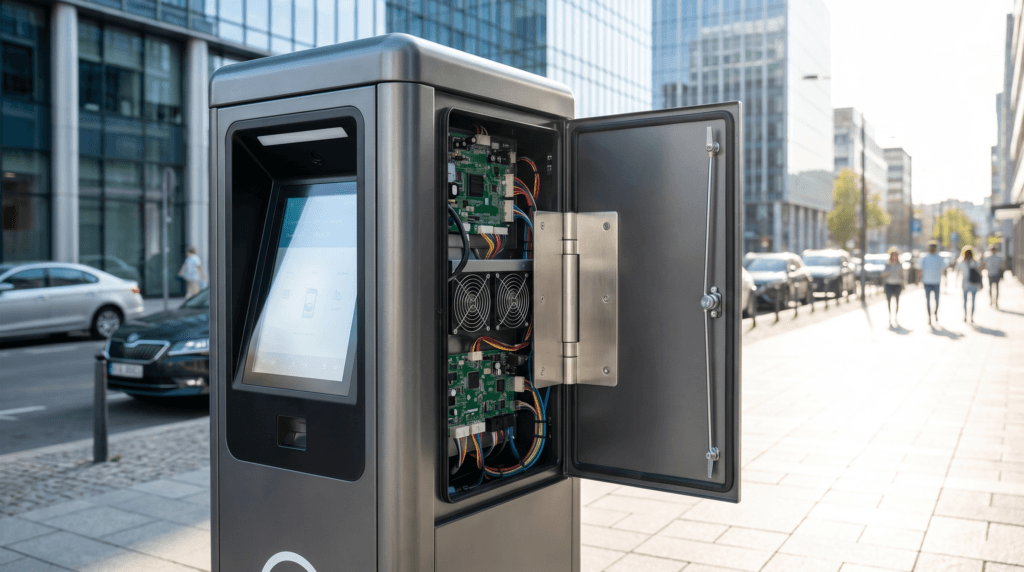
The Dual Challenge of Outdoor Self-Service Machines
Designing hardware for outdoor public spaces presents two unique challenges that directly impact hinge selection: unpredictable environments and unpredictable humans.
1. The Environmental Challenge
An indoor mall kiosk lives a pampered life. An outdoor EV charger, however, is subjected to freezing rain, baking UV rays, coastal salt spray, and urban pollution. If the internal mechanism of your hinge corrodes, the maintenance door will either seize completely shut or lose all its holding torque, turning into a dangerous guillotine.
2. The Human Challenge
Outdoor self-service terminals require rapid maintenance. When technicians arrive on-site to replace receipt printer paper rolls or restart the mainboard, they need their hands free. They don’t have time to fiddle with support bars or auxiliary latches. High-quality friction hinges allow technicians to easily open heavy access doors to a precise 90 degrees (or any angle) and keep them open. The hinge’s internal torque resists gravity and wind, acting like an invisible “third hand” for maintenance personnel.
Furthermore, outdoor equipment is vulnerable to vandalism. Fragile external hinges are easily pried open. Using suitable heavy-duty friction hinges with concealed hardware for internal installation significantly improves the equipment’s physical security.
4 High-Growth Applications for Kiosk Friction Hinges
The term “kiosk” covers a massive range of hardware. Here is how friction hinges are solving specific design problems across four of the fastest-growing outdoor self-service sectors.
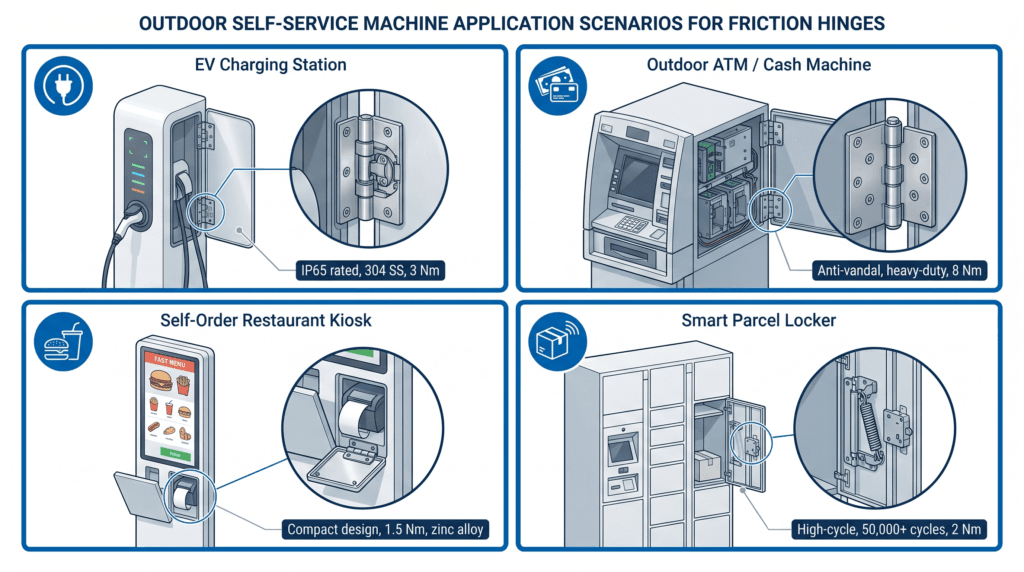

From EV chargers to smart parcel lockers, friction hinges provide essential hands-free position control for field technicians.
EV Charging Stations
EV chargers are essentially high-voltage electrical cabinets exposed to the elements. They require thick, heavy, IP65-rated sealed doors. A 304 or 316 stainless steel friction hinge is typically used here to hold the heavy front fascia open during installation and routine electrical maintenance. Because these are installed outdoors, the torque specification must account for significant wind loads.
Smart Parcel Lockers
Think about an Amazon or UPS locker bank. While the individual customer doors might use standard spring hinges, the master service door—which the courier opens to load 20 packages at once—is large and heavy. A high-cycle friction hinge allows the courier to open the master panel and keep it securely out of the way while they rapidly load boxes with both hands.
Drive-Thru & Self-Order Restaurant Kiosks
Fast-food kiosks require daily maintenance: replacing receipt paper, clearing coin jams, or cleaning the scanner glass. Because these kiosks are often squeezed into narrow drive-thru lanes, space is at a premium. A compact, high-torque friction hinge allows the maintenance door to hold its position without requiring bulky gas springs that would otherwise dictate a larger machine footprint.
Outdoor ATMs and Ticketing Machines
Security is the primary concern here. The hinges on a cash-handling machine must be incredibly robust. Heavy-duty friction hinges made from hardened steel or marine-grade stainless steel are often used on the secondary access panels (the fascia covering the screen and card reader) to allow secure, controlled access for bank technicians.
How to Specify a Friction Hinge for an Outdoor Kiosk
If you are transitioning a kiosk design from indoor to outdoor use, you cannot simply copy and paste your hardware bill of materials. Here is a quick selection guide to keep your project on track.
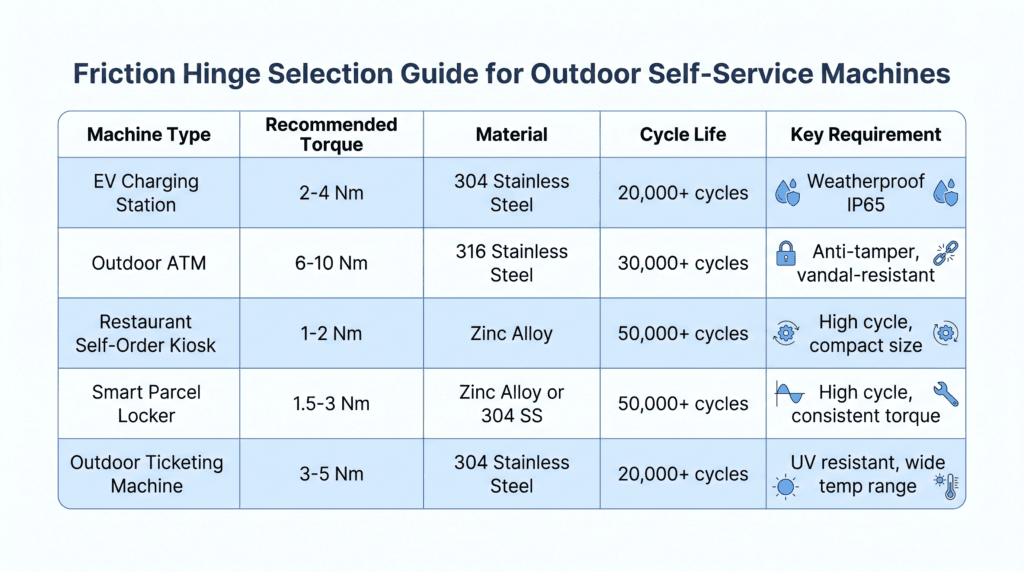
Always match your hinge material and torque rating to the specific environmental demands of your kiosk. Discuss more on Whatsapp
1. Upgrade the Material
Ditch the zinc alloy. While zinc is great for indoor POS terminals, it will corrode quickly outdoors. For any outdoor kiosk, 304 stainless steel should be your baseline. If the kiosk is being deployed in a coastal city, near a road that is heavily salted in winter, or in an industrial area, upgrade to 316 stainless steel for maximum pitting resistance.
2. Calculate for Wind Load, Not Just Weight
When calculating the required torque (Nm) to hold your access panel open, you must factor in wind resistance. An open kiosk door acts like a sail. A general rule of thumb for outdoor enclosures is to calculate the static torque required to hold the door’s weight, and then add a 50% to 100% safety margin to account for sudden gusts of wind.
3. Specify “Asymmetric Torque”
This is a pro-tip that many designers miss. If your kiosk has a heavy top-opening lid (like a scanner cover), ask your manufacturer for an asymmetric friction hinge. This type of hinge provides high resistance in one direction (preventing the heavy lid from slamming shut) but low resistance in the opposite direction (making it easy for the user to lift the lid against gravity).
Don’t Let a $5 Part Ruin a $5,000 Machine
When you are designing an outdoor self-service terminal, the user interface and software get all the glory. But it is the mechanical hardware that determines whether the machine survives its first winter.
A high-quality friction hinge improves the serviceability of your machine, protects field technicians from injury, and eliminates the need for clunky secondary prop rods. It is a small component that delivers massive ROI in field reliability.
At JAN Hinge, we specialize in engineering robust, weather-resistant motion control solutions for the self-service and EV charging industries. Whether you need a compact hinge for a sleek drive-thru kiosk or a heavy-duty stainless steel hinge for a rugged outdoor ATM, our engineering team can help you calculate the perfect torque profile. Contact us today to discuss your kiosk project and request testing samples. Discuss more on Whatsapp
Frequently Asked Questions (FAQ)
Q1: Can friction hinges maintain their torque in extreme cold or heat?
Yes, provided they are manufactured with the correct internal lubricants. High-quality outdoor friction hinges use specialized temperature-stable damping greases that maintain consistent viscosity from -40°C to +85°C. Cheap hinges use standard grease that freezes in winter (causing the hinge to seize) or thins out in summer (causing the door to droop).
Q2: How many cycles can an outdoor friction hinge survive?
A well-engineered constant torque hinge should maintain its holding power (within ±15% of its original spec) for 20,000 to 30,000 cycles. For a kiosk maintenance door that is opened once a day, a 20,000-cycle hinge will easily outlast the electronic lifespan of the machine itself.
Q3: Are friction hinges IP-rated for waterproofing?
The hinge itself is a mechanical joint and does not carry an IP rating. While a 304 or 316 stainless steel hinge is highly weather-resistant and will not rust, it will not prevent water from entering your kiosk. You must still use proper rubber gasketing around the perimeter of your access door to achieve an IP65 or IP67 rating for the enclosure.
Q4: Should we mount the friction hinge on the inside or outside of the kiosk?
Whenever possible, mount friction hinges internally (concealed mounting). This provides a cleaner aesthetic for the kiosk and significantly improves security by preventing vandals from accessing or tampering with the hinge pins.
Q5: Can we use an adjustable friction hinge on a public kiosk?
Adjustable friction hinges (which feature a set screw to change the tension) are excellent for the prototyping phase. However, for mass production of public-facing kiosks, it is highly recommended to use factory-calibrated, non-adjustable constant torque hinges. This prevents unauthorized individuals or untrained field techs from loosening the hinge and creating a safety hazard.
Need engineering support for your kiosk’s access panels? Reach out to the JAN Hinge technical team for custom torque calculations and CAD models. Discuss more on Whatsapp