
When you step into a luxury car, you’re treated to a sensory feast. The scent of leather, the smooth click of the doors closing, the crystal-clear resolution of the infotainment screen… However, what truly defines “premium” in a car is a subtle tactile experience: the way the interior components function.
Lower the sun visor, and it will stay firmly in place. Open the center console, and the lid will slide upwards with a smooth, steady resistance, never slamming shut and injuring your fingers.
This satisfying, high-quality tactile feedback is no accident. It stems from sophisticated mechanical engineering, particularly the ingenious use of friction hinges.
These small components, also known as torque hinges or position control hinges, are the unsung heroes behind automotive interior design. As the automotive industry—especially the rapidly growing electric vehicle (EV) sector—shifts its focus to creating a living room-like in-car experience, the importance of friction hinges becomes increasingly apparent, the demand for precision friction hinges has skyrocketed.
Let’s lift the lid on how automotive engineers use friction hinges to eliminate rattles, improve safety, and deliver that unmistakable premium feel. Discuss more on Whatsapp

Why Automotive Interiors Demand Specialized Hinges
You might wonder why a car manufacturer cannot just use standard spring hinges or cheap plastic pivots for interior compartments. The answer comes down to three strict automotive engineering requirements: NVH (Noise, Vibration, and Harshness), crash safety, and extreme temperature tolerance.
The NVH Challenge
Cars vibrate. A lot. If a center console lid or an overhead storage bin is mounted on a loose hinge, it will rattle incessantly at highway speeds. A high-quality friction hinge provides constant internal tension, essentially clamping the lid in place and absorbing micro-vibrations before they turn into audible rattles.
Crash Safety and “Head Strike” Zones
In the event of a sudden deceleration or crash, every interior component must remain secure. A sun visor or overhead console lid that swings open freely during a collision becomes a dangerous projectile or a head-strike hazard. Friction hinges provide the necessary holding torque to keep these components locked in their stowed positions, even under high G-forces.
The “Greenhouse” Temperature Extremes
A car parked in the summer sun can reach interior temperatures of 85°C (185°F), while a winter night can drop the cabin to -40°C (-40°F). Cheap lubricants inside standard hinges will melt and leak in the heat, or freeze solid in the cold. Automotive-grade friction hinges use proprietary, temperature-stable damping greases that ensure the center console feels exactly the same in a Dubai summer as it does in an Oslo winter.
6 Key Locations for Friction Hinges in Modern Cars
From the driver’s seat to the rear passenger area, friction hinges are deployed wherever controlled motion is required. Here are the most common applications in modern vehicle architectures.
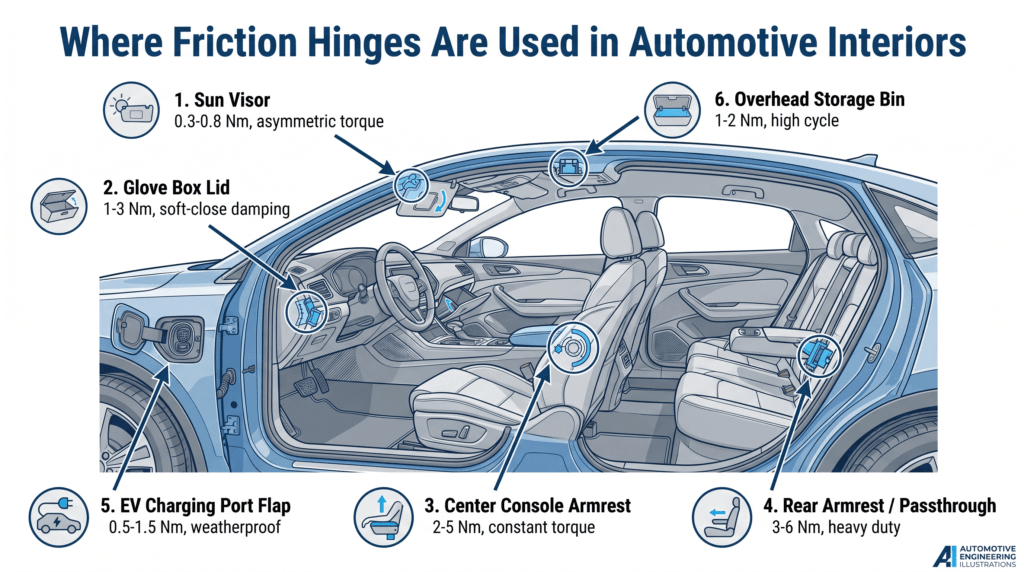
Friction hinges are strategically placed throughout the cabin to provide smooth, rattle-free motion control.
1. The Center Console Armrest
This is the most frequently interacted-with compartment in the car. A heavy, leather-wrapped armrest lid requires a robust center console hinge (typically 2 to 5 Nm of torque) to hold it open at any angle. This allows the driver to reach into the deep storage bin with one hand without the heavy lid falling on their wrist.
2. The Sun Visor
Have you ever wondered how a sun visor can easily flip down, yet never droop while you are driving over potholes? It relies on a specialized, compact friction hinge. These hinges often utilize asymmetric torque—meaning they provide high resistance against gravity (to prevent drooping) but lower resistance when the driver intentionally pushes the visor up or down.
3. The Glove Box
While some glove boxes use rotary dampers for a soft-open effect, many modern EV architectures use friction hinges to provide a deliberate, smooth resistance throughout the entire opening and closing arc, giving the door a “weighted,” expensive feel.
4. Rear Seat Passthroughs and Fold-Down Armrests
The heavy center armrest in the rear seat needs to stay securely stowed when not in use, and hold firmly horizontally when folded down. Heavy-duty friction hinges prevent the armrest from slamming down during hard braking.
5. Overhead Storage Bins (Sunglass Holders)
These small compartments require precise, low-torque friction hinges (usually 1 to 2 Nm) to ensure they open smoothly and do not rattle against the roof liner.
6. EV Charging Port Flaps (Exterior)
While technically on the exterior, the EV charging port flap is a critical user touchpoint. Unlike traditional gas caps that flap in the wind, premium EVs use weatherproof stainless steel friction hinges to hold the heavy, motorized charging port door open at a precise angle while the user plugs in the cable. Discuss more on Whatsapp
Specifying Automotive Friction Hinges: A Quick Guide
If you are an interior trim engineer or a Tier 1 automotive supplier, selecting the right hinge is critical for passing OEM validation testing.
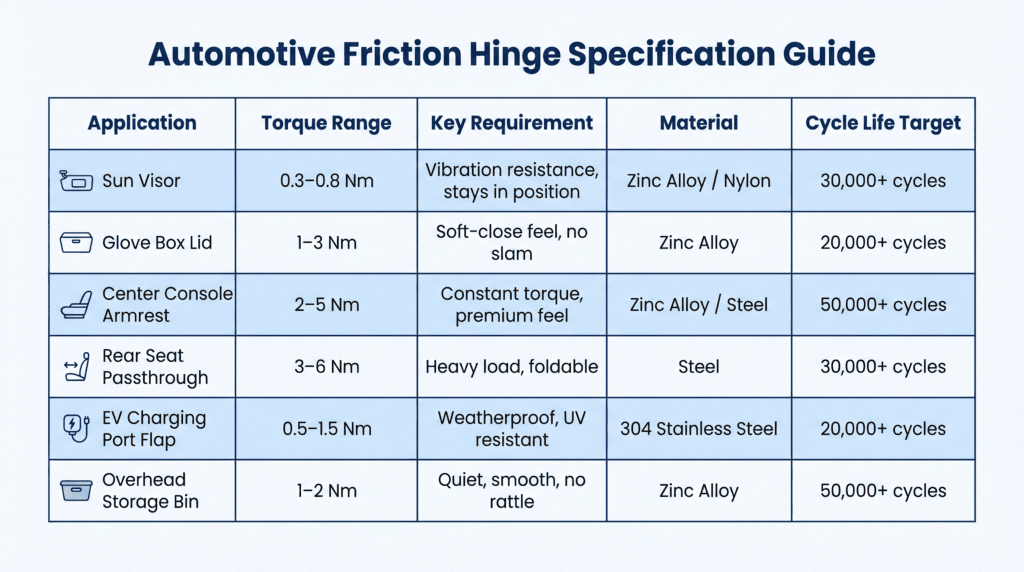
Matching the torque range and material to the specific interior application is critical for passing OEM validation.
When evaluating a hinge for an automotive application, cycle life is paramount. A center console hinge must typically survive a minimum of 50,000 open/close cycles with less than 15% torque decay. Furthermore, the hinge must pass stringent automotive salt spray tests (for corrosion) and off-gassing tests (to ensure the internal lubricants do not emit VOCs that cause “new car smell” window fogging).
The Future of EV Interiors: More Screens, More Hinges
As the industry transitions to Electric Vehicles and autonomous driving, the car interior is fundamentally changing. Without a massive transmission tunnel, EV designers are creating floating center consoles, fold-out tray tables for laptops, and massive rotating infotainment screens.
Every one of these moving parts requires precision position control. A fold-out work table in a luxury EV must be held perfectly level by a heavy-duty friction hinge, capable of supporting the weight of a laptop and the driver’s resting arms.
The friction hinge is no longer just a piece of hardware; it is a critical enabler of the modern, flexible automotive interior.
At JAN Hinge, we engineer high-performance friction hinges and rotary dampers for Tier 1 automotive suppliers and OEM manufacturers worldwide. Our engineering team understands the rigorous demands of PPAP (Production Part Approval Process) and automotive NVH standards. Whether you are designing a next-generation EV center console or a heavy-duty fold-out tray table, contact our engineering team today to discuss custom torque profiles and request validation samples. Discuss more on Whatsapp
Frequently Asked Questions (FAQ)
Q1: Why does my car’s center console lid squeak when I open it?
A squeaking center console is usually a sign that the internal lubrication of the friction hinge has dried out or failed, often due to extreme cabin temperatures over many years. In some cases, dust or debris has contaminated the friction bands. The hinge mechanism typically needs to be replaced, as applying external oil will destroy its holding torque.
Q2: What is “asymmetric torque” in a sun visor hinge?
Asymmetric torque means the hinge provides different levels of resistance depending on the direction of movement. For a sun visor, the hinge is engineered to have high resistance when moving downward (to fight gravity and prevent drooping over bumps) but lower resistance when being pushed back up to the roof liner, making it easier for the driver to stow.
Q3: Do automotive friction hinges require maintenance?
No. High-quality automotive friction hinges are designed to be “maintenance-free” for the life of the vehicle. They are sealed units packed with proprietary lifetime damping grease. Attempting to lubricate a friction hinge with WD-40 or silicone spray will ruin the friction mechanism and cause the door to fall freely.
Q4: Can a friction hinge replace a gas strut on a heavy car part?
For interior components like center consoles or fold-down seats, yes. Friction hinges are preferred over gas struts indoors because they take up less space, never leak gas, and hold the panel at any angle. However, for massive exterior panels like a rear liftgate or hood, gas struts are still required to provide lift assistance, as friction hinges only hold position and do not actively lift weight.
Q5: How do friction hinges improve automotive safety?
During a crash or sudden braking, the G-forces exert massive pressure on interior lids and compartments. Friction hinges provide the necessary holding torque to keep overhead bins, glove boxes, and center consoles firmly shut or locked in their stowed positions, preventing them from flying open and causing injuries.
Designing the next generation of automotive interiors? Reach out to the JAN Hinge technical team for automotive-grade torque calculations and CAD models. Discuss more on Whatsapp