
For many years, hardware engineers discussing friction hinges have invariably focused on laptops. Laptop hinges were once the gold standard for position control, requiring a perfect balance between torque retention and smooth one-handed opening and closing.
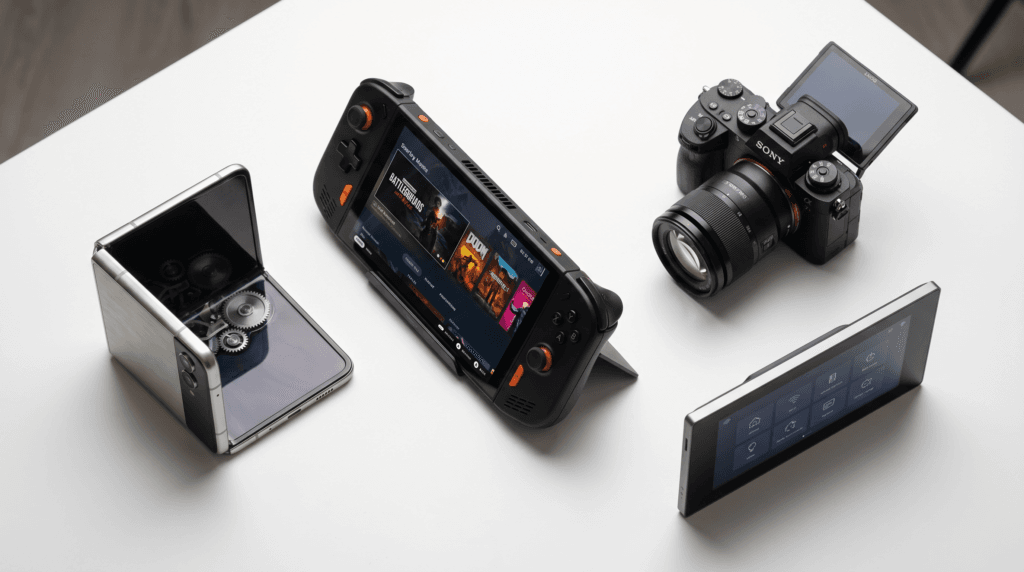
But today, the landscape of consumer electronics has expanded far beyond clamshell laptops. Devices are becoming increasingly smaller, screens can bend, and users expect top-quality from every moving part.
Whether it’s a $1,800 foldable smartphone, a high-end handheld gaming console, or a premium camera monitor, modern consumers are extremely sensitive to haptic feedback. If the consumer electronics friction hinge feels loose, stiff, or droops under its own weight, the user immediately perceives the entire device as “cheap.”
This need to provide superior haptic feedback within ever-shrinking device sizes has pushed the engineering of miniature friction hinges (or torque hinges) to their limits. Let’s examine how these tiny mechanical marvels are solving some of the most challenging design problems in the next generation of consumer electronics. Discuss more on Whatsapp
5 Emerging Applications for Micro Friction Hinges
While laptops still consume a massive volume of torque hinges, the real engineering innovation is happening in these five high-growth categories.
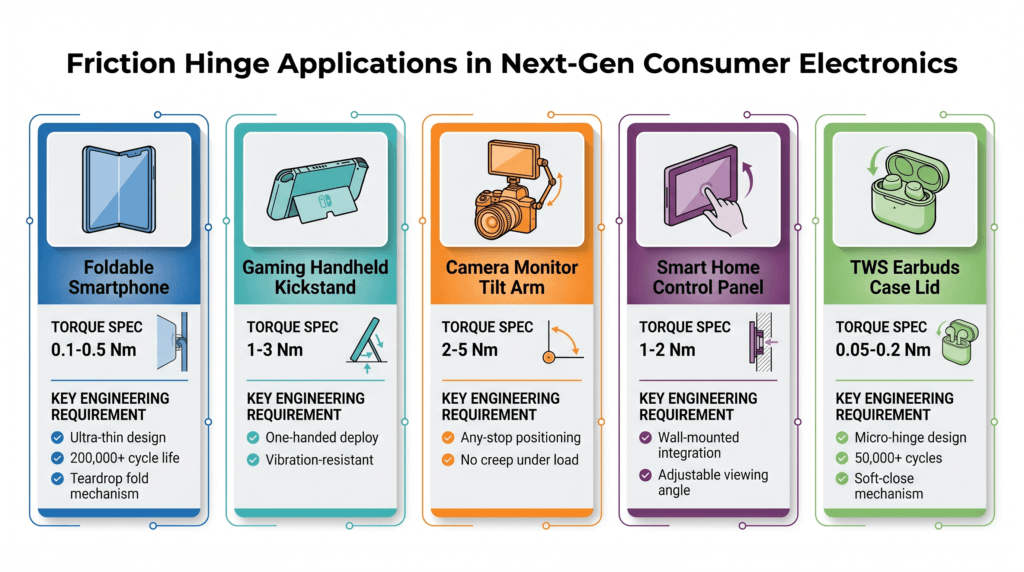
From foldable phones to TWS earbuds, micro friction hinges provide the premium tactile feedback consumers demand.
1. Foldable Smartphones
The hinge is the single most critical, expensive, and heavily engineered component in a foldable phone. Unlike a laptop hinge that rotates around a single axis, a foldable phone hinge often uses a complex “waterdrop” or “teardrop” mechanism. This allows the flexible OLED screen to fold flat without creasing. The friction elements within this mechanism must be microscopic, yet provide enough consistent torque to allow the user to hold the phone open at a 90-degree angle for video calls (often marketed as “Flex Mode”).
2. Gaming Handhelds (Kickstands)
With the rise of portable PC gaming consoles like the Steam Deck, ROG Ally, and Nintendo Switch OLED, gamers have placed higher demands on the ergonomic design of these devices. Simple plastic stands that only fit in one position are no longer sufficient. Modern handheld gaming consoles feature large metal stands equipped with dual friction hinges. This allows players to smoothly adjust the screen to any viewing angle, while the hinges provide enough resistance to prevent the screen from collapsing even with frequent button presses.
3. Professional Camera Monitors (Tilt Arms)
Videographers and vloggers constantly adjust the angle of their external monitors. A standard screw-and-knob mount is slow and frustrating. Today’s premium camera monitor mounts use integrated friction hinges. The photographer can simply grab the monitor and tilt it to the desired angle. The hinge provides high “static torque” to hold the heavy monitor securely in place, even when the camera operator is running or moving the rig aggressively.
4. Smart Home Control Panels
As smart home hubs move from tablet-style devices to permanent wall fixtures, user ergonomics become a challenge. A wall-mounted touchscreen that is flat against the wall is hard to read for people of different heights. Hardware designers are now integrating hidden friction hinges behind the wall mounts, allowing the user to tilt the screen up or down up to 30 degrees for optimal viewing, while keeping the wiring completely concealed.
5. TWS Earbuds Charging Cases
Have you ever noticed how satisfying it is to flick open the lid of a premium pair of wireless earbuds? That premium “snap” and smooth resistance is often achieved using a microscopic friction hinge combined with a magnetic closure. These hinges are incredibly small (often less than 3mm in diameter) but must survive tens of thousands of nervous “fidgeting” cycles by the user.
The 4 Engineering Nightmares of Consumer Electronics
Designing a friction hinge for a heavy industrial door is relatively straightforward. Designing one for a 6mm-thick smartphone is an engineering nightmare. Here is how hinge manufacturers are overcoming the laws of physics.
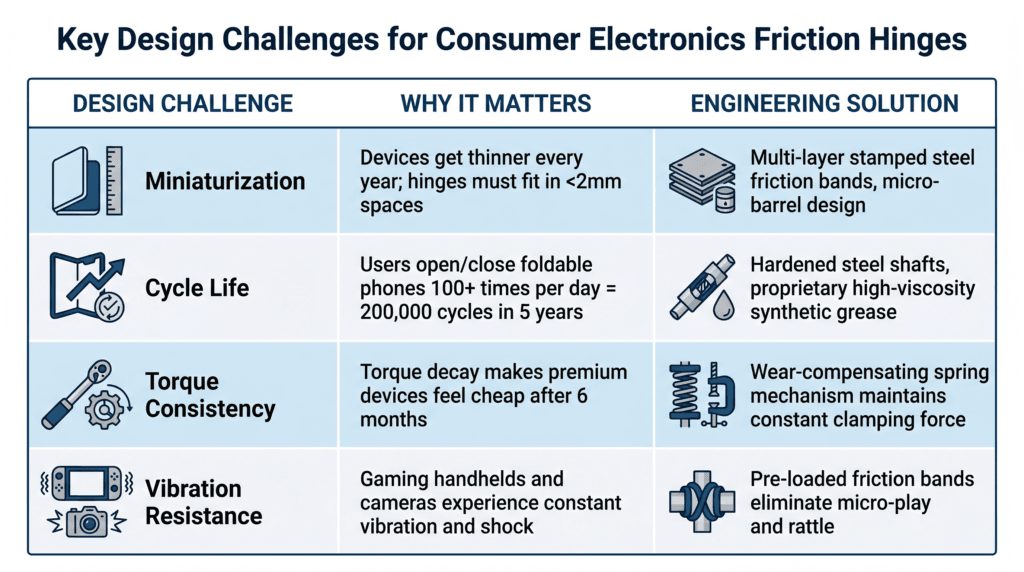
Miniaturization and cycle life are the two biggest hurdles when designing friction hinges for consumer devices. Discuss more on Whatsapp
1. The Miniaturization Paradox
As devices get thinner, the internal space allocated for the hinge shrinks. However, to generate friction, you need surface area. To solve this, engineers use multi-layer stamped steel bands. Instead of one large friction surface, they stack 5 to 10 microscopic, hardened steel rings tightly around a central shaft. This multiplies the friction surface area without increasing the overall diameter of the hinge barrel.
2. The “Torque Decay” Problem
The fastest way to ruin a brand’s reputation is “torque decay”—when a hinge feels stiff out of the box but becomes floppy after six months of use. This happens because the friction bands physically wear down the metal shaft over time. Premium consumer electronics hinges solve this by using wear-compensating spring mechanisms that constantly squeeze the friction bands tighter as the material wears away, maintaining a consistent torque profile for years.
3. Cycle Life Expectations
A laptop might be opened 4 times a day. A foldable phone might be opened 100 times a day. Over a 5-year lifespan, a foldable phone hinge must survive over 200,000 cycles. This requires the use of aerospace-grade hardened steel alloys and proprietary, high-viscosity synthetic greases that do not break down or leak under constant kinetic friction heat.
4. Zero “Spring-Back”
When you adjust a camera monitor to 45 degrees and let go, it should stay at exactly 45 degrees. Cheaper hinges suffer from “spring-back,” where the internal tension causes the hinge to bounce back a few degrees after you release it. Precision micro-hinges use pre-loaded friction elements to eliminate all internal micro-play, ensuring true “any-stop” positioning.
The Tactile Signature of Your Brand
In the hyper-competitive consumer electronics market, the spec sheet only gets you so far. Once a customer picks up your device in a retail store, the physical feel of the moving parts immediately dictates their perception of quality.
A meticulously engineered friction hinge is not just a mechanical connector; it is the tactile signature of your brand.
At JAN Hinge, we specialize in the miniaturization of motion control. Our engineering team designs and manufactures ultra-compact friction hinges and rotary dampers for the world’s leading consumer electronics brands. Whether you are developing a next-generation foldable device, a gaming handheld, or a smart home interface, contact our engineering team today to discuss custom torque profiles and request micro-hinge prototypes.
Frequently Asked Questions (FAQ)
Q1: What is the difference between a friction hinge and a detent hinge in consumer electronics?
A friction hinge (or constant torque hinge) provides smooth, continuous resistance, allowing the user to stop the screen at any angle (infinite positioning). A detent hinge only holds the device at specific, pre-engineered angles (e.g., it clicks into place at 0°, 90°, and 180°). Premium devices increasingly favor friction hinges for better user customization.
Q2: How small can a friction hinge be manufactured?
With modern micro-stamping and precision machining, friction hinges can be manufactured with barrel diameters as small as 3mm to 4mm. These ultra-micro hinges are typically used in TWS earbuds cases, AR/VR headsets, and lightweight smart glasses.
Q3: Can friction hinges be made waterproof for outdoor electronics?
Yes. While the internal friction mechanism itself is sensitive to water and dust, the hinge assembly can be sealed using O-rings, or the entire hinge can be mounted internally within an IP67 or IP68 waterproof chassis, with only the sealed rotating shaft exposed to the elements (commonly seen in action cameras).
Q4: Why do some laptop or handheld screens wobble when I tap the touch screen?
Screen wobble is caused by inadequate “static torque” or micro-play within the hinge mechanism. High-quality friction hinges are engineered with pre-loaded friction bands that eliminate the microscopic gaps between the shaft and the bands, providing a rigid foundation that resists the tapping force of a user’s finger.
Q5: What is “asymmetric torque” and why do gaming handhelds use it?
Asymmetric torque means the hinge is harder to move in one direction than the other. For a gaming handheld kickstand, the hinge provides high resistance when the stand is pushed inward (to prevent the console from collapsing while you play), but lower resistance when you pull the stand outward, making it easy to deploy with one finger.
Need to eliminate screen wobble or improve the tactile feel of your next device? Reach out to the JAN Hinge technical team for custom micro-hinge solutions. Discuss more on Whatsapp