
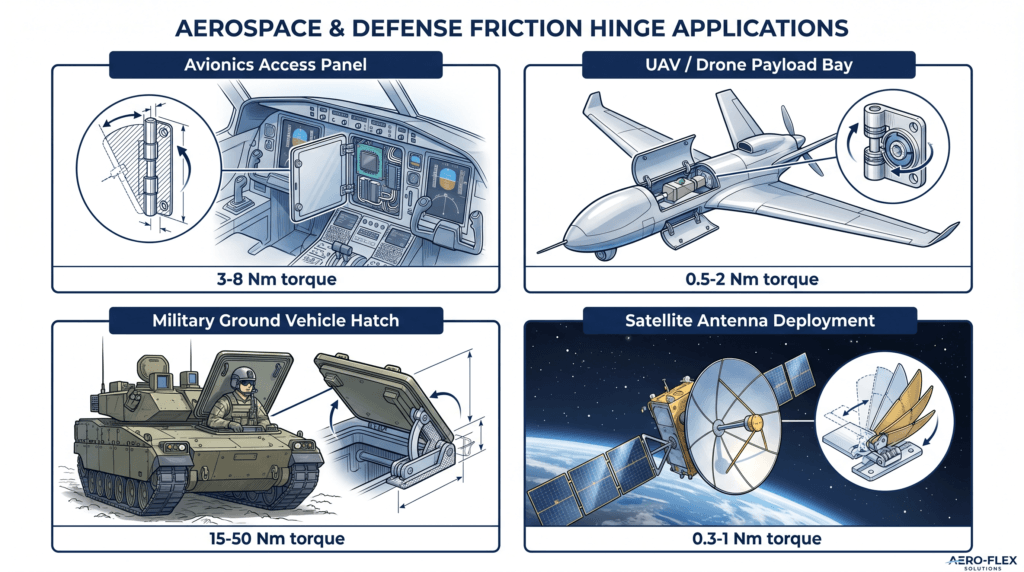
If a friction hinge fails on a laptop, the user gets annoyed and the manufacturer deals with a warranty claim. If a friction hinge fails on an aircraft avionics panel during a high-G maneuver, or on a military ground vehicle hatch in the middle of a combat zone, the consequences are catastrophic.
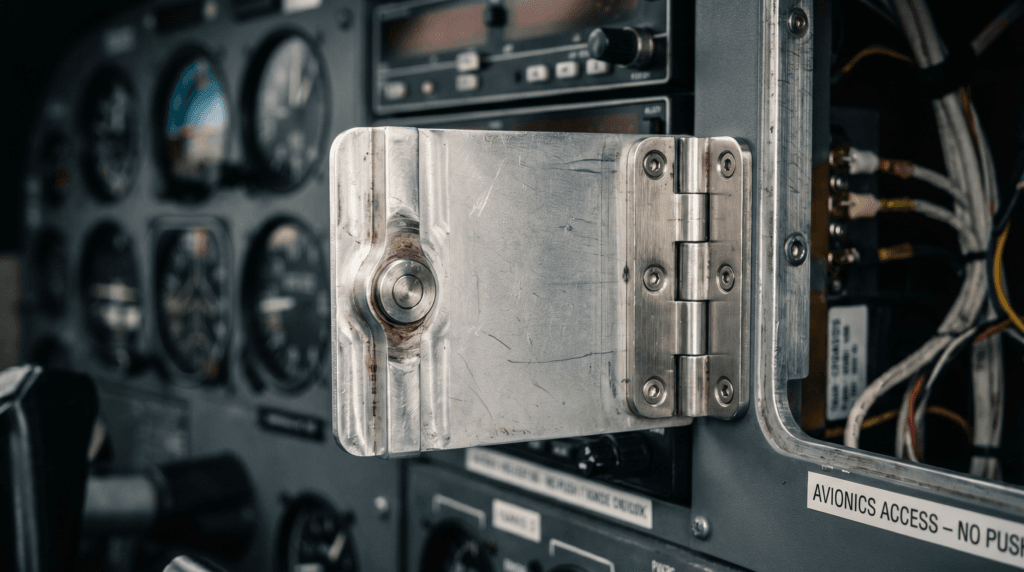
In the aerospace and defense sectors, “mission-critical” is not a marketing gimmick, but a fundamental requirement. Engineers designing for these industries cannot simply order off-the-shelf commercial hardware. They need position control components capable of withstanding extreme temperatures, severe vibrations, and corrosive environments, while maintaining absolute torque consistency over decades of service life.
Let’s unveil the hidden yet crucial world of aerospace and military-grade friction hinges and explore why these tiny mechanical connections require the application of the world’s most advanced metallurgical and tribological technologies. Discuss more on Whatsapp
The Harsh Reality of Aerospace Environments
Standard commercial torque hinges are designed to operate in the comfort, temperature-controlled environment of a living room. However, aerospace hinges must function in extreme environments.
Imagine a drone (UAV) parked on a helipad in the Middle East where temperatures can reach 50°C (122°F). Minutes after takeoff, it climbs to an altitude of 30,000 feet (approximately 9,144 meters), where the ambient temperature plummets to -50°C (-58°F). The mechanical components would suffer severe thermal shock.
In a standard hinge, the varying rates of contraction of the metal components would cause the internal grease to freeze solid, resulting in the hinge completely jamming or the torque dropping to zero, causing the payload bay door to sway precariously in the wind.
To address this, aerospace friction hinges forgo standard zinc alloys and lithium-based greases. Instead, they utilize titanium alloys, 316L stainless steel, or 7075 aluminum alloys for their structural components. More importantly, the friction mechanism uses proprietary dry film lubricants or perfluoropolyether (PFPE) greases that maintain stable viscosity over a wide temperature range (-55°C to +125°C).
4 Critical Applications for Military and Aerospace Torque Hinges
Where exactly are these ultra-high-performance hinges used? While many applications are classified, the core engineering challenges remain consistent across these four primary domains.
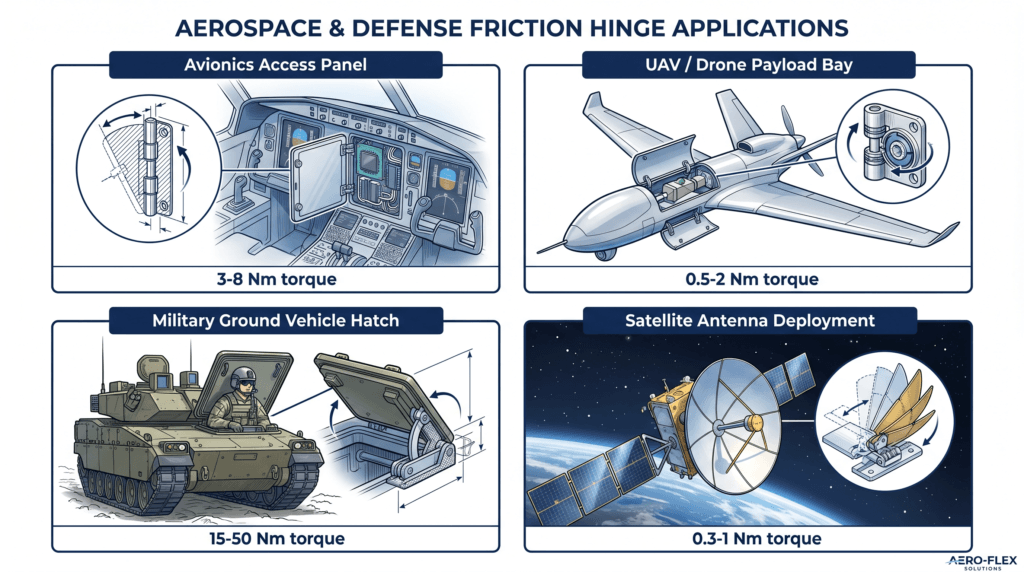
From avionics panels to satellite antennas, military-grade friction hinges must deliver precise torque control in unforgiving environments.
1. Avionics Access Panels and Displays
Inside a fighter jet or commercial airliner cockpit, space is at an absolute premium. Pilots and maintenance crews need to open avionics panels, fold out tactical displays, and access critical wiring without needing a prop rod to hold the heavy metal doors open. A precision friction hinge allows a technician to open a 10-pound panel to exactly 85 degrees and know it will stay exactly there, even while the aircraft engines are causing the entire airframe to vibrate.
2. UAV / Drone Payload Bays
Drones are designed to be as light as possible to maximize flight time. Every gram counts. Engineers cannot afford the weight of complex motorized actuators just to open and close a sensor bay door or a camera gimbal shield. Micro-friction hinges provide a passive, zero-power solution. They hold the doors securely closed during high-speed flight and allow them to be manually opened for quick sensor swaps on the ground.
3. Military Ground Vehicle Hatches
The hatches on armored personnel carriers (APCs) or tanks are incredibly heavy, often lined with ballistic glass or armor plating. If an operator pushes a hatch open, it must stay open. If the vehicle hits an IED or traverses brutal off-road terrain, a loose hatch could slam shut, causing severe injury to the crew. Heavy-duty military friction hinges are engineered to deliver massive holding torque (often exceeding 50 Nm) while surviving the shock and vibration profiles dictated by MIL-STD-810G.
4. Satellite Antenna Deployment
In low Earth orbit, there is no maintenance crew. When a satellite deploys its solar arrays or communication antennas, the hinge mechanism must work perfectly on the first try, in a vacuum, under intense solar radiation. These specialized “space-rated” friction hinges often use cold-welding prevention techniques and specialized dry lubricants to ensure smooth, controlled deployment without the risk of outgassing (which could contaminate sensitive optical sensors). Discuss more on Whatsapp
Standard vs. MIL-SPEC: The Specification Gap
How different is a military-grade friction hinge from the one in your laptop? The gap in engineering specifications is massive.
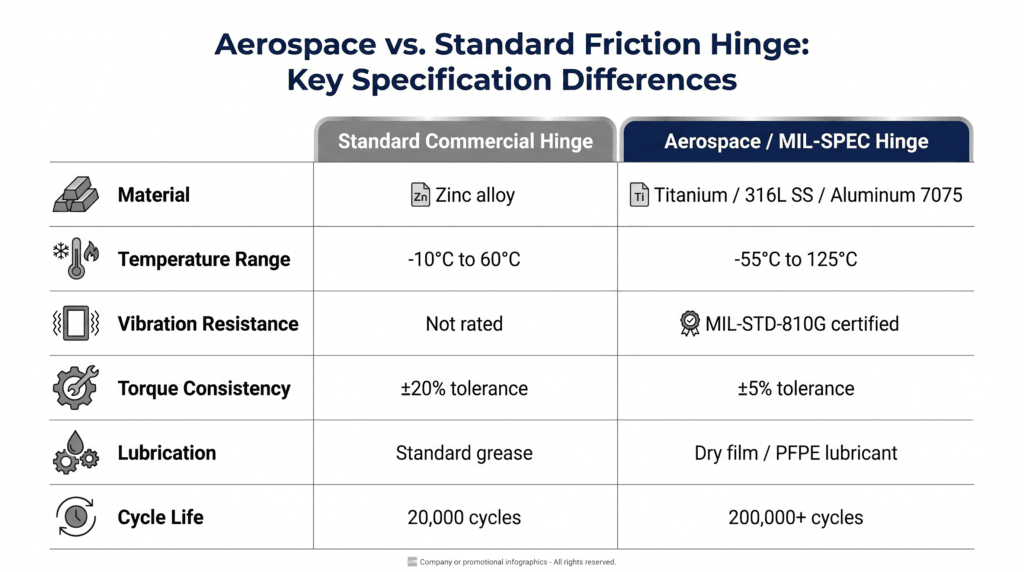
The engineering gap between commercial and aerospace hinges involves exotic materials, extreme temperature ratings, and zero-tolerance vibration resistance.
The most critical difference lies in Vibration Resistance. A commercial hinge relies entirely on static friction. But under high-frequency vibration (like that from a jet turbine or a tank tread), static friction breaks down into kinetic friction, causing standard hinges to lose their grip and “walk” out of position.
Aerospace hinges counter this through a combination of asymmetric torque profiles (making it harder to close than to open) and pre-loaded spring steel bands that maintain a death-grip on the hinge shaft, regardless of external harmonic frequencies.
The Hidden Enemy: Outgassing and Galvanic Corrosion
Beyond torque and temperature, defense engineers must fight two invisible enemies.
1. Outgassing: In the vacuum of space or high-altitude flight, standard plastics and greases release volatile organic compounds (VOCs) as a gas. This gas can condense on expensive optical lenses or sensitive electronics, ruining a multi-million-dollar mission. Aerospace hinges must be manufactured using strictly low-outgassing materials approved by NASA or the ESA.
2. Galvanic Corrosion: When an aircraft operates in a maritime environment (like a Navy fighter jet on an aircraft carrier), the salt spray acts as an electrolyte. If a standard steel hinge is bolted to an aluminum airframe, galvanic corrosion will rapidly destroy the joint. Aerospace hinges must be passivated, anodized, or plated (e.g., Cadmium or Zinc-Nickel) to perfectly match the anodic index of the mounting surface.
Engineering for the Unforgiving
Designing a friction hinge for the aerospace and defense sectors is not about making a product that works; it is about making a product that cannot fail. It requires an obsessive attention to metallurgy, lubrication chemistry, and brutal environmental testing.
If you are an engineer designing avionics panels, UAV payload bays, or ruggedized military hardware, you cannot compromise on position control.
At JAN Hinge, we understand the rigorous demands of extreme environments. Our engineering team has decades of experience designing heavy-duty and precision torque hinges that survive where standard hardware fails. Contact our technical team today to discuss your MIL-SPEC requirements, custom torque profiles, and environmental testing needs. or Discuss more on Whatsapp
Frequently Asked Questions (FAQ)
Q1: What does “MIL-SPEC” mean when referring to a friction hinge?
MIL-SPEC (Military Specification) means the hinge has been designed, manufactured, and tested to meet specific defense standards (such as MIL-STD-810 for environmental engineering). This typically involves surviving extreme temperature shock, salt fog corrosion, and high-frequency vibration without a loss of holding torque.
Q2: Can a friction hinge survive the vibration of a helicopter or tank?
Yes, but it requires specific engineering. High-vibration environments cause standard friction to break down. Aerospace-grade hinges use pre-loaded spring bands and specialized dampening greases to maintain static friction even under severe harmonic resonance, preventing the hinge from “walking” or drifting out of position.
Q3: Why are standard lubricants not used in aerospace hinges?
Standard lithium or silicone greases freeze solid at high altitudes (-50°C) and melt at high engine temperatures. Furthermore, in a vacuum, standard greases “outgas,” releasing vapors that can blind optical sensors. Aerospace hinges use dry-film lubricants (like PTFE) or advanced Perfluoropolyether (PFPE) greases.
Q4: How do engineers prevent a heavy military hatch from slamming shut?
For heavy hatches, engineers often use an asymmetric friction hinge. This type of hinge provides low resistance when opening the hatch (making it easy for the soldier to push up), but extremely high resistance when closing it (preventing gravity or a sudden jolt from slamming it shut).
Q5: Are aerospace friction hinges heavier than standard hinges?
Not necessarily. While ground vehicle hinges are heavy-duty, UAV and satellite hinges are engineered for extreme weight reduction. By using materials like Titanium or aircraft-grade Aluminum 7075, manufacturers can create ultra-lightweight micro-hinges that still deliver high torque.
Need a torque hinge that won’t fail at 30,000 feet? Explore our custom engineering solutions and let’s build something mission-critical. Discuss more on Whatsapp