
In the fast-paced world of hardware engineering, off-the-shelf components rarely meet the exacting demands of cutting-edge product design. Whether you are developing a revolutionary foldable smartphone, a life-saving medical diagnostic device, or a high-performance commercial drone, the tactile feedback and mechanical stability of your product are paramount. This is where the true value of custom motion control engineering comes into play.
For procurement teams and lead engineers, the journey from a conceptual CAD drawing to a mass-produced, flawless rotary damper or friction hinge is fraught with technical challenges. Janhinge, a specialized OEM/ODM manufacturer with over 21 years of experience, has guided thousands of clients through this exact process. This article explores the critical phases of custom motion control development, highlighting how specialized engineering partnerships accelerate innovation in high-tech industries. Discuss more on Whatsapp.
The OEM Development Lifecycle for Motion Control
Creating a custom rotary damper or friction hinge is not merely about altering physical dimensions; it is about engineering a specific mechanical “feel” and ensuring absolute reliability under unique environmental stresses. The development lifecycle typically follows a rigorous, multi-stage process.
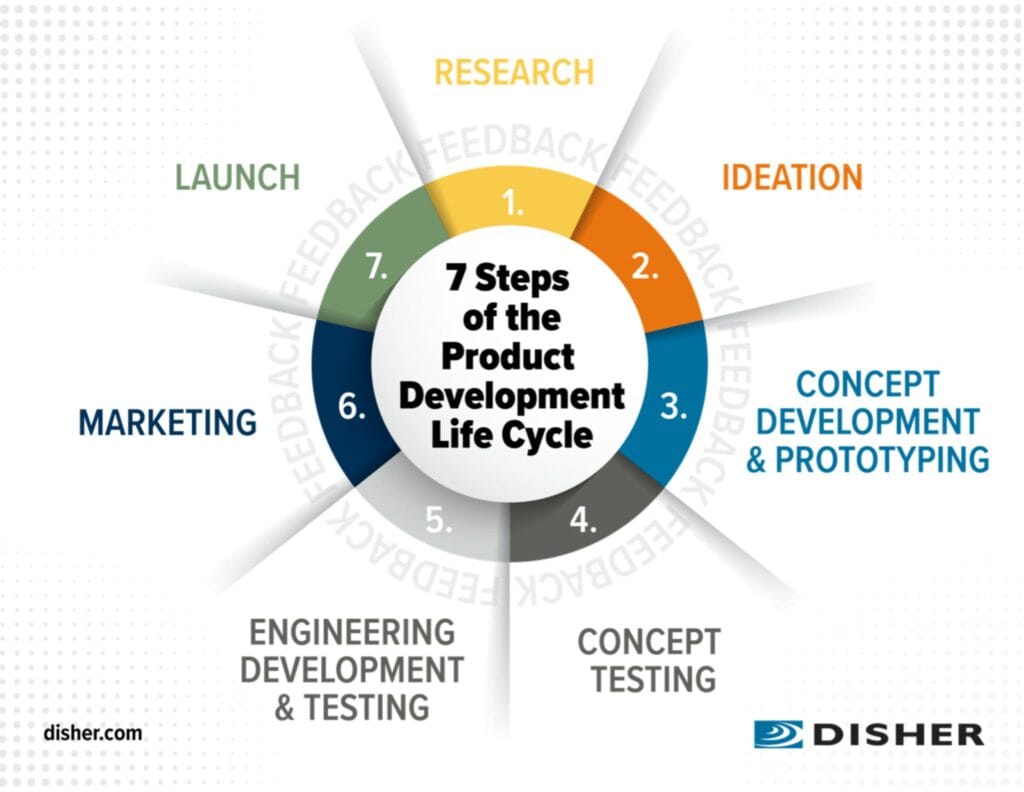
Figure 1: The typical OEM product development lifecycle, from initial ideation to mass production.
Phase 1: Requirements Gathering and Feasibility Analysis
The process begins with a deep dive into the application’s mechanical requirements. Engineers must define several critical parameters before any design work begins:
•Load and Center of Gravity: What is the exact weight of the moving component (e.g., a heavy medical monitor or a lightweight drone arm), and where is its center of gravity relative to the hinge axis?
•Torque Profile: Does the application require constant torque throughout the rotation, or a variable profile (e.g., high resistance at the beginning, dropping to zero at the end)?
•Spatial Constraints: What is the maximum allowable envelope for the hinge or damper housing?
•Environmental Factors: Will the component be exposed to extreme temperatures, high humidity, or corrosive chemicals?
During this phase, Janhinge’s engineering team collaborates directly with the client to determine if the requested torque is physically achievable within the specified spatial constraints using available materials.
Phase 2: 3D CAD Modeling and Structural Optimization
Once the parameters are established, the design moves into the digital realm. Engineers utilize advanced 3D CAD software to model the internal components—such as the rotor, vanes, friction plates, and spring washers.
For friction hinges, structural optimization is critical. The design must ensure that the Belleville washers provide uniform compression across the friction plates without exceeding the yield strength of the housing material. For rotary dampers, fluid dynamics must be considered to ensure the silicone oil flows smoothly through the throttling channels without cavitation.
Phase 3: Rapid Prototyping and Tactile Validation
A digital model cannot convey the tactile “feel” of a soft-close mechanism or the precise resistance of a position-hold hinge. Therefore, rapid prototyping is essential.
Using CNC machining, powder metallurgy, or 3D printing (for non-load-bearing housings), Janhinge produces physical prototypes—often within 20 days. These samples are sent to the client for tactile validation. This is the moment where the product design team physically interacts with the component, assessing whether the opening force is too stiff, or if the soft-close action is too slow. Adjustments to the internal fluid viscosity or spring compression are made iteratively based on this feedback.
High-Tech Applications Driving Customization
The demand for custom OEM motion control solutions is largely driven by three rapidly advancing sectors: consumer electronics, medical devices, and unmanned aerial vehicles (UAVs).
1. Consumer Electronics: The Foldable Revolution
The advent of foldable smartphones and dual-screen laptops has pushed friction hinge technology to its absolute limits. These devices require hinges that are incredibly thin (often less than 4mm in diameter) yet capable of providing enough torque to hold a screen steady at any angle.

Figure 2: Foldable smartphones require ultra-miniature, high-precision friction hinges to maintain screen stability.
Furthermore, these hinges must survive tens of thousands of folding cycles without any noticeable degradation in torque or “wobble.” This requires custom-engineered micro-friction plates, often manufactured using advanced metal injection molding (MIM) techniques, and specialized synthetic greases that will not dry out over the lifespan of the device.
2. Medical Equipment: Precision and Hygiene
In the medical field, motion control components are not just about luxury; they are about safety and precision. Diagnostic monitors, surgical lighting arms, and adjustable hospital beds rely heavily on custom friction hinges and rotary dampers.

Figure 3: Rotary dampers integrated into hospital bed rails ensure silent, controlled movement, enhancing patient comfort and safety.
Medical applications often require components made entirely of high-grade stainless steel (such as SUS316) to withstand harsh chemical sterilization processes. Additionally, the torque tolerances are exceptionally tight. A surgical monitor arm must move smoothly with a light touch but stop instantly and hold its position with zero drift, requiring highly customized, dual-axis friction hinges.
3. UAVs and Robotics: High Strength-to-Weight Ratios
Commercial drones and industrial robots require folding arms for portability and deployment. The hinges connecting these arms must be lightweight, yet capable of withstanding immense vibrational forces and torque loads during flight or operation.

Figure 4: Heavy-duty, lightweight torque hinges are critical for the folding arms of commercial UAVs and drones.
Custom OEM solutions for UAVs often involve hybrid material designs—such as aerospace-grade aluminum housings paired with hardened steel internal shafts. The friction mechanisms must be engineered to lock securely into place, ensuring the drone’s geometry remains perfectly rigid in high winds.
The OEM Testing Protocol: Ensuring Reliability
The final phase of custom OEM development is rigorous, documented testing. A custom rotary damper or friction hinge is only as good as its ability to perform consistently over its intended lifespan.

Figure 5: Precision torque testing equipment is used to verify the performance of rotary dampers and friction hinges.
For procurement professionals, demanding a comprehensive testing report is non-negotiable. Leading manufacturers like Janhinge employ a multi-tiered testing protocol:
1.Initial Torque Verification: Every prototype is tested on a precision torque meter to ensure it falls within the specified tolerance (e.g., ±10% of the target torque).
2.Accelerated Lifecycle Testing: The component is subjected to continuous, automated opening and closing cycles. For consumer electronics, this may be 20,000 cycles; for automotive or medical applications, it often exceeds 50,000 cycles. The torque is measured at regular intervals to plot the decay curve.
3.Environmental Stress Screening: The component is placed in an environmental chamber and subjected to extreme temperature cycling (e.g., -40°C to +85°C) to verify the stability of the silicone oil and the integrity of the elastomer seals. Salt spray testing is also conducted to ensure the metal components resist corrosion.
4.Destructive Testing: In some cases, components are pushed beyond their design limits to determine their ultimate failure point, providing engineers with valuable data on the safety margin.
Only after a custom design passes all these tests is it approved for mass production.
Frequently Asked Questions (FAQs)
Q1: How long does it typically take to develop a custom rotary damper or friction hinge?
The timeline varies depending on the complexity of the design. However, an experienced OEM manufacturer like Janhinge can often move from initial CAD drawings to physical, testable prototypes within 20 to 30 days. Mass production typically follows 4 to 6 weeks after prototype approval.
Q2: What information do I need to provide to get a custom quote?
To provide an accurate quote and feasibility analysis, engineers need the following: 1) The weight and dimensions of the moving component (e.g., a lid or screen), 2) The distance from the hinge axis to the component’s center of gravity, 3) The desired opening/closing angle, 4) The required lifecycle (e.g., 50,000 cycles), and 5) Any spatial constraints or environmental requirements. Providing a 2D drawing or 3D CAD model of your product’s housing is highly recommended.
Q3: Can a custom friction hinge be designed to have different torque in different directions?
Yes. This is known as an asymmetric (or unidirectional) torque hinge. It is commonly used in applications where a heavy lid needs to be lifted easily (low torque) but must not fall shut on its own (high torque). The internal friction plates and spring washers are engineered to provide differential resistance based on the direction of rotation.
Q4: What materials are best for medical or sanitary applications?
For medical diagnostic equipment, hospital beds, and sanitary ware, corrosion resistance and hygiene are paramount. The housings and internal shafts of rotary dampers and friction hinges should be manufactured from high-grade stainless steel (such as SUS304 or SUS316) or specialized engineering plastics (like PBT or POM) that can withstand harsh chemical cleaning agents without degrading.
Q5: Why should I choose an OEM manufacturer over buying off-the-shelf components?
Off-the-shelf components are designed for general use and rarely provide the precise tactile feel or exact dimensions required for premium products. Partnering with an OEM manufacturer like Janhinge allows you to customize the torque profile, optimize the physical footprint, and ensure the component is rigorously tested for your specific application, ultimately enhancing your product’s quality and brand value. Contact Janhinge’s engineering team to discuss your custom project. Discuss more on Whatsapp.
Conclusion
The development of custom motion control components is a complex but highly rewarding engineering endeavor. By moving beyond standard, off-the-shelf solutions, product designers can achieve the exact tactile response, mechanical stability, and long-term reliability required for premium consumer electronics, critical medical devices, and advanced robotics.
Navigating the OEM development lifecycle—from initial feasibility analysis and 3D CAD modeling to rapid prototyping and rigorous lifecycle testing—requires a specialized manufacturing partner. With over two decades of expertise, Janhinge provides the engineering capabilities, material science knowledge, and testing infrastructure necessary to turn your conceptual designs into flawless, mass-produced reality.
The Strategic Value of Early Supplier Involvement (ESI)
One of the most common pitfalls in hardware development is treating motion control components as an afterthought. Engineers often design the entire product housing and then attempt to find a rotary damper or friction hinge that fits the remaining space. This approach frequently leads to compromised performance, as the available space may be too small to accommodate a component with the required torque or lifecycle durability.
To avoid this, procurement teams and lead engineers should embrace Early Supplier Involvement (ESI). By engaging an OEM manufacturer like Janhinge during the initial conceptual phase (Phase 1), the product design can be optimized around the ideal motion control solution, rather than the other way around.
Benefits of ESI in Motion Control:
•Optimized Spatial Planning: Janhinge engineers can provide 3D CAD models of the optimal hinge or damper early in the design process, ensuring the product housing is designed with adequate space for the component and its mounting hardware.
•Cost Reduction: Customizing a component early is significantly cheaper than redesigning a product housing late in the development cycle because an off-the-shelf hinge doesn’t fit or perform adequately.
•Enhanced Performance: By understanding the application’s exact load, center of gravity, and environmental requirements from day one, the manufacturer can engineer a solution that delivers the perfect tactile feel and maximum longevity.
•Faster Time-to-Market: ESI streamlines the prototyping and testing phases, as the initial custom design is much closer to the final production requirement, reducing the number of iterative design loops.
In the highly competitive landscape of modern hardware manufacturing, the tactile experience of your product is a key differentiator. By leveraging the expertise of a specialized OEM partner early in the development cycle, you can ensure that every interaction with your product conveys a sense of premium quality and absolute reliability.