
Have you ever opened a high-end laptop and marveled at how the screen stays exactly where you leave it, no matter the angle? Or perhaps you’ve adjusted a heavy medical monitor arm with just two fingers, only for it to lock solidly in place the moment you let go. It feels like magic, but as engineers, we know it’s something much more precise: the friction hinge.
Also known as torque hinges or position control hinges, these unassuming mechanical components are the unsung heroes of modern product design. While standard free-swinging hinges simply connect two parts, friction hinges dictate how those parts interact. They provide the resistance needed to hold lids, screens, and panels at any desired angle, eliminating the need for gas struts, prop rods, or secondary locking mechanisms.
At Janhinge, we’ve spent years perfecting the art of motion control. Today, I want to take you behind the scenes to explore the engineering nuances of friction hinges. We’ll look at how they work, why asymmetric torque is a game-changer, and how to select the right hinge for your next OEM project. Discuss more on Whatsapp.
The Mechanics of Position Control: How Friction Hinges Work
At its core, a friction hinge relies on a very simple principle: mechanical interference. Unlike rotary dampers which use fluid resistance (like silicone oil) to slow down motion, friction hinges use the physical rubbing of internal components to generate holding torque.
Inside the hinge barrel, a series of friction bands, spring steel clips, or stacked friction disks are tightly wrapped around a central shaft. As you try to rotate the hinge, these internal components grip the shaft, creating resistance.
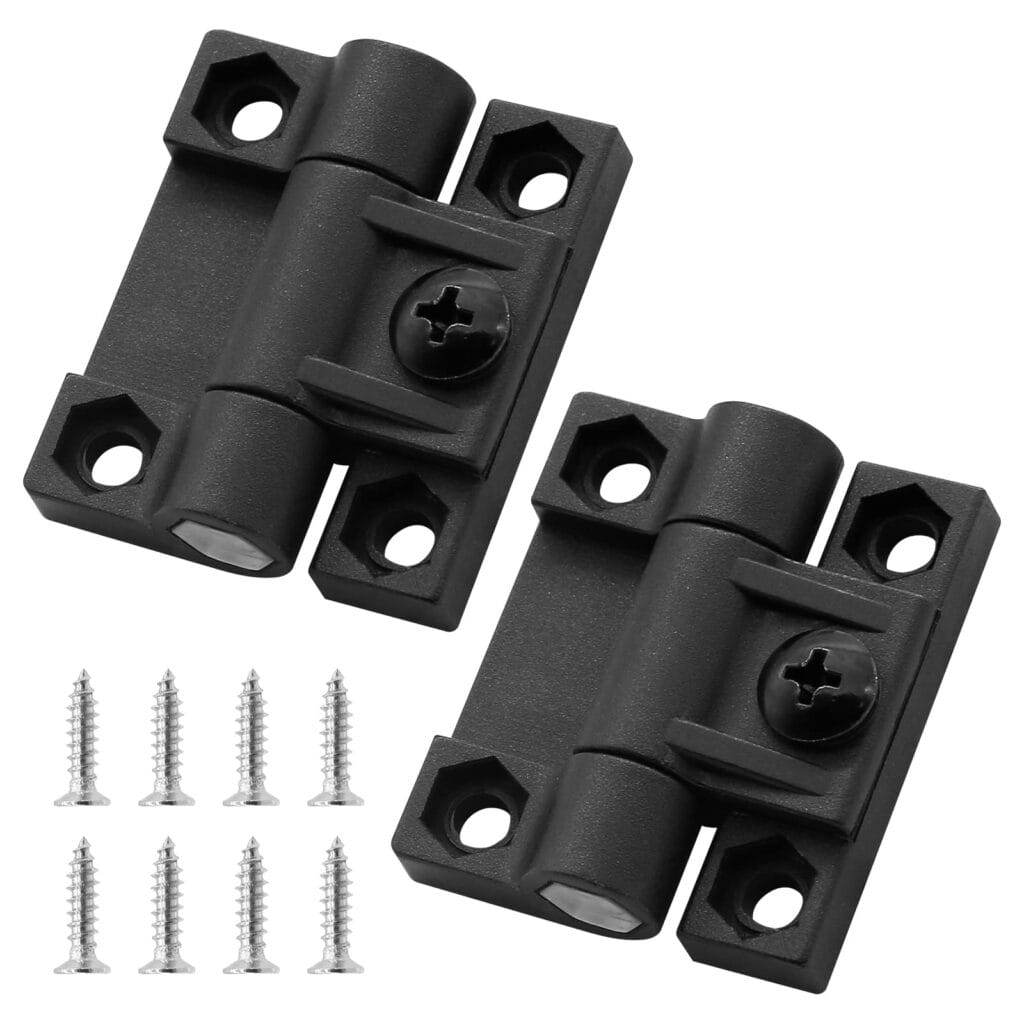
A standard adjustable friction hinge, designed to provide consistent holding torque across its entire range of motion.
The “Stiction” Challenge
One of the biggest engineering hurdles in designing a friction hinge is overcoming “stiction” (static friction). Static friction is the force required to start moving an object, while dynamic friction is the force required to keep it moving.
In poorly designed hinges, the static friction is significantly higher than the dynamic friction. This results in a “jerky” or “sticky” feel when the user first tries to move the panel. Premium friction hinges, like those manufactured by Janhinge, use specialized greases and proprietary friction materials to bring the static and dynamic friction coefficients as close together as possible. This ensures a buttery-smooth, premium feel from the very first degree of rotation.
Asymmetric Torque: The Secret to Ergonomic Design
If you’re designing a heavy lid—say, for an industrial control panel or a deep freezer—you face a unique ergonomic challenge. You need high torque to hold the heavy lid open against the force of gravity. But if the hinge has high torque in both directions, the user will have to fight the hinge just to lift the lid in the first place.
Enter the asymmetric torque hinge.
Asymmetric hinges are engineered to provide different levels of resistance depending on the direction of rotation. For example, a hinge might offer 5.0 N·m of resistance when closing (to prevent the heavy lid from slamming shut) but only 1.5 N·m of resistance when opening (making it easy for the user to lift).
How Asymmetric Torque is Achieved
This directional bias is typically achieved using a one-way clutch mechanism or directional friction bands. When rotating in the “easy” direction, the internal bands slightly uncoil, reducing their grip on the shaft. When rotating in the “hard” direction, the bands tighten, increasing the friction.
This technology is absolutely critical in applications like:
•Overhead Storage Bins: Easy to push up, but stays firmly in place.
•Heavy Industrial Enclosures: Prevents operator fatigue while ensuring safety.
•Medical Centrifuges: Allows lab technicians to open heavy lids with one hand.

Constant torque hinges can be engineered with asymmetric profiles to improve user ergonomics on heavy panels.
Detent Hinges: Adding Tactile Feedback to Motion Control
While standard friction hinges offer infinite positioning (meaning they hold at any angle), some applications require the panel to snap into specific, predefined positions. This is where detent hinges come into play.
A detent hinge combines the holding power of a friction hinge with a mechanical “click” at specific angles—commonly 0°, 90°, 120°, or 180°.
The Engineering Behind the “Click”
Inside a detent hinge, the central shaft features machined grooves or flats. A spring-loaded ball bearing or cam follower rides along the shaft as it rotates. When the follower hits a groove, it drops in, locking the hinge in place with a satisfying tactile click. To move the hinge out of the detent position, the user must apply a slightly higher initial force to push the follower out of the groove.

Detent hinges feature internal cam mechanisms that lock the hinge at predefined angles, providing tactile feedback to the user.
Detent hinges are incredibly popular in:
•Fold-down seating in marine and automotive applications.
•Service access panels that need to lock fully open during maintenance.
•Adjustable lighting fixtures that require specific aiming angles.
Material Selection: Balancing Cost, Weight, and Durability
When selecting a friction hinge for your project, the material of the hinge body and internal components is just as important as the torque rating. The right material ensures the hinge will survive its intended environment—whether that’s a sterile hospital room or a corrosive marine deck.
1. Zinc Alloy Die-Casting
Zinc alloy is the workhorse of the friction hinge world. It’s incredibly strong, relatively inexpensive, and can be die-cast into complex shapes with tight tolerances. Zinc hinges are typically powder-coated or electroplated to improve corrosion resistance. They are the go-to choice for heavy-duty industrial enclosures, server racks, and robust medical carts.
2. Stainless Steel (SUS304 / SUS316)
For applications where hygiene or extreme corrosion resistance is paramount, stainless steel is the only option. SUS304 is standard for food processing equipment and outdoor kiosks, while SUS316 (marine grade) is required for saltwater environments or harsh chemical exposure. Stainless steel friction hinges are more expensive to manufacture due to the difficulty of machining the material, but their longevity in harsh conditions is unmatched.
3. Engineered Plastics (POM / PC / Nylon)
When weight reduction is critical—such as in aerospace interiors, lightweight consumer electronics, or portable medical devices—engineered plastics are used. Polyoxymethylene (POM), commonly known as Delrin, is frequently used for internal friction components because of its excellent wear resistance and low coefficient of friction. Plastic hinges are often reinforced with glass fibers to increase their structural rigidity.

Miniature friction hinges used in laptops and tablets often combine high-strength steel shafts with engineered plastic housings to save weight.
360-Degree Rotation: The Ultimate Flexibility
Most standard hinges are designed to open to 180 degrees or less. But what if your application requires a screen to flip entirely around, like a 2-in-1 convertible laptop or a dual-sided point-of-sale (POS) terminal?
This requires a 360-degree friction hinge.
These specialized hinges use a dual-axis design. Instead of a single central shaft, they feature two parallel shafts connected by a central linkage. As the user rotates the panel, the first shaft handles the initial 180 degrees of motion, and the second shaft takes over for the remaining 180 degrees.

Dual-axis 360-degree friction hinges allow screens to fold completely flat against the back of the device, enabling “tablet mode” in convertible laptops.
Designing a 360-degree hinge is incredibly complex. The torque on both shafts must be perfectly synchronized so the motion feels continuous and smooth to the user, without any “dead zones” or sudden drops in resistance as the load transfers from one shaft to the other.
The Hidden Costs of Poor Hinge Selection
While it might be tempting to specify a generic, low-cost friction hinge for your project, the long-term consequences can be severe. A hinge that fails prematurely or loses its holding torque over time doesn’t just result in a floppy screen or a falling lid—it damages your brand’s reputation.
1. Warranty Claims and Field Replacements
If a hinge loses its torque after just 5,000 cycles, the lid it supports will no longer stay open. In a medical environment, a falling monitor could damage expensive equipment or, worse, injure a patient. In consumer electronics, a laptop screen that won’t stay upright renders the device unusable. The cost of dispatching a technician to replace a $2 hinge in the field can easily exceed $200 in labor and logistics, completely wiping out any initial cost savings.
2. User Frustration and Brand Perception
As mentioned earlier, the hinge is often the primary physical touchpoint between the user and the device. If the hinge feels “gritty,” squeaks during operation, or requires excessive force to move, the user will subconsciously associate those flaws with the overall quality of the product. A premium device demands a premium feel, and that feel is entirely dependent on the engineering of the friction hinge.
3. Assembly Line Inefficiencies
Cheap hinges often suffer from poor batch-to-batch consistency. If the torque variance between hinges is too high, your assembly line workers will struggle to install them correctly. Some lids will be too stiff, while others will be too loose, leading to high rejection rates during end-of-line quality control testing. Partnering with a manufacturer like Janhinge ensures that every hinge delivered to your facility has been 100% torque-tested for consistency, streamlining your assembly process. Discuss more on Whatsapp.
Frequently Asked Questions (FAQs)
1. How do I calculate the required torque for a friction hinge?
To calculate the required torque (T), you need to know the weight of the panel (W) and the distance from the hinge axis to the panel’s center of gravity (L). The formula is T = W × L. Always add a safety factor of 20-30% to account for manufacturing tolerances and long-term wear.
2. Can friction hinges be adjusted after installation?
Yes, many friction hinges feature an adjustable set screw. By tightening or loosening this screw, you can increase or decrease the pressure on the internal friction bands, allowing you to fine-tune the holding torque in the field. However, constant-torque hinges (which are pre-set at the factory) cannot be adjusted.
3. What is the typical lifespan of a friction hinge?
A high-quality friction hinge from a reputable manufacturer like Janhinge is typically tested to withstand 20,000 to 50,000 open/close cycles with less than a 15% drop in holding torque. Discuss more on Whatsapp.
4. Why does my friction hinge squeak when I move it?
Squeaking is usually a sign of “stiction” or poor lubrication between the internal friction components. It can also occur if the hinge is overloaded beyond its rated torque capacity. Premium hinges use specialized damping greases to eliminate noise and ensure smooth operation.
5. Can I use a friction hinge outdoors?
Yes, but you must select the right material. Zinc alloy hinges with a high-quality powder coat can survive mild outdoor conditions, but for true weatherproofing, you should specify SUS304 or SUS316 stainless steel hinges to prevent rust and degradation.
Conclusion: Engineering the Perfect Feel
A friction hinge is rarely the focal point of a product’s marketing campaign, but it is often the very first thing a user interacts with. Whether it’s the satisfying resistance of a premium laptop screen, the effortless lift of a heavy industrial lid, or the precise positioning of a medical monitor, the hinge dictates the “feel” of the entire device.
At Janhinge, we specialize in engineering that perfect feel. From standard adjustable torque hinges to custom asymmetric and 360-degree designs, our team is ready to help you solve your toughest motion control challenges.
If you’re struggling with a heavy lid, a floppy screen, or a hinge that just doesn’t feel “right,” contact our engineering team today. Let’s build something exceptional together.