
When designing a product that requires a screen, lid, or panel to hold its position at any angle, engineers inevitably turn to friction hinges. Also known as torque hinges or position control hinges, these mechanical marvels are the unsung heroes of modern hardware. From the satisfying stiffness of a premium laptop screen to the rugged reliability of an industrial control panel, the quality of the user experience rests entirely on the hinge.
However, finding a reliable friction hinge supplier is notoriously difficult. Unlike simple free-swinging hinges, torque hinges are precision-engineered components. A slight deviation in manufacturing tolerances or material selection can result in a hinge that is either too stiff to move or too weak to hold its position.
In this comprehensive guide, we will explore what separates a world-class torque hinge manufacturer from a low-tier vendor, how to evaluate their engineering capabilities, and why partnering with an OEM specialist like Janhinge is critical for your product’s success. Discuss more on Whatsapp.
1. Understanding the Mechanics: Why Torque Consistency is King
Before you can evaluate a friction hinge supplier, you must understand what makes a friction hinge difficult to manufacture.
A friction hinge generates resistance (torque) by pressing two or more surfaces together. This is typically achieved using a stack of metal bands (clips) wrapped tightly around a central shaft, or through a series of alternating friction plates compressed by Belleville spring washers.
The Challenge of Torque Decay
The primary enemy of any friction hinge is torque decay—the gradual loss of holding power over time. Every time the hinge is rotated, the friction surfaces wear down microscopically. A low-quality hinge might lose 30% of its torque after just 5,000 cycles, causing the laptop screen or monitor arm to droop.
A premium torque hinge manufacturer combats torque decay through advanced metallurgy and proprietary lubrication. By selecting specific grades of stainless steel or high-carbon steel and applying specialized synthetic greases, they can ensure that the torque drop remains below 15% even after 50,000 cycles. When auditing a supplier, always ask for their lifecycle torque decay charts. If they cannot provide empirical data, walk away.
The internal mechanics of a friction hinge rely on precise compression between the shaft and the friction bands to generate consistent torque.
2. The Importance of Asymmetric Torque Capabilities
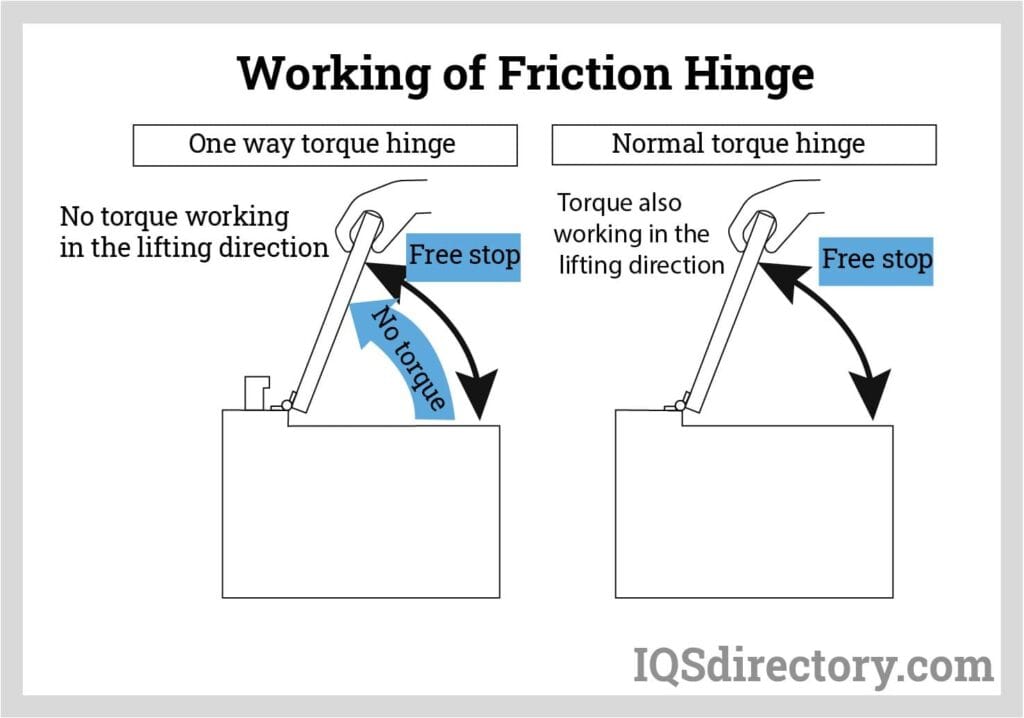
Not all applications require the same amount of force in both directions. Consider a heavy industrial lid or a medical device monitor. You want the lid to be easy to lift (low torque) but difficult to push down (high torque) so that it doesn’t slam shut on the user’s fingers.
This requires an asymmetric torque hinge. Manufacturing an asymmetric hinge is significantly more complex than a symmetric one. It typically involves integrating a one-way clutch mechanism—such as a wrapped spring or a roller clutch—inside the hinge barrel.
Evaluating Supplier Engineering
When vetting a friction hinge supplier, ask about their asymmetric capabilities. A supplier that only offers symmetric hinges is likely a low-tech factory or a trading company. A true OEM friction hinge partner will have an engineering team capable of designing custom asymmetric profiles, allowing you to specify exactly how much resistance is needed in the forward and reverse directions.

Laptop and monitor arm applications frequently require asymmetric torque hinges to balance the weight of the screen against the user’s lifting force.
3. Material Selection: Matching the Hinge to the Environment
The environment in which your product operates dictates the materials your torque hinge manufacturer must use. A hinge designed for a consumer laptop will fail rapidly if installed on a marine boat hatch.
Zinc Alloy vs. Stainless Steel
For indoor consumer electronics, die-cast zinc alloy housings with steel shafts are common. They are cost-effective and offer excellent dimensional stability. However, for outdoor, medical, or industrial applications, corrosion resistance is paramount.
A specialized friction hinge supplier will offer hinges machined entirely from SUS304 or SUS316 stainless steel. These materials can withstand harsh chemical washdowns in hospitals or salt spray in marine environments. Furthermore, the supplier should be able to provide salt spray test reports (typically 48 to 96 hours) to verify the corrosion resistance of their plating and passivation processes.

Industrial and medical applications demand friction hinges manufactured from high-grade stainless steel to resist corrosion and chemical degradation.
4. The 360-Degree Challenge: Dual-Axis Hinges
As consumer electronics evolve, so do the demands placed on friction hinge suppliers. The rise of 2-in-1 convertible laptops and 360-degree rotating kiosks has pushed hinge engineering to its limits.
A standard friction hinge typically rotates up to 180 degrees before the internal components bind or the housing interferes with the rotation. To achieve a full 360-degree rotation, a torque hinge manufacturer must design a dual-axis hinge.
Synchronized Rotation
A dual-axis hinge consists of two parallel shafts connected by a complex gear train or a synchronized linkage system. As the user opens the laptop past 180 degrees, the first shaft locks, and the second shaft takes over the rotation. This ensures that the screen remains perfectly aligned with the keyboard base at all times.
Designing and manufacturing a dual-axis hinge requires extreme precision. If the gears are not perfectly meshed, the hinge will feel “gritty” or bind during rotation. When evaluating a supplier for a 360-degree application, ask to see their gear hobbing and inspection equipment. A premium OEM friction hinge partner will have dedicated gear inspection machines to verify the tooth profile and pitch of every gear before assembly.

Dual-axis friction hinges enable 360-degree rotation for convertible laptops and kiosks, requiring synchronized gear trains for smooth operation.
5. Detent Mechanisms: The “Click” of Quality
While most friction hinges are designed to hold a position at any angle (free-stop), some applications require the hinge to snap into specific, predefined angles. This is known as a detent hinge.
Imagine a folding drone arm or a medical monitor that needs to lock securely at 0 degrees (closed), 90 degrees, and 180 degrees. A detent hinge achieves this by integrating a spring-loaded cam follower that drops into machined grooves on the hinge shaft.
The Engineering of the “Click”
The tactile feel of a detent hinge—the crispness of the “click”—is a direct reflection of the manufacturer’s engineering prowess. If the spring is too weak, the hinge will not lock securely. If the groove is machined poorly, the click will feel mushy.
A top-tier friction hinge supplier will use CNC Swiss-type lathes to machine the detent grooves with micron-level precision. They will also carefully select the spring rate and the cam profile to ensure that the detent force is perfectly balanced against the friction torque. When auditing a supplier, ask for samples of their detent hinges and evaluate the tactile feedback. A crisp, consistent click is the hallmark of a premium torque hinge manufacturer.

Detent friction hinges integrate spring-loaded cams and machined grooves to provide tactile feedback and secure locking at specific angles.
6. Customization: The Hallmark of an OEM Partner
While standard off-the-shelf friction hinges work for many applications, true innovation often requires a custom solution. A premium friction hinge supplier does not just sell parts from a catalog; they act as an extension of your engineering team.
Rapid Prototyping and Iteration
When an OEM approaches a torque hinge manufacturer with a unique problem—such as fitting a high-torque hinge into an ultra-thin laptop chassis—the supplier’s R&D team must spring into action. Using advanced 3D CAD software, they design a custom hinge profile, perhaps utilizing Metal Injection Molding (MIM) to achieve complex geometries that are impossible with traditional machining.
Within days, the supplier should be able to produce physical prototypes using SLA or SLS 3D printing, allowing the OEM to test the fit and feel before committing to expensive steel tooling. This rapid iteration cycle is what separates a true OEM friction hinge partner from a simple parts vendor.
Torque Tuning
Furthermore, the supplier must be able to tune the torque output to match the exact weight and center of gravity of the customer’s lid or screen. This involves adjusting the compression force on the friction bands or selecting a different viscosity of synthetic grease. A world-class manufacturer will work closely with the OEM to fine-tune the torque until the motion feels absolutely perfect.
7. The Hidden Costs of Poor Manufacturing
When procurement teams evaluate a friction hinge supplier, the unit price is often the primary focus. However, the true cost of a motion control component extends far beyond the invoice. A cheap hinge produced in a sub-standard factory carries hidden costs that can devastate an OEM’s bottom line.
Warranty Claims and Brand Damage
Consider a high-end laptop. If the friction hinge fails after six months, the screen will flop backward. This not only creates a terrible user experience but also risks damaging the delicate ribbon cables connecting the screen to the motherboard. The cost to dispatch a technician, replace the hinge, and repair the laptop far exceeds the $1.00 saved on the initial component purchase. Furthermore, the damage to the brand’s reputation—often amplified by negative online reviews—is incalculable.
Assembly Line Downtime
A reliable torque hinge manufacturer ensures that every batch of components is dimensionally identical. If a low-tier supplier ships a batch of hinges with mounting holes that are 0.1mm off-center, those hinges will not fit into the OEM’s assembly line fixtures. This causes immediate production downtime, forcing the OEM to halt the line, quarantine the defective parts, and scramble for replacements. The cost of a stalled assembly line can run into thousands of dollars per hour.
By partnering with a premium OEM friction hinge manufacturer that utilizes in-house CNC machining and 100% automated torque inspection, OEMs eliminate these hidden costs and secure a predictable, high-quality supply chain.
Frequently Asked Questions (FAQs)
1. What is the difference between a friction hinge and a regular hinge?
A regular hinge allows a door or lid to swing freely. A friction hinge (or torque hinge) contains internal mechanisms that generate resistance, allowing the lid or screen to hold its position at any angle without falling shut.
2. How do I choose the right torque for my friction hinge?
The required torque is calculated by multiplying the weight of the lid by the distance from the hinge axis to the lid’s center of gravity. A premium friction hinge supplier will help you perform this calculation and recommend a hinge with a 20% safety margin to account for torque decay over time.
3. What is an asymmetric torque hinge?
An asymmetric torque hinge provides different levels of resistance depending on the direction of rotation. For example, it might be easy to open a heavy lid (low torque) but difficult to close it (high torque) to prevent it from slamming.
4. Why do some friction hinges lose their holding power over time?
All friction hinges experience some degree of wear (torque decay) as the internal surfaces rub against each other. Low-quality hinges use inferior materials and poor lubrication, leading to rapid torque loss. A premium torque hinge manufacturer uses advanced metallurgy and synthetic greases to minimize this decay.
5. Can a friction hinge rotate a full 360 degrees?
Yes, but it requires a specialized dual-axis design. A single-axis hinge typically binds before reaching 360 degrees. A dual-axis hinge uses two synchronized shafts to achieve full rotation, commonly used in convertible laptops.
Conclusion: The Value of a True Manufacturing Partner
The journey from a CAD drawing to a mass-produced friction hinge is complex and fraught with potential pitfalls. By partnering with a premium friction hinge supplier that controls every step of the process—from CNC machining and material selection to 100% torque inspection and global logistics—OEMs can mitigate risk and ensure the success of their products.
At Janhinge, we are proud to be a world-class torque hinge manufacturer and a trusted OEM friction hinge partner for global brands. Our commitment to precision engineering, automated manufacturing, and uncompromising quality control ensures that every hinge we produce delivers the perfect motion control experience.
Contact our engineering team today to discuss your custom OEM requirements, request a factory audit, or order engineering samples. Let us show you what happens inside a true premium manufacturing facility. Discuss more on Whatsapp.