
The Convergence of Two Industries: Why Motion Control Matters
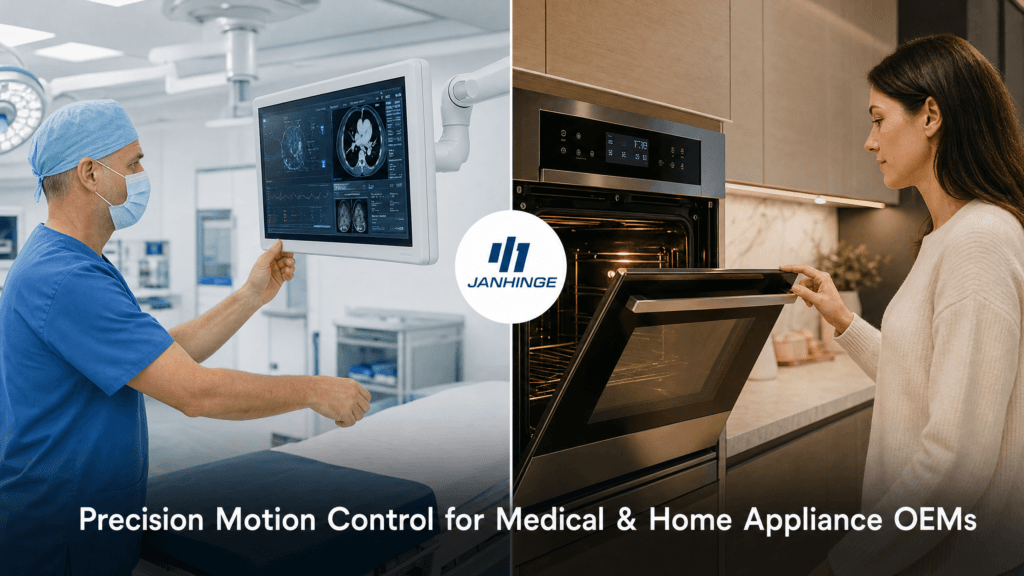
At first glance, a high-tech hospital operating room and a modern residential kitchen seem to have little in common. However, from a mechanical engineering perspective, the design goals for smart home appliance motion control and medical device articulation are remarkably similar. Both industries demand absolute safety, intuitive user interaction, and uncompromising reliability.
Whether it is a nurse quickly repositioning a diagnostic monitor or a homeowner closing a heavy oven door, the tactile feedback provided by the equipment’s hinges dictates the user’s perception of quality. A slamming door or a drooping monitor screen is not just an annoyance; it is a potential safety hazard.
This article explores how partnering with a specialized medical device hinge manufacturer and appliance damper supplier like Janhinge can solve complex kinematic challenges, ensuring your products deliver a premium, safe, and reliable user experience.
Medical Devices: Precision, Positioning, and Compliance
In the healthcare sector, equipment must perform flawlessly under high-stress conditions. The mechanical joints of medical devices must be robust enough to hold heavy equipment steady, yet smooth enough to allow for one-handed adjustments by medical staff.
The Role of Friction Hinges in Healthcare
A friction hinge medical equipment application relies on constant torque. Unlike standard free-swinging hinges, friction hinges (or torque hinges) utilize internal resistance to counteract gravity. This allows a component to be moved to any angle and remain firmly in place without the need for manual locking knobs or gas struts.
Key Medical Applications:
•Diagnostic Monitor Arms: Radiologists and surgeons require monitors to be positioned at precise ergonomic angles. A high-torque friction hinge ensures the heavy display does not slowly droop over time.
•Surgical Lighting: Overhead lights must be easily maneuverable during a procedure but remain perfectly still once positioned to eliminate shadows.
•Hospital Bed Adjustments: Heavy-duty hinges provide the necessary structural support and controlled movement for patient positioning.
•Laboratory Centrifuges & Analyzers: Protective lids require smooth opening and secure holding to prevent accidental closure while technicians are loading samples.
Regulatory Compliance and Cleanability
Medical OEMs must also consider FDA compliance and hygiene. Hinges used in clinical environments must be manufactured from corrosion-resistant materials (like 304 or 316 stainless steel) to withstand harsh chemical disinfectants. Furthermore, the internal mechanisms must be fully sealed to prevent the ingress of fluids or the shedding of metallic dust into sterile environments.

Smart Home Appliances: The Expectation of Silent Luxury
The home appliance market has undergone a massive transformation. Consumers no longer just want machines that wash clothes or bake food; they want “smart” appliances that integrate seamlessly into peaceful, modern living spaces. The defining physical characteristic of this new generation of appliances is the home appliance soft close hinge.
Eliminating the “Slam” with Rotary Dampers
The primary motion control challenge in appliances is managing kinetic energy. A heavy glass washing machine lid or a thick, insulated oven door carries significant momentum when closing. If allowed to free-fall, the resulting impact creates a loud, jarring noise and can shatter the glass or damage the internal electronics.
This is where a washing machine oven door damper becomes essential. By integrating a rotary damper into the hinge mechanism, the kinetic energy of the falling door is absorbed by the high-viscosity silicone oil inside the damper. This forces the door to descend in a slow, controlled, and completely silent manner.
Key Appliance Applications:
•Top-Load Washing Machines: Heavy glass lids require robust rotary dampers to ensure a slow, safe closure, protecting users’ fingers from being pinched.
•Built-In Ovens: Drop-down oven doors utilize specialized damping hinges that engage in the final 20 degrees of closure, pulling the door shut softly and ensuring a tight heat seal.
•Smart Refrigerators: Internal compartment doors and exterior French doors benefit from soft-close mechanisms that prevent items from rattling when the door is shut.
•Dishwashers: Heavy, horizontal drop-down doors require strong torque hinges to hold them open at a 90-degree angle for easy loading.

Engineering the Perfect Feel: Torque and Tolerances
Whether designing for a hospital or a kitchen, selecting the right hinge is a matter of physics. The torque requirement (measured in N.m) varies drastically depending on the weight of the door or monitor and the distance to its center of gravity.
For example, a lightweight laptop screen might only require 1.0 N.m of torque, whereas a heavy commercial oven door might require 15.0 N.m to achieve a proper soft-close effect.

The Janhinge OEM Advantage
At Janhinge, we understand that off-the-shelf solutions rarely provide the perfect tactile feel. As a vertically integrated manufacturer, we offer comprehensive OEM/ODM engineering services.
When you provide us with your product’s specifications (weight, dimensions, and desired closing speed or holding force), our engineering team calculates the exact kinematic profile. We then adjust the internal friction bands or the viscosity of the silicone oil to create a custom torque profile tailored specifically to your product.

Conclusion: Partnering for Reliable Motion
The user experience of your medical device or home appliance is ultimately defined by how it moves. A slamming door or a weak monitor arm immediately detracts from the perceived value of your engineering.
By partnering with Janhinge, you gain access to 21 years of specialized motion control expertise. Our ISO 9001 and IATF 16949 certified manufacturing processes ensure that every friction hinge and rotary damper we produce delivers consistent, reliable performance for over 50,000 cycles.
Don’t let a standard hinge compromise your premium product. Contact Janhinge today to discuss your specific application and request a custom DFM analysis.
Contact Our Engineering Team | Explore Our Motion Control Solutions
Frequently Asked Questions (FAQ)
Q1: Can your friction hinges be sterilized for use in hospital environments?
A: Yes. For medical applications, we manufacture friction hinges using high-grade stainless steel (such as SUS304 or SUS316) and sealed internal components. These hinges are highly resistant to corrosion and can withstand regular cleaning with harsh hospital-grade disinfectants.
Q2: How do you prevent the silicone oil in oven dampers from breaking down under high heat?
A: Heat is the enemy of standard dampers. For high-temperature applications like commercial and residential ovens, we utilize specially formulated, high-temperature silicone oils and advanced heat-resistant O-ring seals. This ensures the damping effect remains consistent even when exposed to ambient heat from the appliance.
Q3: We need a soft-close hinge for a very heavy washing machine lid. Can you handle high torque?
A: Absolutely. We manufacture heavy-duty rotary dampers specifically designed for large appliances. If a single damper is insufficient, our engineers will design a dual-damper hinge system (one on the left, one on the right) to safely manage the kinetic energy of heavy glass or metal lids.
Q4: Do you offer “free stop” hinges that only provide resistance in one direction?
A: Yes. We engineer asymmetric friction hinges and one-way rotary dampers. For example, a washing machine lid can be designed to lift open with near-zero resistance (easy for the user), but provide high damping resistance when closing (preventing the slam).
Q5: How fast can you provide a custom hinge prototype for our new appliance design?
A: Speed to market is critical. Once we receive your CAD files and finalize the DFM analysis, we can produce and ship functional, test-ready custom prototypes within 20 days, allowing your R&D team to validate the tactile feel quickly.