
Table of Contents
- Introduction
- Taxonomy of Modern Industrial Enclosures: Cabinet & Cupboard Hardware
- Deep Dive: Concealed Hinges and Invisible Kinematics
- Geometric Challenges in Corner Configurations
- Cylindrical and Barrel Hinges: High-Load Axial Performance
- Mechanical Stress Analysis & Load-Bearing Calculations
- Procurement Strategy: Reducing Total Cost of Ownership (TCO)
- Frequently Asked Questions (FAQs)
1. Introduction
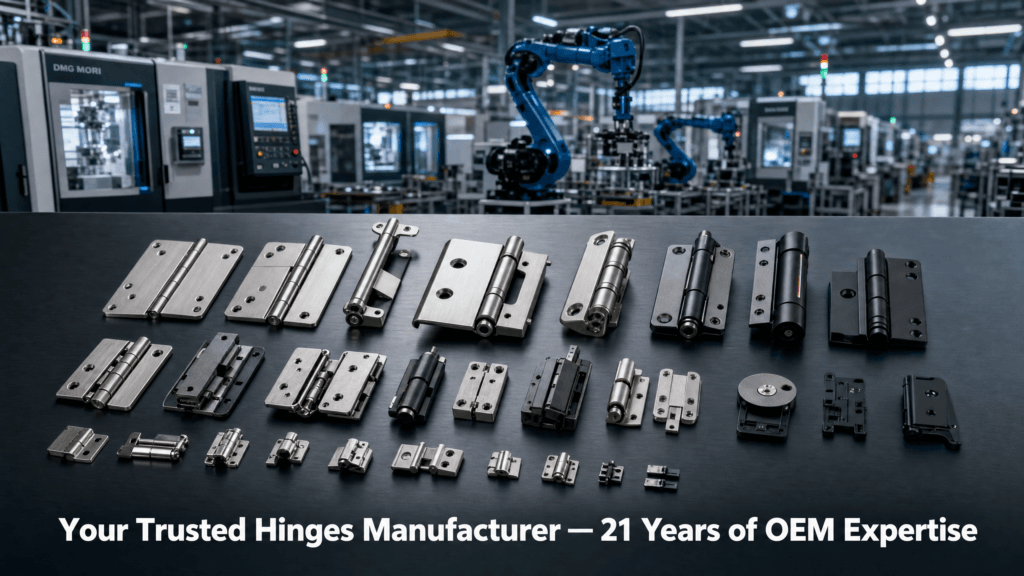
In furniture manufacturing, industrial manufacturing, telecommunications infrastructure, medical devices, and high-end commercial equipment, seemingly insignificant cabinet doors are crucial connection points. Selecting hardware from generic commercial product catalogs often overlooks the actual structural considerations. For mechanical design engineers and technical procurement managers, choosing the right hardware means analyzing mechanical dynamics, structural reliability, and installation efficiency.
An incorrectly specified hinge layout can lead to door sag, uneven gasket sealing, accelerated wear under vibration, and field failures that harm your brand’s reputation. This technical guide explores industrial cabinet hinges, breaking down concealed hinges, corner cabinet hinges, and cylindrical hinges. We will examine their kinematics, structural calculations, and material choices to help you optimize your enclosure designs.
2. Taxonomy of Modern Industrial Enclosures: Cabinet & Cupboard Hardware
When sourcing cabinet door hinges types or cupboard hinges for industrial applications, we must categorize hardware by its installation environment and stress profile. While domestic cabinetry relies on lightweight, aesthetic components, industrial applications demand high-strength designs.
Industrial enclosures are generally split into three functional categories:
Electronic & Telecom Enclosures (Server Racks, Control Boxes)
These setups require precise alignment to support environmental sealing (IP65/IP66) and electromagnetic interference (EMI) shielding. Hardware must maintain consistent compression across the sealing perimeter without blocking inner rack components.
Heavy Machining & Equipment Guards
These protective panels face continuous low-frequency vibrations and airborne particles. Hardware must offer predictable friction, resist binding, and handle heavy static and dynamic loads.
Commercial & Laboratory Storage
Medical and cleanroom environments need smooth surfaces that resist chemical cleaners, minimize particulate collection, and operate reliably across thousands of cycles.
Understanding these application profiles allows teams to narrow down the mechanical properties required for their hardware, moving past broad terms like cabinet hinges to precise engineering specifications.
3. Deep Dive: Concealed Hinges and Invisible Kinematics
For many modern industrial enclosures, concealed hinges (also called hidden or concealed door hinges) are the standard choice. Placing the mechanical pivot mechanism completely inside the cabinet envelope provides distinct design and security advantages.
   [ Cabinet Frame ]
         |
         |=== (Hidden Pivot Linkage) ===[ Concealed Hinge Cup ]
         |                                       |
   ===============[ Closed Door Panel ]==========+
   (Exterior surface remains flush, smooth, and tamper-proof)
Security and Tamper Resistance
External barrel hinges expose the hinge pin, leaving them vulnerable to cutting or grinding in high-security settings like outdoor telecom kiosks or power boxes. Concealed models isolate all mounting hardware and pivot joints inside the sealed enclosure, making unauthorized physical entry impossible when the door is locked.
Aerodynamics and Clean Aesthetics
In medical labs and food processing plants, exterior hardware traps dust, bacteria, and residue, making washdowns difficult. A smooth, flush exterior simplifies cleaning and sterilization. In transport and aerospace housings, internal mounting eliminates aerodynamic drag and snag hazards.
Multi-Pivot Linkage Kinematics
Standard hinges pivot around a single fixed axis. High-performance concealed variants often use complex 4-bar or 7-bar mechanical linkages. This multi-axis movement causes the door to pop slightly outward before pivoting open, preventing the door edge from binding against the cabinet frame. This motion path allows for minimal gaps between adjacent panels, which is essential for modular control panels.

4. Geometric Challenges in Corner Configurations
Corner geometries introduce complex spatial constraints. Specifying corner cabinet hinges or corner hinges requires a careful look at clearance space, overlay configurations, and opening clearance trajectories.
When configuring a 90-degree corner or a diagonal corner face, standard 95∘ or 110∘ hardware can cause the door panel to collide with adjacent drawers or outer trim structures.
Negative and Positive Angle Formulations
Engineers specify specialized corner hinges based on the working angle between the door panel and the cabinet wall in its closed state:
- Positive-Angle Configurations (+30∘,+45∘,+60∘): Used for angled corner cabinets, common in medical workstations and command center dashboards.
- Negative-Angle Configurations (−30∘,−45∘): Designed for inset angled doors or specialized folded sheet-metal enclosures.
Inset vs. Overlay Cleating
- Full Overlay: The door panel sits completely in front of the cabinet frame face, concealing the opening edges.
- Half Overlay / Twin Stop: Two doors share a single central partition wall, requiring a cranked hinge arm to prevent collision during simultaneous opening.
- Inset Mounting: The door sits entirely within the cabinet frame opening. This requires precise alignment and tightly controlled clearances to prevent binding against the frame during rotation.
5. Cylindrical and Barrel Hinges: High-Load Axial Performance
When a project calls for extreme load capacities and space is limited, standard multi-linkage configurations may fall short. In these cases, cylindrical hinges (or barrel hinges) are the preferred choice.
High Axial and Radial Load Capacity
Cylindrical models use a simple design: two aligned cylindrical barrels rotating around a single internal pin. Because forces concentrate along a single straight line, these components handle high static loads without bending. This makes them ideal for thick sheet-metal enclosures and heavy electrical power vaults.
Weld-On vs. Bolt-On Integration
- Weld-On Barrels: These feature un-drilled outer barrels made from low-carbon steel or raw stainless steel. They are welded directly onto the heavy steel plates of the frame and door, eliminating fasteners and creating a rigid bond that resists high-vibration stress.
- Bolt-On Cylindrical Models: These include integrated mounting flats or leaves with countersunk mounting holes, allowing for easy replacement in the field.
Low-Friction Interior Bushings
To prevent galling and friction between the rotating barrels, high-duty cylindrical variants incorporate self-lubricating washers and sleeve bushings made from brass, bronze, or PTFE composites. These bushings maintain a smooth rotation profile and extend the system’s service life.
6. Mechanical Stress Analysis & Load-Bearing Calculations
To prevent door sag and structural failure, engineers must calculate the exact forces acting on the hardware layout. This calculation determines the correct quantity and spacing of hinges for each door panel.
Mathematical Radial and Axial Force Derivation
For a standard two-hinge vertical configuration, the radial force (FR) acting on the top component due to the door’s cantilevered weight is calculated using the formula:
FR=2×DW×H
Where:
- W = Total weight of the door panel (Newtons)
- H = Horizontal width of the door panel from pivot centerline (meters)
- D = Vertical distance between the center points of the two hinges (meters)
The total axial force (FA) acting downwards on the hinge pin structure is shared across the layout:
FA=NW
Where:
- N = Number of load-bearing hinges installed on the assembly (N≥2).
Key Engineering Takeaways:
- Maximize Distance (D): Spacing the top and bottom hinges further apart reduces the radial tearing force (FR), minimizing structural wear on the frame.
- Add a Third Unit Judiciously: For tall or heavy doors, adding a third hinge near the top helps counteract radial forces and stops the door frame from bowing out of alignment.
7. Procurement Strategy: Reducing Total Cost of Ownership (TCO)
For purchasing managers, unit cost is only one part of the sourcing equation. The real expense of hardware often includes installation labor, quality inspection, and field replacement costs.
Total Cost of Ownership (TCO) Framework
TCO=Unit Purchase Price+Installation Labor Cost+Rework Cost+Warranty Failure Liability
If a cheap component takes twice as long to align on the assembly line, or fails prematurely in the field, it quickly becomes an expensive liability.
Key Factors for Industrial Hardware Vetting:
- Precision Stamping and Tooling: Sourcing components manufactured via automated progressive die stamping ensures consistent dimensions across production batches. This allows for fast installation on your assembly lines without manual adjustments.
- In-House Fatigue Verification: Select partners who can provide certified life-cycle fatigue test reports (e.g., 50,000 to 100,000 cycles under full load) and salt-spray corrosion resistance records (ASTM B117) to confirm long-term reliability.
- Vertical Integration Advantage: Working directly with vertically integrated manufacturers like Jin En JAN helps streamline your supply chain. Managing everything from raw materials to final assembly ensures reliable lead times, direct technical support, and the ability to customize hardware for unique projects.
8. Frequently Asked Questions (FAQs)
Q1: What opening angle should be specified for industrial concealed hinges?
A: Standard options range from 95∘ to 110∘ for basic access enclosures. For deep server racks or modular equipment cabinets where technicians need full access without obstruction, specifiers should choose wide-angle 165∘ or 180∘ hinges to let the door swing completely clear of the frame opening.
Q2: How do you prevent galvanic corrosion when mounting an aluminum cabinet hinge to a stainless steel enclosure frame?
A: To avoid galvanic corrosion, insert non-conductive isolation barriers, such as precision-molded polyoxymethylene (POM) or nylon washers and pads, between the dissimilar metals. This isolates the components and breaks the electrical path that drives corrosion.
Q3: When should a cylindrical hinge be chosen over a multi-linkage concealed hinge?
A: Choose a cylindrical model when your primary design priorities are maximum load capacity, rugged impact resistance, and simple long-term operation. Concealed multi-linkage models are better when you need hidden installation, flush outer surfaces, or specific opening paths for tight clearance spaces.
Q4: What is the benefit of using 3D-adjustable versions on an industrial assembly line?
A: 3D-adjustable options allow line technicians to calibrate vertical, horizontal, and depth alignments after the door is mounted. This setup accommodates real-world welding and bending tolerances, ensuring consistent environmental gasket compression without requiring custom modifications.
Q5: Can these industrial options be configured with integrated damping or hold-open functions?
A: Yes. Many industrial styles can integrate soft-close fluid mechanisms or constant-torque friction elements. Adding high-performance rotary dampers directly into the hinge assembly controls kinetic energy, preventing heavy metal panels from slamming and protecting delicate inner electronic components.
For custom CAD models, finite element analysis (FEA) data, or specific material certifications for your project, reach out to the engineering team at JAN Motion Control Hardware.