
Hello, design engineers and procurement leaders! In the demanding world of product development, every component choice is critical. When it comes to managing movement, holding positions, and ensuring a premium user experience, friction hinges are often the unsung heroes. Yet, selecting the right one can be a complex task, fraught with questions about torque, durability, and application-specific needs. As your trusted partner in motion control, Janhinge is here to demystify the world of friction hinges, addressing the most common questions and challenges you face. This guide will equip you with the knowledge to make informed decisions, optimize your designs, and discover how Janhinge’s OEM hinge solutions can elevate your next project.
What Exactly Are Friction Hinges and How Do They Work?
One of the most frequently asked questions we encounter is about the fundamental mechanics of friction hinges. Simply put, a friction hinge, also known as a position control hinge or torque hinge, is designed to provide resistance to rotational movement, allowing a connected component (like a lid, door, or display) to be held securely at any desired angle without the need for external supports or locking mechanisms. This resistance is generated internally through the controlled interaction of various components.
At its core, a friction hinge typically consists of:
•Friction Elements: These are often specialized washers or discs made from materials like engineered plastics, sintered metals, or composite materials. Their surface properties and geometry are crucial for generating consistent friction.
•Shaft: A central pivot around which the hinge rotates. The shaft material and surface finish are vital for smooth operation and wear resistance.
•Housing/Leaves: The external parts that connect the hinge to your product. These are typically made from robust metals like stainless steel or zinc alloy.
•Compression Mechanism: Often springs or other fastening methods that apply a controlled force to press the friction elements together, thereby creating the desired torque.
When you rotate a friction hinge, the friction elements slide against each other under pressure, creating a resistive force – the torque. This torque counteracts the force of gravity or other external loads on the attached component, holding it firmly in place. The beauty of a well-designed friction hinge lies in its ability to maintain this resistance consistently over thousands of cycles, providing a smooth, predictable feel throughout its range of motion. The specific mechanism for generating friction can vary, leading to different types of friction hinges:
•Disc Friction Hinges: These are perhaps the most common, utilizing multiple friction discs (often interleaved with metal plates) compressed together. The number and material of these discs, along with the compression force, determine the torque.
•Conical Friction Hinges: These employ conical surfaces that engage to create friction. They can offer a compact design and are often used where space is limited.
•Cylindrical Friction Hinges: These use cylindrical surfaces in contact, generating friction as one cylinder rotates within another. They are known for their robustness and are often found in heavy-duty applications.
The role of lubricants in friction hinges is also critical. While some friction hinges are designed to operate dry, many incorporate specialized greases or coatings. These aren’t for reducing friction, but rather for ensuring smooth operation, preventing stick-slip (jerky movement), managing heat, and extending the hinge’s lifespan by minimizing wear on the friction surfaces. The type of lubricant chosen is highly dependent on the application’s environment (temperature, contaminants) and desired performance characteristics.
Friction Hinges vs. Constant Torque Hinges: Understanding the Nuance
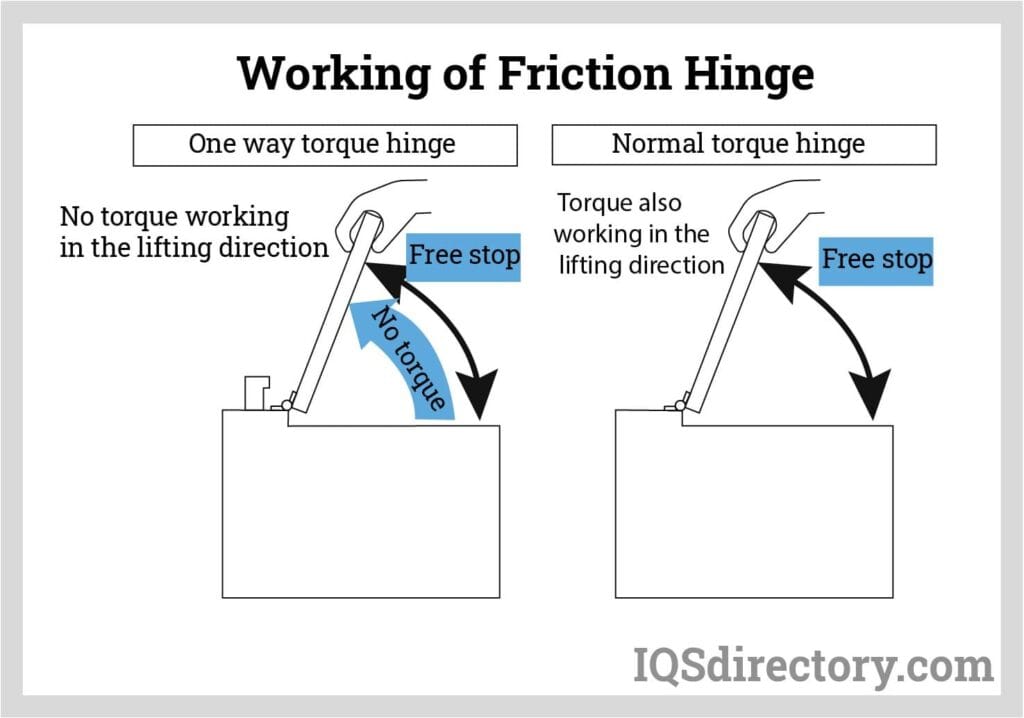
This is a critical distinction for many engineers. While all constant torque hinges are a type of friction hinge, not all friction hinges offer constant torque. Let’s clarify:
•Friction Hinges (General): These provide a consistent level of resistance throughout their travel. The torque value is generally stable, allowing for position holding. They are versatile and suitable for a wide range of applications where consistent resistance is needed, but minor variations in torque over the lifespan or due to environmental factors might be acceptable.
•Constant Torque Hinges (Specialized): These are engineered to deliver an exceptionally precise and highly consistent torque value across their entire range of motion and over an extended cycle life. The design minimizes torque degradation due to wear, temperature changes, or manufacturing tolerances. This superior predictability and longevity make them indispensable for high-stakes applications where even slight variations in force can impact performance or safety. Think of medical devices, aerospace components, or high-end consumer electronics where a premium, unwavering feel is paramount.
Key Differences Summarized:
| Feature | General Friction Hinge | Constant Torque Hinge |
| Torque Consistency | Generally consistent, minor variations possible | Exceptionally precise and consistent across full travel |
| Cycle Life | Good (e.g., 20,000-50,000 cycles) | Very High (e.g., 50,000-100,000+ cycles) |
| Predictability | Good, but can be influenced by wear/environment | Superior, minimal degradation over time |
| Complexity | Simpler internal mechanisms | More sophisticated internal design, precision components |
| Cost | Generally more cost-effective | Higher initial cost due to precision engineering |
| Ideal Use | General position holding, moderate demands | Critical applications, premium feel, high reliability |
Mastering Torque: How to Calculate and Specify Your Hinge
One of the most common challenges for engineers is accurately determining the required torque calculation for a friction hinge. Specifying the correct torque is crucial for optimal performance, preventing unwanted movement, and ensuring user satisfaction. Here’s a simplified approach to guide you:
1. Identify the Load: Determine the weight (mass) of the component your hinge will support (e.g., a lid, door, or display).
2. Find the Center of Gravity (CG): Locate the center of gravity of the component. This is the point where its entire weight can be considered to act.
3. Measure the Distance: Measure the horizontal distance from the hinge pivot point to the center of gravity of the component when it is in its most demanding position (e.g., fully open or at a critical angle).
4. Apply the Formula: Torque (T) = Force (F) × Distance (d).
* Force (F) is typically the weight of your component.
* Distance (d) is the horizontal distance from the pivot to the CG.
Example: If a lid weighs 5 kg and its center of gravity is 0.2 meters horizontally from the hinge pivot, the required torque would be approximately 5 kg * 9.8 m/s² (gravity) * 0.2 m = 9.8 Nm. If you have multiple hinges, divide the total torque by the number of hinges.

Important Considerations:
•Dynamic Loads: Account for any additional forces during movement, such as acceleration or deceleration.
•Environmental Factors: Temperature changes can affect material properties and thus torque. Consider the operating environment.
•Desired Feel: Sometimes, a slightly higher torque is desired for a more “premium” or “stiff” feel, which can enhance user perception of quality. This is often a subjective factor that requires prototyping and user testing.
•Number of Hinges: If you are using multiple hinges, the total required torque will be distributed among them. Ensure each hinge is rated for its share of the load.
•Mounting Geometry: The way the hinge is mounted and the leverage points can significantly affect the effective torque required. Off-axis loading or unusual mounting configurations will require careful analysis.
While the basic formula provides a starting point, real-world applications often present complexities. This is where Janhinge’s engineering expertise becomes invaluable. We don’t just sell hinges; we partner with you to precisely determine the optimal torque for your specific application. Our team utilizes advanced simulation software and extensive testing data to fine-tune torque specifications, ensuring your product achieves the perfect balance of controlled movement and user effort. Contact our engineering team for a personalized torque assessment.
Addressing Common B2B Concerns: Durability, Customization, and Supply Chain
Beyond the technical specifications, engineers and procurement professionals frequently raise questions about the long-term reliability, adaptability, and logistical aspects of hinge sourcing. Let’s tackle these head-on.
Durability and Cycle Life: Built to Last
“What materials are best for high-cycle friction hinges?” and “Why is my friction hinge losing torque?” are questions that speak directly to durability. The lifespan and consistent performance of a friction hinge are paramount, especially in industrial and medical applications where failure is not an option. At Janhinge, our commitment to longevity is reflected in:
•Advanced Material Selection: We utilize high-grade stainless steels, hardened alloys, and proprietary engineering plastics for friction elements, shafts, and housings. These materials are chosen for their superior wear resistance, fatigue strength, and environmental compatibility.
•Precision Manufacturing: Tight tolerances, meticulous surface finishes, and automated assembly processes minimize internal wear and ensure consistent torque output over extended periods. Our ISO 9001 certified facilities adhere to the highest manufacturing standards.
•Rigorous Testing Protocols: Every hinge design undergoes extensive cycle testing, often exceeding 50,000 to 100,000 cycles, under various load and environmental conditions. We also perform torque degradation tests to ensure minimal loss of resistance over time. This proactive testing helps us guarantee the specified cycle life and torque stability.
Addressing Torque Loss: If a friction hinge is losing torque prematurely, it often points to several factors:
•Incorrect Specification: The hinge may have been underspecified for the application’s load or cycle requirements.
•Material Degradation: Exposure to extreme temperatures, chemicals, or excessive wear can degrade friction materials.
•Contamination: Dust, debris, or improper lubrication can interfere with friction surfaces.
•Manufacturing Defects: While rare with reputable suppliers, inconsistent manufacturing can lead to early failure.
Partnering with a factory like Janhinge mitigates these risks by ensuring proper specification, high-quality materials, and stringent manufacturing controls. Learn more about Janhinge’s Quality Assurance.
Customization: Tailoring Solutions to Your Unique Needs
“Can friction hinges be adjusted?” and “Cost of custom friction hinges vs. off-the-shelf?” highlight the need for adaptability. While some friction hinges offer limited external adjustment, true customization goes much deeper. Your product’s unique form factor, desired feel, and operational environment often demand a bespoke solution. Janhinge excels in OEM/ODM hinge manufacturing, offering:
•Tailored Torque Values: Precisely matched to your application’s weight and desired feel.
•Custom Geometries and Mounting: Designing hinges that integrate seamlessly into your product’s existing structure, minimizing redesign efforts.
•Specialized Materials and Finishes: For specific environmental challenges (e.g., marine, cleanroom, high-temperature) or aesthetic requirements.
•Integrated Features: Incorporating features like detents, stops, or cable management directly into the hinge design.
While custom solutions may have a higher initial tooling cost than off-the-shelf options, they often lead to significant long-term savings through improved product performance, reduced assembly time, enhanced brand perception, and avoidance of costly field failures. The value of a perfectly integrated, high-performance custom hinge far outweighs the perceived savings of a compromised standard part. Discover our Custom Hinge Solutions.
Streamlined Procurement: Direct Factory Advantages
“Friction hinge manufacturers vs. distributors: Which is better for OEM?” and “Lead times for large volume friction hinge orders?” are critical questions for procurement professionals. Choosing a direct factory partner like Janhinge offers distinct advantages:
•Direct Communication: Engineers talk directly to engineers, eliminating miscommunication and accelerating the design and sampling process.
•Cost Efficiency: Removing the middleman reduces markups, leading to more competitive pricing for high-quality components.
•Faster Lead Times: A direct relationship allows for more agile production scheduling and quicker response to urgent needs.
•Full Traceability and Accountability: You have direct access to the manufacturing process, quality control, and supply chain, ensuring transparency and easier problem resolution.
•Long-Term Partnership: Janhinge invests in long-term relationships, providing consistent support, product evolution, and strategic supply chain planning.
Ready to Optimize Your Motion Control?
As you can see, the world of friction hinges is rich with technical considerations and strategic choices. By understanding the nuances of torque calculation, prioritizing durability, embracing customization, and leveraging the advantages of direct factory partnership, you can unlock superior product performance and gain a competitive edge. Janhinge is not just a supplier; we are your dedicated partner in achieving precision motion control.
Don’t leave your product’s motion to chance. Connect with Janhinge today:
•Request a Free Sample or Custom Quote
•Explore Our Full Range of Friction Hinges
•Consult with Our Engineering Experts
Frequently Asked Questions (FAQs)
1. What is the typical lifespan of a Janhinge friction hinge?
Our friction hinges are engineered for high cycle life, typically ranging from 50,000 to over 100,000 cycles, depending on the specific model, application, and environmental conditions. We conduct rigorous testing to validate these figures.
2. Can Janhinge friction hinges operate in extreme temperatures or harsh environments?
Yes, we offer friction hinges designed with specialized materials and finishes to withstand a wide range of environmental conditions, including extreme temperatures, humidity, salt spray, and chemical exposure. Please specify your environmental requirements during consultation.
3. How does Janhinge ensure torque consistency over time?
We achieve torque consistency through precise material selection, advanced manufacturing processes, and rigorous quality control. Our constant torque hinges, in particular, are designed with sophisticated internal mechanisms and testing protocols to minimize torque degradation over their lifespan.
4. What is the minimum order quantity (MOQ) for custom friction hinges?
MOQs for custom friction hinges vary depending on the complexity of the design and materials. We work with clients on projects of all sizes, from prototyping to high-volume production. Please contact us to discuss your specific project requirements.
5. Does Janhinge provide technical support during the design integration phase?
Absolutely. Our experienced engineering team provides comprehensive technical support, including torque calculation assistance, 3D modeling, prototyping, and design integration guidance, to ensure seamless implementation of our hinges into your product.