
Choosing the right torque hinge for a desk lamp may seem simple, but it has a significant impact on product quality, user satisfaction, and warranty costs. Having worked with lighting manufacturers in Europe, North America, and Asia, their most frequent complaint wasn’t about brightness or color temperature, but rather that the lamp arm wouldn’t stay in place after six months of use. This guide aims to help engineers and purchasing personnel determine the correct torque specifications for the desk lamp’s damping hinge and select the appropriate hinge supplier.
Why Torque Hinge Selection Matters More Than You Think
A torque hinge, sometimes called a friction hinge or free-stop hinge, uses controlled resistance to hold a load at any angle without external locking mechanisms . For a table lamp, this is not a luxury feature—it is the core mechanical function that defines the user experience.
When a lamp head sags or drifts, the product feels cheap regardless of its price point. When a hinge is too stiff, users struggle to adjust the lamp one-handed, creating frustration. When the torque degrades after a few thousand cycles, you face warranty claims and brand damage. Getting the torque right is the difference between a professional product and a disposable one.
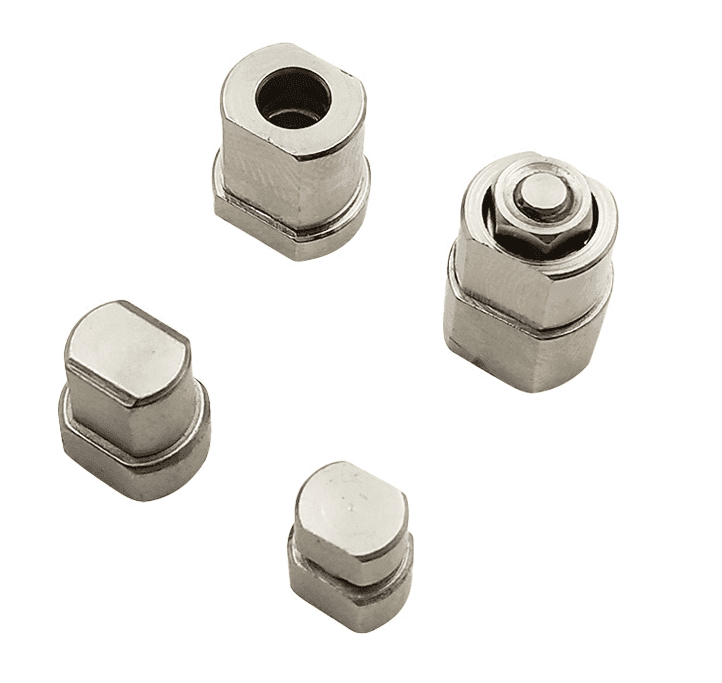
The Physics of Torque: Calculation Formula and Practical Application
Understanding the Basic Formula
The fundamental calculation for hinge torque starts with the load and its center of gravity. The formula used by industry leaders such as Sugatsune is straightforward :
T = W × L × cos θ
Where:
- T = required torque (N·m)
- W = weight of the lamp head or arm assembly (kg)
- L = distance from the hinge pivot to the center of gravity (m)
- θ = angle between the arm and the horizontal plane
In practice, the worst-case scenario occurs when the arm is horizontal—this is when the moment arm is longest and gravitational force is most demanding. At that position, cos θ = 1, so the formula simplifies to T = W × L.
Worked Example
Consider a desk lamp with a head assembly weighing 0.8 kg, with its center of gravity located 0.25 meters from the pivot point. The required torque at the horizontal position is:
T = 0.8 × 0.25 = 0.2 N·m
However, this is the theoretical minimum. In real-world applications, you should apply a safety factor. Most engineers I have worked with use a factor of 1.5 to 2.0 to account for manufacturing tolerances, wear over time, and variations in operating conditions . For this example, a target torque of 0.3 to 0.4 N·m would be appropriate.
When Multiple Hinges Are Used
Some lamp designs use two hinges in parallel—one at the base and one at the arm joint. In these cases, the required torque is distributed across both hinges. For identical hinges, divide the total required torque by the number of hinges. This is a common approach for articulated arm lamps that require multi-axis positioning.
Key Technical Parameters for Specification
1. Torque Value
This is the most critical specification. For table lamp applications, torque values typically range from 0.1 N·m to 3.0 N·m depending on the load and arm length .
- Light-duty desk lamps (LED heads under 0.5 kg, short arms): 0.1 – 0.5 N·m
- Standard desk lamps (0.5 – 1.0 kg heads): 0.5 – 1.5 N·m
- Heavy-duty or floor lamps (1.0+ kg assemblies, long arms): 1.5 – 3.0 N·m
Many manufacturers offer hinges with multiple torque options. For example, some models are available in 0.1 N·m, 0.2 N·m, 0.3 N·m, 0.4 N·m, 0.5 N·m, 0.6 N·m, 0.8 N·m, and 0.9 N·m variants . This granularity allows precise matching to specific load requirements.
2. Torque Consistency
Constant torque hinges provide the same resistance throughout the full rotation range . This is generally preferred for table lamps because it ensures predictable feel regardless of the arm angle. Some applications benefit from variable torque designs where more force is required to start movement than to sustain it, but for most lighting applications, consistent torque is the standard.
3. Directionality
- One-way torque hinges provide resistance in a single direction—for example, resisting downward movement while allowing free upward motion . These are useful for lamps that need to stay up but should be easy to raise.
- Two-way (bi-directional) torque hinges provide resistance in both opening and closing directions . This is more common in applications requiring controlled positioning in all directions, such as monitor arms and articulated lamps.
For most table lamps, two-way torque hinges are preferred because users expect the arm to stay in position whether they are moving it up, down, or sideways.
4. Operating Life
Durability matters. For a lamp used daily, expect 10,000 to 30,000 open-close cycles as a baseline. Some premium hinges are tested to 40,000 cycles or more . When evaluating suppliers, ask for cycle test data. A hinge that passes 20,000 cycles with less than 15% torque degradation is generally considered reliable for consumer lighting applications.
5. Material Selection
| Material | Strength | Corrosion Resistance | Typical Application |
|---|---|---|---|
| Iron (Nickel-plated) | Good | Moderate | Indoor desk lamps, cost-sensitive designs |
| Stainless Steel (SUS304) | Excellent | Good | General industrial, medical, premium lamps |
| Stainless Steel (SUS316) | Excellent | Superior | Marine, medical, high-humidity environments |
| Zinc Alloy | Good (moldable) | Moderate | Complex shapes, indoor electronics |
For most indoor table lamps, nickel-plated iron or SUS304 stainless steel are suitable and cost-effective choices .
Application-Specific Considerations
Desktop Reading Lamps
These require smooth, precise adjustment to accommodate different user postures. The hinge torque must be high enough to hold the lamp head steady during reading but low enough to allow single-handed adjustment. For many designs in this category, a torque value around 0.3 – 0.6 N·m works well.
Floor Lamps
For lamps over 1.5 meters in height, multi-section torque hinges are often used to adjust both height and angle . These require higher torque values—often 1.0 – 3.0 N·m—to support longer arms and heavier assemblies.
Bedside Lamps and Smart Lamps
These emphasize silent operation and minimal aesthetic impact. Compact hinges with low-profile designs are preferred. Some models are engineered specifically for sleep lamps and reading lights, with dimensions as small as Ø9.0 x L16.5 mm .
Medical and Specialty Lamps
Surgical lights and diagnostic lamps demand millimeter-level positioning accuracy and compatibility with sterile environments . These often require stainless steel construction and higher torque consistency standards.
Common Pitfalls in Torque Hinge Selection
Underestimating Wear
The most common mistake I see is designing for initial torque rather than end-of-life torque. Friction surfaces wear over time, and torque naturally degrades. Starting with a higher nominal torque and allowing for degradation is better than starting at the minimum and falling below specification after a few months.
Ignoring Temperature Effects
Some hinge designs, particularly those using friction plates with certain materials, can change torque characteristics with temperature. If your lamp is used in environments with wide temperature swings (e.g., tropical climates, unheated warehouses), ask suppliers about torque stability across the operating temperature range. Many manufacturers specify an operating range of 0°C to 40°C .
Forgetting Mounting Constraints
The physical size of the hinge must fit within the available mounting space—length, width, and stack height all matter . For minimalist lamp designs, compact hinge dimensions are critical. Always verify the mounting envelope before selecting a model.
FAQ
Q1: How do I calculate the required torque for a lamp arm with a complex shape?
The center of gravity is not always at the geometric center of the lamp head. For complex shapes, use CAD software to locate the center of gravity precisely. Then apply the formula T = W × L, where L is the horizontal distance from the pivot to the center of gravity. The key is getting the L dimension right—measure from the pivot to the CG, not from the pivot to the end of the arm.
Q2: What happens if I use a hinge with a torque value that is too high?
The lamp will be difficult to adjust, especially for one-handed operation. Users may apply excessive force and damage the hinge mechanism or the lamp structure. It also increases assembly effort during production. Always match torque to the actual load with a reasonable safety factor, not a wildly oversized specification.
Q3: How do I verify the torque consistency of a supplier’s hinge?
Request torque vs. angle curves from the supplier. A good manufacturer will provide data showing torque values across the full rotation range. You should also ask for cycle test results—at least 10,000 cycles—with torque measurements before and after. Reputable suppliers often publish these data in their technical documentation.
Q4: Is an adjustable torque hinge better for my application?
Adjustable hinges, such as models that allow torque setting from 0 to 4 N·m, are useful when load may vary over time or during product development . However, for mass production, fixed-torque hinges are generally more cost-effective and consistent once the required torque is determined. Adjustable designs are best suited for prototypes, R&D environments, or products where users may need to fine-tune the feel themselves.
Summary
Torque hinge selection for table lamps requires a systematic approach: calculate the load, apply a safety factor, verify the torque consistency, and confirm the operating life. The right hinge makes the lamp feel premium and reliable. The wrong hinge creates warranty claims and user complaints. Do the math early, test the samples thoroughly, and work with suppliers who can provide documented performance data. Your product—and your customers—will notice the difference.