
Introduction: The Component That Solves Two Problems at Once
Here is a question that every engineer designing a powered rotating assembly has faced: how do you get power and signal from the fixed base to the moving part, without the cables snagging, chafing, or breaking after a few thousand cycles?
Run the cables around the outside of the hinge, and they flex, rub, and eventually fail at the bend point. Use a drag chain or spiral wrap, and you add cost, complexity, and visible clutter. Leave the cables exposed, and you compromise the design’s aesthetic integrity and reliability.
The elegant solution is a 360° rotation torque hinge with a wire pass hole—also called a hollow-shaft torque hinge, wire-through hinge, or cable-hole torque hinge. It does two jobs in one component: it provides controlled friction for free-stop positioning at any angle, and it routes cables straight through the center of the rotation axis.
This article is written for engineers specifying motion-control components, procurement professionals evaluating suppliers, and business owners who understand that in powered rotating assemblies, the hinge is not just a mechanical pivot—it is the conduit for everything that makes the device work.
The Problem: Getting Wires Across a Rotating Joint
In many OEM assemblies, the hardest part of a hinged joint is not holding the panel in position—it is getting the wires across the joint without them snagging, chafing, or breaking after a few thousand open-close cycles.
Consider a typical application: a medical monitor mounted on a swing arm, a robotic camera head that pans continuously, or an industrial control panel that operators rotate for optimal viewing. In each case, the moving panel carries electronics—a display, a sensor, a camera, or a touchscreen—that needs power and signal from the fixed base.
The traditional approach is to route cables externally, around the outside of the hinge. This creates several problems:
Cable fatigue — External cables flex at the bend point with every rotation. Over time, the conductors break, insulation wears through, and the device fails.
Snagging and damage — Exposed cables can catch on surrounding equipment, be pulled by operators, or be damaged during maintenance.
Aesthetic compromise — Visible cables make a product look unfinished and unprofessional.
Assembly complexity — Routing cables externally requires additional clips, guides, or protective sheathing, increasing part count and assembly time.
A wire pass hole torque hinge solves all of these problems at once. Run the cables through the center of the hinge, and the cable sees far less movement—because the rotation axis is the one place on the joint where travel is smallest. The hinge becomes both the mechanical pivot and the cable conduit.
The Solution: Hollow-Shaft Torque Hinge with 360° Rotation
A 360° rotation torque hinge with wire pass hole—also called a hollow-shaft torque hinge or swivel torque hinge—is a positioning hinge with a hole running down the center of its rotation axis.
How It Works
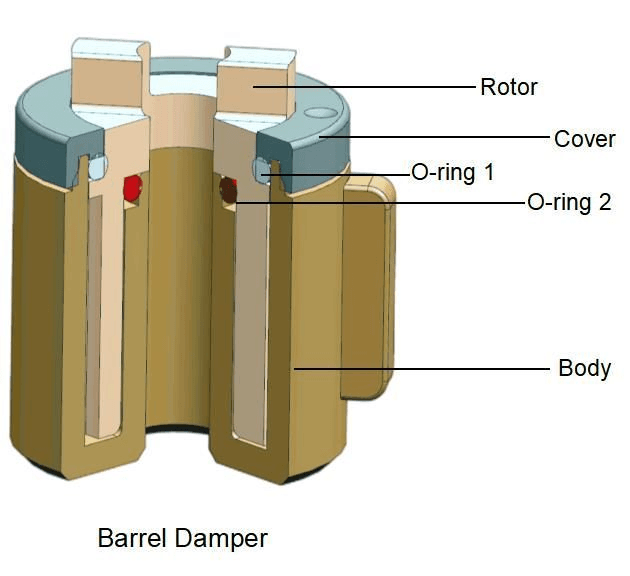
Internally, these hinges generate controlled rotational resistance through friction interfaces. As the hinge rotates, internal components—friction discs, washers, or precision-engineered torque elements—create resistive torque that counteracts gravity and holds the attached panel, display, or arm at any chosen angle.
The “wire pass hole” is what sets these hinges apart. A hollow shaft runs through the center of the hinge, allowing cables to pass through the pivot point. This means the cables rotate with the joint instead of being draped around the outside of it.
Key Functional Benefits
360° continuous rotation — The hinge can rotate freely through a full 360 degrees, making it ideal for applications that require unlimited rotation.
Free-stop positioning — The hinge holds the panel or device at any angle without external supports, gas springs, or locking mechanisms. This is sometimes called “arbitrary stop” or “random stop” capability.
Integrated cable management — The central hole allows wires, tubing, and connectors to pass through the hinge axis, hiding cables and streamlining the overall assembly.
Clean aesthetic — With cables routed internally, the exterior of the device remains uncluttered and professional-looking.
Reduced part count — By combining positioning and cable routing in a single component, these hinges eliminate the need for separate cable guides, drag chains, and protective sheathing.
Technical Specifications: What Engineers Need to Know
When specifying a 360° rotation torque hinge with wire pass hole, several engineering parameters demand attention.
Cable Hole Diameter
The hole diameter determines what size cables, connectors, and tubing can pass through the hinge. Available options range widely:
Sugatsune’s HG-S series, for example, offers five hole diameter options: 12 mm, 21.5 mm, 34 mm, 50 mm, and 75 mm.
Torque Range
Torque—measured in Newton meters (N·m)—determines how much weight the hinge can support and hold in position.
For 360° rotation torque hinges with wire pass holes, torque options typically range from 0.5 N·m to 11.5 N·m:
The Reell HTH60 Hollow Shaft Friction Hinge offers torque options from 5.5 N·m to 11.5 N·m. The HTAN XG11-098 offers a torque range from 1.0 N·m to 6.0 N·m. Some adjustable torque hinges offer ranges from 0 to 12 N·m.
Rotation Angle
Full 360° rotation is the defining feature of these hinges. Some models offer additional capabilities:
- 360° continuous rotation — Unlimited rotation in both directions
- 360° with detent stops — Positive positioning at preset angles
- 360° with angle restriction — Rotation can be limited using an included angle regulation bolt
Cycle Life
Industrial and medical applications demand long-term reliability. Quality 360° torque hinges are validated for:
- 20,000 cycles — Minimum for most applications
- 25,000 cycles — Reell HTH60 standard
- 30,000 cycles — Premium products
Material Options
Material selection affects strength, corrosion resistance, weight, and cost:
Operating Temperature
For industrial and medical applications, hinges must perform reliably across temperature ranges:
Core Design Advantages
Free-Stop Positioning
Unlike standard hinges that either swing freely or require external locks, a torque hinge with wire pass hole provides free-stop functionality. The hinge holds the panel or device at any angle the user chooses, without drift or spring-back.
For a display arm, this means the monitor stays precisely where positioned. For a robotic camera, it means the head holds its orientation reliably. For a medical device, it means consistent, predictable positioning for clinical workflows.
Clean Cable Management
The wire pass hole is not a convenience feature—it is a reliability feature. Cables routed through the hinge axis experience far less movement and fatigue than cables routed externally.
As one manufacturer explains: “Run it through the center of the hinge and the cable sees far less movement, because the rotation axis is the one place on the joint where travel is smallest”.
Reduced Assembly Complexity
A cable-hole torque hinge replaces multiple components: a standard hinge, cable guides, protective sheathing, and sometimes even drag chains. This reduces part count, simplifies assembly, and lowers overall system cost.
Design Aesthetics
With cables routed internally, the exterior of the device remains clean and uncluttered. This is particularly important for premium products—medical equipment, high-end displays, and consumer electronics—where aesthetics matter.
Application Scenarios
Medical Diagnostic Equipment
Medical devices—CT scanners, MRI machines, surgical microscopes, and patient monitors—require reliable positioning and clean cable management. The XG11-098 torque hinge with an 11 mm cable pass-through hole is specifically designed for medical diagnostic equipment and surgical applications.
Industrial Robots and Automation
Robot joints and automated production line transfer devices require 360° rotation with precise positioning. Torque hinges with wire pass holes enable power and signal transmission through the joint while maintaining stable positioning.
Control Panels and HMIs
Industrial control panels and human-machine interfaces are frequently rotated for optimal viewing. A swivel torque hinge with a central hole allows cables to be routed internally while the panel holds its position at any angle.
Display Arms and Monitor Mounts
Adjustable display arms for offices, control rooms, and healthcare settings benefit from torque hinges with wire pass holes. The cables run through the hinge, keeping the arm clean and professional-looking while the display holds position reliably.
Surveillance Cameras
PTZ and fixed surveillance cameras require 360° rotation with stable positioning. Torque hinges with wire pass holes allow power and signal cables to pass through the rotation axis.
Lighting and Optical Equipment
Adjustable light heads, medical examination lamps, and optical instruments require precise positioning and clean cable management. Wire-through torque hinges enable both.
When a Wire-Through Hinge Makes Sense
A cable-hole torque hinge is the right choice when:
- A powered component is mounted on the moving panel and its cabling must cross the hinge axis
- External cable routing would be exposed, vulnerable, or unsightly
- Repeated motion would fatigue a cable run outside the joint
- The design needs to look clean with no visible wiring
- You want to cut part count by removing drag chains, spiral wrap, and external cable guides
It is usually the wrong choice when:
- Nothing on the moving panel needs power or signal
- The cable bundle is too large for any practical hole diameter
- The panel is so heavy that a hollow shaft cannot provide the required torque and structural strength at once
Choosing the Right Supplier: What to Look For
For procurement professionals and engineers, supplier selection is critical.
Key Criteria
Hole Diameter Options
Does the supplier offer a range of hole diameters to accommodate different cable bundles? Look for options from 5 mm to 75 mm.
Torque Range and Adjustability
Can the supplier provide the torque you need—from 0.5 N·m to 11.5 N·m or more? Is adjustable torque available for field tuning?
Material Options
Does the supplier offer stainless steel, zinc alloy, and nickel-plated options for different environments?
Cycle Life Validation
Look for documented cycle life test results: 20,000 cycles minimum, 30,000+ for premium products.
Quality Certification
ISO 9001:2015 certification is a baseline indicator of quality management.
OEM and Customization Capability
Can the supplier customize torque, hole diameter, material, surface finish, and mounting style? Leading manufacturers offer “OEM/ODM customization to meet specific cable routing or mounting needs”.
Conclusion
A 360° rotation torque hinge with a wire pass hole is not just a hinge—it is a motion-control component that solves two fundamental engineering challenges at once. It provides controlled, free-stop positioning for panels, displays, and devices, while simultaneously routing power and signal cables through the rotation axis.
For engineers, the technical parameters are clear: specify the right hole diameter for your cable bundle, select the correct torque for your load, and validate cycle life for your application. For procurement professionals, the supplier criteria are equally clear: look for material options, torque range, quality certification, and customization capability.
The cost of a quality wire-through torque hinge is modest. The cost of cable fatigue, snagging, and premature failure—in warranty claims, downtime, and brand damage—is not.
FAQ
Q1: What is a 360° rotation torque hinge with a wire pass hole?
A 360° rotation torque hinge with a wire pass hole—also called a hollow-shaft torque hinge or cable-hole torque hinge—is a positioning hinge with a hole running through the center of its rotation axis. It provides free-stop positioning at any angle while allowing cables to pass through the hinge, eliminating external cable routing and reducing cable fatigue.
Q2: What hole diameters are available for wire-through torque hinges?
Hole diameters range from 5 mm to 75 mm, depending on the manufacturer and model. Common sizes include 6 mm, 8 mm, 11 mm, 12 mm, 14 mm, 18 mm, 21.5 mm, 34 mm, 50 mm, and 75 mm. The choice depends on the size of your cable bundle and connectors.
Q3: What torque ranges are available for 360° rotation torque hinges?
Torque options typically range from 0.5 N·m to 11.5 N·m. Some adjustable models offer torque ranges from 0 to 12 N·m. The required torque depends on the weight of the attached panel and the distance from the hinge axis to its center of gravity.
Q4: How many cycles can a quality wire-through torque hinge withstand?
Premium 360° torque hinges are validated for 20,000 to 30,000 cycles or more. The Reell HTH60, for example, offers a 25,000-cycle life. Always verify cycle life specifications with your supplier and request test documentation.
Summary: A 360° rotation torque hinge with a wire pass hole combines free-stop positioning with integrated cable routing, solving the problem of getting power and signal across a rotating joint. Available with hole diameters from 5 mm to 75 mm and torque ranges from 0.5 N·m to 11.5 N·m, these hinges are essential for medical equipment, industrial robots, control panels, displays, and surveillance cameras. Engineers should specify the correct hole diameter, torque, and cycle life (20,000+ cycles). Procurement professionals should select suppliers with material options, quality certification, and OEM customization capability. The investment in quality wire-through hinges delivers reduced cable fatigue, cleaner design, and lower warranty claims.