
Introduction
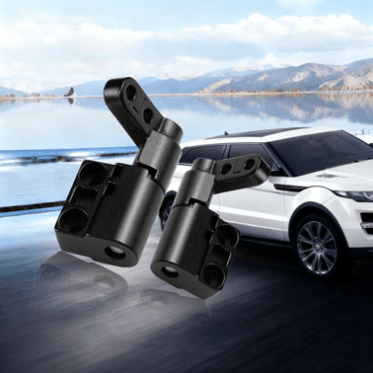
Friction hinges — also called torque hinges or position hinges — are deceptively simple components. They look like ordinary hardware, but their job is anything but simple: they must hold a panel, lid, or display at any angle through controlled internal resistance, cycle after cycle, year after year. When they work correctly, nobody notices them. When they fail, the entire product feels cheap, unreliable, or even unsafe.
If you are an engineer specifying hinges, a procurement professional sourcing them, or an executive responsible for product quality, you have probably encountered the same frustrating pattern: a hinge that feels perfect on day one gradually loses holding force, starts squeaking, or fails entirely after a fraction of its expected life.
The good news is that these failures are predictable. They are not random quality defects — they are the result of identifiable physical mechanisms that can be controlled through proper design, material selection, and mass production discipline. This article walks through the most common friction hinge defects, why they happen, and what your supply chain must do to prevent them at scale.
Part One: The Six Most Common Friction Hinge Defects
1. Torque Decay — The Silent Killer
Torque decay is the gradual reduction in a hinge’s output holding torque over time. It is the most common failure mode in friction hinges, and it is insidious because it happens slowly.
What it looks like: A panel that once held position at any angle slowly begins to drift downward under its own weight. The damping feel becomes weaker. Users start reporting that the lid “feels loose” or won’t stay open.
Why it happens: Torque is governed by a simple relationship: T = μ × F × r × N, where μ is the friction coefficient, F is the normal force (pre-load), r is the effective friction radius, and N is the number of friction interfaces. Torque decays when any of these factors changes. The most common culprits are:
- Friction surface wear: Internal friction surfaces gradually wear down, reducing contact pressure.
- Pre-load loss: Wave springs, Belleville washers, or elastic clips lose their spring force over time due to material relaxation.
- Lubrication degradation: Damping grease breaks down, dries out, or migrates away from friction interfaces.
- Surface morphology changes: The micro-texture of friction surfaces changes with use, altering the friction coefficient.
The reality check: Some torque decay is normal and expected. The engineering goal is not zero decay, but controlled decay that stays within the product’s functional range. A well-designed hinge should not lose more than 20% of its initial torque over its rated cycle life.
2. Stick-Slip and Abnormal Noise
Few things damage a premium product’s reputation faster than a squeaky or jerky hinge.
What it looks like: The hinge makes audible squeaking, clicking, or grinding noises during rotation. The motion feels “sticky” — the user applies force, nothing moves, then suddenly the panel jumps.
Why it happens: Stick-slip occurs when static friction significantly exceeds dynamic friction. The hinge “sticks” due to high static friction, then “slips” suddenly when enough force is applied. Common causes include:
- Excessive surface roughness on friction components
- Contaminated friction pads or surfaces
- Incompatible friction material pairing
- Inadequate or degraded lubrication
- Galling between stainless steel friction surfaces
Stick-slip is not just a noise problem — it is a wear problem. The sudden jerking motion accelerates surface damage and shortens hinge life.
3. Galling and Seizure
Galling is a form of adhesive wear where microscopic welds form between sliding metal surfaces, then tear apart, creating rough, jagged surfaces that increase friction dramatically.
What it looks like: The hinge becomes increasingly difficult to move, eventually seizing completely. The motion feels rough or “grindy.” In severe cases, the hinge locks up entirely.
Why it happens: Galling is most common when stainless steel components slide against each other under high contact pressure without adequate lubrication. Austenitic stainless steels like 304 have poor anti-galling properties and are prone to cold welding. Engineers often assume “stainless steel is stainless steel” and pair 304 with 304 in the friction interface — this is a recipe for galling.
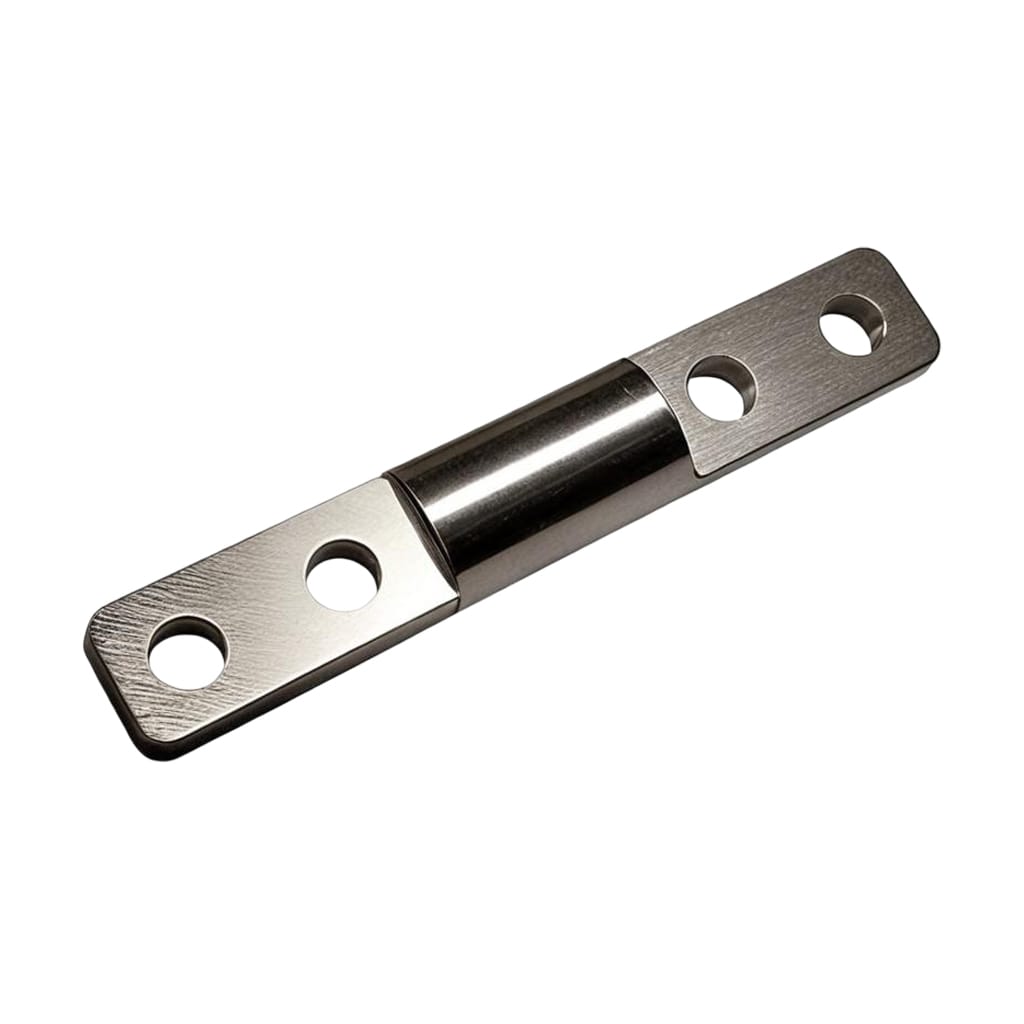
4. Skew and Racking in Dual-Hinge Systems
When a panel uses two hinges (left and right), the system is only as good as the match between them.
What it looks: The panel twists slightly during motion — one side leads, the other drags. There are rub marks on the edges, uneven gaps, or audible squeaks from the panel binding against its frame. Holding stability is poor: the panel droops or springs back inconsistently.
Why it happens: Two hinges with the same model number are not automatically identical in real torque behavior. Small differences in torque, breakaway friction, or hysteresis become visible at the system level as skew and uneven wear. Torque spread does not “average out” in parallel structures — it becomes visible as uneven motion feel. One hinge absorbs more load, wears faster, and accelerates the failure of the entire system.
5. Material-Induced Failures — Corrosion and Environmental Degradation
Many field failures begin at the material level, not the design level.
What it looks: Rust, pitting, or surface staining on the hinge exterior. Internal corrosion that seizes the mechanism. Loss of torque stability in temperature extremes. Premature wear in environments with salt spray, chemicals, or washdown cycles.
Why it happens: The material that works beautifully in a climate-controlled lab may fail catastrophically in the field. Common mismatches include:
- Using SS304 in chloride-rich marine or coastal environments where SS316 is required
- Using standard mineral-oil grease in -40°C outdoor applications — it freezes, causing torque spikes or structural fracture
- Using unhardened friction cores in high-cycle applications — they wear out quickly
- Ignoring the effects of temperature on torque — some hinge designs show torque changes of 26-34% at -30°C
6. Assembly and Mounting Errors
Even a perfectly manufactured hinge will fail if it is installed incorrectly.
What it looks: Premature wear on one side of the hinge. Cracking around mounting brackets. Uneven load distribution between hinges.
Why it happens: Friction hinges are precision components. If mounting surfaces are not coplanar within 0.1 millimeter in a dual-hinge system, one hinge absorbs most of the torque and wears out much faster than the other. Other common assembly errors include:
- Incorrect center of gravity estimation — failing to account for added components like cables, insulation, or accessories
- Over-tightening mounting screws, distorting the hinge housing
- Misalignment between hinge axis and panel rotation axis
- Wrong left-hand/right-hand hinge orientation
Part Two: Mass Production Solutions
Preventing these defects at scale requires more than good intentions. It requires a systematic approach that starts before the first production run and continues through every batch.
Solution 1: Define the Right Specifications — Beyond “2.0 Nm”
The most common mistake in hinge procurement is specifying only torque. A request for a “2.0 Nm torque hinge” ignores critical variables that determine real-world performance.
What to specify:
- Static vs. dynamic torque ratio: For premium products, the difference between breakaway torque and running torque should be within 15% for smooth, consistent feel
- Operating temperature range: If your equipment operates at -40°C, standard grease will fail — you need synthetic fluorinated grease
- Corrosion requirements: Specify salt spray hours (e.g., 96+ hours per ASTM B117)
- Cycle life and failure definition: Define what “failure” means — typically, torque decay exceeding 20% of initial value
- Environmental exposures: Chemicals, cleaning agents, humidity, UV exposure
The procurement implication: When you send an RFQ, include these parameters. A supplier who asks clarifying questions about your application is a good sign. A supplier who quotes based solely on torque without understanding your environment is a red flag.
Solution 2: Match the Material to the Environment — Not the Datasheet
Material selection is not a one-size-fits-all decision. Each material solves a different engineering problem.
SS304: The workhorse for indoor and general-purpose applications. Good corrosion resistance, good cost, good availability. But it is not suitable for marine environments, coastal installations, or aggressive washdown zones.
SS316: The upgrade for chloride exposure. The molybdenum content improves resistance to pitting corrosion. Essential for outdoor EV charging stations, marine-adjacent enclosures, and chemical plant interfaces.
Hardened steel with coating: Often the best choice for the friction interface itself. Stainless-on-stainless friction pairs are prone to galling. Hardened steel friction components with appropriate coatings (QPQ, DLC, or similar) can provide superior wear resistance and torque stability.
The procurement implication: Do not let your supplier default to “stainless steel” without specifying the grade. And remember: the friction interface material matters as much as the housing material.
Solution 3: Require Statistical Process Control — CPK > 1.33
In mass production, consistency is everything. A hinge that is perfect in the sample but varies by ±20% in production creates assembly problems, field failures, and brand damage.
What to require: Your supplier must demonstrate a CPK value greater than 1.33 for torque. This means the production process is under statistical control — consistency comes from process capability, not luck or sorting. With CPK > 1.33, mass production torque tolerance can be controlled within ±10%, rather than the industry-standard ±20%.
What CPK > 1.33 tells you:
- The process is stable and predictable
- Torque variation is controlled, not random
- You can trust that every hinge in the batch will perform like the sample
The procurement implication: Ask for CPK data in your PPAP submission. If the supplier does not track CPK, they are not controlling their process — they are hoping for good parts.
Solution 4: Implement PPAP and Automotive-Grade Quality Controls
The automotive industry’s Production Part Approval Process (PPAP) was developed because inconsistent parts kill people. The same discipline applies to friction hinges — inconsistent hinges kill products.
What PPAP provides:
- Design records that confirm the hinge matches your specifications
- Process flow diagrams that document every manufacturing step
- Process FMEA that identifies and mitigates failure modes before production
- Control plans that define how each critical characteristic is measured and controlled
- Measurement system analysis that proves torque measurement is accurate and repeatable
- Initial process capability studies that demonstrate CPK > 1.33
- Production part approval that ensures samples represent actual production
The procurement implication: If your application is safety-critical, medical, automotive, or premium consumer, require PPAP Level 3. If your supplier does not understand PPAP, find one who does.
Solution 5: Matched Pair Sourcing for Dual-Hinge Systems
If your product uses two hinges, specify matched pairs — not just two of the same model number.
What a matched pair means: The supplier applies stricter controls to ensure both hinges fall within a tighter torque window, have consistent breakaway and running torque, and are correctly direction-paired (LH/RH or CW/CCW). Each pair is factory-grouped and traceable with a Pair ID.
What a matched pair prevents:
- Skew and racking — the panel twisting during motion
- Uneven load sharing — one hinge wearing out faster
- Unstable holding behavior — droop and spring-back
- Assembly rework — the line depending on subjective feel tuning
The procurement implication: Specify “matched pair” in your RFQ. Ask how the supplier matches pairs — batch binning, left-right mirror pairing, or serial binding. If the supplier cannot explain their matched-pair process, assume you are not getting matched pairs.
Solution 6: Rigorous Incoming and In-Process Quality Control
Quality cannot be inspected into a product — it must be built in. But inspection is still essential to verify that the process is working.
What to require:
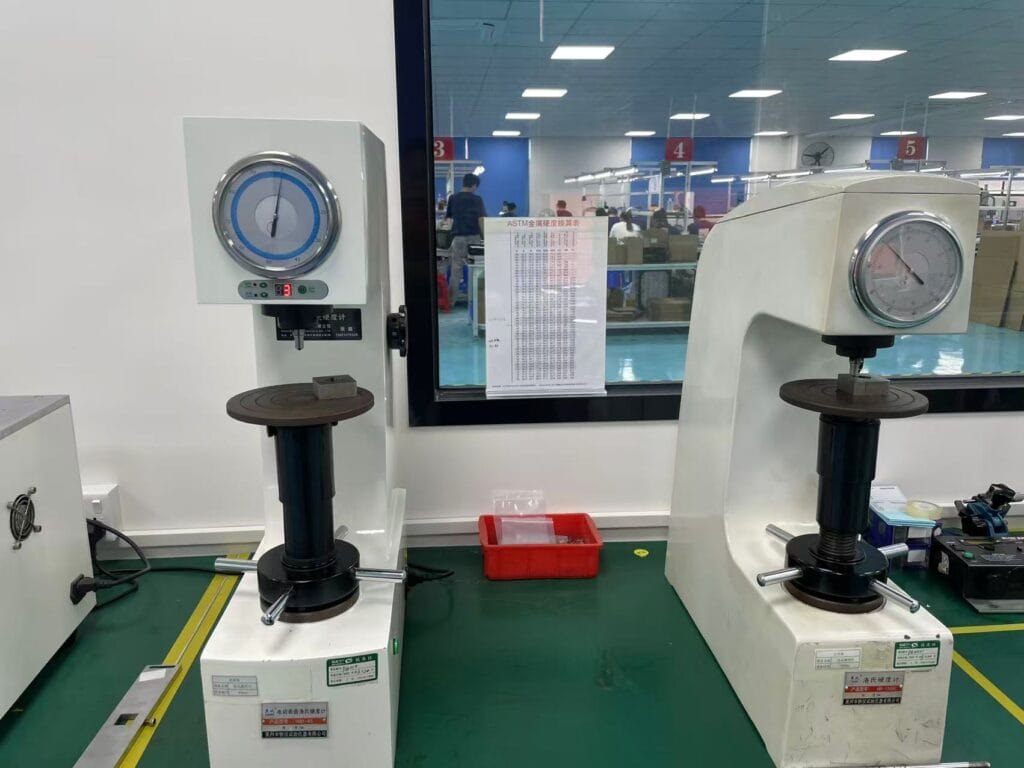
- 100% torque measurement for critical applications — every hinge tested, not just a sample
- In-house torque calibration with documented traceability to national standards
- Salt spray testing per ASTM B117 on every batch for outdoor applications
- Cycle life testing to validate that production hinges meet the rated life
- Dimensional inspection to verify shaft clearance, mounting hole positions, and coplanarity
The procurement implication: Ask for test reports with every shipment. Do not accept “certificates of compliance” without data. If the supplier cannot provide test data, they are not testing.
Solution 7: Design for Manufacturability (DFM) Before Tooling
The best time to prevent defects is before the first part is made. DFM analysis identifies potential problems in the design phase, when changes are cheap.
What DFM provides:
- 3D center of gravity simulation — many engineers calculate torque based on the geometric center of the panel, but the actual center of gravity shifts with added components
- Stress prediction — identifying high-stress areas that will cause premature wear or fracture
- Tolerance analysis — ensuring that manufacturing tolerances do not stack up to create functional problems
- Assembly validation — confirming that the hinge can be installed correctly in production
The procurement implication: Work with a supplier who offers DFM support during the development phase. A supplier who only builds what you specify — without asking questions or offering suggestions — is not adding value.
Summary: What to Look for in a Friction Hinge Supplier
When evaluating friction hinge suppliers for mass production, ask these questions:
- Do they track CPK? If not, they are not controlling their process.
- Do they offer PPAP? If your application is critical, this is non-negotiable.
- Can they match pairs? If you use two hinges, this is essential.
- Do they test every batch? Salt spray, cycle life, and torque measurement should be routine.
- Do they ask about your environment? Material and lubricant choices depend on temperature, humidity, and chemical exposure.
- Do they offer DFM support? The best suppliers help you avoid problems before tooling.
Friction hinges look simple, but torque stability and wear control determine whether your equipment holds position or slowly drops under load. In mass production, the difference between a good hinge and a bad one is not the design — it is the discipline behind the manufacturing process.
FAQ
Q1: What is the acceptable torque decay rate for a friction hinge over its lifetime?
A: For most industrial and consumer applications, the industry standard is that torque decay should not exceed 20% of the initial torque value after the rated cycle life. Some premium applications (e.g., high-end medical devices or laptops) may require tighter control, with some suppliers achieving less than 5% decay over 25,000 cycles. The key is not zero decay — which is physically impossible — but controlled, predictable decay that stays within the functional range.
Q2: Why do my dual-hinge systems always feel uneven even when both hinges have the same torque rating?
A: Because two hinges with the same model number are not automatically identical in real torque behavior. Small differences in torque, breakaway friction, or hysteresis become visible at the system level as skew, uneven feel, and faster single-side wear. The solution is to specify matched pair hinges, where the supplier applies stricter controls to ensure both hinges behave closely enough. Torque spread does not “average out” in parallel structures — it becomes visible as uneven motion.
Q3: Can I use stainless steel for both friction surfaces in a friction hinge?
A: Generally, no — this is a common mistake. Direct dry friction between austenitic stainless steels like 304 is risky because they have poor anti-galling properties and are prone to cold welding and adhesive wear. For the friction interface, hardened steel components with appropriate coatings (QPQ, DLC, or similar) typically provide superior wear resistance and torque stability. The housing can be stainless for corrosion resistance, but the friction pair itself should be engineered for wear, not just corrosion.
Q4: What does CPK > 1.33 mean for my friction hinge order, and why should I care?
A: CPK (Process Capability Index) measures how consistently a manufacturing process produces parts within specification. CPK > 1.33 means the process is under statistical control — product consistency comes from process capability, not luck or sorting. In practical terms, a supplier with CPK > 1.33 can hold mass production torque tolerance within ±10%, compared to the industry-standard ±20%. This means every hinge in your shipment will perform like the sample you approved. If your supplier cannot demonstrate CPK > 1.33, you are gambling on inconsistent quality.
Conclusion
Friction hinge failures are not random — they are the predictable result of torque decay, stick-slip, galling, material mismatch, assembly errors, or inconsistent manufacturing. The solution is not to hope for better luck, but to build a systematic approach: specify the right parameters, choose materials for the real environment, require statistical process control (CPK > 1.33), implement PPAP quality systems, specify matched pairs for dual-hinge applications, and work with suppliers who offer DFM support.
A hinge that fails in the field damages your brand, your customer relationships, and your bottom line. A hinge that performs consistently — cycle after cycle, year after year — is invisible. And invisible is exactly what you want.