
Introduction
In modern office environments and gaming setups, dual-monitor desktop mounts have gained immense popularity. Heavy 27-inch to 32-inch ultrawide monitors require robust support structures to deliver optimal viewing angles and ergonomic comfort.
Users expect smooth screen tilt adjustments without manual locking knobs. At the same time, the display arm must hold heavy monitors firmly without sagging forward unexpectedly.
For structural design engineers, supporting large screens presents a distinct mechanical challenge. Extended monitor arms create significant gravitational leverage on the VESA pitch pivot.
A mounting arm’s performance depends entirely on its tilt mechanism. Selecting an inferior monitor arm torque hinge creates severe operational problems for OEMs. Budget hardware frequently suffers from rapid torque decay, wide manufacturing variances, and unwanted joint play.
When a tilt pivot loses holding force, heavy displays suddenly tip forward. This creates safety risks, inflates warranty returns, and destroys customer trust in product quality.
Conversely, choosing a precision monitor arm torque hinge guarantees smooth pitch control, constant holding torque, and a lower Total Cost of Ownership.
Friction hinges—also known as constant torque hinges or positioning hinges—are compact motion control components engineered to provide continuous resistance across their full range of motion.
This technical guide analyzes the mechanical requirements, failure modes, and sourcing strategies needed to optimize a monitor arm torque hinge assembly according to standards recognized by the Society of Manufacturing Engineers (SME).
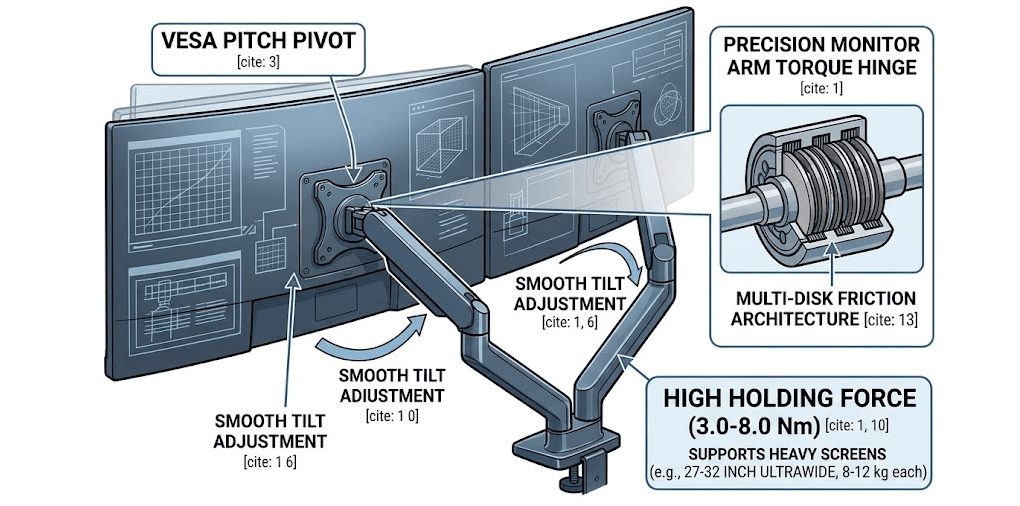
Mechanical Anatomy: High Holding Force for Extended VESA Mounts
Designing an effective monitor arm torque hinge requires generating substantial holding torque within extremely compact profiles. Desktop dual-monitor arms must support heavy displays across extended tilt angles. Generating sufficient resistance demands precise mechanical engineering.
Gravitational Torque and Pitch Control
Heavy 32-inch gaming monitors can weigh over 8 kg to 12 kg including mounting hardware. When tilted forward, the display’s center of gravity moves outward from the pivot axis, increasing rotational moment dramatically.
A high-performance monitor arm torque hinge must deliver 3.0 Nm to 8.0 Nm of continuous holding torque within narrow VESA bracket enclosures. High-quality friction hinges achieve this through controlled interference fits.
Multiple internal spring clips or friction disks clamp tightly around a central pin, providing consistent resistance without requiring manual clamping levers.
Multi-Disk Friction Architecture
Single-clip designs often fail under heavy static loads. Multi-disk or multi-band architectures distribute clamping force across multiple friction interfaces, increasing surface area while keeping the joint diameter compact.
This multi-interface geometry ensures smooth rotation during user adjustment while preventing sudden slip when holding heavy ultrawide displays in position.
Material Selection and Tribology
Substandard components rely on soft carbon steel that deforms permanently under high clamping pressure. Premium manufacturers construct every monitor arm torque hinge using high-grade SK5 or 65Mn spring steel alloys.
These high-strength alloys undergo specialized heat treatment and precision quenching to maintain yield strength and fatigue resistance.
Micro-precision surface polishing prevents “stiction”—the sudden jerky movement experienced during initial adjustment. Equalizing static friction and dynamic friction ensures effortless positioning for end users.
Overcoming the Top 3 Structural Failures in Dual-Monitor Mounts
Analyzing field return data helps engineering teams prevent structural failures early in product development. Selecting a verified monitor arm torque hinge eliminates three primary failure modes.
1. Unintended Forward Tilting and Screen Sagging
The most common failure in heavy-duty monitor arms is forward screen sagging. Low-cost hinges lose 30% to 50% of holding force within 1,000 adjustment cycles as low-grade spring bands undergo plastic deformation.
Precision manufacturing preserves spring steel elasticity across extended lifecycles. By controlling tempering processes, a quality monitor arm torque hinge keeps torque decay under <5% over 20,000 operations, ensuring heavy screens remain locked at the desired angle.
2. Thermal Softening and Lubricant Migration
Heavy gaming displays and monitor power units generate significant heat during continuous operation. Low-grade mineral grease breaks down under thermal stress, causing oil separation and reduced joint tension.
A high-performance monitor arm torque hinge utilizes high-viscosity synthetic grease. Specialized lubricant formulations preserve stable internal friction across operating temperatures ranging from -20°C to +80°C.
3. Wide Torque Tolerance and Assembly Line Scrap
Uncontrolled component variance causes major delays on factory assembly lines. Uncertified suppliers often ship hardware lots with a torque tolerance variance exceeding ±25% to ±40%.
These extreme variations create severe production bottlenecks:
- Over-Torque Units: Factory line workers struggle to install overly stiff components, risking cracked plastic VESA covers or stripped threads.
- Under-Torque Units: Loose components pass initial visual checks but fail final quality inspections when screens drop under light pressure.
Leading suppliers maintain strict monitor arm torque hinge tolerances within ±5% to ±10% of nominal ratings, ensuring rapid assembly times and zero line scrap.
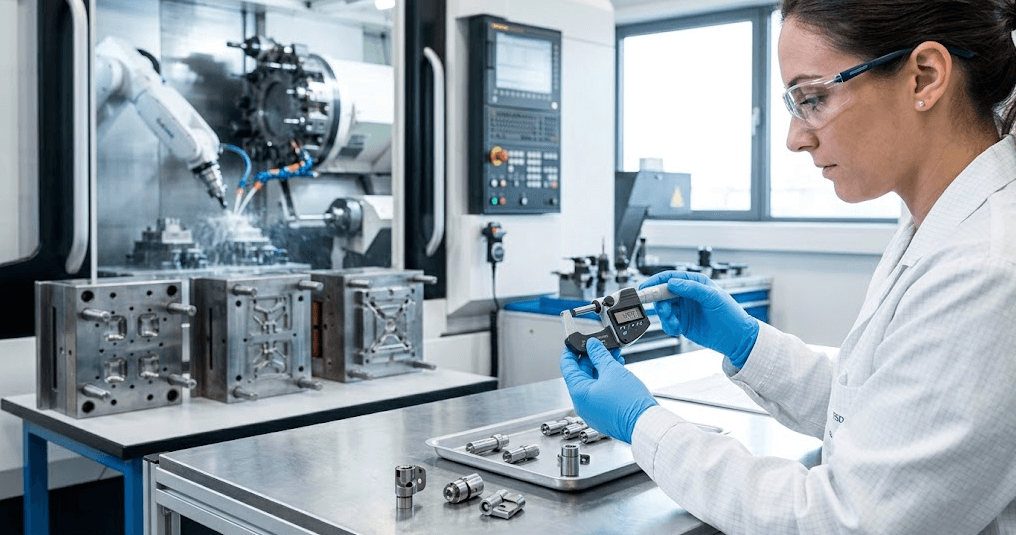
Sourcing Checklist for Ergonomic Arm OEM/ODMs
Purchasing leads and structural engineers must evaluate long-term mechanical reliability during supplier selection. Use this practical checklist during vendor audits.
1. Tilt Load Torque Calculation Formula
Before finalizing hardware specs, verify holding force requirements using standard mechanical equations:
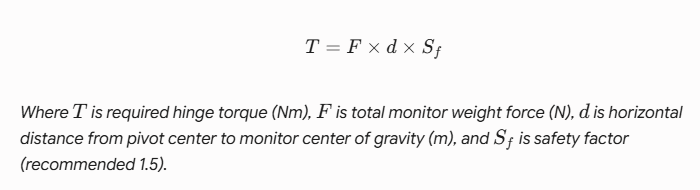
Calculating peak torque requirements early prevents under-specifying a monitor arm torque hinge during 3D CAD modeling.
2. Salt Spray Corrosion Resistance
Ergonomic monitor arms face atmospheric humidity, sweat during installation, and liquid spills. Thin plating degrades quickly, resulting in rust and joint binding.
Ensure your supplier applies zinc, nickel, or black oxide plating on every monitor arm torque hinge batch to pass 24-hour to 48-hour neutral salt spray tests (ASTM B117).
3. Custom Mounting Flanges and DFM Support
Standard off-the-shelf components rarely fit custom ergonomic arm housings. Partnering with a supplier that offers a custom positioning hinge allows you to integrate custom mounting flanges, square drive shafts, or direct-fit VESA mounting plates, simplifying assembly steps and lowering overall BOM costs.
Quality Management: Why In-House Control Matters
Achieving smooth hand-feel and long lifecycle performance requires total control over every manufacturing phase. Outsourcing critical steps creates dangerous quality variances across production lots.
High-quality component manufacturers maintain complete vertical integration. Managing toolmaking, stamping, die-casting, injection molding, heat treatment, and assembly under one roof ensures absolute raw material traceability and consistent spring tempering for every monitor arm torque hinge unit.
Furthermore, advanced facilities operate certified quality management systems adhering to international frameworks like ISO 9001 Quality Standards.
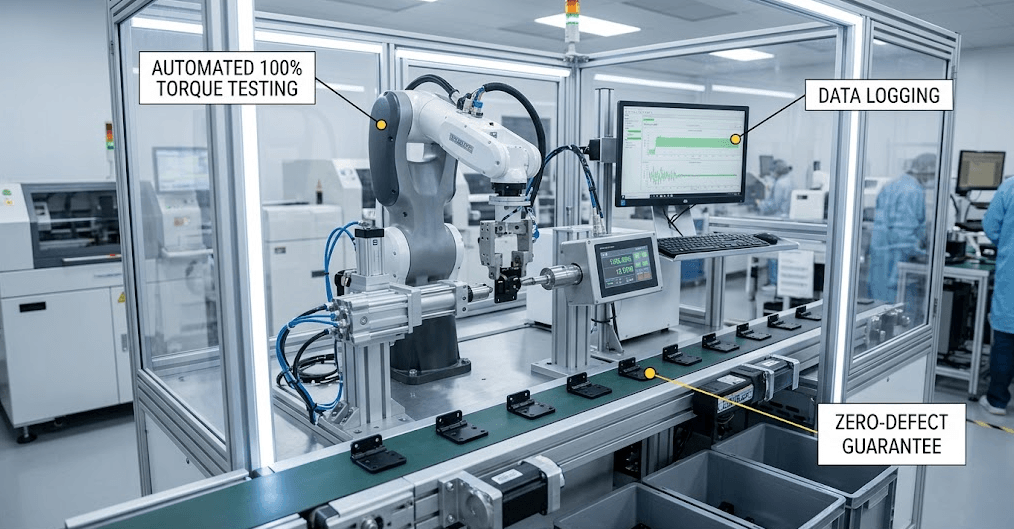
Rather than relying on periodic manual sampling, automated 100% torque testing equipment inspects every monitor arm torque hinge before dispatch. Out-of-spec parts are automatically rejected, guaranteeing zero-defect delivery to global assembly lines.
Conclusion
In the competitive ergonomic desktop accessories market, a monitor arm torque hinge is not just a hidden fastener—it is the core component that defines product stability, user safety, and long-term durability.
Minor initial savings gained by purchasing low-cost components are quickly wiped out by factory assembly delays, customer returns, and damaged brand reputation.
By partnering with a precision manufacturer that prioritizes tight torque tolerances, advanced spring steel alloys, and 100% automated quality inspection, OEMs can eliminate screen sagging, streamline assembly efficiency, and deliver heavy-duty monitor arms that stand the test of time.
Developing a heavy-duty dual-monitor arm or ergonomic workstation mount? Contact the engineering team at JAN today to request 3D STEP files, custom torque calculations, or free prototype samples for your monitor arm torque hinge projects!
FAQ
Q1: What torque rating is needed for a monitor arm torque hinge supporting a 32-inch gaming display?
A1: A heavy 32-inch gaming display typically requires a monitor arm torque hinge rated between 4.0 Nm and 7.5 Nm, depending on screen weight and offset distance, preventing unwanted forward tilt.
Q2: How do you stop a heavy dual-monitor VESA mount from tilting forward?
A2: Unintended tilting is prevented by using heat-treated SK5 spring steel bands, high-viscosity synthetic grease, and precision multi-disk interference fits. This combination limits torque decay to less than 5% across 20,000+ adjustment cycles.
Q3: What is the ideal torque tolerance for a monitor arm torque hinge on automated assembly lines?
A3: JAN maintains a strict torque tolerance of ±5% to ±10% on nominal specifications through 100% automated torque testing, eliminating factory line assembly issues and housing stress cracking.
Q4: Can JAN customize mounting flanges for heavy-duty monitor arm torque hinge designs?
A4: Yes. JAN offers complete OEM/ODM engineering support. We can design a custom positioning hinge featuring specialized mounting flanges, square drive shafts, and custom torque ratings to fit your unique arm enclosure.