
Introduction
In modern healthcare facilities, mobile nursing workstations, ward round diagnostic trolleys, and medical ultrasound carts are indispensable. Diagnostic monitors ranging from 15 to 27 inches require reliable support systems to ensure clear viewing angles for clinical staff.
Nurses and doctors must adjust screen angles effortlessly during patient examinations. At the same time, the display joint must remain completely stable without sagging or making noisy creaks.
For medical device engineers, designing display mounts for clinical trolleys presents strict mechanical and environmental challenges. Medical hardware must satisfy demanding requirements for acoustic compliance, chemical resistance, and smooth physical adjustment.
A mobile cart’s clinical usability depends heavily on its pivot assembly. Selecting an inferior medical cart display hinge creates severe operational issues for OEMs. Standard industrial hinges often suffer from metallic noise, corrosion binding, rapid torque loss, and harsh mechanical backlash.
When a display joint loses friction or squeaks during night rounds, it disturbs resting patients and risks sudden screen dropping during cart movement. This leads to clinical safety risks, elevated warranty claims, and damaged brand reputation.
Conversely, specifying a premium medical cart display hinge guarantees silent articulation, seamless hygienic cleaning, smooth one-handed screen positioning, and long-term durability.
Friction hinges—also known as constant torque hinges or positioning hinges—are compact motion control components engineered to deliver continuous holding force across their entire rotational range.
This technical guide analyzes the mechanical requirements, clinical protocols, and sourcing criteria needed to optimize a medical cart display hinge assembly according to international standards recognized by the Society of Manufacturing Engineers (SME).
Clinical Anatomy: Silent, Smooth, and Hygienic Motion Control
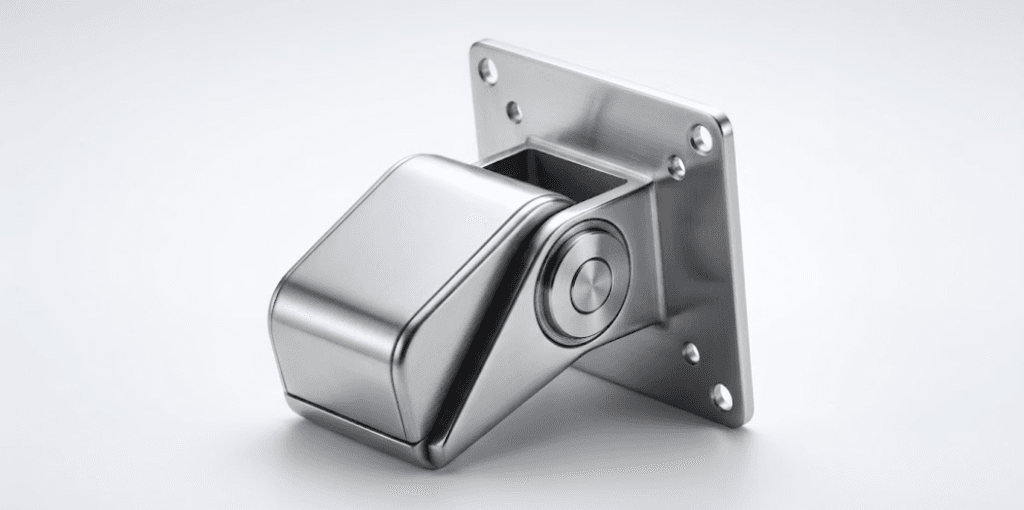
Developing an effective medical cart display hinge requires balancing robust torque output with strict clinical hygiene standards. Mobile diagnostic carts operate in sensitive environments where equipment noise and contamination must be strictly minimized.
Acoustic Dampening and Silent Articulation
Intensive Care Units (ICUs) and night wards require acoustic levels to stay below strict decibel thresholds. Standard metallic hinges often produce squeaking noises during angle adjustments due to stick-slip friction.
A high-performance medical cart display hinge uses micro-polished friction surfaces combined with specialized acoustic dampening greases. Premium friction hinges maintain whisper-quiet operation (<30 dB) across 20,000+ adjustment cycles, preventing noise disturbance in quiet hospital environments.
Seamless Hygienic Architecture
Hospital equipment faces frequent chemical sterilization using aggressive disinfectants containing isopropyl alcohol, hydrogen peroxide, or ammonium compounds. Hardware with open crevices traps moisture and breeds bacterial colonies.
To ensure easy cleaning, advanced positioning joints feature enclosed housing geometries without exposed screws or internal cavities.
Constructed with high-grade stainless steel (SUS304/SUS316) or medical-grade anti-corrosion platings, these units resist fluid ingress and prevent chemical degradation during daily hospital wipe-downs.
One-Handed Ergonomic Positioning
Healthcare workers frequently adjust display angles while holding diagnostic probes, patient files, or medical devices in their other hand.
Delivering constant holding torque between 2.0 Nm and 6.0 Nm allows clinical staff to position 15-to-27-inch diagnostic screens smoothly using one hand. The joint holds its exact position instantly without requiring manual locking levers or adjustment knobs.
Overcoming Top 3 Failures in Mobile Medical Workstations
Analyzing field performance data helps engineering teams eliminate structural failures early in product development. Specifying a verified medical cart display hinge resolves three major operational failure modes.
1. Disinfectant Degradation and Corrosion Binding
The most frequent hardware failure on mobile medical carts is joint binding caused by harsh chemical sterilization. Low-grade carbon steel hinges corrode quickly when exposed to daily medical disinfectants, becoming overly stiff or seizing completely.
Precision manufacturing prevents chemical attack through multi-layer electroplating and synthetic sealing grease. A quality medical cart display hinge maintains smooth rotation and passes 48-hour to 96-hour neutral salt spray corrosion tests without surface degradation.
2. Screen Sagging During Rapid Trolley Movement
Mobile workstations frequently cross elevator thresholds, tile expansion joints, and door sills. Dynamic impacts during transit generate high shock loads on display tilt pivots, causing low-quality joints to slip downward.
Precision spring steel bands provide high static friction to resist sudden kinetic shocks. This ensures the monitor remains locked at its set viewing angle even during rapid cart transport across uneven hospital floors.
3. Wide Torque Tolerance and Assembly Line Scrap
Inconsistent component torque creates major assembly line delays for medical device manufacturers. Uncertified hardware suppliers frequently deliver positioning joints with a torque tolerance variance exceeding ±25% to ±40%.
These extreme variations cause severe manufacturing problems:
Over-Torque Units: Assembly line technicians struggle to install overly stiff hardware, risking cracked plastic display enclosures during mounting.
Under-Torque Units: Loose components fail final quality testing when heavy diagnostic monitors tilt forward under light pressure.
Leading suppliers maintain strict medical cart display hinge tolerances within ±5% to ±10% of nominal ratings, ensuring rapid line assembly and zero component scrap.

OEM/ODM Sourcing Checklist for Medical Equipment Manufacturers
Purchasing managers and structural design engineers must evaluate long-term mechanical reliability during vendor selection. Use this practical checklist during supplier audits.
1. Tilt Load Torque Calculation Formula
Before finalizing hardware specs, verify holding force requirements using standard mechanical equations:
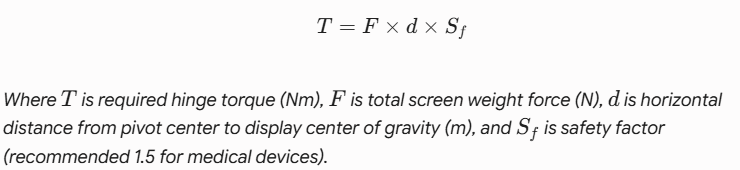
Calculating peak torque requirements early prevents under-specifying a medical cart display hinge during 3D CAD modeling.
2. Custom VESA Mounting Interfaces
Standard off-the-shelf hinges rarely integrate directly into streamlined medical trolley enclosures. Partnering with a supplier that offers a custom positioning hinge allows you to integrate custom VESA adapter plates, internal wire routing channels, and concealed mounting tabs.
This simplifies trolley assembly steps, hides messy cables, and lowers total Bill of Materials (BOM) costs.
3. Medical Compliance Protocols
Ensure component manufacturing aligns with recognized medical quality frameworks. Suppliers should maintain certification under ISO 13485 medical devices quality management and adhere to IEC 60601-1 structural safety standards for medical electrical equipment.
Quality Management: Why In-House Control Matters
Achieving smooth hand-feel and long lifecycle performance requires total control over every manufacturing phase. Outsourcing critical steps creates dangerous quality variances across production lots.
High-quality component manufacturers maintain complete vertical integration. Managing toolmaking, stamping, die-casting, heat treatment, and assembly under one roof ensures absolute raw material traceability and consistent spring tempering for every medical cart display hinge unit.
Furthermore, advanced facilities operate certified quality management systems adhering to international frameworks like ISO 9001 Quality Standards.
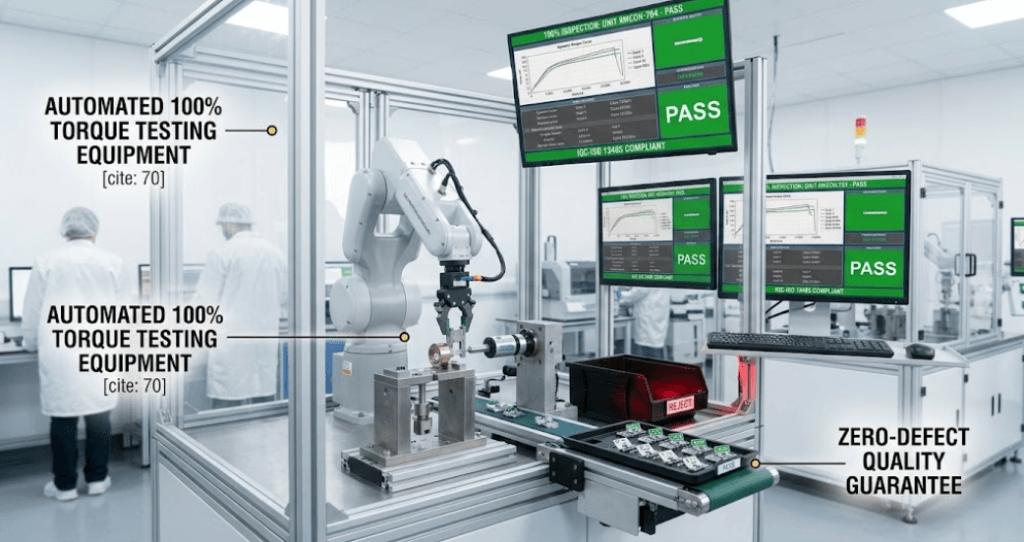
Rather than relying on periodic manual sampling, automated 100% torque testing equipment inspects every medical cart display hinge before dispatch. Out-of-spec parts are automatically rejected, guaranteeing zero-defect delivery to global assembly lines.
Conclusion
In the demanding medical equipment sector, a medical cart display hinge is not just a hidden mechanical bracket—it is a critical safety component that defines clinical usability, hygiene compliance, and equipment durability.
Minor initial savings gained by purchasing low-cost industrial hinges are quickly wiped out by factory assembly defects, chemical corrosion failures, and customer service calls.
By partnering with a precision manufacturer that prioritizes tight torque tolerances, medical-grade materials, and 100% automated quality inspection, OEMs can eliminate screen sagging, streamline assembly efficiency, and deliver mobile medical carts that stand the test of time.
Developing a medical diagnostic trolley, mobile nursing cart, or ultrasound workstation? Contact the engineering team at JAN today to request 3D STEP files, medical torque calculations, or free prototype samples for your medical cart display hinge projects!
FAQ
Q1: What torque rating is needed for a medical cart display hinge supporting a 24-inch diagnostic screen?
A1: A typical 24-inch medical diagnostic screen requires a medical cart display hinge rated between 3.5 Nm and 6.0 Nm, depending on screen weight and offset distance, preventing unwanted screen drop during trolley movement.
Q2: How do medical cart display hinges resist harsh hospital disinfectants?
A2: Chemical resistance is achieved by using SUS304/SUS316 stainless steel or specialized multi-layer electroplating, paired with high-viscosity synthetic grease and enclosed housing designs that prevent disinfectant fluid ingress.
Q3: What makes a medical cart display hinge quiet enough for ICU environments?
A3: Quiet operation is ensured by micro-polishing internal friction surfaces and applying specialized acoustic dampening grease. This eliminates stick-slip friction and maintains operation noise below <30 dB during screen adjustments.
Q4: Can JAN manufacture custom medical cart display hinge designs with VESA mounting plates?
A4: Yes. JAN provides complete OEM/ODM engineering support. We can manufacture a custom positioning hinge with integrated VESA plates, hidden mounting tabs, internal wire channels, and precise torque settings for your medical cart enclosure.