
Introduction
In modern emergency medicine and field diagnostics, portable ECG machines, veterinary ultrasound scanners, and rugged diagnostic kits are essential tools. Mobile healthcare units must perform reliably under unpredictable field conditions and rapid transit.
Field paramedics and clinicians rely on screen covers and display lids that open instantly and stay firmly in position. At the same time, protective covers must resist sudden movement caused by vehicle vibration or accidental bumps.
For medical hardware design engineers, engineering display joints for compact diagnostic gear presents unique structural challenges. Portable devices require high holding torque within compact enclosures, extreme temperature stability, and high dynamic shock resistance.
A field unit’s operational safety depends heavily on its pivot assembly. Choosing a low-grade portable medical device hinge creates serious risks for OEMs. Standard industrial hinges often suffer from severe torque loss, mechanical backlash, binding, and physical play.
When a protective screen cover snaps shut unexpectedly during an ambulance ride or field diagnosis, it risks damaging sensitive equipment, delaying treatment, or injuring operators. This causes field failures, inflated warranty costs, and brand dissatisfaction.
Conversely, integrating a specialized portable medical device hinge guarantees stable hold-at-any-angle performance, high shock absorption, smooth operation, and long-term joint durability.
Positioning hinges—also known as constant torque hinges or friction joints—are compact motion control mechanisms engineered to deliver constant resistance across their full range of motion.
This technical guide analyzes mechanical design criteria, field failure modes, and OEM sourcing strategies needed to optimize a portable medical device hinge assembly according to standards recognized by the Society of Manufacturing Engineers (SME).
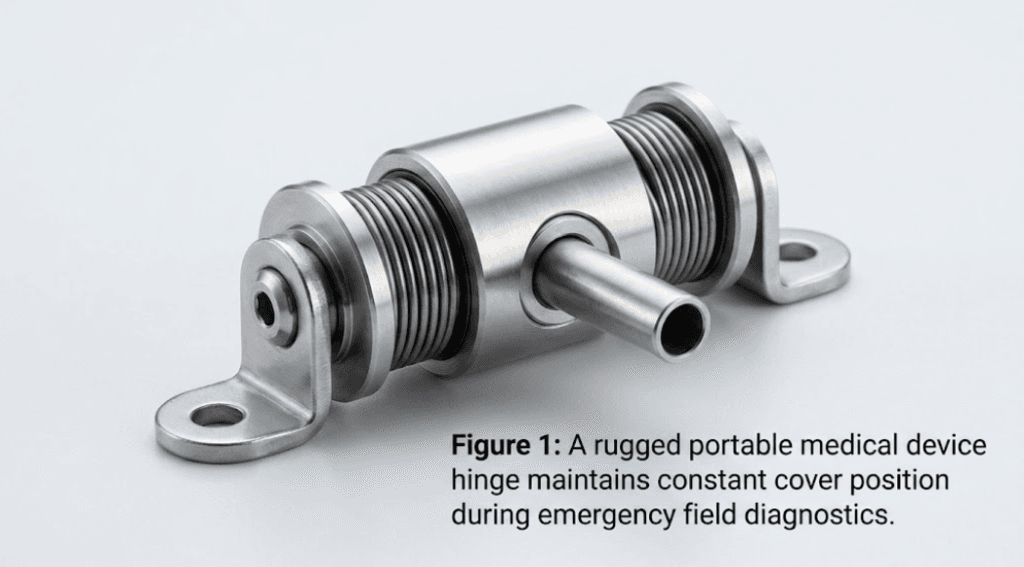
Mechanical Architecture: Anti-Vibration and Constant Torque Performance
Designing a high-performance portable medical device hinge requires maintaining steady holding torque within extremely limited internal spaces. Compact diagnostic instruments require precise friction mechanisms capable of enduring harsh mobile conditions.
Constant Torque Spring Band Assembly
Traditional spring latches or free-swinging hinges fail to keep screen covers steady under dynamic motion. Compact positioning joints rely on precision-formed spring bands clamped around center pivot pins.
A high-performance portable medical device hinge uses symmetrical spring bands that provide equal resistance in both opening and closing directions. High-quality friction hinges generate 1.0 Nm to 4.5 Nm of continuous torque, securing display covers at any angle without manual lock knobs.
Dynamic Vibration Resistance
Mobile diagnostic units face continuous mechanical vibration during ambulance transport and rough outdoor handling.
Static Friction Hold: High static torque prevents display lids from drooping during vehicle transit over uneven terrain.
Kinetic Smoothness: Balanced dynamic torque ensures medical staff can adjust display angles smoothly without sudden mechanical jerky motion.
Material Selection and Wide-Temperature Lubrication
Field hardware must perform across extreme climate conditions, from sub-zero winter rescues to scorching desert clinics. Standard mineral lubricants break down under thermal stress, leading to joint binding or fluid leaks.
Engineers construct every portable medical device hinge using premium SK5/SK7 spring steel or stainless steel alloys. Synthetic grease formulations maintain stable internal friction across broad operating temperatures ranging from -30°C to +85°C.
Overcoming Top 3 Failures in Mobile & Emergency Medical Hardware
Analyzing field return data helps engineering teams prevent structural failures early in product development. Specifying a verified portable medical device hinge eliminates three major field failure modes.
1. Accidental Cover Slamming in Emergency Scenarios
The most critical safety hazard in field diagnostics is a heavy display cover snapping shut unexpectedly due to engine vibration or bumps. Low-cost hinges lose clamping tension quickly after minimal usage cycles.
Precision manufacturing guarantees zero axial play across extended lifecycles. By maintaining tight dimensional controls, a quality portable medical device hinge keeps torque decay under <5% over 20,000 cycles, keeping display covers completely stable.
2. Environmental Degradation and Fluid Ingress
Field medical equipment is regularly exposed to rain, dust, bodily fluids, and harsh chemical sanitizers. Low-grade plating corrodes rapidly, causing joints to bind or lock up.
High-grade anti-corrosion platings protect component surfaces against environmental exposure. Sealed internal greases prevent moisture ingress and pass 48-hour to 96-hour neutral salt spray tests (ASTM B117).
3. Casing Stress Cracking from Poor Torque Tolerances
Inconsistent component torque creates severe structural failures during automated assembly. Uncertified suppliers frequently deliver hardware lots with a torque tolerance variance exceeding ±25% to ±40%.
These extreme variations cause severe manufacturing problems:
Over-Torque Units: Excessive stiffness stresses lightweight ABS/PC composite device housings, causing stress cracks around mounting screws during assembly.
Under-Torque Units: Loose components fail final quality inspection when heavy covers drop under minor vibration.
Leading suppliers maintain strict portable medical device hinge tolerances within ±5% to ±10% of nominal ratings, ensuring fast assembly times and zero line scrap.
OEM/ODM Sourcing Checklist for Emergency & Diagnostic Equipment
Purchasing leads and mechanical engineers must evaluate long-term reliability during hardware vendor selection. Use this practical checklist during vendor audits.
1. Dynamic Load Torque Calculation Formula
Before finalizing CAD specs, calculate holding force requirements using standard mechanical equations:

Calculating torque requirements early prevents under-specifying a portable medical device hinge during 3D modeling.
2. Compact Footprint and Cable Routing Options
Internal wiring is essential for portable ECG units and dual-display diagnostic kits. Partnering with a supplier that offers a custom positioning hinge allows you to integrate hollow center shafts.
This enables delicate flexible printed circuits (FPC) to pass directly through the pivot axis without pinching during 180-degree rotation.
3. Ergonomic Hand-Feel and Single-Hand Operation
Field medical personnel frequently operate equipment with one hand while holding medical tools with the other.
A well-engineered portable medical device hinge provides smooth friction resistance, allowing clinicians to open, adjust, and close protective lids effortlessly using one hand.
Quality Management: Why In-House Control Matters
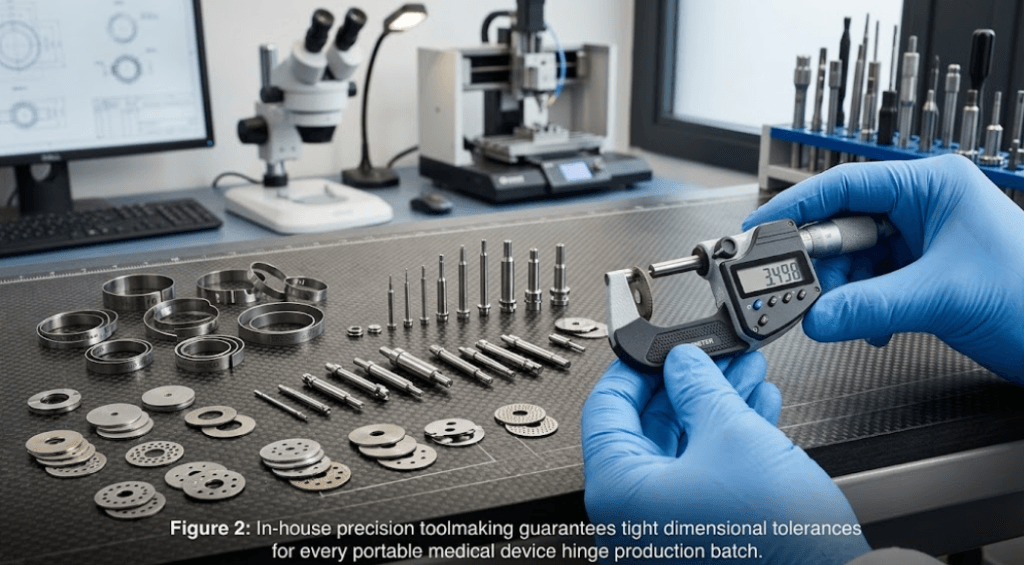
Achieving smooth hand-feel and long lifecycle performance requires total control over every manufacturing phase. Outsourcing critical steps creates dangerous quality variances across production lots.
High-quality component manufacturers maintain complete vertical integration. Managing micro-toolmaking, stamping, die-casting, heat treatment, and assembly under one roof ensures absolute raw material traceability and consistent spring tempering for every portable medical device hinge unit.
Furthermore, advanced facilities operate certified quality management systems adhering to international frameworks like ISO 9001 Quality Standards.
Rather than relying on periodic manual sampling, automated 100% torque testing equipment inspects every portable medical device hinge before dispatch. Out-of-spec parts are automatically rejected, guaranteeing zero-defect delivery to global assembly lines.

Conclusion
In the demanding emergency medical equipment sector, a portable medical device hinge is not just a hidden mechanical joint—it is a critical safety component that defines equipment protection, field usability, and diagnostic efficiency.
Minor initial savings gained by purchasing low-cost industrial hinges are quickly wiped out by factory assembly defects, casing cracks, and field equipment failures.
By partnering with a precision manufacturer that prioritizes tight torque tolerances, wide-temperature lubricants, and 100% automated quality inspection, OEMs can eliminate cover drooping, streamline assembly efficiency, and deliver portable medical devices that stand the test of time.
Developing a portable ultrasound scanner, ECG machine, or rugged emergency kit? Contact the engineering team at JAN today to request 3D STEP files, torque calculations, or free prototype samples for your portable medical device hinge projects!
FAQ
Q1: What torque rating is required for a portable medical device hinge in an ECG machine cover?
A1: A portable ECG machine cover typically requires a portable medical device hinge rated between 1.0 Nm and 3.5 Nm, depending on lid size and weight, ensuring stable positioning without housing strain.
Q2: How does a portable medical device hinge prevent cover slamming during ambulance transport?
A2: Unwanted movement is prevented by utilizing high-friction spring steel bands and high static torque ratios. This design counteracts dynamic vehicle vibration and shock loads to keep the cover securely open.
Q3: Can portable medical device hinges operate in extreme outdoor temperatures?
A3: Yes. High-quality positioning joints use wide-temperature synthetic greases and heat-treated spring alloys, allowing the portable medical device hinge to maintain stable friction performance from -30°C to +85°C.
Q4: Does JAN offer custom mounting plates for portable medical device hinge applications?
A4: Yes. JAN provides complete OEM/ODM engineering support. We can manufacture a custom positioning hinge with integrated mounting brackets, hollow shafts for FPC wiring, and tailored torque settings to fit compact diagnostic enclosures.