
Introduction: The Infamous “Drooping Screen” Problem
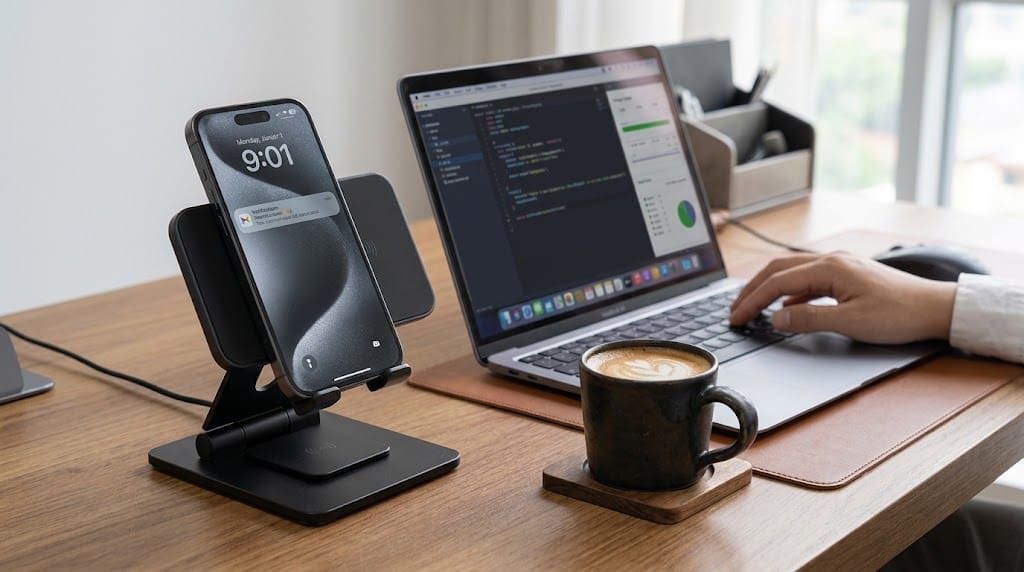
We are all familiar with this scenario: you buy a stylish, beautifully designed aluminum desktop phone stand, place your phone on it, adjust the viewing angle, and settle in to watch a video or join an urgent video call. At first, everything feels solid, reliable, and premium. But fifteen or twenty minutes into the call, you notice a subtle yet incredibly annoying issue: the phone screen is slowly tilting downward.
By the time the half-hour meeting ends, the phone’s camera is pointing straight down at the desk. You push it back into position, but within minutes, gravity wins out again. The stand’s friction hinge has failed.
In the consumer electronics and hardware manufacturing industries, this phenomenon is known as “sagging,” “collapsing,” or “torque slippage.”
As a specialized manufacturer of custom Friction hinges working directly with overseas hardware engineering teams at JanHinge Friction Hinge Solutions, we can tell you one thing with complete certainty: a drooping stand is rarely caused by cheap materials alone; it is almost always the direct result of under-calculating operational torque or failing to account for real-world dynamic leverage.
If you are a mechanical engineer designing the next generation of adjustable mobile accessories, or a sourcing manager trying to figure out why your overseas factory samples keep failing after two weeks of testing, this comprehensive guide is written specifically for you. We are going to strip away overly dense academic textbook jargon and talk through how hinge torque actually behaves, how to accurately calculate required holding forces, and how to specify a reliable free stop hinge that holds rock-solid every single time.
Why Do Phone Stands Sag Over Time? (The Physics of Failure)
Before jumping into mathematical equations, let’s talk about why friction hinges fail in real-world environments. Understanding these specific failure points allows mechanical engineers and procurement teams to design around them before committing tens of thousands of dollars to production tooling.
1. The Lever Arm Effect (Center of Gravity Shift)
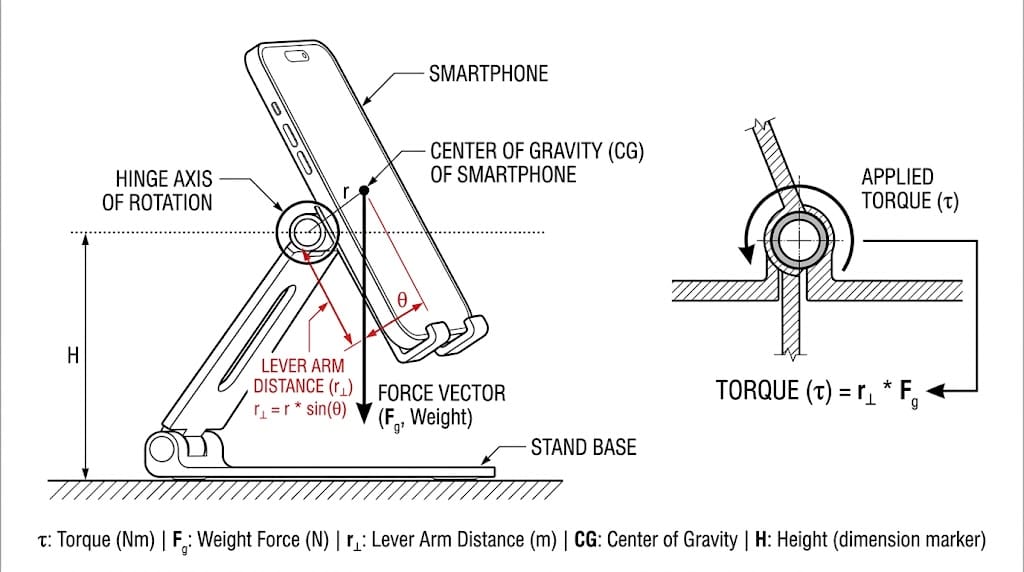
A smartphone doesn’t simply sit flat on top of a pivot axis; it extends outward and upward from it. The distance between the phone’s center of gravity (CG) and the center line of the hinge pivot creates a rotational force called torque (or moment). The farther the user leans the phone back or extends the mounting arm forward, the longer the effective moment arm becomes, drastically increasing the rotational force exerted on the internal friction mechanism. If your design calculations only account for the phone’s static dead weight sitting perfectly vertical, the stand will inevitably collapse the second a user adjusts it to a 45-degree horizontal tilt.
2. Torque Decay (Loss of Friction Over Lifecycle)
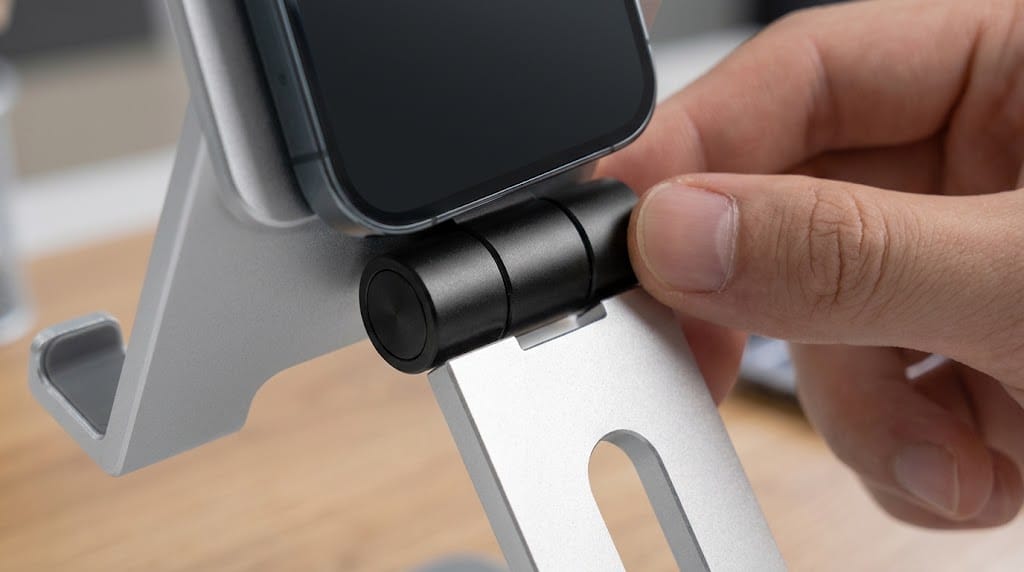
Every friction hinge operates through mechanical interference—typically hardened spring steel clips wrapped tightly around a ground steel pin, or compressed steel disk packs bathed in high-performance synthetic grease. Every single time a user adjusts or folds the stand, microscopic mechanical wear occurs on these contact surfaces.
Over 5,000, 10,000, or 20,000 continuous motion cycles, the holding tension gradually diminishes. This phenomenon is known as torque decay or attenuation. If your initial product design starts with zero safety margin above the static load, even a minor 5% drop in friction force will result in immediate screen drooping.
3. Thermal Expansion & Viscosity Changes
Will your phone stand be used inside a sunlit vehicle on a hot summer dashboard? Or placed directly next to a high-powered gaming laptop’s heat exhaust vent? Temperatures inside a parked car in summer can easily reach 60C-140^\circ\text{F}$). Heat causes plastic housings and aluminum structural arms to expand at different thermal rates while simultaneously lowering the viscosity of internal dampening grease. A hinge mechanism that feels firm and resistive at room temperature ($20^\circ\text{C}$) can become loose and floppy when exposed to elevated operating temperatures.
4. Dynamic User Interaction (Screen Tapping & Swiping)
End users do not simply stare at their phone screens; they actively tap buttons, swipe notifications, and type text messages while the device remains mounted on the stand. Every single finger tap applies a dynamic downward force ($F_{\text{dynamic}}$) that is significantly higher than the static gravitational weight of the phone itself. If the friction mechanism cannot withstand these momentary dynamic force spikes, the phone stand will incrementally slip downward with every touch.
The Torque Calculation Formula: Step-by-Step
Calculating the exact holding torque required for an adjustable phone stand mechanism isn’t rocket science, but it requires mechanical rigor with units, leverage distances, and safety multipliers. Let’s break down the step-by-step mathematical model used by senior mechanical designers.
Basic Formula for Static Holding Torque
Step-by-Step Practical Example
Let me walk you through a practical, real-world calculation example for a heavy-duty modern desktop smartphone holder.
Step 1: Establish Your Maximum Weight Load ($F$)
Never calculate holding force based on the lightest modern smartphone (e.g., $160\,\text{g}$). Always design for the heaviest plausible real-world configuration.
- Heavy Smartphone (e.g., iPhone Pro Max or Ultra model): 240g
- Protective Armor Case + Magnetic Ring/Wallet Attachment: 110g
- Total Maximum Load Mass (M): 350g = 0.35kg
- Gravitational Force (F): 0.35kg*9.8*m/s2 = 3.433N
Step 2: Measure the Maximum Lever Arm Distance (d)
Measure the linear distance from the center line of your torque hinge pin to the geometric center of the phone mounting pad at full extension.
constant torque friction hinge.
Dual-Shaft vs. Single-Shaft Stands: Torque Distribution
When designing multi-axis adjustable desktop stands, you typically incorporate two distinct pivot points: a Base Pivot (Hinge A) and a Top Display Pivot (Hinge B).
         [ SMARTPHONE ]
               |
          (Pivot B)   <-- Top Display Hinge (Controls tilt angle)
               |
         [ Extension Arm ]
               |
          (Pivot A)   <-- Base Pivot Hinge (Controls height & reach)
               |
         [ BASE PLATE ]
Top Display Hinge (Pivot B)
- Primary Role: Adjusts the viewing tilt angle of the screen facing the user.
- Lever Arm Length: Short distance (from the center of the phone plate to Pivot B).
- Target Torque Specification: Lower rating 0.35Nm
- User Experience Goal: Needs to feel smooth and responsive so the user can easily adjust screen tilt with one hand without dragging the entire base across the table.
Base Pivot Hinge (Pivot A)
- Primary Role: Supports the combined load of the smartphone, mounting bracket, AND the upper extension arm.
- Lever Arm Length: Long distance (from the phone’s center of gravity all the way down to the desktop base axis).
- Target Torque Specification: High rating (typically $0.45 – 0.85\,\text{N}\cdot\text{m}$).
- User Experience Goal: Must maintain absolute structural rigidity so that tapping the upper corners of the screen does not cause the support arm to collapse downward.
Material Selection: Balancing Structural Integrity & Budget
Selecting the proper raw materials for the friction bands, internal pivot pins, and outer mounting housings directly influences both the manufacturing cost and the long-term lifecycle performance of your stand.
| Material Combination | Key Performance Strengths | Ideal Product Application | Expected Lifecycle | Relative Cost |
| High-Carbon Steel Clips + Hardened Stainless Pin | Exceptional torque stability, minimal wear decay, extreme fatigue resistance | Heavy-duty desktop stands, tablet mounts | 20,000+ Cycles | Moderate |
| Zinc Alloy Molded Housing + Steel Clip | High structural precision, easy custom geometry integration, sleek finish | Premium aluminum-style desktop accessories | 10,000 – 15,000 Cycles | Cost-Effective |
| Full Stainless Steel (SUS304 / SUS316) | Superior corrosion resistance, waterproof, high tensile strength | Outdoor mounts, marine & vehicle holders | 30,000+ Cycles | Premium |
| Stamped Sheet Steel Assembly | Extremely thin profile, lightweight, ultra-compact footprint | Pocket folding stands, back-of-case kickstands | 3,000 – 5,000 Cycles | Low Cost |
For high-volume consumer electronic accessories where slim profiles and sleek aesthetic integration are mandatory, custom OEM friction hinges featuring zinc-alloy die-cast housings provide the ultimate balance between structural rigidity, tight dimensional tolerances, and unit cost efficiency.
Common Design Pitfalls That Cause Hinge Droop
Over our two decades as a specialized custom hinge manufacturer, our engineering team has evaluated thousands of returned market samples and client prototypes. Here are the top three mistakes mechanical designers make:
Pitfall #1: Designing for “Hand Feel” Instead of Quantitative Data
Many product designers select a sample hinge based purely on how stiff it feels when turned by hand during an initial meeting. Subjective hand testing is deeply misleading. An engineer twisting a small hinge component between their thumb and index finger exerts far more concentrated torque than a 250-gram smartphone exerts at the end of an 8-centimeter arm. Always rely on calibrated digital torque meters rather than subjective human tactile feel.
Pitfall #2: Ignoring Environmental Thermal Cycling
If your finished product is exported globally, it will experience shipping inside unconditioned ocean freight containers ($70^\circ\text{C}$) and freezing winter warehouse transit ($-20^\circ\text{C}$). Low-grade dampening grease can bleed, melt, or migrate away from internal friction contact points under heat exposure, resulting in sudden loss of resistance or harsh metal-on-metal squeaking. Ensure your hinge supplier utilizes high-viscosity synthetic hydrocarbon or fluorosilicone greases specifically formulated for wide operating temperature windows.
Pitfall #3: Forgetting Structural Mounting Deflection
If your internal mounting shaft has a loose clearance tolerance ($\pm 0.15\,\text{mm}$) or your plastic support housing flexes under load, that physical play creates mechanical slack. The internal friction hinge itself might not be slipping at all, but the surrounding plastic structural frame gives way, giving the end user the exact same impression of a loose, drooping stand. Always reinforce structural mounting bosses with support ribs or die-cast metal inserts.
How Procurement Managers Can Guarantee Mass Production Quality
If you manage sourcing and procurement, your main concern isn’t just approved engineering samples—it’s mass production consistency across tens of thousands of units. It is a common nightmare in international sourcing for factory “golden samples” to pass incoming inspection perfectly, only for a full shipment container of 50,000 finished units to arrive with $25\%$ of the batch feeling noticeably loose or sloppy.
To safeguard your brand reputation and project delivery timelines, require your hinge manufacturing supplier to adhere strictly to the following quality verification protocols:
- Tight AQL Torque Specifications: Enforce strict Acceptance Quality Limit (AQL) standards for torque output. While standard industrial components allow tolerances of $\pm 15\%$, high-end consumer mobile accessories require $\pm 10\%$ or strict $\pm 8\%$ limits.
- Standardized Lifecycle Testing: Require 100% verified factory lifecycle test reports. Standard verification procedures run hinges continuously at 10 to 15 cycles per minute for 10,000 cycles, tracking torque attenuation curves over time. Torque loss after completing the full lifecycle test should never exceed $15\%$ to $20\%$ of the initial nominal rating.
- 100% Automated In-Line Torque Inspection: Confirm that your manufacturing partner utilizes automated, computerized torque testing fixtures on the production assembly line rather than relying on manual spot checks by line workers.
At JanHinge Quality Control Laboratory, every production batch of constant torque positioning hinges undergoes automated $100\%$ torque screening, ensuring that the first production unit off the assembly line delivers the exact same smooth, reliable holding feel as the 100,000th unit delivered to your factory.
Frequently Asked Questions (FAQ)
Q1: What is the main difference between a friction hinge and a detent hinge for phone stands?
A friction hinge (also called a constant torque hinge or free-stop hinge) provides continuous, uniform resistance throughout its full range of rotation. This allows the user to position and stop their phone at any custom angle. A detent hinge, on the other hand, snaps mechanically into pre-determined indexing angles (e.g., $30^\circ$, $60^\circ$, $90^\circ$) using internal detent notches or spring balls. For modern smartphones and tablets, continuous friction hinges are vastly preferred because users require precise micro-adjustments for screen glare and camera angles.
Q2: What torque tolerance standard should I specify on my engineering drawings?
For high-quality consumer electronics accessories, specifying a nominal torque rating with a tolerance of $\pm 10\%$ provides the ideal balance between smooth user tactile feel and efficient mass-manufacturing yields. Requesting ultra-tight tolerances tighter than $\pm 8\%$ significantly increases component inspection and manufacturing costs without delivering a noticeable performance benefit to the end user.
Q3: Why does my phone stand hinge begin making a squeaking or grinding noise after a few weeks of use?
Squeaking or grinding sounds indicate dry metal-on-metal wear (galling) occurring inside the friction mechanism. This happens when low-grade dampening grease breaks down under friction heat, migrates out of the friction zone, or was improperly applied during factory assembly. Premium constant torque hinges utilize specialized high-viscosity synthetic lubricants combined with surface-hardened steel alloys to ensure silent, smooth operation throughout the product’s lifespan.
Q4: Can a single hinge torque specification work effectively for both smartphones and large tablets?
Generally, no. A standard smartphone holder hinge rated at $0.3 – 0.5\,\text{N}\cdot\text{m}$ will quickly collapse under the weight of a heavy 12.9-inch tablet ($650\,\text{g}$ to $800\,\text{g}$ plus a longer moment arm). Conversely, utilizing a heavy-duty tablet hinge rated at $1.2\,\text{N}\cdot\text{m}$ on a small phone stand makes the accessory feel stiff, stubborn, and nearly impossible to adjust with one hand. If you are developing a universal product, consider a dual-stage mechanism or a multi-hinge layout optimized for heavy loads.
Q5: What is the typical lead time for custom friction hinge development?
At JanHinge, prototype samples for modified standard hinge structures can be produced and delivered in 5 to 7 business days utilizing rapid CNC machining and specialized tooling fixtures. Fully customized molded or zinc die-cast friction hinges typically require 2 to 3 weeks for complete mold tooling fabrication, sample assembly, and full lifecycle torque validation testing.
Conclusion: Get Your Torque Right From Day One
Eliminating phone stand drooping isn’t about trial-and-error guesswork—it’s about applying accurate physical torque equations, factoring in realistic safety multipliers, and partnering with an experienced hinge manufacturing specialist that understands precision tolerances.
By taking the time to calculate center-of-gravity shifts, select appropriate structural materials, and enforce strict incoming torque specifications, you can build a sleek, durable, and premium mobile accessory that delights end users and stands up to years of daily use.
Need expert assistance calculating required torque specifications for your next smartphone holder or electronic device project? Contact the Engineering Team at JanHinge today to receive complimentary CAD models, detailed torque calculations, and rapid prototype samples!