
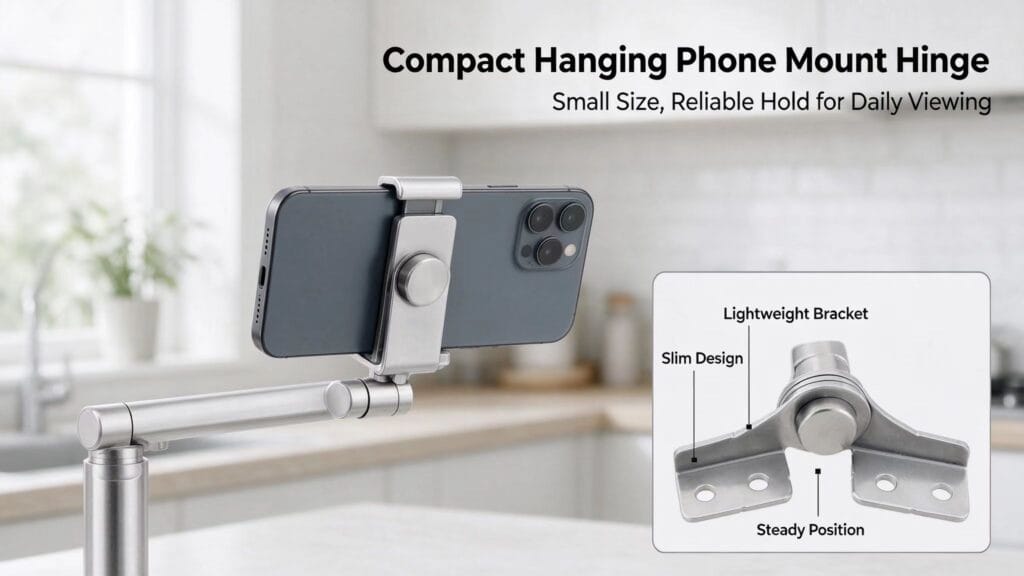
Whether you are designing an overhead cooking phone mount for kitchen recipes, a live-streaming desk arm, a bedside tablet holder, or an under-cabinet smartphone bracket, one single hardware component dictates the entire user experience: the friction hinge.
Think about how end-users actually interact with a hanging phone mount. They grab their phone with one hand, pull it down to eye level, tilt the screen slightly to avoid glare, and let go. If the hinge inside that mount is too loose, gravity wins—the phone slowly droops, sags, or drops straight down onto the counter. If the hinge is too stiff, the user has to wrestle with the arm using both hands, risking ripping the mount off the wall or cabinet.
Achieving that effortless, buttery-smooth, multi-angle hover requires precise mechanical engineering. Even more importantly, bringing that product to market without delays or quality headaches requires the right manufacturing partner.
Why the Friction Hinge is the Heart of a Hanging Phone Mount
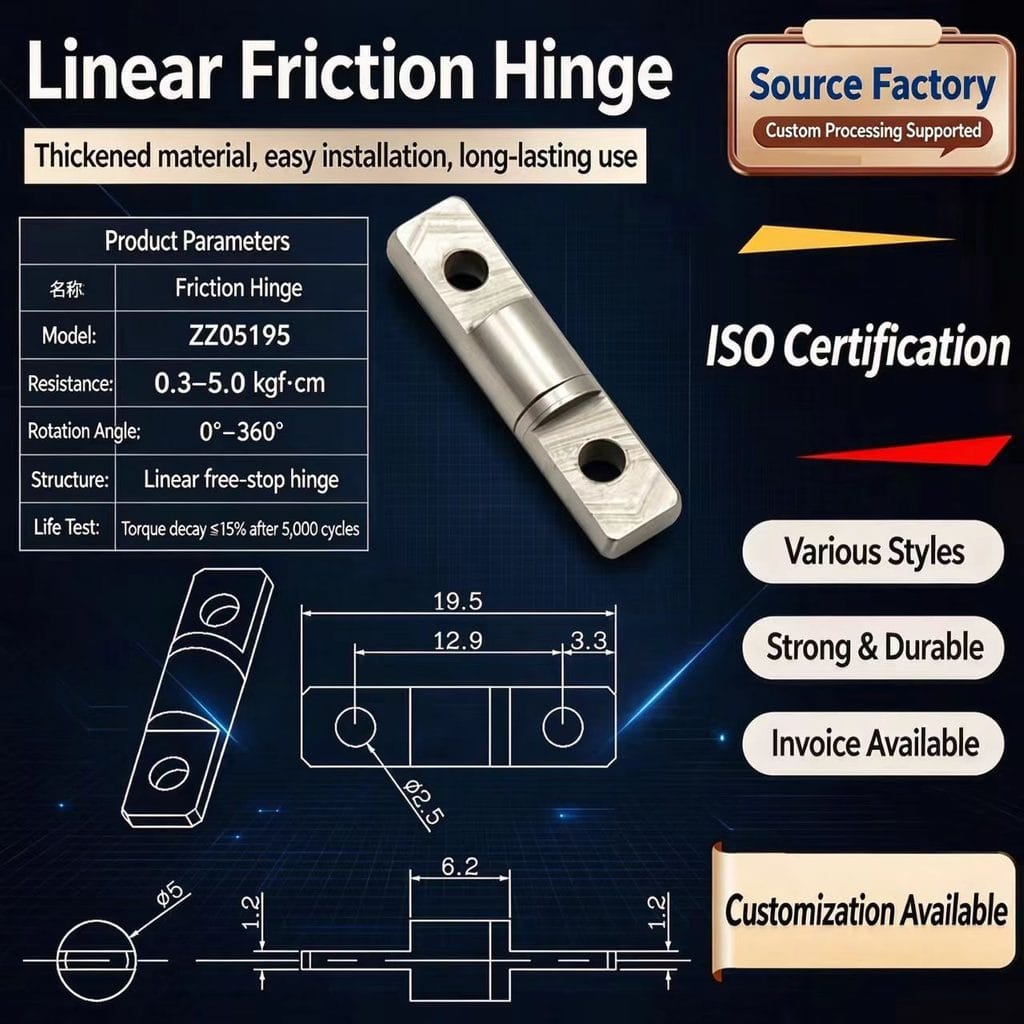
Our constant torque hinge maintains consistent holding force against gravity.Unlike standard door hinges that simply swing freely, a friction hinge (also known as a constant torque hinge) uses controlled internal resistance to hold an object securely at any angle along its path of motion. In a hanging phone mount, the hinge must constantly fight against gravity and leverage—especially when the arm is fully extended.
When consumers buy an overhead mount friction hinge system, they expect three non-negotiable things:
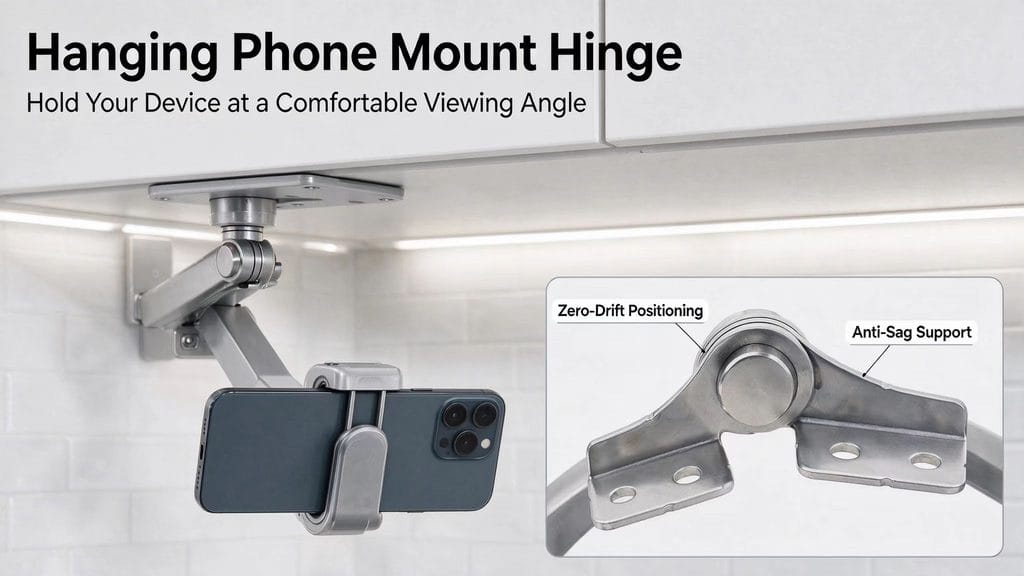
- Zero-Drift Positioning: Wherever they place the screen, it stays there. Whether holding a lightweight smartphone or a heavier Pro Max model with a thick protective case, there should be no creeping or sagging.This hanging phone mount hinge is built to prevent sagging for overhead brackets.
- Smooth, Quiet Operation: Nobody wants a phone mount that creaks, grinds, or jerks when adjusted. A well-engineered hinge delivers consistent torque from the first degree of rotation to the last.
- Long-Term Durability: A hanging phone mount gets adjusted multiple times a day. Over months and years, poor-quality hinges suffer from “torque decay”—meaning the internal parts wear down and the arm goes limp. A reliable hinge must survive tens of thousands of open-and-close cycles without losing its grip.
Relying on generic, off-the-shelf catalog hinges often forces your design team to compromise. Either the bracket holes don’t line up with your housing, the profile is too bulky for a sleek aesthetic, or the torque rating doesn’t quite match the weight of your mount arm. That is why successful hardware brands turn to custom friction hinges built specifically for their product’s exact geometry and load requirements.
Key Engineering Factors for Hanging Phone Mount Hinges
Before sourcing a hinge for your next hanging mount project, it helps to understand what makes a great hinge perform under real-world stress:
- Torque Calculation & Leverage: The longer your mount arm is, the more rotational force (torque) a smartphone exerts on the pivot point. A hinge rated for 0.5 Nm might hold a phone close to the base, but fail completely at the end of a 12-inch arm.
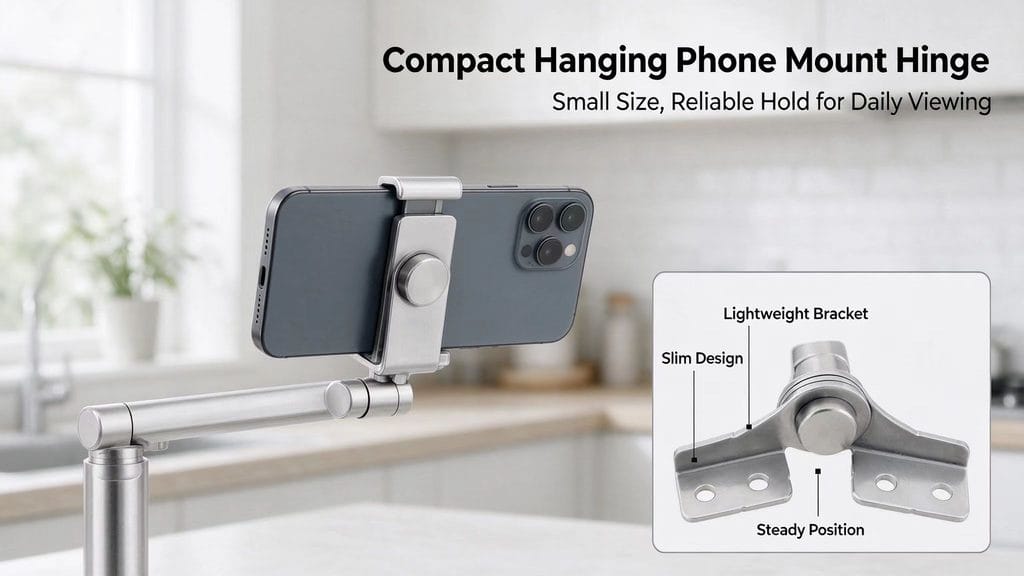
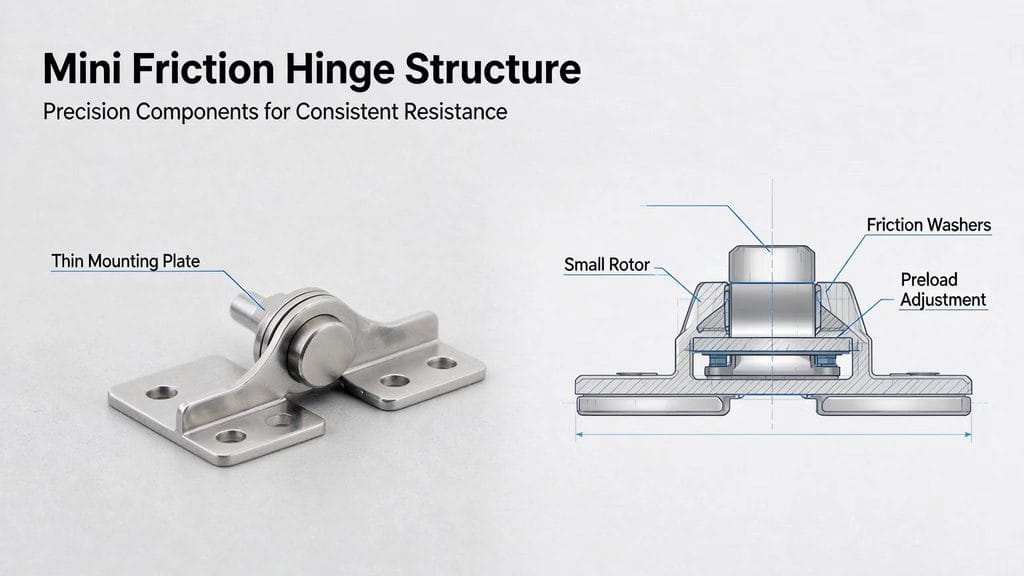
- Compact Footprint: Modern consumer electronics and accessories prioritize clean, minimalist aesthetics. A miniature friction hinge allows you to hide the mechanical joint inside sleek plastic or aluminum housings without adding ugly bulk.
- Symmetric vs. Asymmetric Torque: Depending on the mount design, you may want equal resistance when lifting and lowering the phone, or lighter resistance when folding the arm away and stronger resistance when pulling it down against gravity.
- Material & Corrosion Resistance: Kitchens and bathrooms are humid environments. Using high-grade stainless steel or properly treated alloys ensures the hinge never rusts or seizes up over time.
Why Source Your Friction Hinges Directly From Us?
When you are developing a new hanging phone mount, two things keep product managers and buyers awake at night: finding a supplier you can actually trust, and getting samples and mass production delivered on schedule.
Working with trading companies or middlemen often leads to miscommunication, hidden markups, and painful delays when engineering tweaks are needed. Partnering directly with our manufacturing facility eliminates those risks and gives your supply chain two major competitive advantages:
1. 100% Customizable to Your Exact Specifications
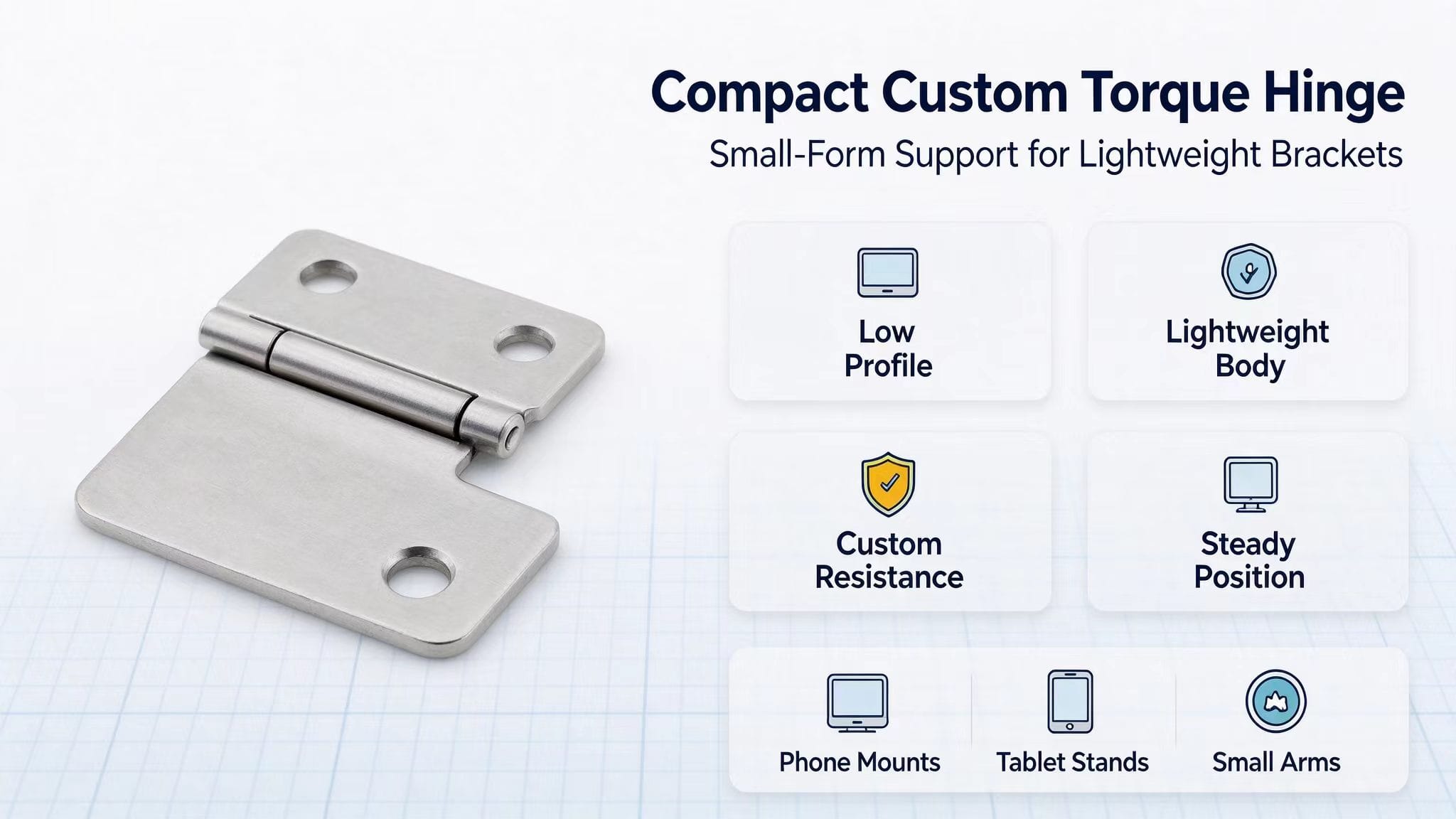
We don’t believe in forcing your product to fit a standard catalog part. Whether you need a specific torque range, an adjustable torque hinge for fine-tuning resistance, a custom-shaped mounting bracket, or a ultra-compact miniature profile, our engineering team works directly alongside yours.Every custom torque hinge can be engineered to match your arm length and load.
From early-stage 3D CAD validation and rapid prototyping to full-scale mass production, every friction hinge is tailored to match your exact structural, dimensional, and aesthetic requirements. You tell us the arm length, device weight, and cycle-life target—we engineer the exact internal mechanism to make it work seamlessly.
2. The Fastest, Most Reliable Way to Secure Your Supply Chain
We know that speed to market can make or break a product launch. If you are looking for the safest, quickest route to lock in a dependable OEM/ODM hinge supplier, our vertically integrated production model is built specifically for you:
- Complete In-House Manufacturing: Spanning over 3,000 square meters, our facility handles every critical step under one roof—including precision tooling, injection molding, die casting, stamping, and automated assembly. Because we don’t rely on outside subcontractors for core parts, we have total control over lead times and tolerances.
- High-Volume Daily Capacity: With a daily production output of up to 500,000 units, we easily scale with your business—from initial pilot runs to peak-season retail orders—ensuring your shipments go out on time, every time.
- Strict Quality Assurance: Every batch is backed by ISO 9001 quality management systems and verified through rigorous laboratory testing, including torque consistency checks, salt-spray corrosion tests, and 20,000+ cycle durability runs. You get zero-defect reliability and complete peace of mind.
Frequently Asked Questions (FAQ)
Q1: How do I know what torque rating my hanging phone mount needs?
A: You don’t have to guess. Simply share the weight of the phone (plus any cradle or magnetic plate), the length of your mount arm, and the desired tilt angles with our team. Our engineers will calculate the exact Newton-meter (Nm) or kgf·cm torque required so your mount holds steady without feeling overly stiff to the user.
Q2: Can you customize the mounting brackets and overall dimensions to fit our existing housing?
A: Yes, completely. As a custom OEM/ODM manufacturer, we regularly design custom leaf shapes, hole patterns, shaft lengths, and surface finishes. Whether you are working with tight internal clearances that require a miniature friction hinge or need a multi-axis pivot joint, we build to your exact 2D/3D drawings.
Q3: How quickly can we receive prototypes to test on our mount?
A: Speed is one of our core strengths. Because we maintain our own in-house tooling and machining workshops, we can produce functional prototypes and custom samples in the shortest possible turnaround time—allowing your engineering team to test, validate, and finalize your design without waiting months for parts.
Q4: How do you prevent the hinge from loosening after months of daily adjustments?
A: Cheap hinges rely on simple washers that wear out quickly. Our friction hinges utilize precision-engineered internal clips and high-grade spring steel components lubricated with specialized damping grease. Every design undergoes strict cycle-life testing to ensure minimal torque decay over tens of thousands of rotations.
Q5: What is your Minimum Order Quantity (MOQ), and how do we get started?
A: We support both emerging hardware brands and established global distributors, offering flexible MOQs for custom projects alongside free or low-cost evaluation samples. To get started, simply send us your 2D/3D CAD files, target torque specs, or even a basic concept sketch. Our technical team will review your requirements within 24 hours and send back a clear, straightforward proposal and timeline.