
When engineers decide to incorporate a rotary damper into their product design, they are immediately faced with a choice between the two dominant architectures in the motion control industry: Vane Dampers and Gear Dampers.
While both utilize the principle of viscous fluid resistance (shearing silicone oil) to soft slow down movement, their mechanical design, torque capabilities, and ideal applications are vastly different. Choosing the wrong type can lead to mechanical failure, poor user experience, or unnecessary costs.
In this comprehensive comparison, we break down the engineering differences to help you select the right component for your application. Explore on Whatsapp
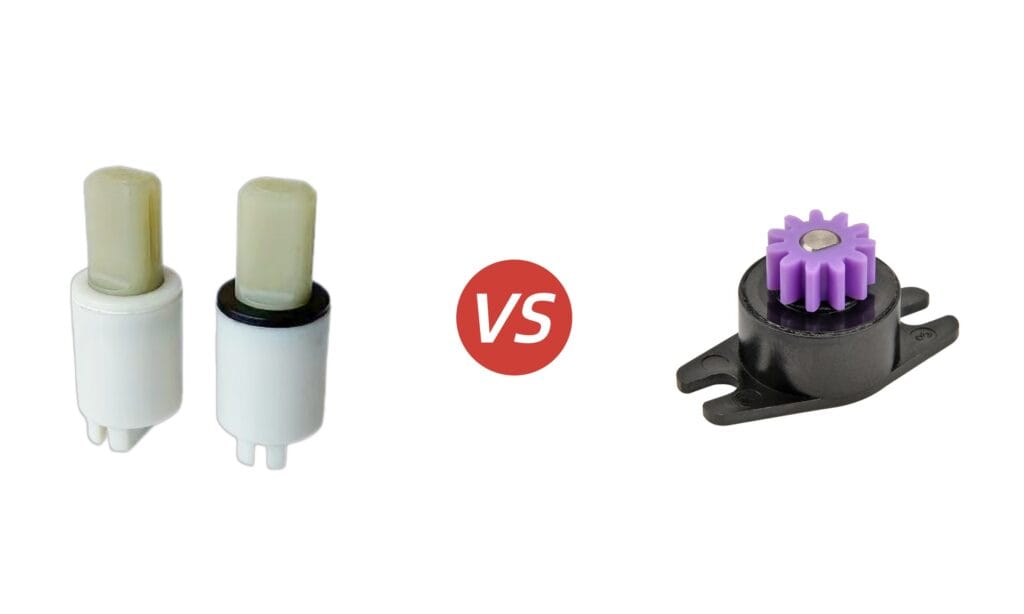
The Vane Damper: High Torque, Limited Rotation
The vane damper (often called a barrel damper or cylindrical damper) is the heavy lifter of the rotary damper world.
How It Works
Inside the cylindrical housing, a central shaft is attached to a paddle-like structure called a vane. As the shaft turns, the vane sweeps through a cavity filled with highly viscous silicone oil. The oil is forced through a tiny gap between the edge of the vane and the inner wall of the housing, creating massive fluid shear and high damping torque.
Key Characteristics
•Limited Rotation Angle: Because the vane eventually hits a physical stop inside the housing, vane dampers cannot rotate continuously. Their range of motion is typically limited to 110° to 180°.
•High Torque Capacity: The large surface area of the vane allows it to generate significant resistance, making it suitable for heavy loads (e.g., 1 N·m to 50+ N·m).
•Uni-directional Capability: Vane dampers can easily be designed with internal bypass valves to provide asymmetric damping (e.g., strong resistance when closing a lid, but almost zero resistance when opening it).
Typical Applications
Vane dampers are used where heavy objects need to be controlled over a fixed arc:
• Sanitary: Toilet seats and bidet covers
•Home appliances: Washing machine lids, Coffee machine
•Forniture: Piano fallboards, chair
•Medical, Heavy industrial access panels, Consumer electronics
The Gear Damper: Continuous Rotation, Light Duty
The gear damper is designed for versatility, smooth continuous motion, and integration into existing mechanical drive trains.
How It Works
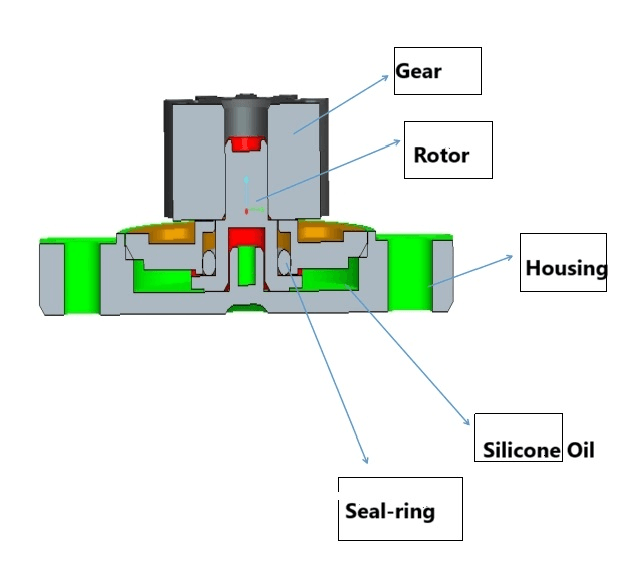
A gear damper consists of a small housing containing a rotor attached to an external gear. The internal rotor (often a simple cylinder or disk) spins continuously inside the silicone oil. The external gear meshes with a rack (for linear motion) or another gear (for rotational motion) on the moving part of the product.
Key Characteristics
•Continuous 360° Rotation: Unlike vane dampers, gear dampers have no internal stops. They can rotate infinitely in either direction.
•Lower Torque Capacity: Because they rely on the shear of a smaller internal rotor, they generally produce much lower torque (e.g., 0.01 N·m to 0.5 N·m) compared to vane dampers.
•Symmetric Damping: Gear dampers typically provide the same amount of resistance in both clockwise and counter-clockwise directions.
Typical Applications
Gear dampers are ideal for lightweight components, delicate electronics, and linear-to-rotary conversions:
•Automotive cup holders and ashtrays
•CD/DVD/Blu-ray drive trays
•Retractable handles and hidden sockets
•Vending machine delivery flaps
Direct Comparison Matrix
| Feature | Vane Damper | Gear Damper |
| Rotation Angle | Limited (110° – 180°) | Continuous (Infinite 360°) |
| Torque Capacity | High (1 N·m to 50+ N·m) | Low (0.01 N·m to 0.5 N·m) |
| Damping Direction | Bi-directional or Uni-directional | Usually Bi-directional (Symmetric) |
| Size/Profile | Larger, cylindrical | Compact, easy to hide |
| Integration Method | Direct shaft connection | Meshes with a gear or rack |
| Best For… | Heavy lids, doors, covers | Lightweight trays, drawers, handles |
How to Choose
The decision usually comes down to two simple questions:
1.Does the part rotate more than 180 degrees? If yes, you must use a gear damper.
2.Is the part heavy? If it requires more than 0.5 N·m of torque to control the fall, you almost certainly need a vane damper.
Frequently Asked Questions (FAQ)
Q1: Can I use multiple gear dampers to handle a heavier load?
A: Yes, you can use two gear dampers (one on each side of a drawer or tray) to double the damping torque. However, for truly heavy loads like a washing machine lid, a single vane damper is far more efficient and cost-effective.
Q2: Do gear dampers wear out faster because they rotate continuously?
A: High-quality gear dampers from JAN Hinge Damper use highly shear-stable silicone oil and durable plastic housings (like POM) designed to withstand 50,000+ continuous rotations without significant torque degradation.
Q3: Can a gear damper provide uni-directional (asymmetric) damping?
A: It is mechanically difficult to build a bypass valve into a continuous-rotation gear damper. If uni-directional motion is required with a gear damper, engineers usually incorporate a separate one-way clutch bearing into the gear train assembly.
Q4: What happens if I force a vane damper past its maximum angle?
A: Forcing a vane damper past its physical stop will break the internal vane or snap the external shaft, destroying the damper. Always ensure your product’s hinge design includes hard mechanical stops before the damper reaches its limit.
Q5: Are disk dampers the same as gear dampers?
A: No. Disk dampers are a third category. They offer continuous 360° rotation like a gear damper, but they use stacked flat plates to generate moderate torque in an ultra-slim profile, usually connecting directly via a shaft rather than a gear.