
Introduction: The Thermal Challenge No One Talks About
Picture this: a brand-new SUV rolls off the production line in Munich in January. The glove box damper feels perfect—smooth, controlled, premium. Three months later, that same vehicle is delivered to a customer in Dubai. The glove box now drops like a stone. Six months after that, the vehicle is exported to northern Canada. The same glove box now creaks and struggles to open at all.
This is not a hypothetical. This is the reality of automotive interior damping hinges—and it is a problem that costs OEMs millions in warranty claims, customer complaints, and brand damage every year.
The culprit? Temperature. Standard damping hinges—particularly those using oil-filled rotary dampers—are inherently temperature-sensitive. As ambient temperature rises, damping oil viscosity decreases, torque drops, and the lid or door opens too fast. As temperature drops, viscosity increases, torque rises, and the mechanism becomes sluggish or even locks up.
For engineers specifying motion-control components, procurement professionals sourcing hinge solutions, and business owners who understand that global vehicle programs demand global performance, the high and low temperature resistance test is not a checkbox exercise. It is the difference between a component that performs flawlessly from the Arctic to the Sahara—and one that fails in the field.
The Problem: Why Temperature Matters for Damping Hinges
The Physics of Damping Oil
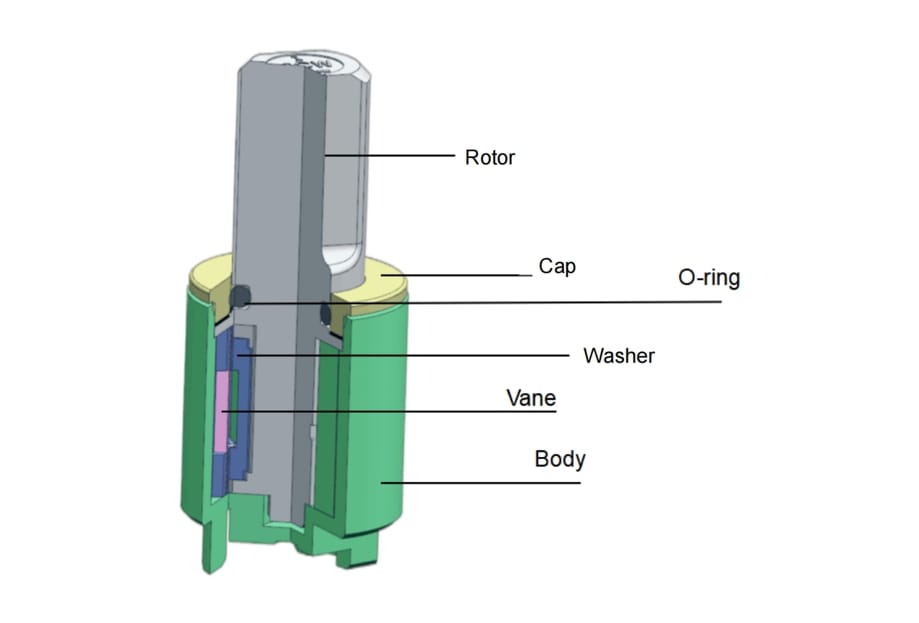
Most rotary dampers used in automotive interiors rely on silicone oil or similar viscous fluids to generate damping torque. As the damper rotates, the oil is forced through restricted flow paths, creating resistance. The torque output is directly proportional to the oil’s viscosity.
Here is the problem: oil viscosity changes with temperature.
- As temperature increases, oil thins out. Viscosity drops. Torque decreases. The lid opens faster—sometimes uncontrollably fast.
- As temperature decreases, oil thickens. Viscosity rises. Torque increases. The lid becomes sluggish, difficult to open, or may not open at all.
Most standard rotary dampers exhibit torque variations of 50% or more across a typical automotive temperature range of -40°C to +90°C.
The Real-World Impact
Consider a glove box damper specified at 23°C with a 3-second drop time. At 60°C, that same damper might drop in 1.5 seconds—too fast, potentially unsafe. At -20°C, it might take 6 seconds or more—too slow, frustrating for the user.
One damper manufacturer explicitly notes: “Typically, however, present-day rotation dampers are temperature-dependent, i.e. the rotation damping increases when the temperature decreases. This negative aspect is manifested, inter alia, in vehicle tests in a climatic chamber”.
Why Automotive Interiors Are Particularly Demanding
Automotive interior components face a uniquely brutal thermal environment:
- Solar loading: Dashboard temperatures can exceed 85°C on a sunny day
- Cold soak: In winter, interior components can reach -40°C
- Thermal cycling: Components experience repeated temperature swings from -40°C to +85°C over the vehicle’s lifetime
- Humidity: Combined with temperature, humidity accelerates degradation
For flip parts—glove boxes, center console lids, overhead compartments, cup holder covers—the damping hinge is touched every time the vehicle is used. Any temperature-related performance degradation is immediately noticed by the customer.
The Solution: High & Low Temperature Resistance Testing
A high and low temperature resistance test is a standardized procedure that evaluates a damping hinge’s performance across extreme temperature ranges. It is the only way to ensure that a component designed in a 23°C laboratory will perform reliably from -40°C in a Winnipeg winter to +90°C in a Phoenix summer.
The Test Standards Landscape
Several standards define high and low temperature testing for automotive components:
| Standard | Description | Application |
|---|---|---|
| JIS D 0204 | Method of high and low temperature test for automobile parts | General automotive components |
| SAE J3119 | Low temperature endurance test for automotive materials | Materials in cold environments |
| SAE J1717 | Interior automotive plastic part testing | Interior trim components |
| BMW PR 303 | Climate cycle test | Thermal cycling durability |
| BMW AA P 276 | Temperature cycle test | Thermal stress simulation |
| ISO 16750-4 | Road vehicles — Environmental conditions | Steady-state high temperature |
| GB/T 24550 | Hinge fatigue life test | Cycle life at temperature extremes |
For damping hinges specifically, many OEMs have developed their own corporate test specifications that define temperature ranges, dwell times, cycle counts, and performance acceptance criteria.
The Core Test Profile
A comprehensive high and low temperature test for a damping hinge typically includes:
Low Temperature Test
- Condition: -20°C to -40°C at 65% humidity for 72 hours
- Recovery: Move to 25±5°C for 24 hours
- Performance check: Damping torque and drop time variation ≤30% vs pre-test; no oil leakage or structural damage
High Temperature Test
- Condition: +60°C to +90°C at 65% humidity for 72 hours
- Recovery: Move to 25±5°C for 24 hours
- Performance check: Same as low temperature test
Temperature Cycling
- Range: -40°C to +85°C (or +90°C)
- Rate: Up to 10°C per minute for thermal shock conditions
- Cycles: Multiple cycles to simulate real-world thermal stress
- Performance check: After each cycle or at completion
Cold Start / Low Temperature Wake-Up
- Condition: Component soaked at -30°C to -40°C
- Test: Operate the hinge immediately after cold soak
- Acceptance: Must function without stalling, excessive force, or damage
High Temperature Degradation
- Condition: Extended exposure at 80°C–90°C (8+ hours)
- Test: Verify no permanent torque loss, oil degradation, or material deformation
Performance Acceptance Criteria
For a damping hinge to pass high and low temperature testing, it must meet specific performance criteria:
- Torque variation: ≤30% from baseline at 23°C
- Drop time variation: ≤30% from baseline
- No oil leakage: Under any temperature condition
- No structural damage: No cracks, deformation, or failure
- No functional degradation: Must operate smoothly across the entire temperature range
Some premium dampers achieve significantly tighter tolerances. Manufacturers offering “temperature independent damping” claim consistent performance across all temperatures.
Technical Specifications for Engineers
Operating Temperature Range
For automotive interior applications, the minimum acceptable operating temperature range for a damping hinge is -40°C to +90°C.
Some products extend this range further. One manufacturer offers dampers with a working temperature range of -45°C to +50°C. Others offer high-temperature specifications up to 100°C.
Torque Temperature Coefficient
The torque temperature coefficient is a critical specification that quantifies how much torque changes with temperature. It is typically expressed as a percentage change per degree Celsius.
For standard oil-filled rotary dampers, the coefficient can be 1-2% per °C—meaning a 60°C temperature swing can cause 60-120% torque variation.
For premium temperature-compensated designs, the coefficient may be 0.2-0.5% per °C or better.
Cycle Life at Temperature Extremes
Temperature extremes accelerate wear. A hinge that lasts 50,000 cycles at room temperature may fail after 5,000 cycles at -30°C or 80°C.
Industry benchmarks for automotive damping hinges include:
- Room temperature (23°C) : ≥20,000 cycles
- High temperature (85°C) : ≥5,000 cycles
- Low temperature (-40°C) : ≥5,000 cycles
Some manufacturers test to more demanding requirements. Nifco, for example, validates their glove box dampers to 10,000 cycles at room temperature, 2,000 cycles at -30°C, and 2,000 cycles at 80°C.
Material Selection for Temperature Resistance
Material choice is critical for temperature performance:
- Housing materials: Polycarbonate (PC) can endure high temperatures found in vehicle interiors without degrading. POM and PA66 are also common.
- Seals: VMQ (silicone rubber) O-rings maintain sealing integrity across wide temperature ranges.
- Damping fluid: High-quality silicone oil with stable viscosity-temperature characteristics.
- Metal components: Stainless steel or corrosion-resistant alloys for durability.
Free-Stop vs. Damping-Only Hinges
Not all hinges are created equal. Two distinct types are relevant for automotive flip parts:
Free-stop hinges (also called torque hinges or positioning hinges) use friction between metal or resin components to hold a lid at any angle. Because they rely on friction rather than fluid viscosity, they are inherently less temperature-sensitive than oil-filled dampers.
Damping-only hinges (rotary dampers) use oil viscosity for motion control and are highly temperature-sensitive.
For applications requiring both position holding and controlled motion, some manufacturers offer combined solutions—free-stop hinges with integrated damping.
Application Scenarios
Glove Boxes
The glove box is perhaps the most temperature-sensitive application. In hot climates, an undamped glove box drops too fast, potentially spilling contents or injuring fingers. In cold climates, an overdamped glove box may not open at all.
Center Console Lids and Armrests
Center console lids are opened frequently and must operate smoothly across all temperatures. Many incorporate free-stop hinges that hold the lid at any angle.
Overhead Compartments and Sunvisor Mirrors
Overhead components face the most extreme solar loading. Temperatures can exceed 90°C. Hinges must maintain performance without degradation.
Cup Holder Covers and Storage Bins
These high-use components require consistent damping across temperature extremes. Many use air dampers that are less temperature-sensitive than oil-filled designs.
Seat Back Tables and Folding Mechanisms
For rear-seat entertainment and convenience, folding tables and mechanisms require smooth, controlled motion. Temperature-compensated damping is essential.

Choosing the Right Supplier: What to Look For
For procurement professionals and engineers, supplier selection is critical.
Key Criteria
Temperature Testing Capability
Does the supplier have in-house environmental chambers capable of -40°C to +90°C testing? Do they perform temperature cycling, thermal shock, and steady-state high/low temperature tests?
Test Documentation
Look for documented test reports:
- Temperature performance reports: Torque vs. temperature curves
- Cycle life reports: At room, high, and low temperatures
- Leakage tests: At temperature extremes
- Material certifications: For temperature-resistant materials
Temperature-Compensated Design
Does the supplier offer temperature-independent damping or temperature-compensated designs? Some manufacturers have developed advanced dampers that maintain consistent performance across wide temperature ranges.
OEM Approval
Has the supplier’s product been validated against OEM test specifications? BMW, Mercedes-Benz, GM, and other major OEMs have rigorous internal standards for damping components.
Customization Capability
Can the supplier customize torque values, temperature ranges, and materials to meet your specific requirements? Leading manufacturers offer OEM and ODM customization for automotive applications.
The Cost of Failure: A Business Perspective
The Cost of Temperature-Related Failure
A damping hinge that fails in the field generates multiple costs:
- Warranty claims: Replacement parts and labor
- Customer dissatisfaction: Negative reviews and brand damage
- Field campaigns: Recalls or service bulletins
- Lost sales: Brand reputation impacts future purchasing decisions
One damper manufacturer notes that temperature-dependent dampers cause problems that are “manifested, inter alia, in vehicle tests in a climatic chamber”. If a problem is found in the climatic chamber, it will be found in the field—by your customers.
The Value of Temperature-Tested Quality
A well-specified, temperature-tested damping hinge delivers:
- Reduced warranty claims: Through validated performance across temperature extremes
- Global vehicle capability: One specification works from Arctic to desert
- Enhanced user experience: Consistent feel in all conditions
- Brand differentiation: Premium quality that customers notice
- Regulatory confidence: Compliance with OEM and industry standards
Conclusion
In automotive interiors, the damping hinge is a small component with an outsized impact on perceived quality, user experience, and warranty exposure. A hinge that performs perfectly at 23°C but fails at -40°C or +90°C is not a reliable component—it is a warranty claim waiting to happen.
The high and low temperature resistance test is the only way to ensure that a damping hinge will perform reliably across the full range of conditions a vehicle will encounter. From -40°C cold soaks to +90°C solar loading, from the Canadian winter to the Arabian summer, a properly tested hinge delivers consistent, predictable performance.
For engineers, the technical parameters are clear: specify an operating temperature range of -40°C to +90°C, require documented temperature performance testing, and validate cycle life at temperature extremes. For procurement professionals, the supplier criteria are equally clear: look for in-house temperature testing capability, documented test reports, and OEM approval. For business owners, the strategic imperative is undeniable: invest in the components that protect your brand and your customers.
The cost of temperature testing is modest. The cost of a temperature-related failure—in warranty claims, customer dissatisfaction, and brand damage—is not.
FAQ
Q1: What temperature range should a car interior damping hinge be tested to?
For automotive interior applications, the minimum acceptable operating temperature range is -40°C to +90°C. Testing should include low temperature exposure (-20°C to -40°C for 72 hours), high temperature exposure (+60°C to +90°C for 72 hours), and temperature cycling (-40°C to +85°C).
Q2: Why do damping hinges perform differently in hot and cold temperatures?
Most damping hinges use viscous oil (silicone oil) to generate damping torque. Oil viscosity changes with temperature—it thins out in heat (reducing torque) and thickens in cold (increasing torque). This is why standard oil-filled dampers can show torque variations of 50% or more across the automotive temperature range.
Q3: What is the difference between a free-stop hinge and a damping hinge for automotive applications?
A free-stop hinge (also called a torque hinge) uses friction between metal or resin components to hold a lid at any angle. Because it relies on friction rather than fluid viscosity, it is inherently less temperature-sensitive. A damping hinge (rotary damper) uses oil viscosity for motion control and is highly temperature-sensitive. Many automotive applications use both—free-stop for position holding and damping for controlled motion.
Q4: What cycle life should I expect from a temperature-tested automotive damping hinge?
Industry benchmarks for automotive damping hinges are: ≥20,000 cycles at room temperature (23°C), ≥5,000 cycles at high temperature (85°C), and ≥5,000 cycles at low temperature (-40°C). Some manufacturers test to more demanding requirements—for example, 10,000 cycles at room temperature, 2,000 cycles at -30°C, and 2,000 cycles at 80°C. Always verify cycle life specifications at temperature extremes with your supplier.
Summary: Car interior flip part damping hinges must undergo rigorous high and low temperature resistance testing to ensure reliable performance from -40°C to +90°C. Standard oil-filled dampers are inherently temperature-sensitive, with torque varying significantly as viscosity changes with temperature. Testing should include low temperature exposure, high temperature exposure, temperature cycling, and cycle life validation at temperature extremes. Engineers should specify -40°C to +90°C operating range and require documented test reports. Procurement professionals should select suppliers with in-house temperature testing capability, OEM approval, and temperature-compensated or friction-based design options. The investment in temperature-tested quality delivers reduced warranty claims, consistent global performance, and enhanced brand reputation.