
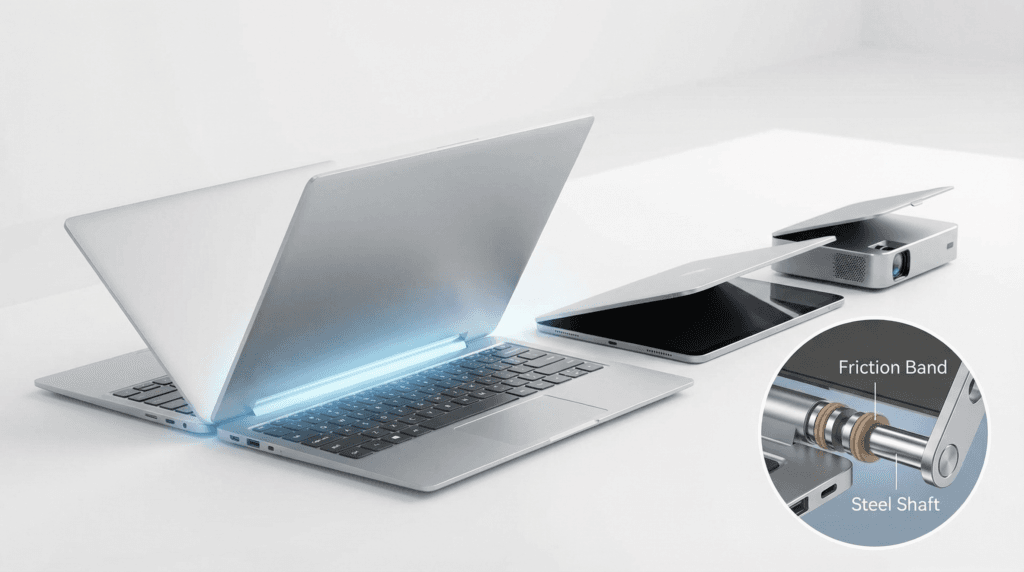
In the fiercely competitive consumer electronics market, hardware differentiation is no longer limited to simple processing power and screen resolution. Today’s product engineers and industrial designers understand that haptic feedback—such as the feel of opening and closing, adjusting, soft-close lids, or the ability to stop at any angle—is a key factor influencing user experience. Whether it’s the satisfyingly stable damping of a high-end laptop hinge or the controlled, gentle opening mechanism of a high-end printer lid, these subtle interactions define the user experience.
For purchasing managers and product engineers, selecting the right motion control components—especially micro rotary dampers and friction hinges—is crucial to achieving this premium tactile feel while meeting stringent space and weight constraints. This guide, meticulously crafted by JAN Hinge Damper’s engineering team, delves into the technical considerations, design challenges, and strategic sourcing strategies for micro-motion control components in consumer electronics.
The Dual Challenge: Miniaturization and High Torque
Consumer electronics such as laptops, tablets, portable projectors, and smart home hubs face conflicting design pressures. Devices are becoming thinner and lighter, but their internal components, such as high-resolution OLED displays, are becoming heavier and more fragile. This presents a significant engineering challenge: how to generate enough torque within a chassis that is only a few millimeters in size to hold a heavy screen in place or cushion a dropped lid.Consumer electronics, such as laptops, tablets, portable projectors, and smart home hubs, are subjected to conflicting design pressures. Devices are becoming thinner and lighter, yet the components they house (like high-resolution OLED displays) are becoming heavier and more delicate. This creates a significant engineering challenge: how to generate sufficient torque to hold a heavy screen in place or damp a falling lid, using a mechanism that fits within a chassis measured in millimeters.
Miniature Friction Hinges (Torque Hinges)
Friction hinges are designed to hold a load at any angle without spring-back or drift. In a laptop, for instance, the hinge must provide enough resistance to keep the screen upright against gravity and typing vibrations, but not so much resistance that the user cannot open the device with one hand.
Achieving this balance in a miniature profile requires precision engineering. High-performance friction hinges often utilize a combination of hardened steel shafts and specialized friction bands or multiple thin friction disks. These designs maximize the surface area for friction generation within a tiny cylindrical footprint.
Micro Rotary Dampers
Rotary dampers use the fluid resistance of high-viscosity silicone oil to slow down motion. In consumer electronics, they are used to prevent lids, covers, and pop-out trays from snapping open or slamming shut. The challenge here is sealing the silicone oil perfectly within a housing that might be smaller than a dime. Any leakage not only ruins the damping effect but can also cause catastrophic damage to the surrounding sensitive electronic circuitry.
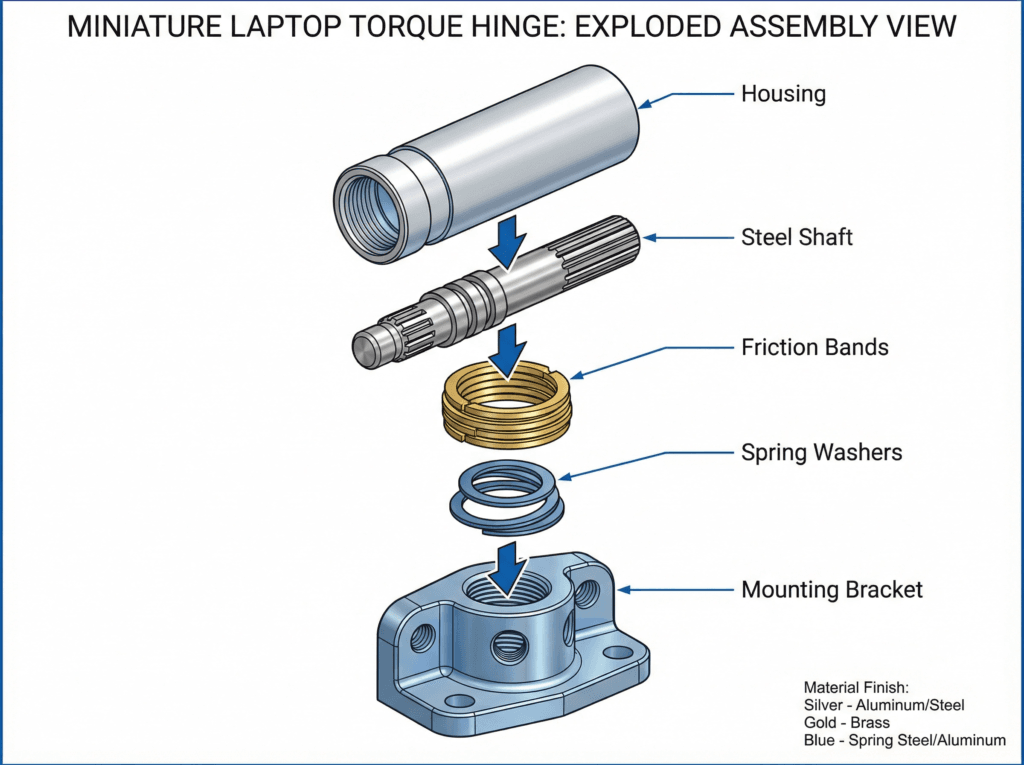
Critical Technical Specifications for Engineers
When specifying motion control components for consumer electronics, engineers must look beyond basic torque ratings and evaluate several critical parameters to ensure long-term reliability.
1. Torque Tolerance and Consistency
In mass production, the variance between individual components (tolerance) is the enemy of quality. If a laptop hinge has a ±20% torque tolerance, some units will feel stiff and difficult to open, while others will feel loose and fail to hold the screen steady.
Engineering Best Practice: Specify components with a tight torque tolerance (±10% or better). At JAN Hinge Damper, we achieve this through automated assembly and 100% online torque inspection, ensuring every unit delivers identical tactile feedback on the assembly line.
2. Torque Degradation Over Lifecycle
A hinge might feel perfect on day one, but how will it perform after two years of daily use? Friction hinges naturally experience some wear, leading to a drop in torque. In consumer electronics, a device is typically expected to endure 20,000 to 30,000 opening/closing cycles.
Engineering Best Practice: Request lifecycle testing data from your supplier. A high-quality friction hinge should exhibit less than a 15% drop in torque after 20,000 cycles. This requires the use of specialized, wear-resistant materials and proprietary lubrication techniques.
3. Asymmetric Torque (Free-Stop vs. One-Way)
Many applications require different resistance depending on the direction of motion. For example, a laptop should be relatively easy to open (low torque) but require more force to close or push backward (high torque) to prevent accidental slamming.
Engineering Best Practice: Utilize asymmetric friction hinges. These hinges are engineered to provide high resistance in one direction and lower resistance (often 30–50% less) in the opposite direction, optimizing the user experience for both opening and closing.
4. Environmental Stability
Consumer electronics are shipped globally and used in diverse environments. The viscosity of the silicone oil in rotary dampers changes with temperature, which can alter the damping speed.
Engineering Best Practice: Ensure the dampers are filled with temperature-stable silicone fluids capable of maintaining consistent performance from -20°C to +60°C. Furthermore, verify that the housing materials (often specialized engineering plastics like POM or PC) are UV resistant and will not become brittle over time.
| Specification | Industry Average | JAN Hinge Damper Standard |
| Torque Tolerance | ±20% | ±10% (100% online inspection) |
| Lifecycle (Torque Degradation < 15%) | 15,000 cycles | 30,000+ cycles |
| Operating Temperature | 0°C to 50°C | -20°C to 60°C |
| Oil Leakage Risk | Standard single seal | Zero-leakage dual-seal design |
| Prototype Lead Time | 4–6 weeks | 1 day (standard) / 20 days (OEM) |
Strategic Sourcing for Procurement Managers
For procurement professionals, sourcing motion control components is not just about finding the lowest unit price. The hidden costs of component failure—product recalls, brand damage, and assembly line downtime—far outweigh initial savings.
Supplier Engineering Capability: Does the supplier offer custom design services, or do they only sell off-the-shelf parts? Consumer electronics often require bespoke hinge designs to fit unique chassis constraints. JAN Hinge Damper offers rapid prototyping, moving from CAD to custom OEM/ODM samples in just 20 days.
Quality Control Infrastructure: A supplier must have the infrastructure to guarantee consistency at scale. Look for manufacturers that utilize automated injection molding and comprehensive end-of-line testing rather than manual assembly and batch sampling.
Supply Chain Resilience: Can the supplier scale production rapidly to meet product launch demands? Ensure your partner has the manufacturing capacity to deliver bulk orders (e.g., 50k+ pieces) within a standard 10–15 day lead time.
Frequently Asked Questions (FAQ)
Q1: What is the difference between friction hinge and rotary damper?
Friction hinges provide constant holding resistance, allowing components to remain at any angle (e.g., a laptop screen can be fixed in any position you place it). Rotary dampers provide speed-dependent resistance to slow movement and prevent violent impacts, soft close and open (e.g., a printer paper tray can open slowly and gently). Many applications combine both friction hinges and rotary dampers.
Q2: How do I calculate the required torque for my device’s lid or screen?
The basic formula is T = (L/2) × W × 9.8, where L is the distance from the hinge pivot to the center of gravity of the lid (in meters) and W is the weight of the lid (in kg). For example, a 0.3 kg laptop screen with a 0.15 m lever arm requires approximately 0.22 N·m of holding torque. We strongly recommend consulting our engineering team, as real-world factors like vibration and user force must also be considered.
Q3: Can rotary dampers leak silicone oil and damage nearby electronic PCBs?
Poorly manufactured dampers with inadequate sealing can leak. JAN Hinge Damper utilizes ultrasonic welding and proprietary dual-seal designs to ensure zero oil leakage, making them fully safe for integration in close proximity to sensitive electronic components and circuit boards.
Q4: What is the typical lifecycle of your miniature torque hinges?
Our standard miniature torque hinges are tested to exceed 30,000 full open-close cycles with less than a 15% degradation in holding torque. This exceeds the standard expected lifespan of most consumer electronic devices and is validated by our in-house lifecycle testing equipment.
Q5: We need a custom asymmetric torque profile for our new tablet. What is your lead time for prototypes?
For custom OEM/ODM designs requiring new tooling, we can typically deliver functional, testable prototypes within 20 days of CAD drawing approval. For modifications to existing standard designs, samples can often be ready within 1–3 business days.
Q6: How do you ensure consistent torque across a mass production run of 100,000 units?
Consistency at scale is achieved through two pillars: automated precision manufacturing (eliminating human assembly variance) and 100% online torque inspection (every single unit is tested, not just a batch sample). This guarantees that every hinge shipped to your assembly line falls within the specified ±10% tolerance range.
Ready to perfect the tactile experience of your next device? Let’s talk on Whatsapp.
Contact the JAN Engineering Team today to discuss custom micro-motion solutions and request technical samples for your R&D department.