
When we think about friction hinges in the medical field, our minds immediately jump to heavy diagnostic monitors or surgical lighting arms. These are classic, static applications: you move the monitor, you let go, and it stays.

But there is a rapidly growing sector in the medical device industry where the rules of motion control are entirely different: Rehabilitation and Physical Therapy Equipment.
From high-tech robotic exoskeletons helping stroke survivors walk again, to the humble folding walker, rehabilitation equipment interacts directly with the patient’s body. In this space, a hinge isn’t just holding a screen—it is bearing human weight, providing therapeutic resistance, and moving thousands of times a day.
Let’s explore why medical hardware designers are moving away from traditional locking pins and gas springs, and increasingly turning to precision friction hinges (torque hinges) to build safer, more ergonomic rehabilitation equipment. Discuss more on Whatsapp
The Problem with Traditional Rehabilitation Hardware
Historically, adjustable rehabilitation equipment relied on mechanical detents (spring-loaded pins popping into holes) or locking knobs.
If you have ever adjusted the height of a pair of crutches or the backrest of a standard wheelchair, you know the frustration. You have to pull a pin, guess the right angle, and hope it clicks into place. For a healthy person, this is annoying. For an elderly patient with arthritis or a physical therapist managing a 200-pound patient, it is a physical strain and a safety hazard.
Furthermore, traditional hinges wear out quickly under repetitive human loads. A loose hinge on a knee rehabilitation brace doesn’t just feel cheap—it compromises the patient’s biomechanical alignment, potentially causing further injury.
5 Ways Friction Hinges Are Upgrading Rehab Tech
Precision friction hinges solve these ergonomic nightmares by offering infinite positioning. There are no preset holes or pins. The user simply pushes the equipment to the exact desired angle, and the internal friction mechanism holds it there.
Here is how this technology is being applied across five key rehabilitation sectors.
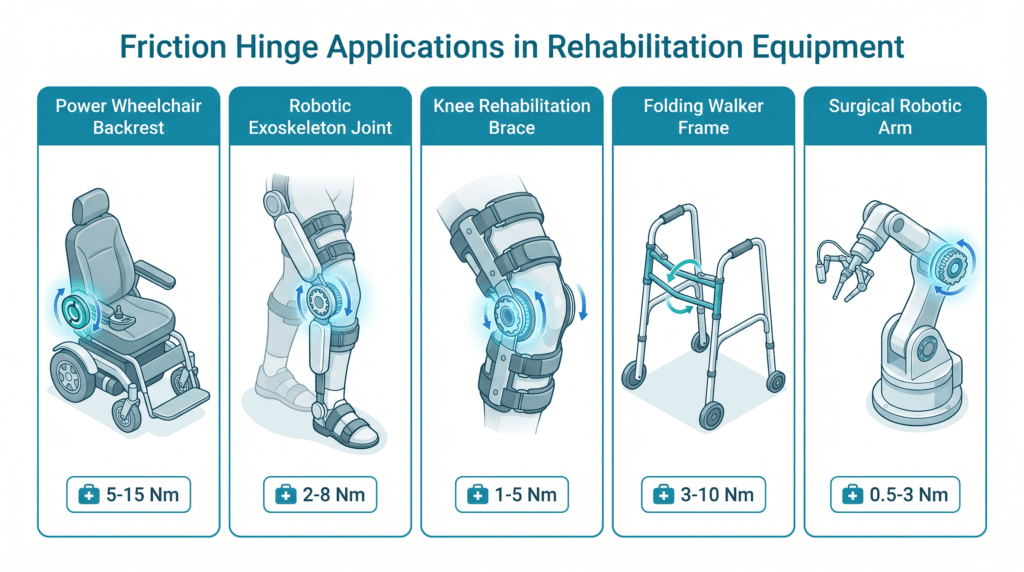
From power wheelchairs to robotic exoskeletons, torque hinges provide infinite positioning and therapeutic resistance.
1. Power Wheelchair Backrests and Footrests
Modern power wheelchairs are essentially mobile living spaces. Patients spend 12 to 16 hours a day in them. To prevent pressure ulcers, the backrest and leg rests must be constantly adjusted. Heavy-duty friction hinges allow caregivers to smoothly recline the backrest to any angle without sudden jerks or the need to lock/unlock levers. The hinge provides enough holding torque (often 10-15 Nm) to support the patient’s weight safely.
2. Robotic Exoskeletons (Passive Joints)
While the primary joints of a robotic exoskeleton are driven by electric motors, many secondary joints (like the ankle or hip abduction joints) rely on passive motion control. Micro-friction hinges are used here to provide a specific amount of resistance. This prevents the exoskeleton limb from swinging wildly when the motor is disengaged, giving the patient a more natural, controlled gait.
3. Orthopedic Knee and Shoulder Braces
Post-surgery rehabilitation often requires the patient to move their joint against a specific, controlled resistance to rebuild muscle. Medical designers are integrating adjustable friction hinges directly into orthopedic braces. A physical therapist can use a hex key to increase the torque of the hinge week by week, turning a simple supportive brace into a wearable physical therapy machine.
4. Folding Walkers and Rollators
The traditional folding walker uses a loud, clunky push-button mechanism. If the button sticks, the elderly user cannot fold it to put it in a car. Next-generation rollators use asymmetric friction hinges. They fold up smoothly with a firm push, but provide massive resistance against collapsing when the user leans their weight on the frame.
5. Surgical and Therapy Robotic Arms
In advanced physical therapy clinics, robotic arms assist patients with repetitive motion exercises. The joints of these arms often utilize precision torque hinges to provide a “zero-gravity” feel. The hinge perfectly counterbalances the weight of the robotic arm, allowing the patient to move it with minimal effort while preventing the arm from dropping if the patient suddenly lets go.
Designing for FDA Compliance and Clinical Environments
Designing a friction hinge for a consumer laptop is a matter of user experience. Designing one for a Class II medical device requires strict regulatory compliance.
When engineers specify a torque hinge for rehabilitation equipment, they must navigate a minefield of clinical requirements.
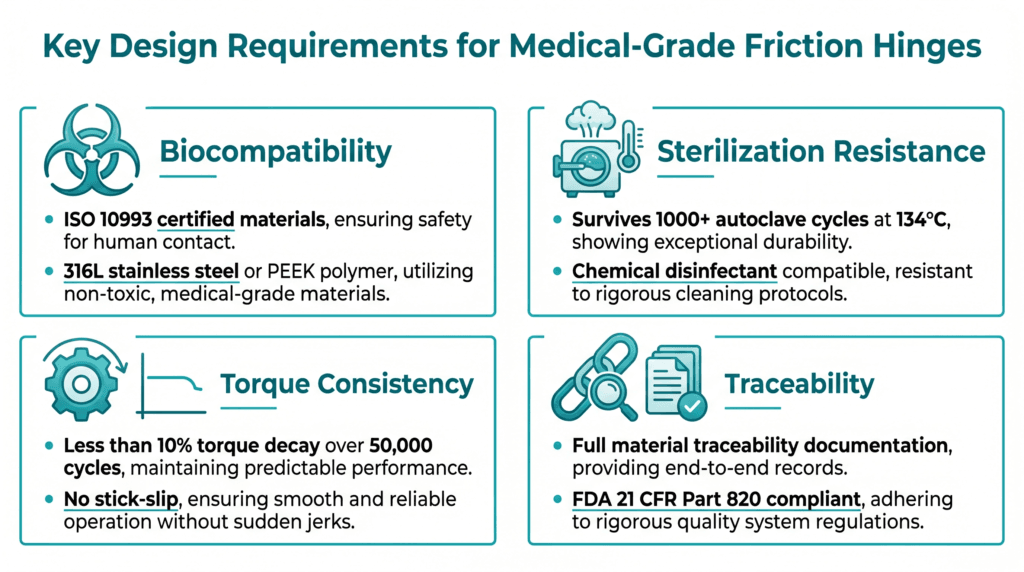
Medical-grade hinges must meet strict standards for biocompatibility, sterilization, and lifecycle traceability.
Biocompatibility: If a hinge on a knee brace touches human skin, the materials and lubricants must be ISO 10993 certified. This often means utilizing 316L stainless steel and medical-grade PEEK polymers instead of standard zinc alloys.
Sterilization Resistance: Equipment in a clinical rehab center is wiped down with harsh chemical disinfectants (like bleach or quaternary ammonium) multiple times a day. The hinge barrel must be perfectly sealed, or manufactured from highly corrosion-resistant materials, to prevent rust and the harboring of hospital-acquired pathogens.
Zero “Stick-Slip”: In physical therapy, smooth motion is critical. If a hinge suffers from “stick-slip” (where it requires a hard jerk to start moving, then suddenly moves too fast), it can tear a patient’s healing ligament. Premium medical friction hinges use proprietary greases to ensure the dynamic friction (moving) and static friction (holding) are nearly identical, resulting in buttery-smooth operation. Discuss more on Whatsapp
The Future of Therapeutic Motion
As the global population ages and the demand for in-home rehabilitation equipment skyrockets, the hardware must evolve. Patients and therapists will no longer accept clunky, unsafe, or difficult-to-adjust equipment.
By integrating precision friction hinges, medical device manufacturers can eliminate mechanical frustration, improve patient safety, and create products that feel like modern, premium healthcare solutions.
At JAN Hinge, we specialize in the engineering and manufacturing of medical-grade torque hinges. Whether you are designing a lightweight orthopedic brace or a heavy-duty power wheelchair, our engineering team can customize the torque profile, materials, and form factor to meet your strict clinical requirements.
Contact the JAN Hinge engineering team today to discuss your next rehabilitation device project and request technical samples. Discuss more on Whatsapp
Frequently Asked Questions (FAQ)
Q1: Can friction hinges be used to provide therapeutic resistance for muscle training?
Yes. Adjustable friction hinges are increasingly used in orthopedic braces and therapy machines. By turning an adjustment screw, a physical therapist can increase the torque (resistance) of the hinge, forcing the patient’s muscles to work harder during flexion or extension exercises.
Q2: How do you prevent a friction hinge from rusting when wiped with hospital disinfectants?
Medical-grade friction hinges are typically manufactured from 304 or 316L stainless steel, rather than standard zinc or carbon steel. Additionally, the internal friction bands and lubricants can be sealed with O-rings to prevent harsh chemical cleaners from penetrating the hinge barrel.
Q3: What is “stick-slip” and why is it dangerous in rehabilitation equipment?
Stick-slip (or stiction) occurs when a hinge requires a large amount of force to break static friction, but then suddenly moves very easily. In a rehabilitation setting, this sudden, jerky movement can cause a patient to lose their balance or tear a healing muscle. High-quality hinges use specific lubricants to eliminate this effect.
Q4: Can a friction hinge hold the weight of a patient leaning on a walker?
Yes, but it requires an asymmetric torque hinge. This specialized hinge provides very low resistance in one direction (making it easy for the elderly user to fold the walker) but extremely high resistance in the opposite direction (preventing the walker from collapsing under the user’s body weight).
Q5: Do medical friction hinges require FDA approval?
The hinge itself is a component and does not require standalone FDA approval. However, the final medical device (e.g., a wheelchair or exoskeleton) must pass FDA (or CE) certification. Therefore, the hinge manufacturer must provide full material traceability, lifecycle testing data, and ISO 9001/13485 quality documentation to support the OEM’s regulatory submission.
Upgrading your medical device’s motion control? Reach out to our technical team or Discuss more on Whatsapp for custom torque solutions.