
As an engineer or product designer, specifying a friction hinge isn’t just about getting the right torque for day one. It is about ensuring that the hinge continues to hold that heavy display panel, industrial enclosure door, or medical device screen securely in place on day one thousand. If you have ever had a customer complain about a “floppy” laptop screen or a kiosk panel that suddenly slams shut, you know exactly what happens when a friction hinge reaches the end of its useful life.
The most common question we get from engineering teams is straightforward: How long do friction hinges actually last?
The answer, however, is rarely a simple number of years. Unlike standard free-swinging hinges that might outlast the product they are attached to, friction hinges are dynamic mechanical components subject to continuous wear. Their lifespan is measured in cycles, and their performance inevitably experiences what engineers call “torque decay.” In this comprehensive guide, we will explore the real-world lifespan of friction hinges, break down the science of torque decay, and provide actionable maintenance strategies to keep your hinges performing optimally for years.

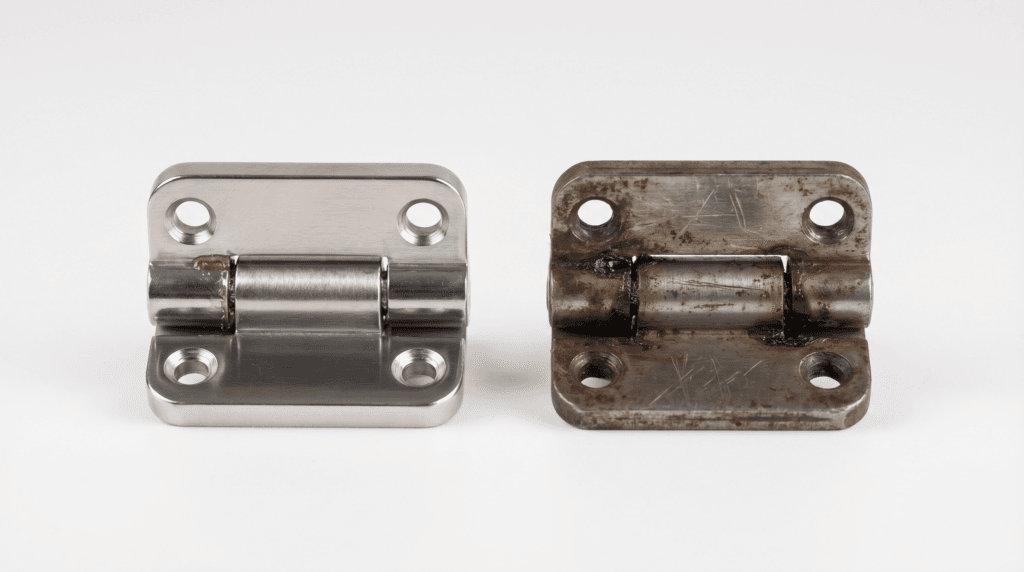
Brand new stainless steel friction hinge (left) vs. a heavily worn and oxidized hinge (right) after years of harsh environmental exposure.
Understanding Friction Hinge Lifespan: Cycles vs. Years
When manufacturers talk about the lifespan of a friction hinge, they rarely speak in terms of months or years. Instead, lifespan is quantified in operating cycles. One cycle is typically defined as opening the hinge to its maximum designed angle and closing it back to its original resting position.
For standard commercial-grade friction hinges, their lifespan is typically 20,000 to 30,000 cycles before significant torque loss occurs. High-performance industrial or aerospace hinges can be rated for 50,000 to 100,000 cycles or more.
To translate this into actual lifespan, you need to consider the application scenario:
Medical monitor brackets: Adjusted 20-30 times per shift by different nurses. Under such high usage, ordinary hinges may begin to fail within just 2 to 3 years, thus requiring heavy-duty hinges.
Consumer laptops: Opened and closed 5-10 times per day. A hinge with 25,000 cycles will last approximately 7 to 10 years, which is generally longer than the lifespan of the device’s electronics.
Industrial enclosures: May require weekly maintenance. In terms of cycle count alone, a standard hinge can theoretically last for decades.
However, cycle count is only half the story. The environment in which those cycles occur plays a massive role in how quickly the hinge degrades. Discuss more on Whatsapp.
The Science of Torque Decay
Friction hinges work by forcing two or more surfaces to rub against each other under immense pressure. Whether it is a band wrapped around a shaft, interleaved discs, or a curled sheet metal design, the fundamental principle is the same: mechanical interference creates resistance.
Over time, this constant rubbing wears down the microscopic peaks and valleys on the friction surfaces. As the material wears away, the pressure between the components decreases. This gradual loss of resistance is known as torque decay.
It is important to understand that torque decay is not a sign of a defective hinge; it is a fundamental law of physics. A high-quality friction hinge is designed to experience controlled and predictable torque decay. Typically, an acceptable decay rate is around 15% to 20% loss of initial torque over the rated cycle life. If you specify a hinge with 4.0 N·m of torque, you should expect it to drop to roughly 3.2 N·m by the end of its lifecycle. This is why engineers always specify a hinge with slightly more torque than the absolute minimum required to hold the panel.
5 Primary Factors That Accelerate Hinge Failure
If your friction hinges are failing prematurely, it is rarely due to reaching their maximum cycle count. More often, environmental and operational factors are accelerating the wear process.

The five primary environmental and operational factors that accelerate torque decay in friction hinges.
1. Temperature Cycling
Metals expand when heated and contract when cooled. If a friction hinge is subjected to extreme temperature fluctuations—such as in an outdoor EV charging station or aerospace application—the continuous expansion and contraction of the friction elements can alter the interference fit. Extreme heat can also cause internal lubricants to thin out and leak, while extreme cold can make them viscous and brittle, changing the torque profile dramatically.
2. Loss of Lubrication
Most high-quality friction hinges contain a specific type of engineered grease or dry lubricant applied at the factory. This lubricant isn’t there to make the hinge swing freely; it is there to prevent galling (metal tearing) and ensure smooth, consistent resistance. Over time, this lubricant can dry out, get pushed out of the friction zone, or degrade. When it does, metal-on-metal wear accelerates exponentially, leading to a rapid drop in torque and a gritty, uneven feel.
3. Overloading and Side-Loading
Friction hinges are designed to handle loads in a specific radial direction. If you mount a heavy door using hinges that are too small, the excessive weight compresses the friction discs or bands beyond their elastic limit. Worse, if the hinges are misaligned during installation, it introduces side-loading (axial stress). This uneven pressure causes the friction surfaces to wear asymmetrically, destroying the hinge in a fraction of its rated lifespan.
4. Environmental Contamination
Dust, dirt, sand, and manufacturing debris are the enemies of friction hinges. If abrasive particles find their way into the friction mechanism, they act like microscopic sandpaper. Every time the hinge is cycled, these particles gouge the metal surfaces, rapidly grinding away the interference fit and causing severe torque decay.
5. Corrosion and Oxidation
For applications in marine environments, chemical plants, or outdoor settings, moisture and corrosive gases can attack the hinge material. While stainless steel hinges (like 304 or 316 grade) resist this well, lesser materials will rust. Rust creates a rough, flaky surface that initially spikes the torque (making the hinge stiff and jerky) before rapidly wearing away, leaving the hinge completely loose.
Practical Maintenance: How to Extend Hinge Lifespan
While friction hinges are generally considered low-maintenance components, a proactive approach can significantly extend their usable life, especially in demanding industrial applications.

A practical guide to extending the lifespan of your friction hinges and recognizing early warning signs of failure.
Proper Specification is the First Step
The best maintenance strategy starts before the hinge is even installed. Always specify a hinge with a torque rating about 20% higher than your calculated requirement to account for inevitable torque decay. Additionally, if the environment is harsh, invest in sealed hinges or those made from corrosion-resistant materials like 316 stainless steel.
Keep It Clean
In industrial settings, regularly wipe down the exterior of the hinges with a clean, dry cloth to prevent dust buildup. If the hinges are exposed to heavy debris, consider designing a protective shroud or rubber boot to cover the hinge mechanism. Never use high-pressure air or water to clean a friction hinge, as this can force contaminants deeper into the friction bands. Discuss more on Whatsapp
Lubrication: Proceed with Extreme Caution
This is where many maintenance teams make a critical error. Do not spray standard penetrating oils (like WD-40) or heavy greases into a friction hinge.
Standard lubricants are designed to eliminate friction. If you flood a friction hinge with oil, you will instantly destroy its ability to hold a position, turning it into a free-swinging hinge. If a hinge begins to squeak or feel gritty, consult the manufacturer. Some hinges can accept a very light application of a specific dry PTFE (Teflon) spray, but many are sealed for life. If a sealed hinge loses its internal lubrication, it usually must be replaced.
Regular Alignment Checks
Vibration and heavy use can cause mounting screws to loosen over time. When a hinge becomes loose on its mount, it introduces side-loading. Make it a part of your annual maintenance schedule to check and retighten the mounting screws on all heavy-duty friction hinges to ensure they remain perfectly aligned.
Conclusion
Friction hinges are marvels of mechanical engineering, providing smooth, reliable position control without the need for gas struts or locking mechanisms. By understanding that torque decay is a natural process, calculating your cycle requirements accurately, and protecting the hinges from harsh environmental factors, you can ensure your product performs flawlessly for years.
If you are designing a new product and need help calculating the perfect torque or selecting a hinge that will survive your specific environmental challenges, the engineering team at JAN Hinge is here to help. Explore our wide range of Friction Hinges or Contact Us today to discuss your custom application requirements. Discuss more on Whatsapp
Frequently Asked Questions (FAQ)
1. How long do friction hinges last in a normal application?
In standard applications, a high-quality friction hinge is typically rated for 20,000 to 30,000 cycles. Depending on daily usage, this usually translates to 5 to 10 years of reliable service before significant torque decay affects performance.
2. What is torque decay and is it normal?
Torque decay is the gradual loss of rotational resistance caused by the microscopic wear of internal friction surfaces over time. It is a completely normal and expected physical process. A well-designed hinge will typically lose about 15% to 20% of its initial torque over its rated lifespan.
3. Can I lubricate a friction hinge if it gets stiff or squeaky?
You should never use standard oils or greases (like WD-40) on a friction hinge, as this will destroy the friction mechanism and cause the hinge to lose its holding power. If lubrication is absolutely necessary, consult the manufacturer; they may recommend a specific dry PTFE spray. In many cases, a squeaky hinge indicates it is nearing the end of its life and should be replaced.
4. Why did my friction hinge lose its torque so quickly?
Premature torque failure is usually caused by environmental factors rather than cycle count. The most common culprits are overloading (using a hinge too weak for the panel weight), misalignment during installation (causing uneven wear), or contamination from dust and abrasive particles entering the hinge mechanism.
5. How do I choose the right hinge to ensure a long lifespan?
To ensure longevity, always calculate the required holding torque for your panel and then select a hinge rated for about 20% more torque to compensate for future decay. Additionally, choose the right material—such as stainless steel—if the hinge will be exposed to moisture or corrosive environments. Discuss more on Whatsapp.