
1. Introduction
In heavy industrial plant design, specialized commercial facilities, and high-duty infrastructure projects, doorways are high-wear failure points. While standard structural architecture focuses heavily on static loads, door hardware must manage complex dynamic forces, cycle fatigue, and physical wear. For design engineers and B2B procurement managers, sourcing door hinges requires moving past retail-level options to analyze precise mechanical tolerances, yield strength, and kinetic behavior.
Specifying the incorrect hardware type for a high-traffic entry point, automated fire barrier, or heavy cleanroom airlock results in door sagging, latch misalignment, and compromised environmental control. This comprehensive engineering guide breaks down commercial door hinges types, focusing heavily on double action hinges, door hinges heavy duty specifications, door pivot hinges, and door hidden hinges.
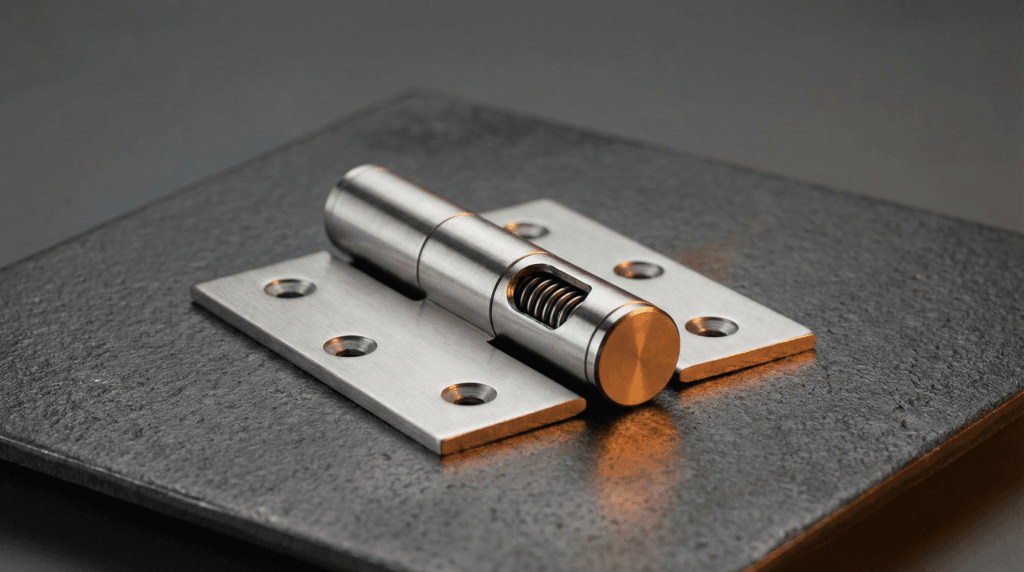
2. The Industrial Specification Reality vs. Consumer Retail Sourcing
When researching industrial hardware online, search trends often bring up consumer-facing retail queries like door hinges bunnings or door hinges home depot. While consumer retail centers serve residential construction well, industrial equipment and institutional facilities operate under completely different stress profiles.
The Engineering Gap: Commercial vs. Industrial Grade
- Consumer-Grade Hardware: Typically manufactured from thin, stamped mild steel or zinc alloys. These are rated for low daily operational cycles and standard environmental conditions. They rely on basic internal pins that experience rapid friction wear under heavy loads.
- Industrial/Institutional Grade: Engineered from heavy-gauge sus304/sus316 stainless steel, extruded high-tensile brass, or structural carbon steel. These systems feature specialized internal bearing configurations (such as ball bearings or needle rollers) to handle continuous, high-frequency operation and harsh chemical exposures.
Procurement teams must recognize that while consumer retail stores offer fast replacement parts for simple building mockups, true industrial applications require direct-from-factory components with verified load ratings, material traceability sheets, and tested cycle-life minimums.
3. Kinematic Matrix: Categorizing Specialized Door Hinges Types
To select the appropriate hardware configuration, engineers must match the door panel layout with the required kinematic behavior. Below is a structural matrix analyzing common industrial styles:
| Hinge Category | Primary Pivot Mechanism | Main Structural Benefit | Common Applications |
| Heavy Duty Butt Hinge | Surface or mortised fixed-pin leaf | Exceptional radial load capacity | Heavy perimeter doors, security vaults |
| Double Action Hinge | Dual-spring internal barrels | Bidirectional $180^\circ$ travel with self-closing capability | Kitchen corridors, hospital corridors, emergency bays |
| Pivot Hinge | Floor and header mounted axial pin | Transfers panel weight directly to the substructure flooring | Oversized glass facades, heavy industrial gates |
| Hidden / Concealed Hinge | Internal multi-bar scissor linkage | Completely flush exterior, tamper-proof security | Cleanrooms, data center server enclosures, premium facades |
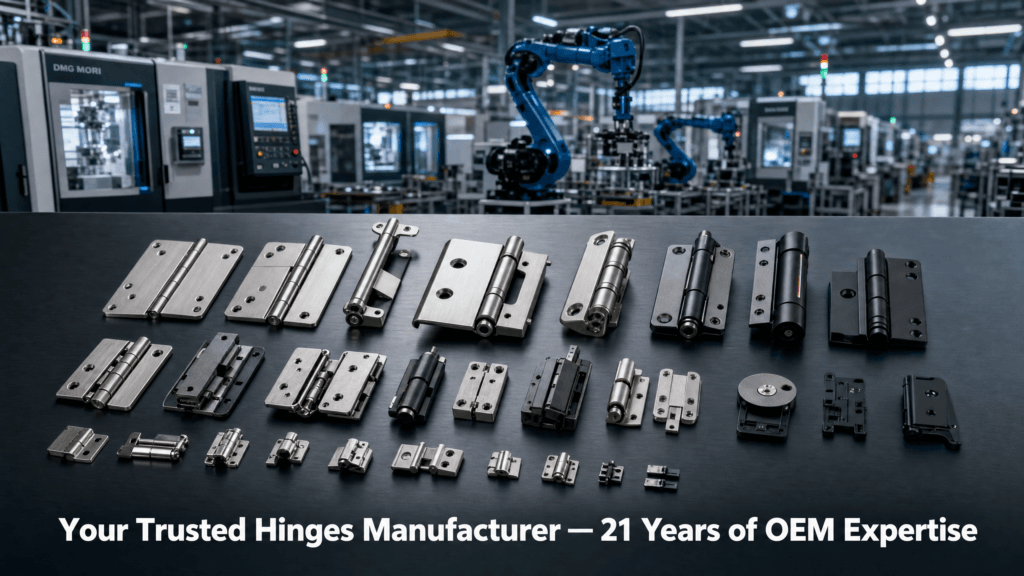
4. Deep Dive: Double Action Hinges & Bidirectional Kinematics
In high-traffic commercial and industrial pathways, doors must open smoothly in both directions to maintain efficient traffic flow. This operational profile requires the use of double action hinges (frequently referred to as saloon or spring-loaded double-acting hardware.
The Dual-Cylinder Internal Spring Torsion System
Double-action hardware uses a central spine flanked by two separate spring-loaded cylinders. One barrel controls the outward swing path, while the other manages the inward path. Internal heavy-duty torsion springs store mechanical energy as the door panel opens and release it to automatically return the panel to its central $0^\circ$ alignment.
Managing Momentum and Oscillation Control
A common issue with lower-grade double-action hardware is excessive oscillation—where the door panel swings back and forth repeatedly past the center point before stopping. For industrial corridors, engineers specify premium variants with adjustable spring tension or integrated hydraulic damping. Adjusting the internal spring force allows teams to fine-tune the closure profile to match the door panel’s mass, preventing dangerous rebound effects.
5. Architectural Invisibility: Hidden & Concealed Door Hardware
Where security, cleanroom standards, or seamless modern aesthetics are primary project requirements, traditional surface-mounted butt hardware is often replaced by door hidden hinges or door concealed hinges.
Eliminating Lever Arm Leverage Points
Standard external components provide intruders with an exposed leverage point. A pry bar, grinder, or hydraulic cutter can quickly compromise external knuckles. Door concealed hinges mount completely inside mortised slots cut into the door thickness and frame inner lining. When the door is closed, the entire hardware mechanism is fully shielded, removing external access points and significantly boosting security.
Multi-Axis Linkage Engineering
Because a hidden hinge must sit entirely within the door and frame footprint when closed, it cannot use a single fixed pin. Instead, it relies on an engineered multi-bar linkage mechanism (often a 5-bar or 7-bar kinematic layout). This linkage geometry shifts the pivot center dynamically as the door opens, lifting the panel edge up and away from the frame cutout to prevent binding.
For heavy architectural installations or industrial electronic cabinetry, integrating premium door cabinet hinges ensures clean outer surfaces and a perfectly flush finish.

6. Axial Load Distribution: The Mechanics of Door Pivot Hinges
When a door panel’s weight exceeds typical operational limits (such as heavy lead-lined radiation shielding doors, large glass storefront entries, or heavy steel plate access hatches), traditional frame-mounted hardware faces extreme leverage forces. In these demanding scenarios, door pivot hinges are the standard choice.
Direct Floor Substructure Load Loading
Unlike traditional variants that mount to the side vertical frame jamb, pivot systems install at the extreme top and bottom edges of the door panel, functioning as an absolute vertical axis. The bottom pivot bearing assembly anchors directly into the concrete floor subfloor. This layout transfers $100\%$ of the door panel’s vertical deadweight directly down into the ground, eliminating the cantilevering torque stress that typically warps side frames over time.
Radial Alignment and Reduced Opening Resistance
Because the load is supported axially from below, the force required to open the door (breakaway force) is significantly lower than that of a standard leaf setup. This allows a single operator to open a massive door assembly weighing upwards of $500 \text{ kg}$ smoothly and safely with minimal effort.
7. Structural Failure Modes in Door Hinges Heavy Duty Frameworks
When designing high-performance structural systems, engineers look closely at common failure modes to select the correct door hinges heavy duty specifications.
1. Frame Fatigue and Fixing Pull-Out
Heavy doors create a continuous leverage force against the upper vertical jamb. Over time, this stress can pull mounting screws loose from sheet metal or timber framing.
- Engineering Solution: Use heavy-gauge reinforcement backing plates inside the frame structure and specify deep, countersunk machine screws to distribute the pulling forces evenly.
2. Internal Pin Wear and Door Sag
Continuous friction between raw metal knuckles causes material loss along the central axis pin, which leads to door sag. This misalignment prevents latches from engaging cleanly and causes the bottom edge of the door to drag along the floor.
- Engineering Solution: Specify industrial heavy-duty styles fitted with internal hardened stainless steel ball bearings or self-lubricating thrust bearings to minimize friction and prevent axial drop over millions of cycles.
3. Yield Deformation Under Wind Load
Outdoor perimeter entries often face sudden, violent pressure spikes from wind loads. If a hinge lacks sufficient yield strength, these pressure forces can permanently bend the mounting leaves, misaligning the door assembly.
- Engineering Solution: Ensure the chosen hardware leaves are stamped or extruded from thick structural materials (such as $3.0 \text{ mm}$ to $5.0 \text{ mm}$ thick stainless steel) that can handle high wind loads without structural deformation.
By partnering with an experienced manufacturing expert like Jin En JAN, procurement and engineering teams can access advanced production capabilities—including in-house precision injection molding, die casting, and automated stamping. This end-to-end quality control ensures every component delivers stable, predictable performance across its entire operational life.
8. Frequently Asked Questions (FAQs)
Q1: What makes a hinge classified as “Heavy Duty” for industrial door specification?
A: A true heavy-duty industrial option is defined by leaf material thickness (typically $\ge 3.5 \text{ mm}$), high-tensile base metals like sus304 or sus316 stainless steel, and integrated internal ball bearings or needle bearings. These components are engineered to handle heavy panels (exceeding $120 \text{ kg}$) across high daily operational cycles without bending or sagging.
Q2: How do you adjust the closing speed on a double-action spring hinge?
A: Most industrial double-action spring variations feature an adjustable tension collar at the top or bottom of the spring cylinders. Using a specialized tension rod or hex key, technicians turn the collar to increase or decrease internal spring tension, adjusting the closing speed to match the door’s weight and prevent excessive swing oscillation.
Q3: What are the main clearance challenges when specifying concealed hidden hinges for thick doors?
A: As door thickness increases, a standard hidden linkage can cause the interior leading edge of the door to bind against the frame face during opening. Engineers must use full 3D CAD simulation software to verify that the hinge’s linkage movement lifts the panel far enough outward to clear the frame throughout its entire opening path.
Q4: Why are pivot hinges preferred over butt hinges for oversized glass entrances?
A: Oversized glass doors are heavy and lack rigid perimeter frames for deep side screws. Pivot systems solve this by securing the glass panel at the top and bottom corners, shifting the weight away from the vertical side frame and routing it directly down into the floor structure.
Q5: Can these industrial options integrate safety motion control mechanisms?
A: Yes. High-traffic industrial doors often incorporate specialized rotary dampers or custom friction elements into the pivot axis. This addition manages kinetic energy, preventing heavy panels from slamming shut under wind loads or high-pressure differentials, protecting both personnel and delicate equipment.
For custom 3D CAD file extraction, physical load-bearing laboratory validations, or tailored material specification sheets, contact the technical engineering desk at JAN Motion Control Hardware.