

When you release the heavy piano lid, you might hear a loud thud. However, it falls slowly and gently onto the frame, without a sound. This seemingly magical “slow-close” effect is achieved through the precise application of fluid dynamics and mechanical engineering in a process called rotary dampers.
For engineers working on everything from car glove boxes to medical devices to high-end appliances and cabinets, understanding the basic workings of rotational dampers is crucial for selecting the right component. This technical guide, written by JAN Hinge Damper‘s engineering team, delves into the science behind rotational dampers, explaining how kinetic energy is controlled, absorbed, and dissipated. Inquire on Whatsapp
The Core Principle of Rotary Dampers: Viscous Fluid Resistance
At its most basic level, a rotary damper is an energy conversion device. It takes the kinetic energy of a moving object (like a falling lid) and converts it into a minute amount of thermal energy (heat), which is then dissipated into the surrounding environment.
Unlike a spring, which stores energy and bounces back, or a friction hinge, which uses dry mechanical friction to hold an object in place, a rotary damper relies on viscous fluid resistance (also known as viscous drag).
The Anatomy of Rotary Dampers
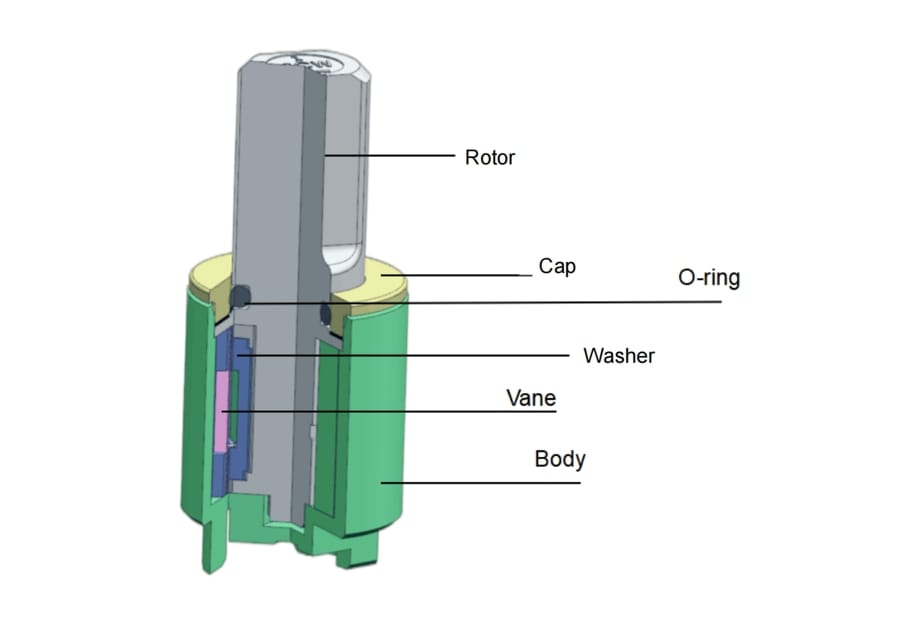
A standard rotary damper consists of three primary components:
1.The Housing (Stator): The outer shell, typically made of zinc alloy or reinforced engineering plastic (POM/PC), which contains the fluid.
2.The Rotor (or Vane): The internal moving part connected to the central shaft. This is the component that is driven by the external moving object (e.g., the falling lid).
3.The Viscous Fluid (Silicone oil): The medium that fills the sealed cavity between the housing and the rotor. In almost all high-quality dampers, this is a specialized silicone oil.
While the Rotary Damper provides velocity-dependent resistance, the Friction Hinge (Constant Torque Hinge) provides position-holding capability. In 2026, the most sophisticated devices use a hybrid approach.
Case Study: The Medical Imaging Monitor: A monitor arm requires a friction hinge to stay in the exact position the surgeon moves it to. However, if the surgeon releases the arm too quickly, a rotary damper is integrated to ensure that the final 10 degrees of “parked” movement are soft and controlled. This prevents the “metal-on-metal” impact that can recalibrate sensitive medical sensors.
The Physics of Rotary Dampers Shear
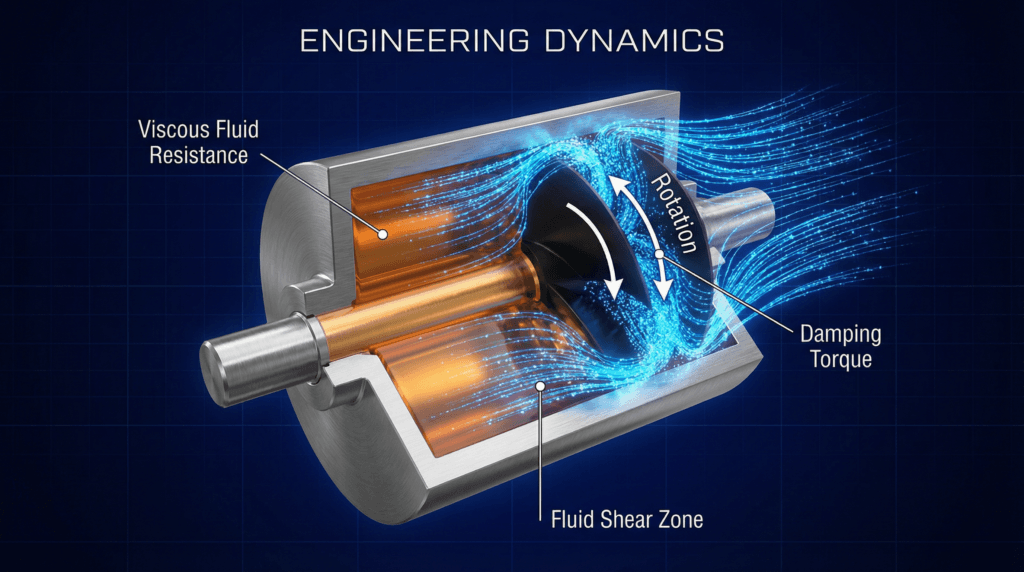
When an external object moves, it causes the rotor shaft to rotate. As the rotor rotates within the sealed housing, it must pass through a highly viscous silicone oil.
The design tolerances for the rotor and housing are extremely tight—typically measured in fractions of a millimeter. As the rotor rotates, it forces the viscous silicone oil through these tiny gaps (gaps).
This action creates fluid shear. The silicone oil molecules resist being pulled apart and squeezed through the narrow gaps. This resistance generates a counter-rotating force (damping torque), hindering the rotor’s movement.
Crucially, viscous damping is rotationally dependent. The faster the rotor rotates, the greater the resistance to shearing by the fluid, and the greater the resulting damping torque. This is why a soft-close lid closes slowly, but if you try to slam it shut, the damper generates significant resistance, preventing the lid from closing abruptly.

Why Silicone Oil? The Secret Ingredient
The performance of a rotary dampers depends entirely on the properties of its internal fluid. Water is too thin; ordinary mineral oil decomposes under shear stress, and its viscosity changes drastically with temperature.
Silicone oil, due to its three unique chemical properties, has become the industry standard for high-end rotary dampers:
Chemical inertness: Silicone oil does not react with the plastic or metal components of the shock absorber, nor does it damage the rubber O-rings used to seal the housing, thus ensuring a leak-free service life.
High viscosity index (temperature stability): Silicone oil maintains a relatively stable viscosity profile over a wide temperature range. Automotive glove box dampers must function properly in extreme temperatures ranging from -20°C in winter to +60°C in summer. If ordinary oil is used, the damper will freeze at low temperatures and completely fail at high temperatures.
Shear stability: The fluid inside the damper is subjected to enormous mechanical tearing forces. Silicone oil has long and stable polymer chains that can withstand tens of thousands of consecutive shear cycles without decomposing or losing viscosity.
Directional Control: Symmetric VS Asymmetric Damping
Engineers often require motion control in only one direction. For example, a toilet seat needs rotary dampers when closing (falling), but it should be easy to lift (open) without fighting the damper.
Rotary dampers achieve this through internal valving or structural design, categorizing them into two types:
Symmetric (Bi-directional) Rotary Dampers
These dampers provide equal resistance regardless of which way the shaft is turned. They are typically used in applications requiring continuous motion control, such as a volume knob on a high-end stereo or a sliding drawer mechanism. Gear dampers and disk dampers are usually symmetric.
Asymmetric (Uni-directional) Dampers
These dampers provide high torque in one direction (the damping direction) and very low torque in the opposite direction (the free-wheeling direction).
In a vane damper, this is achieved through a clever internal valve system.
•During the damping stroke: The vane pushes against the oil, forcing a one-way valve closed. The oil is forced through the tiny clearance gap, generating high resistance.
•During the return stroke: The vane moves in the opposite direction. The pressure differential forces the one-way valve open, creating a large bypass channel for the oil. The fluid flows easily through the bypass, resulting in minimal resistance.
| Feature | Symmetric Damping | Asymmetric Damping |
| Resistance | Equal in both directions | High in one direction, low in the other |
| Typical Damper Type | Gear damper, Disk damper | Vane damper |
| Primary Use Case | Continuous rotation (knobs, sliding trays) | Hinged lids (toilet seats, toy boxes, glove boxes) |
| Internal Valve | None | One-way bypass valve |
The Importance of Precision Manufacturing
Because the damping torque is exponentially related to the clearance gap between the rotor and the housing, manufacturing precision is paramount. A difference of just 0.01mm in the clearance can drastically alter the closing speed of a lid.
At JAN Hinge Damper, we utilize advanced CNC machining for our zinc alloy housings and precision injection molding for our engineering plastics. Furthermore, we employ automated, 100% inline torque testing to ensure every single damper leaving our facility performs exactly to the specified torque curve, guaranteeing a consistent soft-close experience for the end-user.
Frequently Asked Questions (FAQ)
Q1: Does a rotary damper wear out over time?
A: High-quality rotary dampers are designed for exceptional longevity. Wear typically occurs if the internal seals degrade (causing oil leakage) or if the silicone oil breaks down under extreme shear. JAN Hinge Damper products are tested to exceed 50,000 to 100,000 cycles, meaning they will outlast the typical lifespan of the furniture or appliance they are installed in.
Q2: Can the damping torque be adjusted after installation?
A: Generally, no. Most rotary dampers are sealed units with a fixed torque rating determined by the internal clearance and the viscosity of the silicone oil used during manufacture. The correct torque must be calculated and specified during the engineering phase.
Q3: How does temperature affect the closing speed?
A: While silicone oil is highly stable, extreme temperature changes will cause minor fluctuations in viscosity. In very cold environments, the oil thickens slightly, causing the lid to close slower. In very hot environments, it thins slightly, causing a faster close. However, with premium silicone oil, this variance is kept within a tight, acceptable tolerance (usually ±10-15% of the nominal closing time).
Q4: What causes a rotary damper to leak?
A: Leakage is the most common failure mode in low-quality dampers. It is usually caused by cheap O-ring seals degrading, poor ultrasonic welding on plastic housings, or the damper being subjected to forces far exceeding its rated torque (e.g., someone violently slamming a soft-close lid). We use dual O-ring designs and overload protection valves to prevent this.
Q5: Why does my soft-close lid drop quickly at first and then slow down?
A: This is a common issue related to the starting angle and gravity. When a lid is fully upright (near 90 degrees), gravity exerts very little rotational torque on the hinge. As the lid falls, the gravitational torque increases (peaking at 0 degrees, fully horizontal). If the damper’s torque curve isn’t perfectly matched to the lid’s weight and center of gravity, it may free-fall slightly before the fluid shear resistance “catches” it. Our engineering team calculates these dynamic forces to specify a damper that provides a smooth, linear close from top to bottom.
Master motion control in your next product design.
Contact the JAN Engineering Team today to discuss your application, request dynamic torque calculations, and receive custom rotary damper samples.