

The “Silent” Salesperson: Why Tactile Feedback Matters
In an increasingly crowded marketplace, manufacturers are constantly searching for ways to differentiate their products. While software features and aesthetic design often take center stage, there is a hidden dimension of product design that profoundly impacts consumer psychology: tactile feedback.
When a consumer interacts with a physical product, their brain subconsciously evaluates its quality within milliseconds. The harsh bang of a slamming cabinet door or the cheap, springy resistance of a budget laptop hinge instantly signals low quality. Conversely, the smooth, controlled, and silent soft close mechanism of a premium product communicates luxury, engineering precision, and care.
For B2B manufacturers and product managers, investing in high-quality motion control components like a rotary damper or a friction hinge is not just an engineering decision—it is a strategic marketing and pricing tool. This article explores how a product user experience upgrade through advanced motion control directly translates to higher profit margins and market leadership.
The Economics of the “Premium Feel”
Many procurement teams hesitate to spend a few extra cents on a premium friction hinge or rotary damper, viewing it strictly as a cost increase. However, pricing psychology reveals that consumers are willing to pay a disproportionate premium for products that feel expensive.
Justifying a Higher Price Point
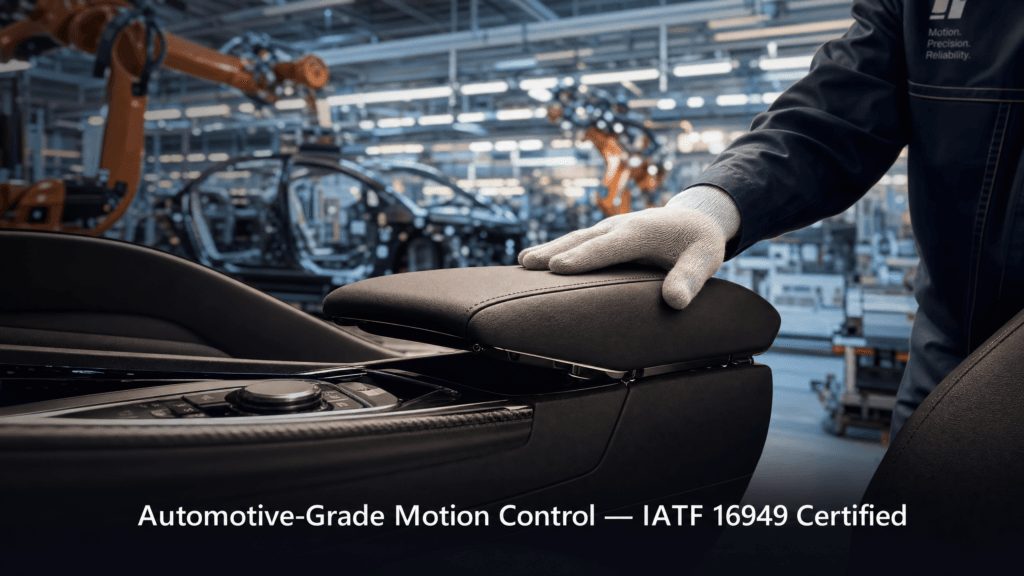
Consider the automotive industry. The difference in manufacturing cost between a standard spring-loaded center console lid and one equipped with a fluid-damped rotary damper is minimal. Yet, that smooth, slow-motion closing action is a hallmark of luxury vehicles.
When you integrate a premium product feel motion control system into your design, you elevate the entire product’s perceived value. Market studies consistently show that products featuring soft-close or infinite-positioning technologies can command a 10% to 15% price premium over standard alternatives. The return on investment (ROI) for upgrading your hinges is exceptionally high.

Reducing the Hidden Costs of “Cheap”
Beyond increasing revenue, premium motion control significantly reduces hidden costs. A slamming lid doesn’t just sound bad; it creates mechanical shock. Over time, this shock leads to cracked plastic housings, loosened screws, and premature product failure.
By utilizing a high-quality damper to absorb kinetic energy, you extend the lifespan of your product. This directly translates to fewer warranty claims, lower reverse logistics costs, and higher customer satisfaction.
How Rotary Dampers and Friction Hinges Transform Industries
To understand how rotary damper improves product quality, let’s look at how different industries leverage these components to create a soft close hinge competitive advantage.
1. Consumer Electronics: The Art of Positioning
In laptops, tablets, and 2-in-1 devices, the screen hinge is the most frequently interacted-with mechanical component. A premium friction hinge provides consistent torque, allowing the user to open the device with one hand and position the screen at any angle without it bouncing or drooping. This stability is the defining characteristic of high-end electronics.
2. Smart Home Appliances: Silent Operation
Modern consumers expect their homes to be peaceful. A washing machine lid that slams shut shatters that peace. By integrating rotary dampers, appliance manufacturers ensure that heavy glass or metal lids close silently and safely, protecting both the machine and the user’s fingers.
3. Medical Equipment: Precision and Reliability
In healthcare settings, equipment must feel robust and reliable. A diagnostic monitor mounted on an articulating arm must stay exactly where the surgeon positions it. High-holding-force friction hinges provide this critical stability, conveying a sense of clinical precision.

The OEM Partnership: Designing for the Senses
Achieving the perfect tactile feel is not a matter of guessing; it is a matter of precise engineering. The torque, the speed of descent, and the resistance curve must be perfectly matched to the weight and dimensions of your specific product.
This is why partnering with a dedicated OEM manufacturer like Janhinge is crucial. We do not just sell off-the-shelf parts; we engineer tactile experiences.
The Janhinge Customization Process
When you bring your project to Janhinge, our engineering team works directly with your CAD files. We calculate the exact center of gravity and moment of inertia to determine the perfect torque profile.
We then utilize our rapid prototyping capabilities to provide physical samples. This allows your product team to actually feel the motion before committing to mass production. Whether you need the heavy, luxurious resistance of a high-end audio receiver knob or the light, snappy closure of a sunglass case, we can tune the internal fluid dynamics and mechanical friction to match your brand’s identity.

Conclusion: Upgrade Your Brand’s Touchpoint
Every time a customer opens, closes, adjusts, or turns a part of your product, they are having a conversation with your brand. What is your product saying?
If you are still relying on basic springs and standard hinges, you are missing a critical opportunity to build brand equity. Upgrading to Janhinge’s 100%-tested rotary dampers and friction hinges is the most cost-effective way to transform a standard product into a premium experience.
Discover Our Custom OEM Solutions | Explore the Janhinge Product Catalog

Frequently Asked Questions (FAQ)
Q1: How much does upgrading to a soft-close mechanism typically increase the manufacturing cost?
A: The component cost increase is often just a few cents to a few dollars per unit, depending on the size and complexity of the damper. However, this minor increase is heavily outweighed by the ability to command a higher retail price and the reduction in warranty claims due to impact damage.
Q2: Will a rotary damper make my product harder for the user to open?
A: Not if engineered correctly. Janhinge specializes in “one-way” rotary dampers. These provide high resistance when closing (for the soft-close effect) but feature an internal bypass valve that allows for near-zero resistance when the user is opening the lid.
Q3: Our product is already in the market. Can we retrofit a friction hinge into an existing design?
A: Yes. Janhinge has an extensive library of standard friction hinges with various mounting hole patterns. If a standard part doesn’t fit, our OEM team can design a custom mounting plate that integrates directly into your existing housing without requiring you to change your main product molds.
Q4: How do I know the “premium feel” will last over time?
A: The “feel” of a damper is dictated by the viscosity of the silicone oil inside. Cheap dampers leak or the oil breaks down. Janhinge guarantees longevity through 100% automated air-pressure leak testing and the use of premium, temperature-stable silicone oil that retains its properties for over 50,000 cycles.
Q5: Can you provide samples so our marketing team can feel the difference?
A: Absolutely. We encourage it. We can ship standard samples within 1 day. Once you feel the smooth, silent operation of a Janhinge component, the value proposition becomes immediately clear.