
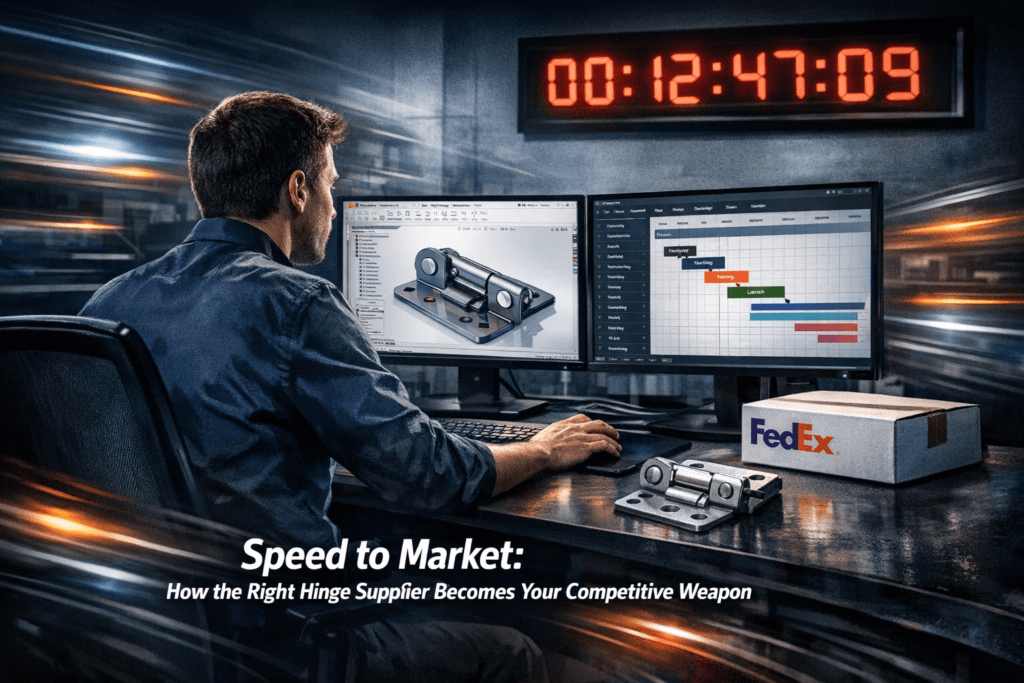
The Hidden Bottleneck in New Product Development
In the high-stakes world of OEM manufacturing, speed is the ultimate competitive advantage. Whether you are launching a revolutionary 2-in-1 laptop, a next-generation medical device, or a smart home appliance, the first brand to reach the market captures the lion’s share of the revenue.
However, new product development motion control often becomes an unexpected bottleneck. Mechanical engineers frequently spend months perfecting the external housing and electronic circuitry, only to realize late in the development cycle that the standard catalog hinge they planned to use does not fit the physical constraints or provide the correct tactile feel.
When forced to source a custom hinge late in the game, OEMs often encounter suppliers who require 90 to 120 days just to deliver a functional prototype. This delay can push an entire OEM product launch hinge damper off schedule.
This article explores how partnering with a vertically integrated manufacturer like Janhinge can dramatically reduce product development cycle times through rapid prototyping, in-house tooling, and collaborative Design for Manufacturing (DFM).
The Cost of Slow Suppliers
To understand the value of speed, we must first look at the traditional, slow supply chain model. Many Western OEMs unknowingly partner with trading companies or fragmented factories that outsource their tooling and molding.
The Fragmented Supply Chain Timeline
When you request a custom friction hinge from a fragmented supplier, the timeline looks like this:
1.RFQ and Design Translation (7-14 Days): The trading company translates your requirements and sends them to a third-party engineering firm.
2.Mold Outsourcing (45-60 Days): The design is sent to a separate mold-making facility. Because the hinge factory does not own the mold shop, your project is placed in a queue behind other customers.
3.First Sample Production (14-21 Days): The mold is finally shipped to the hinge factory for the first test run.
4.Revision Cycle (30+ Days): If the first sample’s torque is incorrect (which is common), the mold must be sent back to the third-party shop for modification.
This fragmented process easily consumes 3 to 4 months before you even have a testable prototype in your hands.

The Janhinge Fast-Track: 20 Days to Custom Prototype
At Janhinge, we recognize that a hinge damper supplier fast sample capability is not just a customer service perk; it is a critical engineering requirement. We have built our entire manufacturing infrastructure around the concept of vertical integration to eliminate third-party delays.
1. Collaborative DFM (Design for Manufacturing)
Speed begins with getting the design right the first time. When you submit an RFQ, you do not speak to a middleman; you speak directly to our motion control engineers. Within 4 hours, we provide a technical review. Within 7 days, we collaborate with your team to finalize a 3D CAD model optimized for both your product’s spatial constraints and our high-speed manufacturing processes.

2. The In-House Mold Library and Tooling Center
The biggest delay in custom hardware is mold creation. Janhinge operates a massive, meticulously organized in-house mold library and a dedicated CNC tooling center.
Because we do not rely on outside contractors, we prioritize your project immediately. For minor modifications to existing designs, we can often adapt a mold from our library in days. For entirely new custom OEM designs, our CNC machinists can cut a new hardened steel mold in just 15 days.

3. Rapid Prototyping and Sample Delivery
Once the mold is cut, the prototype is injected, assembled, and torque-tested on the same factory floor. This allows us to deliver functional, test-ready custom prototypes—not just 3D printed plastic, but actual production-grade metal and silicone oil assemblies—in as little as 20 days.

Why Physical Prototypes Matter Faster
In motion control engineering, theoretical CAD data is not enough. The true test of a hinge prototype rapid delivery is tactile feedback.
Your product team needs to physically hold the device, open the lid, and feel the resistance. Is the soft-close too slow? Is the friction hinge too stiff for a one-handed open?
By delivering a physical sample in 20 days rather than 90 days, Janhinge gives your engineering team the luxury of time. You have the bandwidth to request a torque adjustment, receive a revised sample within 5 days, and still launch your product months ahead of schedule.
Conclusion: Make Speed Your Strategy
In the race to market, every day counts. A delayed product launch means lost revenue, frustrated investors, and giving your competitors a head start.
Do not let a slow hardware supplier dictate your product roadmap. By partnering with Janhinge, you leverage 21 years of vertical integration, in-house tooling, and rapid prototyping expertise. We turn motion control from a development bottleneck into a strategic advantage.
Ready to accelerate your next project? Send us your CAD files today and experience the Janhinge speed.
Submit Your RFQ for a 4-Hour Response | Download Standard 3D CAD Files
Frequently Asked Questions (FAQ)
Q1: How fast can I get a sample if I just need a standard catalog hinge?
A: For standard, off-the-shelf rotary dampers and friction hinges, we maintain a massive inventory. If you request a standard sample, we will package and ship it via DHL or FedEx within 24 hours.
Q2: What is included in the DFM (Design for Manufacturing) process?
A: Our DFM review includes a thorough analysis of your 3D CAD files. We calculate the exact moment of inertia and center of gravity for your moving panel, recommend the optimal torque range, and suggest modifications to the hinge mounting plates to ensure it fits perfectly within your housing while maintaining structural integrity.
Q3: If we need a custom mold created, who owns the rights to that mold?
A: Transparency is a core value at Janhinge. If you pay the tooling fee for a custom OEM mold, you own the exclusive rights to that mold. We will never use your custom mold to produce parts for another customer or competitor.
Q4: Can you provide 3D printed prototypes before cutting the actual steel mold?
A: Yes. For spatial and fitment testing, we can provide rapid SLA/SLS 3D printed prototypes within 48 hours. However, please note that 3D printed plastic cannot accurately replicate the torque and fluid dynamics of a final metal and silicone oil assembly.
Q5: What happens if the first custom sample doesn’t feel right and we need to change the torque?
A: Because we handle everything in-house, torque revisions are incredibly fast. We do not need to cut a new mold to change the torque. We simply adjust the internal friction bands or inject a different viscosity of silicone oil. We can usually produce and ship a revised sample within 3 to 5 days.