
As an engineer or procurement manager, you have likely encountered this frustrating scenario: you have sourced a batch of premium industrial enclosures or medical display mounts, but during final assembly, the heavy access panel simply will not stay open. It droops, drifts, and ultimately slams shut, creating a massive safety hazard and an unacceptable user experience. Or conversely, the panel is so stiff that the operator has to use two hands and excessive force just to pry it open.
When you are dealing with position control hardware, the difference between a premium, ergonomic feel and a complete product failure often comes down to a fraction of a millimeter of tension.
Friction hinges (also known as torque hinges) are the industry standard for holding doors, lids, and monitors solidly in position at any given angle . However, even the highest-quality friction hinges are subject to mechanical wear, temperature fluctuations, and manufacturing tolerances. This is why understanding how to properly specify, test, and adjust friction hinges is a critical skill for any hardware engineering team.
The Two Categories of Friction Hinges
Before you reach for a tool, it is crucial to understand that not all friction hinges are designed to be adjusted in the field. They generally fall into two distinct categories based on their internal architecture.
1. Constant Torque (Non-Adjustable) Hinges
These hinges are engineered to provide a specific, pre-calibrated amount of rotational resistance straight from the factory. The internal friction mechanism—typically a rolled spring-steel band (curl structure) or a press-fitted shaft—is permanently sealed .
If a constant torque hinge is too loose or too stiff for your application, you cannot adjust it. You must replace the hinge entirely with a unit that has a different torque rating. These are commonly found in high-volume consumer electronics, such as laptops and lightweight plastic enclosures, where the exact weight of the panel is known and never changes.
2. Adjustable Torque Hinges
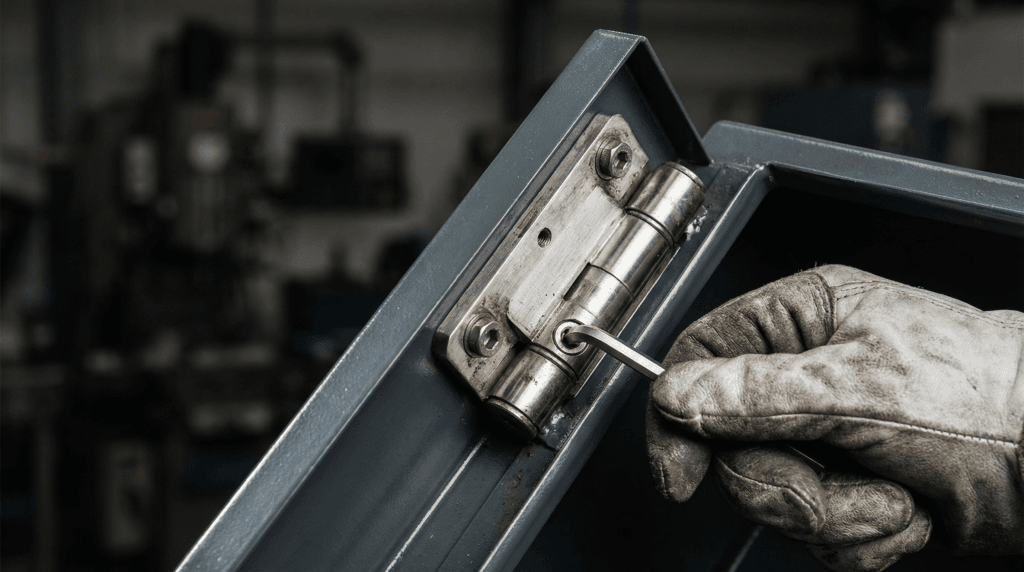
For heavy-duty industrial applications, medical equipment, and variable-load environments, adjustable torque hinges are the standard. These hinges feature a built-in adjustment mechanism—usually a hex socket set screw located on the barrel or the leaf of the hinge .
By turning this screw, you physically compress or decompress the internal friction elements (such as a stack of alternating steel and polymer discs). This allows you to fine-tune the resistance to perfectly match the weight of the door and the desired “feel” of the motion.
Step-by-Step: How to Adjust a Friction Hinge
Adjusting a friction hinge is not a complex process, but it requires patience and the correct methodology to avoid permanently damaging the internal components.
| Step | Action Required | Engineering Rationale |
| 1. Tool Selection | Identify the correct size hex key (Allen wrench) for the adjustment screw, typically 2mm, 2.5mm, or 3mm. | Using an incorrectly sized or worn-out hex key will strip the socket, rendering the hinge permanently unadjustable. |
| 2. Baseline Test | Open the panel to 90 degrees and release it. Observe the behavior. | If the panel falls freely, the torque is too low. If it requires excessive force to move, the torque is too high. |
| 3. Micro-Adjustments | Insert the hex key. Turn clockwise to increase torque (tighten), or counter-clockwise to decrease torque (loosen). | Never turn the screw more than 1/4 turn at a time. Friction elements are highly sensitive; a tiny adjustment creates a massive change in holding force. |
| 4. Cycle and Verify | Cycle the hinge fully open and closed three times. Stop the panel at 30°, 60°, and 90° to verify it holds position without drifting. | Cycling the hinge distributes the internal lubrication evenly and settles the friction discs, giving you an accurate reading of the new torque level. |
| 5. Synchronize (Dual Hinges) | If your panel uses two hinges, you must adjust both screws equally. | Uneven torque distribution will cause the panel to twist, accelerating wear on the hinges and potentially warping the door frame. |

Common Adjustment Pitfalls and Troubleshooting
Even with the correct procedure, engineers often run into issues when dealing with friction hinges in the field. Here are the most common problems and how to solve them.
The “Squeak and Grind” Phenomenon
If you adjust a hinge and it suddenly begins to squeak loudly or feel “gritty” during operation, you have likely over-tightened the adjustment screw. Over-compression forces the internal lubrication out of the friction zone, causing metal-on-metal galling. Immediately loosen the screw by a half-turn and cycle the hinge to redistribute the lubricant.
The WD-40 Mistake
When a friction hinge becomes stiff, the instinct of many maintenance technicians is to spray it with a penetrating oil like WD-40. Never apply wet lubricants to a friction hinge. These oils will permanently destroy the engineered friction profile, causing the hinge to lose all holding power and the panel to crash down . If a hinge is contaminated with debris, use compressed air to clean it. If it absolutely requires lubrication due to extreme wear, use only a specialized dry PTFE (Teflon) spray.
Torque Decay Over Time
All mechanical friction hinges will experience “torque decay” over their lifecycle as the internal components wear down . If you find yourself having to tighten the adjustment screw every few months just to keep a panel from drooping, the hinge has reached the end of its cycle life. For high-cycle applications (over 20,000 operations), you should specify premium hinges with hardened steel components and advanced polymer friction pads that resist decay.
Procurement Advice: Specifying the Right Adjustable Hinge
As a procurement professional, buying adjustable hinges requires asking the right questions upfront. Do not just look at the maximum torque rating.
You must ask the supplier for the Adjustment Range Specification. A high-quality industrial hinge should offer a wide, linear adjustment range (e.g., from 1.0 N-m up to 5.0 N-m) without a sudden drop-off in performance. Furthermore, for critical medical or aerospace applications, you can request that the factory pre-sets the adjustment screws to your exact required torque, complete with a digital torque meter test certificate.
At Janhinge, we engineer our adjustable friction hinges to deliver buttery-smooth position control, even under the most demanding industrial conditions. Whether you need a standard surface-mount adjustable hinge or a custom-designed heavy-duty pivot, our team is ready to assist. Contact us today to discuss your torque requirements and request engineering samples. Let’s talk on Whatsapp.
Frequently Asked Questions (FAQ)
Q1: How do I know if my friction hinge is adjustable or non-adjustable?
Inspect the exterior of the hinge barrel and the mounting leaves. If you see a recessed hex socket screw (Allen head) or a slotted set screw, the hinge is adjustable. If the barrel is completely smooth, sealed, or capped with solid metal/plastic plugs, it is a constant-torque (non-adjustable) hinge.
Q2: I tightened the adjustment screw all the way, but the heavy door still falls. What is wrong?
You have exceeded the maximum torque capacity of that specific hinge. Friction hinges are rated for a specific torque range. If your door is too heavy, or its center of gravity is too far from the pivot point, no amount of tightening will hold it. You must upgrade to a larger hinge with a higher maximum torque rating, or add a second hinge to the assembly.
Q3: Can I adjust the torque to be different in the opening and closing directions?
Not with a standard adjustable friction hinge; they provide symmetrical resistance. If you need the door to be easy to open but stiff to close (or vice versa), you need to specify a One-Way (Asymmetrical) Torque Hinge. These use a specialized internal clutch mechanism to provide high friction in one direction and near-zero friction in the other.
Q4: Will temperature changes affect the torque setting I just dialed in?
Yes, extreme temperature changes can affect friction. Cold environments cause metal components to contract and lubricants to thicken, making the hinge feel stiffer. Hot environments can cause the hinge to feel looser. If your application will be deployed outdoors or in harsh environments, specify hinges made from stainless steel with temperature-stable synthetic friction elements.
Q5: Is there a way to lock the adjustment screw so it doesn’t vibrate loose on heavy machinery?
Many premium industrial adjustable hinges feature a secondary locking nut or utilize a nylon-patch set screw (Nylok) that resists vibration backing-out. If your hinge does not have these features, and you have finalized the perfect torque setting, you can apply a single drop of low-strength threadlocker (like purple or blue Loctite) to the adjustment screw to secure it permanently.
To discuss custom position control solutions for your industrial or consumer electronics manufacturing needs, contact the engineering team at www.janhinge.com.