
As a purchasing manager or sourcing engineer at an OEM, you deal with hundreds of components every day. When you receive a purchase request for a friction hinge, it’s easy to treat it like any other C-grade hardware. You check the required torque specifications, verify the dimensions, find three suppliers on Alibaba or ThomasNet, and then choose the one with the lowest price and the agreed-upon delivery time.
I’ve seen this happen dozens of times and witnessed the devastating financial consequences six months later.
Unlike static brackets or standard fasteners, friction hinges (also known as torque hinges or position-controlled hinges) are dynamic, high-wear mechanical components. If you source a substandard hinge, it won’t fail immediately on the assembly line; it will break down in the hands of the end user. Doors will slam shut, monitor brackets will sag, or the hinge will jam completely.
Suddenly, the $2 you saved per unit turns into a $200 warranty claim, an angry customer, and a damaged brand reputation.
If you’re responsible for sourcing these critical components, you can’t act blindly. In this guide, we will detail the hidden costs of choosing the wrong hinge, the warning signs to watch out for when evaluating friction hinge manufacturers, and the detailed testing procedures to be followed before approving mass production.
The “Sample vs. Mass Production” Trap
One of the most common nightmares in OEM procurement is the bait-and-switch. You contact a new friction hinge supplier, and they send you five beautifully machined, perfectly calibrated samples. Your engineering team tests them, signs off on the First Article Inspection Report (FAIR), and you place an order for 10,000 units.
When the bulk shipment arrives, the disaster begins. Some hinges are so stiff the assembly workers cannot bend them by hand. Others are so loose they cannot hold the weight of the panel.
How does this happen? Discuss more on Whatsapp
Friction hinges rely on microscopic tolerances. The interference fit between the internal friction bands (or disc springs) and the central shaft determines the exact torque output. If a manufacturer lacks strict CNC machining controls or uses inconsistent raw materials, the torque variance across a single production batch can be massive.
A reputable custom friction hinge OEM will guarantee a torque tolerance of ±15% (or even ±10% for precision applications) across the entire production run. A low-tier supplier might have a variance of ±30% or more, meaning a hinge rated for 5 Nm might actually arrive outputting anywhere from 3.5 Nm to 6.5 Nm.
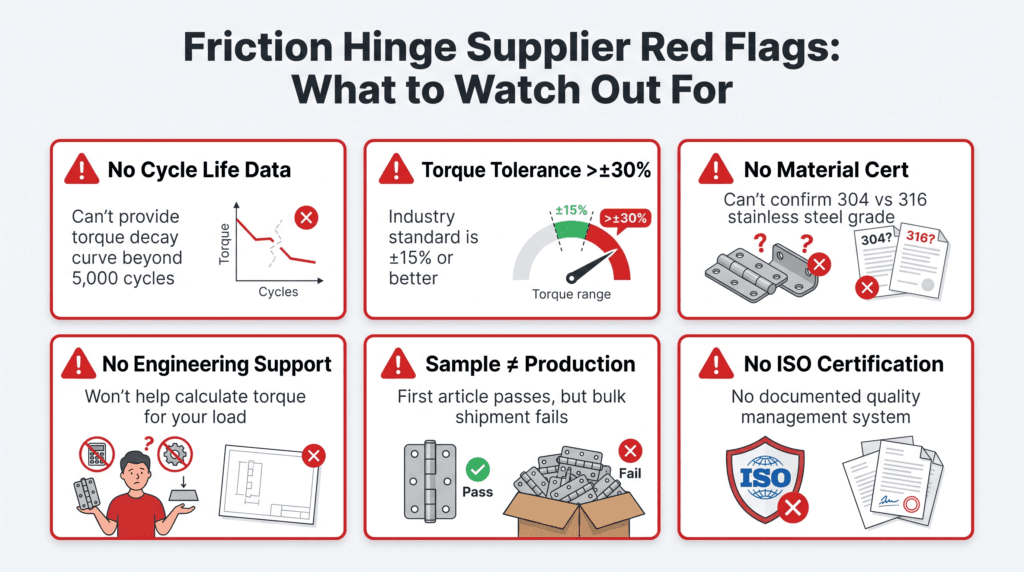
6 Red Flags When Evaluating a Friction Hinge Manufacturer
Before you request a quote, you need to vet the supplier’s engineering and quality control capabilities. If you encounter any of these six red flags during your initial conversations, walk away.

Identifying these warning signs early in the sourcing process can save your company from catastrophic field failures. Discuss more on Whatsapp
1. No Cycle Life Data Available
If a supplier cannot provide a torque decay curve showing how the hinge performs after 10,000 or 20,000 cycles, they are not doing long-term reliability testing. They are simply assembling parts and hoping for the best.
2. Unwillingness to Provide Engineering Support
A true manufacturer does not just sell parts; they solve motion control problems. If the supplier’s sales rep cannot help you calculate the required torque based on your door’s weight, dimensions, and center of gravity, they lack the technical expertise required for OEM partnerships.
3. Vague Material Certifications
If you specify 316 stainless steel for a marine application, the supplier must be able to provide raw material certs. If they dodge the question or only offer generic “stainless steel,” you are likely getting cheaper 304 or even 201 grade, which will rust in harsh environments.
4. Refusal to Customize Torque Profiles
Sometimes an off-the-shelf hinge has the right dimensions but the wrong torque. A capable manufacturer can adjust the internal disc stack or spring tension to meet your exact Nm requirements without requiring a massive tooling fee.
5. No Documented Quality Management System
ISO 9001 certification is the bare minimum. You should also ask about their incoming material inspection (IQC), in-process quality control (IPQC), and final outgoing inspection (OQC) procedures specifically regarding torque testing.
6. Extreme Price Discrepancies
If one supplier is quoting a price that is 50% lower than three other reputable manufacturers, they are cutting corners. They are likely using inferior lubricants that will dry out, cheaper metal alloys that will wear quickly, or skipping the 100% final torque inspection step entirely.
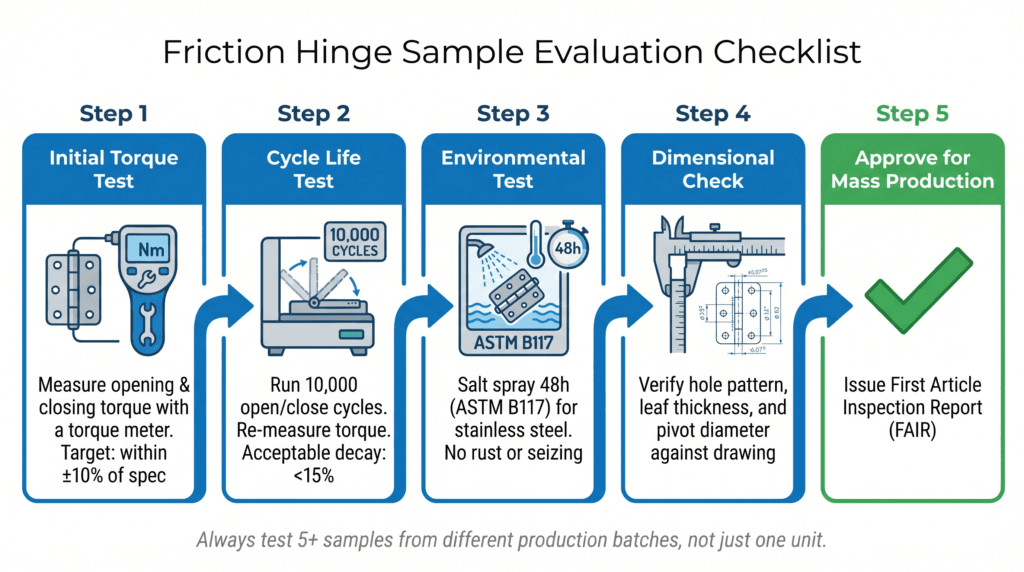
The Procurement Manager’s Sample Testing Checklist
When you do find a promising supplier and receive your first batch of samples, do not just hand them to engineering and wait for a thumbs-up. As a procurement professional, you should ensure the following rigorous friction hinge quality tests are performed.
A standardized testing protocol is the only way to verify that a supplier’s claims match their actual manufacturing capabilities.
Step 1: Initial Torque Verification
Do not rely on “feel.” Have your quality team use a calibrated digital torque meter to measure both the opening (forward) and closing (reverse) torque of at least 5 to 10 samples. Ensure all samples fall within the agreed-upon ±15% tolerance band.
Step 2: The Cycle Life Test
Mount the hinge to a testing rig and run it through its expected life cycle (e.g., 10,000 to 30,000 open/close cycles). After the test, re-measure the torque. A high-quality hinge should not lose more than 15% to 20% of its initial holding power. If the torque drops by 50%, the internal mechanism has failed.
Step 3: Environmental Stress Testing
If your product will be used outdoors, in medical environments, or in food processing, the hinge must undergo environmental testing. This typically involves a 48-hour or 96-hour salt spray test (ASTM B117) to check for corrosion, as well as high/low-temperature cycling to ensure the internal lubricants do not freeze or leak out.
Step 4: Dimensional and Visual Inspection
Verify the hole patterns, leaf thickness, and pivot diameter against the CAD drawing. Check for burrs, sharp edges, or inconsistent surface finishes, which are telltale signs of sloppy manufacturing.
Strategic Sourcing: Partnering for the Long Haul
Treating friction hinges as a commodity is a risky procurement strategy. These components dictate the tactile feel of your product and directly impact user safety.
Instead of chasing the absolute lowest unit price, look for a manufacturing partner who offers transparency, engineering support, and rigorous quality control. A reliable supplier will help you optimize your design, reduce your overall assembly time, and virtually eliminate warranty claims related to hinge failure.
At JAN Hinge, we understand the pressures procurement managers face. That is why we operate as a full-service custom friction hinge OEM, providing comprehensive engineering support, transparent cycle-life testing data, and strict lot-to-lot torque consistency. Whether you are sourcing for medical devices, industrial enclosures, or consumer electronics, our team is ready to prove our quality. Contact us today to request a sample kit and see the difference precision manufacturing makes.
Frequently Asked Questions (FAQ)
Q1: What is a normal lead time for custom friction hinges?
For a completely custom design requiring new tooling, lead times typically range from 4 to 6 weeks for first article samples, followed by 3 to 4 weeks for mass production. However, if you are simply requesting a custom torque setting within an existing standard hinge housing, a capable manufacturer can often deliver samples in 1 to 2 weeks.
Q2: Why do some friction hinges have different torque ratings for opening and closing?
This is an intentional design feature called “asymmetric torque.” It is often used in heavy lids or monitor arms. The hinge provides high resistance when closing (to prevent the heavy lid from slamming down) but low resistance when opening (making it easy for the user to lift the lid). You should always specify if your application requires symmetric or asymmetric torque.
Q3: How can I verify the torque consistency of a bulk shipment?
A reputable supplier will perform a 100% torque inspection on the assembly line before shipping. As a buyer, you should request the Outgoing Quality Control (OQC) report for your specific batch. Upon receiving the goods, your IQC team should perform an AQL (Acceptable Quality Limit) random sampling using a digital torque meter before accepting the lot into inventory.
Q4: Does the type of lubricant used inside the hinge matter?
Absolutely. The proprietary grease used inside the friction bands is critical to preventing metal-on-metal galling and ensuring smooth operation. Cheap manufacturers use standard industrial grease, which can dry out over time or leak out in high temperatures, leading to sudden torque loss or squeaking. High-quality hinges use specialized, temperature-stable damping greases.
Q5: Can we negotiate the ±15% torque tolerance down to ±5%?
While a ±15% tolerance is the industry standard and perfectly acceptable for 95% of applications, tighter tolerances are possible. However, achieving a ±5% tolerance requires extreme precision in CNC machining, hand-sorting of internal components, and meticulous assembly. This significantly increases the scrap rate and the final unit cost. You should consult with your engineering team to determine if that level of precision is truly necessary for your product.
Ready to evaluate a better supplier? Reach out to the JAN Hinge team for technical datasheets, CAD models, and sample requests.