
The Hidden Complexity of a “Simple” Hinge
When designing a new product—whether it is a rugged industrial control panel, a sleek consumer laptop, or a premium kitchen cabinet—the hinge is often one of the last components considered. Yet, it is the primary mechanical interface between the user and the product. A failing hinge does not just cause an inconvenience; it renders the entire product unusable and damages your brand’s reputation.
Finding a reliable hinges manufacturer is not as simple as browsing a catalog and picking a size. Modern product design requires precision motion control: lids that close softly without slamming, screens that hold their position at any angle, and mechanisms that can survive tens of thousands of cycles without losing tension.
This comprehensive guide is designed for B2B procurement managers and OEM design engineers. It will walk you through the different types of precision hinges, how to evaluate an industrial hinges manufacturer supplier, and why vertical integration is the key to supply chain reliability.
Understanding Your Motion Control Options
Before evaluating a precision hinge manufacturer OEM, you must understand the specific motion control requirements of your product. A single factory should be able to guide you through these options rather than forcing a one-size-fits-all solution.
1. Friction Hinges (Torque Hinges)
Friction hinges are designed to hold a door, lid, or screen at any desired angle without the need for external latches, gas struts, or springs. They rely on internal mechanical friction to counteract gravity.
Best for: Laptop screens, medical diagnostic monitors, and industrial display panels where the user needs infinite adjustability.
2. Rotary Dampers
While technically not a hinge themselves, rotary dampers are often integrated into hinge mechanisms. They use the high viscosity of internal silicone oil to control the speed of a moving part, providing a smooth, silent, soft-close effect.
Best for: Automotive glove boxes, toilet seats, and washing machine lids to prevent slamming.
3. Damping Hinges
These are hybrid components that combine the structural pivot point of a standard hinge with the fluid resistance of a rotary damper in one compact unit. They typically engage their damping effect in the final 15° to 30° of rotation.
Best for: Premium cabinetry, heavy equipment hatches, and smart home appliances.

The 7-Point Checklist for Evaluating a Hinges Manufacturer
The global supply chain is flooded with trading companies acting as manufacturers. To ensure quality, competitive pricing, and reliable lead times, you must partner with a true direct factory. Here is how to evaluate a custom hinge manufacturer torque specialist.
1. Vertical Integration (Do they make their own parts?)
The most critical factor is vertical integration. Does the supplier own their injection molding machines? Do they have in-house CNC machining? If a supplier outsources their component manufacturing, they lose control over quality tolerances and lead times. A true factory controls the process from raw material to final assembly.
2. 100% Automated Testing vs. Batch Sampling
Many suppliers claim a defect rate of less than 1%, but they only test 5 out of every 100 hinges produced. For precision motion control, especially components containing silicone oil, batch testing is unacceptable. Look for a manufacturer that utilizes automated machines to test 100% of their output for torque consistency and leak prevention before shipping.
3. Custom OEM Engineering Capabilities
Your product housing may have unique space constraints. A capable manufacturer should have an in-house engineering team that can take your 3D CAD files, calculate the exact center of gravity, and design a custom hinge profile that fits perfectly without requiring you to redesign your entire product.

4. Verified Lifecycle Durability
Never accept a lifespan claim without data. If a supplier claims their friction hinge lasts for 50,000 cycles, ask to see the endurance testing report. High-quality hinges should maintain at least 85% of their original torque after 50,000 continuous opening and closing cycles.
5. Stringent Quality Certifications
In B2B manufacturing, certifications are the baseline of trust. Ensure your supplier holds ISO 9001:2015 for quality management. If you are in the automotive sector, IATF 16949 certification is absolutely mandatory to ensure strict defect prevention and supply chain traceability.
6. Rapid Prototyping Speed
In modern product development, time-to-market is everything. A capable OEM factory should be able to provide standard samples within 24 hours and deliver fully custom, new-mold prototypes within 20 days.
7. Global Logistics Expertise
Sourcing from a hinges manufacturer China direct factory offers significant cost advantages, but only if they can handle the logistics. Ensure the supplier has established partnerships with major global carriers (FedEx, DHL, UPS) and can manage all export documentation seamlessly.
Inside a World-Class Manufacturing Facility
To truly understand what separates a premium manufacturer from a budget supplier, let’s look at the infrastructure required to produce flawless motion control components.
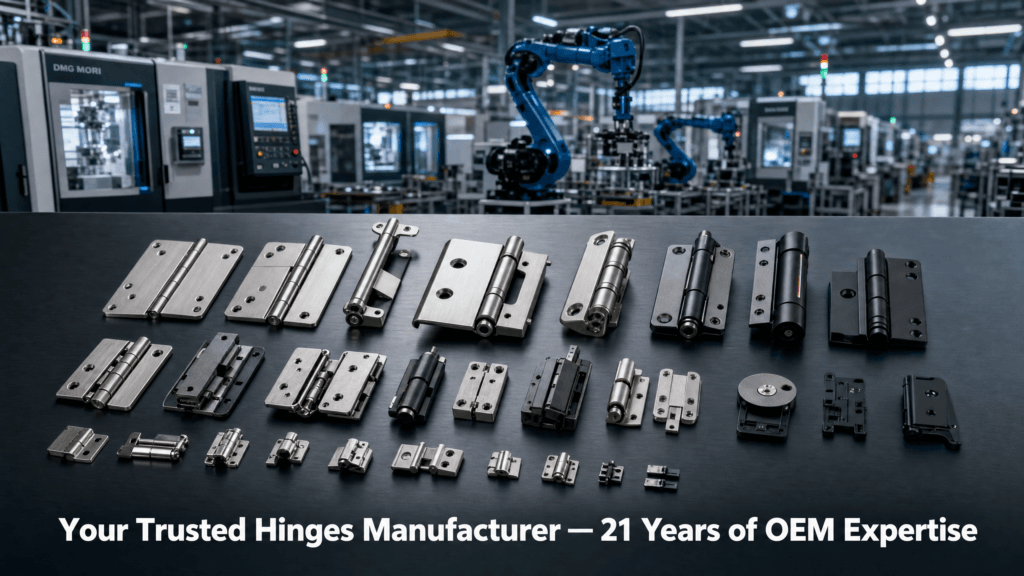
At Janhinge, our 21 years of expertise are backed by substantial investments in manufacturing technology:
•Precision Machining: 16 advanced CNC machines ensure metal components are cut to exact tolerances.
•Injection Molding: 20 injection molding machines paired with robotic arms ensure consistent plastic housing production.
•Automated Assembly: 25 ultrasonic welding units and automated glue dispensers eliminate human error in the sealing process.
•Quality Control: Every single hinge and damper passes through our automated testing stations before being packaged.

Applications Across Industries
Precision hinges are not limited to one sector. The ability to control motion, hold positions, and eliminate noise adds immense value across various industries:
•Consumer Electronics: Providing the stiff, premium feel required for high-end laptop screens and 2-in-1 convertible tablets.
•Medical & Healthcare: Ensuring heavy diagnostic monitors and surgical lights stay exactly where the doctor positions them.
•Automotive Interiors: Delivering the silent, luxurious soft-close motion for center consoles, glove boxes, and grab handles.
•Home Appliances: Protecting users and extending the life of washing machines and smart trash cans with controlled lid descents.

Conclusion: Build Better Products with Janhinge
Choosing the right hinges manufacturer is a strategic decision that impacts your product’s user experience, warranty costs, and brand reputation. By prioritizing vertical integration, 100% automated testing, and proven engineering capabilities, you can eliminate supply chain risks.
Janhinge is a professional OEM/ODM manufacturer dedicated to solving complex motion control challenges. Whether you need a standard rotary damper or a fully custom friction hinge, our team is ready to deliver.
Contact Our Engineering Team Today | Explore Our Custom Hinge Solutions
Frequently Asked Questions (FAQ)
Q1: Are you a trading company or a direct hinges manufacturer?
A: Janhinge is a 100% direct factory located in Dongguan, China. We own our molds, operate our own CNC and injection molding machines, and conduct all assembly and testing in-house. This vertical integration allows us to offer highly competitive pricing and strict quality control.
Q2: What is the minimum order quantity (MOQ) for custom OEM hinges?
A: We understand that new product development requires flexibility. While MOQs for custom parts depend on the complexity of the mold required, we generally support low-volume trial runs to help you validate your design before committing to mass production. Please contact our sales team with your specific requirements.
Q3: How do you ensure the torque remains consistent across a batch of 50,000 hinges?
A: Torque consistency is achieved by removing human error. We use automated assembly machines and automated oil dispensers. Most importantly, we do not rely on batch sampling. Every single hinge is machine-tested for torque output at the end of the line.
Q4: Can you match a hinge design from a competitor if we want to switch suppliers?
A: Yes. If you are experiencing quality issues or long lead times with your current supplier, send us the physical sample or the 3D CAD drawing. Our engineering team can reverse-engineer the component, often improving upon the original design’s flaws (such as leak prevention), and provide a drop-in replacement.
Q5: Do you provide 3D CAD models for our engineers to use during the design phase?
A: Absolutely. We provide comprehensive 2D drawings and 3D CAD models (in formats like STEP or IGES) for all our standard products. For custom projects, we will provide the complete 3D models for your approval before we begin cutting any molds.