
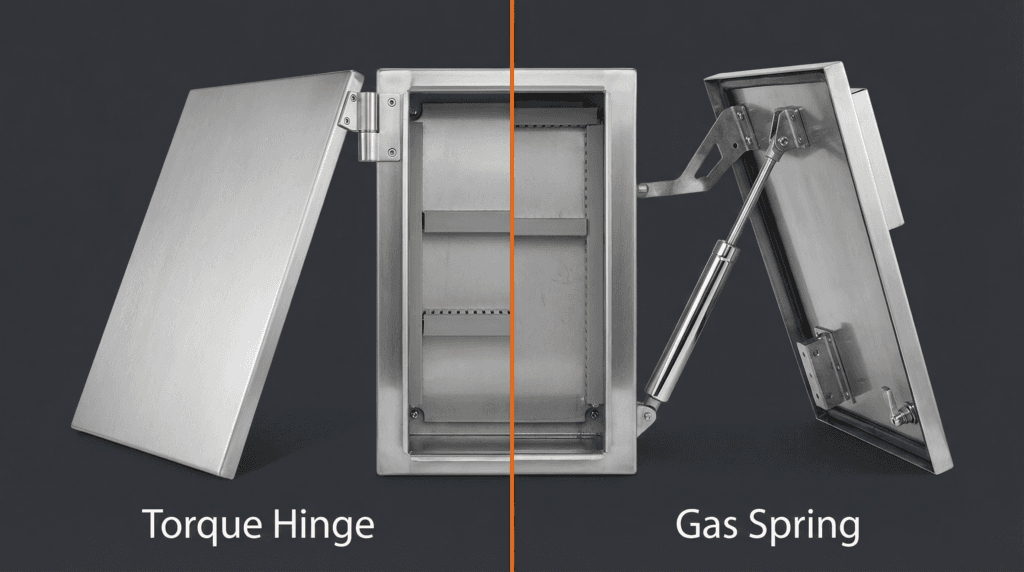
When designing a heavy lid, access panel, or display screen that needs to stay open, engineers generally face a crossroads: do you use torque hinges (friction hinge) or gas springs (gas strut)?
Both components serve the fundamental purpose of position control, but they achieve it through entirely different mechanical principles. Choosing the wrong component can lead to bloated manufacturing costs, compromised aesthetics, or premature failure in the field .
At Janhinge, we manufacture precision torque hinges, but we also recognize that there are specific scenarios where a gas spring is the better choice. In this comprehensive guide, we will break down the engineering differences, the pros and cons of each, and how to make the right specification for your next project.
The Core Mechanical Differences
Before comparing them, it is essential to understand how each mechanism works.
Torque Hinges (Friction Hinges)
A stop hinge replaces a standard free-swinging hinge. It uses internal mechanical friction (usually via compressed steel bands or disc stacks) to resist rotational movement. It is a completely passive, dry mechanical system. You push the panel to the desired angle, and the friction holds it there against gravity.
Gas Springs (Gas Struts)
A gas spring is a separate component mounted in addition to standard hinges. It consists of a sealed cylinder containing pressurized nitrogen gas and a piston rod. When compressed, the gas stores energy. When released, the gas expands, actively pushing the rod outward to lift the panel. Discuss more on Whatsapp
Direct Comparison: 5 Key Engineering Factors
When deciding between the two, evaluate your application against these five criteria:
1. Space and Aesthetics
•Torque Hinges: Because the friction mechanism is built directly into the hinge barrel, torque hinges are incredibly compact. They do not protrude into the interior of the enclosure. This is why they are exclusively used in laptops, tablets, and slim medical displays.
•Gas Springs: Gas struts are bulky. They require significant interior space to accommodate the cylinder and rod, and they create visual clutter inside the enclosure.
2. Motion Control and Positioning
•Position Hinges: They offer infinite positioning. You can stop the panel at 15°, 45°, or 87°, and it will stay exactly there.
•Gas Spring: Standard gas springs are binary—they want to push the door fully open. While “locking” gas springs exist, they require the user to press a release button to change the angle, which is not hands-free.
3. Lifting Assistance (Ergonomics)
•Friction Hinges: A standard symmetric torque hinge does not help you lift the lid; it only provides resistance. (Note: Asymmetric torque hinges provide lower resistance when opening, but they still do not actively lift the weight).
•Gas Springs: This is where gas springs shine. The pressurized gas actively pushes the lid upward, making a 50 kg industrial hatch feel weightless to the operator .
4. Environmental Resilience and Maintenance
•Torque Hinges: Being purely mechanical, they are highly resilient. They cannot leak, they do not lose pressure over time, and high-quality stainless steel versions are immune to most chemicals and temperature extremes.
•Gas Springs: Gas springs rely on rubber seals to keep the nitrogen pressurized. Over time (typically 3 to 5 years), these seals degrade, the gas leaks out, and the strut fails, causing the heavy lid to slam shut. They also perform poorly in extreme cold, as the gas pressure drops significantly.
5. Cost and Assembly Time
•Friction Hinges: Higher initial component cost, but lower total assembly cost. You only need to install two hinges, and the job is done.
•Gas Springs: The struts themselves are often cheaper, but the total cost is higher. You must buy standard hinges, the gas struts, and mounting brackets, and then spend extra assembly time calculating the exact mounting geometry to achieve the correct leverage .
Summary Comparison Table
| Feature | Torque Hinges | Gas Springs |
| Primary Function | Holds position via friction | Actively lifts via gas pressure |
| Positioning | Infinite (stops anywhere) | Usually binary (fully open/closed) |
| Lifting Assist | No (passive resistance) | Yes (active lifting) |
| Space Required | Minimal (replaces standard hinge) | High (requires internal clearance) |
| Failure Mode | Gradual torque decay over tens of thousands of cycles | Sudden failure (seal leak causes immediate pressure loss) |
| Maintenance | Zero maintenance | Requires replacement every 3-5 years |

The Verdict: Which Should You Choose?
Choose a position Hinge if:
•You need the panel to stay at any angle the user chooses (e.g., a monitor arm or laptop screen).
•Interior space is tight, and you cannot accommodate bulky cylinders.
•You are designing for a harsh environment (extreme temperatures or high vibration).
•You want a “fit and forget” solution that will not require maintenance for 10+ years.
Choose a Gas Spring if:
•The lid or hatch is exceptionally heavy (e.g., over 20 kg) and the user needs active physical assistance to lift it.
•The only requirement is that the door opens fully to 90° and stays there.
•You have ample interior space inside the enclosure to mount the strut and brackets.
The Hybrid Solution: Counterbalance Hinges
If you have a heavy lid but cannot use gas springs due to space or maintenance concerns, consider a mechanical counterbalance hinge. These specialized hinges use heavy-duty internal torsion springs (instead of gas) to actively lift the lid, combined with friction bands to hold it in place. They offer the lifting power of a gas spring with the reliability and infinite positioning of a torque hinge.
If you are struggling to decide which motion control solution is right for your application, contact the engineering team at Janhinge. We can review your 3D models, calculate the required forces, and recommend the optimal, most cost-effective solution.
Frequently Asked Questions (FAQ)
Q1: Can a torque hinge replace a gas spring on an existing design?
Usually, yes, but it is not a drop-in replacement. Because a torque hinge does not actively lift the lid, the user will have to bear the full weight of the lid when opening it. If the lid is light to moderately heavy, replacing a failing gas spring with a torque hinge is a great upgrade to eliminate future maintenance. For very heavy lids, you may need a mechanical counterbalance hinge instead.
Q2: Do gas springs lose their strength over time?
Yes. All gas springs will eventually fail. The rubber seals that keep the pressurized nitrogen inside the cylinder degrade with age, temperature fluctuations, and cycle use. When the gas leaks, the spring loses its lifting power. Most industrial gas springs require replacement every 3 to 5 years.
Q3: Why do gas springs fail in the winter?
Gas pressure is directly related to temperature (Gay-Lussac’s Law). In freezing temperatures, the nitrogen gas inside the strut contracts, significantly reducing the lifting force. A gas spring that easily lifts a car trunk in the summer may struggle to hold it open in the winter. Mechanical torque hinges are far less affected by temperature changes.
Q4: Can I use one torque hinge and one standard hinge to save money?
Yes, this is a common engineering practice for lightweight panels. You can use one torque hinge to provide the holding friction, and one standard free-swinging hinge to provide structural support. However, they must share the exact same physical dimensions and be perfectly aligned coaxially.
Q5: Are torque hinges more expensive than gas springs?
Looking purely at the component price, a high-quality torque hinge is often more expensive than a basic gas strut. However, when you factor in the Total Cost of Ownership (TCO)—which includes the cost of the standard hinges you still have to buy, the mounting brackets, the extra assembly labor, and the inevitable warranty replacements for blown gas seals—torque hinges are almost always the more cost-effective long-term solution.
To explore our full range of industrial torque hinges and position control solutions, visit www.janhinge.com.