
When engineers select a rotary damper for a new product, they don’t just guess the required resistance. They rely on precise technical data provided by the manufacturer. The most critical piece of data is the Torque Curve (or Damping Characteristics Graph).
To the untrained eye, a torque curve might look like a simple line graph. But to a mechanical engineer, it reveals exactly how the damper will behave under different speeds and temperatures. Understanding how to read this curve is essential for achieving the perfect “soft-close” motion.
What is a Torque Curve?
A torque curve is a graphical representation of a rotary damper‘s performance. It plots the Damping Torque (the resistance force, usually on the Y-axis) against the Rotational Speed (how fast the damper is turning, usually on the X-axis).
Because rotary dampers use viscous fluid resistance (silicone oil), their resistance is speed-dependent. The faster you turn the damper, the more resistance it provides. The torque curve visualizes this relationship.

A design engineer reviewing a rotary damper torque curve datasheet alongside a physical damper component and CAD model.
Rotary dampers are critical components in motion control, providing the smooth, controlled movement that prevents slamming and protects delicate mechanisms. However, selecting the right rotary damper goes beyond simply matching physical dimensions. The true performance of a damper is defined by its torque characteristics, which are best understood by analyzing its torque curve.
What is a Rotary Damper Torque Curve?
A torque curve is a graphical representation that illustrates how the damping torque of a rotary damper changes in response to varying operational conditions. Because rotary dampers rely on fluid dynamics — typically the viscous shear of silicone oil — their resistance is not a static number. Instead, the damping torque is a dynamic value influenced primarily by two factors: rotational speed (RPM) and ambient temperature.
Manufacturers typically provide two types of torque curves in their technical datasheets:
| Curve Type | X-Axis | Y-Axis | Key Insight |
| Torque vs. Speed | Rotational Speed (RPM) | Damping Torque (N·m) | Torque increases with speed |
| Torque vs. Temperature | Ambient Temperature (°C) | Damping Torque (N·m) | Torque decreases as temperature rises |
Understanding both is crucial for a successful product design.
Reading the Torque vs. Speed (RPM) Curve
The most common curve you will encounter is the Torque vs. Speed graph. In fluid damping, the resistance generated by the silicone oil is directly proportional to the shear rate.

Torque vs. Speed curves for three viscosity grades of silicone oil. Note the rated torque reference point at 20 RPM.
The X and Y Axes
The X-axis (horizontal) represents the rotational speed, usually measured in Revolutions Per Minute (RPM) or radians per second. The Y-axis (vertical) represents the damping torque, typically measured in Newton-meters (N·m) or kilogram-force centimeters (kgf·cm).
The Curve Shape
When you look at a Torque vs. Speed graph, you will typically see an upward-sloping curve. This indicates a fundamental principle of viscous dampers: as the rotational speed increases, the damping torque increases; as the speed decreases, the torque decreases.
At lower RPMs (left side of the graph), the fluid shear is minimal, resulting in a lower damping torque — this is often referred to as the starting torque. As the RPM increases (e.g., if a heavy lid falls quickly), the fluid is forced through the internal clearances at a higher velocity, creating greater shear resistance and thus a higher torque.
The Rated Torque
Manufacturers usually specify a “Rated Torque” in their catalogs. It is vital to understand that this rated torque is measured at a specific, standardized speed — commonly 20 RPM (and at a standard room temperature of 23°C). If your application operates at 10 RPM or 40 RPM, the actual torque your system experiences will be lower or higher than the catalog’s rated value. The curve allows you to predict the exact torque at your specific operating speed.
Reading the Torque vs. Temperature Curve
The second critical graph is the Torque vs. Temperature curve. While high-quality silicone oil is remarkably stable, its viscosity is still somewhat affected by thermal changes.

Torque vs. Temperature curves showing how damping force varies across the operating range from -30°C to +80°C.
The Curve Shape
The Torque vs. Temperature graph typically displays a downward-sloping curve. This illustrates another fundamental rule: as the temperature increases, the damping torque decreases; as the temperature decreases, the torque increases.
In cold environments (e.g., 0°C or below), the silicone oil thickens slightly. This increased viscosity leads to higher shear resistance and a higher damping torque — a lid might close more slowly in the winter. In hot environments (e.g., 40°C or above), the oil thins out, reducing its viscosity and resulting in less resistance — a lid might close slightly faster in the summer.
Importantly, when the temperature returns to standard room temperature, the torque will return to its rated value. For engineers designing products for extreme environments (like automotive interiors), reading this curve is essential to ensure the damper will not seize in the cold or fail to dampen in the heat.
Quick Reference: How to Read Both Curves at a Glance

Side-by-side quick reference guide showing the key reading principles for both the Speed Curve and the Temperature Curve.
Practical Application: Sizing Your Damper
How do you use these curves in practice? Consider designing a soft-close lid for a heavy industrial printer. The step-by-step process is as follows.
First, calculate the required torque by determining the maximum torque exerted by the lid due to gravity (Torque = Mass × Gravity × Distance to Center of Gravity). Second, determine the operating speed by estimating how fast you want the lid to close — for example, closing 90 degrees in 3 seconds equates to roughly 5 RPM. Third, consult the Speed Curve: find 5 RPM on the X-axis, trace up to the curve, and read the actual torque the damper will provide at that speed. If it matches your required torque, the damper is a good fit. Finally, verify the Temperature Range: if the printer will be used in an unheated warehouse, check the Temperature Curve to ensure the torque does not spike too high at 0°C, which might prevent the lid from closing entirely.
Conclusion
A rotary damper’s performance is not a single, static number. By learning how to read and apply Torque vs. Speed and Torque vs. Temperature curves, engineers can move beyond guesswork and make data-driven component selections. Understanding these dynamic characteristics ensures that you select a damper that provides the perfect tactile feel and reliable safety across all real-world operating conditions.
At Janhinge, we provide detailed, accurate torque curves for all our rotary dampers and offer expert engineering support to help you interpret them for your specific custom applications.
Request a Custom Rotary Damper Solution →
Frequently Asked Questions (FAQ)
Q1: Why is the rated torque in the catalog different from what I measure in my application?
The catalog rated torque is measured under standard laboratory conditions, typically at 20 RPM and 23°C. If your application’s rotational speed is slower or faster, or if the ambient temperature differs from the standard, the actual torque will vary according to the damper’s specific torque curves. Always cross-reference the curves, not just the headline specification.
Q2: If my application runs at a very low speed, will the damper still work?
Yes, but it will provide less resistance than its rated torque. You must consult the Torque vs. Speed curve. For very slow applications, you may need to select a damper with a significantly higher rated torque to achieve the desired damping force at low RPMs, or consider using a gear mechanism to amplify the effective torque.
Q3: Does the torque curve change over the lifespan of the damper?
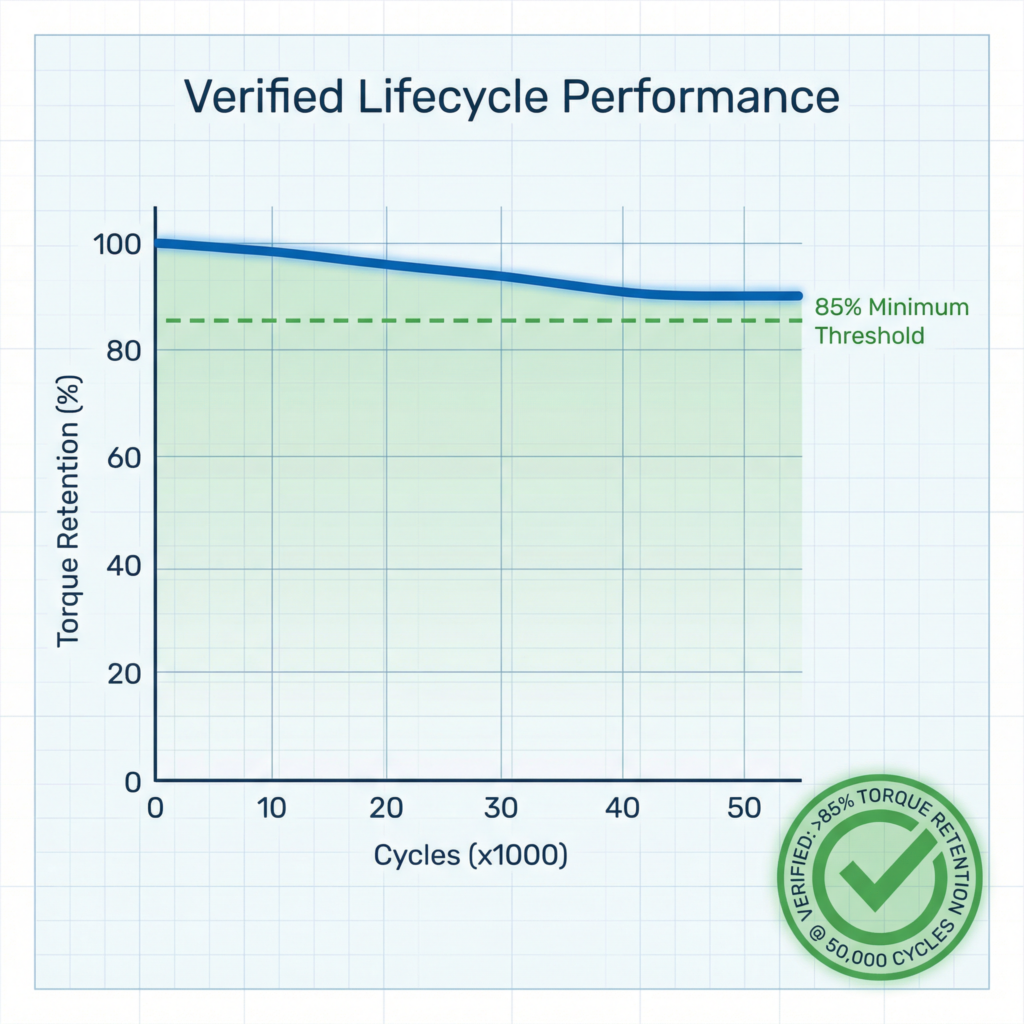
High-quality rotary dampers using premium silicone oil will maintain a consistent torque curve for tens of thousands of cycles. However, after extensive wear (typically beyond 50,000 cycles), the overall torque may drop slightly — industry standards suggest a damper should retain approximately 80% of its original torque after its rated lifecycle. This effectively shifts the entire curve downward by a small margin.
Q4: How do I handle applications with varying speeds, like a free-falling lid?
In a free-fall scenario, the lid accelerates, meaning the RPM is constantly changing. As the RPM increases, the damper’s torque also increases (as shown on the Speed Curve) until the damping torque equals the gravitational torque. At this equilibrium point, the lid reaches a steady, controlled closing speed — which is exactly the self-regulating behavior that makes viscous rotary dampers so effective.
Q5: Can I request a custom torque curve for my product?
Yes. As an OEM/ODM manufacturer, Janhinge can customize the internal geometry of the rotor and stator, or adjust the viscosity of the silicone oil, to create a bespoke torque curve tailored precisely to your product’s weight, speed, and temperature requirements. Standard samples can be shipped within 1 business day, and new mold custom samples are ready within 20 days.
Have a specific engineering challenge? Contact the Janhinge technical team at [email protected] or visit www.janhinge.com for custom rotary damper solutions.