
The Unforgiving Automotive Supply Chain
The global automotive industry operates under the most stringent quality control frameworks in the manufacturing world. For Tier 1 suppliers and Original Equipment Manufacturers (OEMs), there is absolutely no margin for error. A single defective component—even something as small as a glove box damper—can trigger a cascade of assembly line stoppages, warranty claims, and devastating product recalls.
When sourcing motion control components for vehicle interiors, standard industrial quality is simply not enough. The components must withstand extreme temperature fluctuations, constant vibration, and decades of repeated use. This is why the IATF 16949 standard was created.
This article explores the critical importance of IATF 16949 certification when selecting a rotary damper automotive tier 1 supplier and how rigorous lifecycle testing ensures the longevity of your automotive designs.
What is IATF 16949 and Why Does it Matter?
Developed by the International Automotive Task Force (IATF), IATF 16949 is the premier technical specification for automotive sector quality management systems. It is not merely a set of guidelines; it is a mandatory prerequisite for supplying parts to major automotive brands like Ford, General Motors, Toyota, and Volkswagen.
Beyond ISO 9001
While ISO 9001 establishes the foundation of a good Quality Management System (QMS), IATF 16949 builds upon it with automotive-specific requirements. It shifts the focus from simply detecting defects to actively preventing them.
When you partner with an IATF 16949 damper hinge automotive manufacturer like Janhinge, you are guaranteed:
•Advanced Product Quality Planning (APQP): Ensuring that the product meets all customer requirements before production begins.
•Failure Mode and Effects Analysis (FMEA): Identifying potential failure points in the design and manufacturing process and mitigating them proactively.
•Statistical Process Control (SPC): Using data-driven methods to monitor and control manufacturing processes, ensuring consistent torque and dimensions across millions of units.

The Crucial Role of Motion Control in Modern Vehicles
As vehicles transition into “living spaces on wheels,” the tactile experience of the interior has become a major selling point. Consumers associate smooth, silent, and controlled movements with luxury and high build quality.
Key Automotive Applications
Motion control components are hidden throughout the modern vehicle interior:
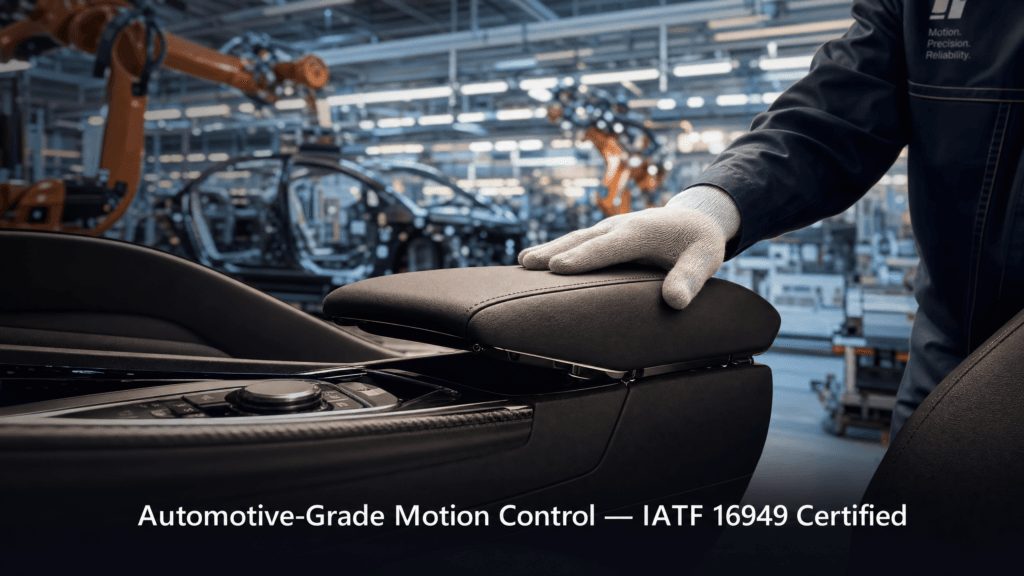
•Center Console Armrests: A heavy, leather-wrapped armrest requires a robust hinge damper component automotive quality to prevent it from slamming shut and pinching fingers.
•Glove Boxes: The slow, controlled descent of a glove box door is achieved using precision rotary dampers.
•Overhead Grab Handles: Dampers ensure the handle retracts smoothly and silently against the headliner, rather than snapping back with a loud crack.
•Sun Visors & Cup Holders: Miniature friction hinges hold visors at the exact angle required by the driver to block glare.

Proving Longevity: The 50,000-Cycle Standard
In the automotive sector, a component’s lifespan must match the expected lifespan of the vehicle itself. A damper that fails after two years of use will result in frustrated customers and costly dealership repairs.
To guarantee a long rotary damper lifespan product lifecycle, rigorous endurance testing is mandatory.
The Science of Durability Testing
At Janhinge, our validation process goes far beyond basic functional checks. We subject our components to extreme environmental and mechanical stress.
The gold standard for automotive motion control is friction hinge durability testing 50000 cycles. In our automated testing laboratories, custom-built pneumatic rigs repeatedly actuate the hinges and dampers 24 hours a day.
We don’t just measure if the part physically breaks; we measure torque decay. A high-quality damper must retain at least 85% of its original damping force after 50,000 cycles. Furthermore, these tests are conducted in environmental chambers that simulate the freezing cold of a northern winter (-20°C) and the baking heat of a closed car cabin in summer (70°C).

The Janhinge Automotive Qualification Process
Transitioning a new component from CAD design to mass production for an automotive Tier 1 supplier requires a structured, transparent process. Janhinge has streamlined this workflow to ensure rapid development without compromising on IATF 16949 compliance.
1.Initial RFQ & Technical Review: We analyze your exact torque requirements, space constraints, and environmental operating conditions.
2.DFM Analysis: Our engineers optimize the design for manufacturability, ensuring stable production at high volumes.
3.Custom Prototypes: Utilizing our in-house tooling, we deliver functional, test-ready samples in just 20 days.
4.PPAP Documentation: We provide comprehensive Production Part Approval Process (PPAP) documentation, including control plans, FMEAs, and material certifications, making your OEM approval process seamless.
5.100% Automated QC: Once in mass production, every single damper undergoes an automated air-pressure leak test and torque verification before leaving our facility.

Conclusion: Partner with Certified Excellence
In the automotive supply chain, trust is built on data, certifications, and proven reliability. Sourcing uncertified, untested motion control components is a risk no Tier 1 supplier can afford to take.
Janhinge is proud to operate under the strict guidelines of IATF 16949, ISO 9001, and ISO 14001. We deliver the precision, documentation, and zero-defect manufacturing required by the world’s leading automotive brands.
Protect your supply chain and elevate your vehicle interiors. Contact Janhinge today to discuss your automotive motion control requirements.
Request Automotive PPAP Documentation | View Our IATF 16949 Certified Products
Frequently Asked Questions (FAQ)
Q1: Why is IATF 16949 certification important for buying rotary dampers?
A: IATF 16949 is the global automotive quality standard. It ensures that the manufacturer has robust systems in place for defect prevention, risk management (FMEA), and continuous improvement. It guarantees that the dampers you receive will perform consistently across millions of units, preventing costly automotive recalls.
Q2: What is the Production Part Approval Process (PPAP), and do you provide it?
A: PPAP is a standardized process in the automotive industry that ensures a supplier understands all customer engineering design specifications and has a process capable of consistently meeting those requirements. Yes, Janhinge provides full PPAP documentation (Levels 1-5) for our automotive clients.
Q3: How do your dampers perform in extreme vehicle cabin temperatures?
A: Vehicle interiors can reach 70°C in the sun and drop below -20°C in winter. Standard silicone oil breaks down under these extremes. We use premium, temperature-stable silicone oil that maintains its viscosity, ensuring smooth damping action regardless of the climate.
Q4: What does “50,000-cycle durability” actually mean for a vehicle owner?
A: If a driver opens and closes their center console armrest 10 times a day, every single day of the year, 50,000 cycles equates to over 13 years of continuous use. Our testing ensures the component outlasts the typical ownership period of the vehicle.
Q5: We are a Tier 2 supplier. Can we use your standard catalog parts, or do we need custom designs?
A: Both. We have a vast catalog of standard, automotive-approved rotary dampers and friction hinges that can be immediately integrated into your designs. If your space constraints or torque requirements are unique, our engineering team can rapidly develop a custom OEM solution that meets all IATF 16949 standards.