
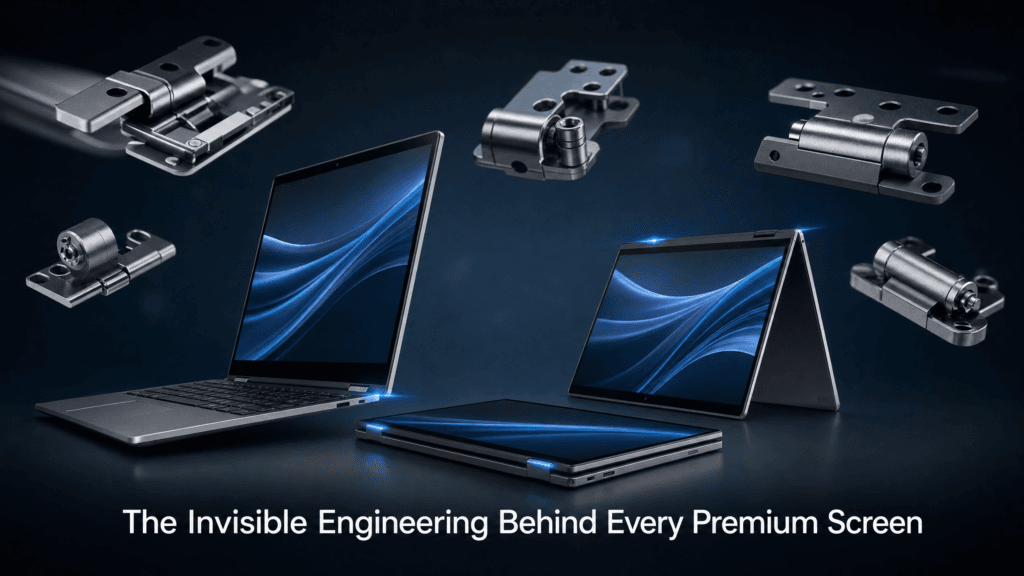
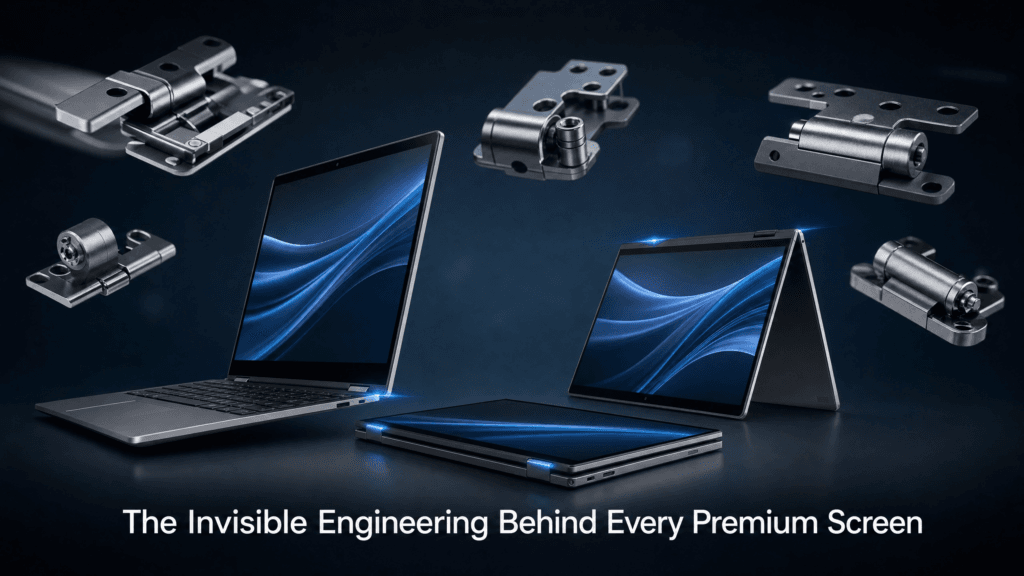
The Era of the “One-Hand Open”
In the highly competitive consumer electronics market, hardware specifications like processor speed and screen resolution are often commoditized. What truly separates a $500 budget laptop from a $2,000 premium ultrabook is the physical user experience—specifically, the kinematics of the device.
When a consumer walks into a retail store and tests a premium laptop, the very first interaction is opening the lid. If they can lift the screen with a single finger while the base remains perfectly flat on the table, the device instantly communicates luxury and engineering prowess. This “one-hand open” test is the holy grail of Friction Hinges notebook design.
Achieving this effortless motion while simultaneously preventing the screen from wobbling while typing requires an incredibly sophisticated piece of hardware: the miniature friction hinge. As a leading laptop hinge manufacturer OEM, Janhinge specializes in solving the complex physics behind modern consumer electronics.
The Physics of Notebook Hinge Torque Design
Designing a hinge for a laptop is an exercise in contradictory requirements. The hinge must provide enough resistance (torque) to hold a heavy touchscreen display steady against the tapping of a stylus or finger. Yet, it must have low enough resistance to allow the user to open it smoothly without lifting the keyboard base.
Asymmetric Torque Profiles
To solve this, engineers utilize asymmetric notebook hinge torque design. This means the friction hinge provides different levels of resistance depending on the direction of rotation.
•Opening: The hinge offers lower torque (e.g., 0.3 N.m), allowing the lid to be lifted easily with one hand.
•Closing/Holding: The hinge engages higher torque (e.g., 0.6 N.m) to hold the screen firmly in place while the user types or interacts with the touch display.
The “Drop” Test
Another critical engineering metric is preventing the “drop.” When a user closes the laptop, the screen should not suddenly slam shut under its own weight when it reaches a 15-degree angle. Precision friction hinges are tuned to provide constant resistance all the way down to 0 degrees, ensuring a soft, controlled closure that protects the delicate LCD panel.

Enabling the 2-in-1 Revolution: 360-Degree Hinges
The rise of convertible devices has completely transformed how consumers use their computers. A 360 degree 2-in-1 laptop hinge must facilitate seamless transitions between multiple form factors without compromising stability in any of them.
The Dual-Axis Synchronized Hinge
To achieve a full 360-degree fold while maintaining a thin profile, engineers cannot use a single, thick pivot point. Instead, they use a dual-axis mechanism. Two parallel miniature shafts are connected by a synchronized gear system. As the user opens the screen past 180 degrees, the gears ensure both shafts rotate simultaneously, allowing the screen to fold completely flat against the back of the keyboard.
This complex mechanism enables four distinct usage modes, each relying entirely on the consistent holding power of the friction hinge:
1.Laptop Mode: For traditional typing and productivity.
2.Tent Mode: For presentations and watching media in tight spaces.
3.Stand Mode: For touch-first interaction and drawing.
4.Tablet Mode: Folded flat for reading and on-the-go use.

The Challenge of Miniaturization
As consumer electronics become thinner and lighter, the internal space allocated for mechanical components shrinks drastically. A decade ago, a laptop hinge might have been 15mm thick. Today, ultrabooks demand hinges that are less than 5mm in diameter.
Manufacturing Miniature Precision Friction Hinges
Creating a miniature precision friction hinge requires manufacturing tolerances measured in microns. The core of a friction hinge is typically a hardened steel shaft wrapped tightly with a series of precision-stamped metal spring clips (friction bands).
If the inner diameter of the clip is off by even a fraction of a millimeter, the hinge will either seize up completely or fail to hold the screen.
As a dedicated consumer electronics hinge supplier, Janhinge utilizes advanced CNC Swiss-type lathes and high-precision stamping presses to manufacture these microscopic components. We use specialized synthetic greases that prevent the metal bands from galling against the shaft, ensuring a smooth, “creak-free” operation for over 30,000 cycles.

Beyond Laptops: Motion Control in the Broader Electronics Ecosystem
The demand for premium tactile feedback extends far beyond notebook computers. Any device with a moving part benefits from precision motion control.
•Foldable Smartphones: The most demanding hinge application in the world today. These micro-hinges must withstand hundreds of thousands of folds while keeping the flexible OLED screen perfectly tensioned to minimize the center crease.
•Digital Cameras: Articulating LCD screens require miniature friction hinges that allow photographers to frame shots from extreme high or low angles without the screen drooping.
•Smart Home Devices: From pop-up displays on smart speakers to the lids of portable photo printers, controlled motion elevates the perceived quality of the entire device.

Conclusion: Partner with a Precision OEM
In the fast-paced world of consumer electronics, a hardware failure can result in devastating reviews and product returns. The hinge is the backbone of your device’s user experience.
Janhinge has over two decades of experience designing and manufacturing custom miniature friction hinges for global OEM brands. We offer rapid 3D CAD design, custom torque tuning, and 100% automated testing to ensure your next device opens flawlessly, every single time.
Request Custom Hinge Samples | Explore Our Engineering Capabilities
Frequently Asked Questions (FAQ)
Q1: How do you achieve the “one-hand open” feel for a laptop?
A: We engineer an asymmetric torque profile. The hinge is designed to have lower friction when rotating open (allowing the lid to lift without raising the base) and higher friction when closing or holding (keeping the screen stable while typing). This requires highly precise manufacturing of the internal friction clips.
Q2: What is the typical lifespan of a laptop friction hinge?
A: For consumer electronics, the industry standard is typically 20,000 to 30,000 cycles. Janhinge tests our miniature friction hinges to ensure they maintain at least 85% of their original holding torque after 30,000 continuous opening and closing cycles.
Q3: Can you design a hinge that fits within a 4mm thick laptop display bezel?
A: Yes. Miniaturization is one of our core capabilities. We utilize high-strength carbon steel and precision CNC machining to create micro-hinges with shaft diameters as small as 3mm, providing high torque in an incredibly compact footprint.
Q4: Do your hinges squeak or make noise over time?
A: No. Squeaking is caused by metal-on-metal galling. We utilize proprietary synthetic dampening greases within the friction band assembly. This grease not only eliminates mechanical noise but also smooths out the torque curve, providing a “buttery” feel throughout the rotation.
Q5: We are developing a new 2-in-1 device. Can you help us design the 360-degree hinge mechanism?
A: Absolutely. Our engineering team has extensive experience designing dual-axis, synchronized gear hinges for 360-degree convertibles. We can work directly with your product designers to integrate the mechanism seamlessly into your device housing.