
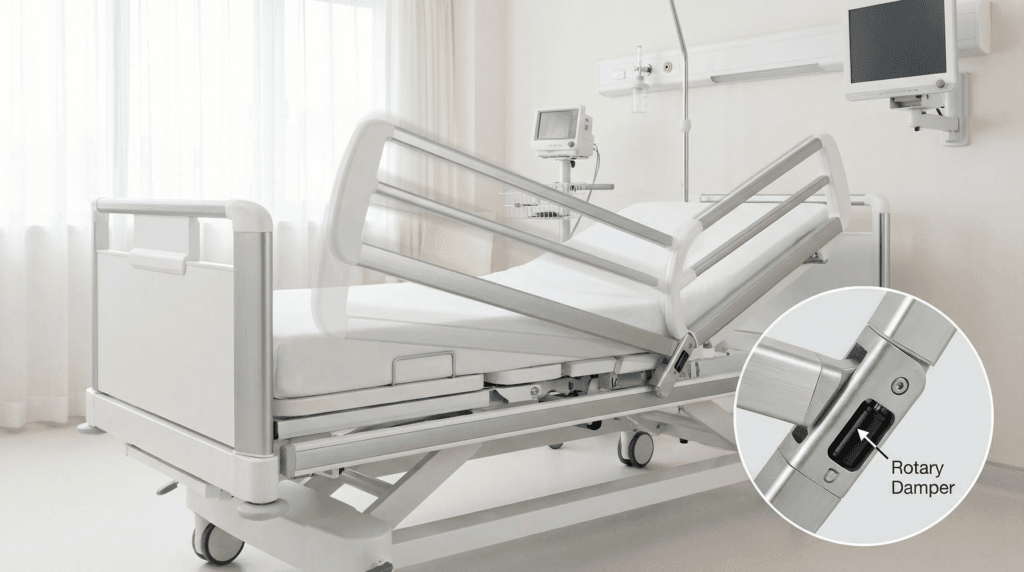
If you have ever visited hospital ward, you know that hospitals are rarely quiet places. Between the beeping monitors, the rolling carts, and the constant hum of activity, getting a good night’s sleep is a genuine challenge for patients. However, one of the most startling and disruptive noises on a hospital ward is entirely preventable: the sharp, metallic clang of a hospital bed side rail dropping into place.
For medical equipment design engineers and procurement specialists, solving this noise problem isn’t just about patient comfort — it is a critical clinical requirement. The World Health Organization (WHO) explicitly recommends that average hospital sound levels should not exceed 35 dB during the day and 30 dB overnight to prevent sleep disturbance . Yet, a slamming steel bed rail can easily spike ambient noise well past 70 dB.
This is where the precision engineering of a rotary damper becomes the unsung hero of the modern healthcare environment. In this article, we will explore why rotary dampers are essential for hospital bed rails, the unique engineering challenges they must overcome in medical settings, and what procurement teams must verify before specifying these critical motion control components. Chat on Whatsapp
The Clinical Case for Soft-Close Bed Rails
The integration of rotary dampers into medical bed rails is driven by three intersecting priorities: patient recovery, physical safety, and caregiver ergonomics .
Noise Reduction and Patient Healing. Sleep is a fundamental pillar of the healing process. Sudden, loud noises trigger a “startle response” in patients, causing spikes in heart rate, blood pressure, and cortisol levels. When a nurse lowers a bed rail to administer care in the middle of the night, a damper ensures the rail glides down silently over 3 to 5 seconds, rather than crashing down instantly. This silent motion control directly supports WHO guidelines for acoustic environments in healthcare facilities, helping to reduce patient anxiety and promote faster recovery times .
Patient and Caregiver Safety. Hospital bed rails are heavy, typically constructed from reinforced aluminum or steel to support a patient’s weight. If a latch is released without a damping mechanism, gravity takes over immediately. This sudden drop poses a severe pinch hazard to both the patient’s fingers and the caregiver’s hands. A high-torque rotary damper absorbs this kinetic energy, transforming a dangerous free-fall into a predictable, safe descent .
Ergonomic Support for Nursing Staff. Nurses and orderlies raise and lower bed rails dozens of times per shift. While dampers control the downward (closing) motion, premium uni-directional dampers are designed to offer near-zero resistance when lifting the rail back up. This means caregivers don’t have to fight hydraulic pressure to secure the patient, reducing repetitive strain injuries over a long shift .
Engineering Dampers for the Medical Environment
Designing a rotary damper for a hospital bed is significantly more complex than designing one for a kitchen cabinet. Medical environments are punishing, highly regulated spaces that demand absolute reliability.
| Engineering Requirement | The Medical-Grade Damper Solution |
| Strict Hygiene & Sterilization | Hospital equipment is subjected to harsh chemical cleaners (bleach, alcohol, quaternary ammonium). Dampers must feature hermetically sealed housings (often ultrasonic welded PC or POM) to prevent chemical ingress and ensure zero silicone oil leakage, which could compromise a sterile environment . |
| High-Frequency Durability | A hospital bed rail may be cycled 20 to 30 times a day. FDA safety guidelines and medical standards often require components to pass rigorous forced durability testing. Premium dampers are tested to exceed 10,000 to 50,000 cycles without dropping the closing time below the safe 3-second threshold . |
| Traceability & Compliance | Medical device manufacturers require strict lot control. High-quality dampers for this sector are often individually laser-marked for full traceability and manufactured under ISO 13485 quality management systems . |

The Mechanics of Uni-Directional Damping
The magic of a hospital bed rail rotary damper lies in its uni-directional (one-way) valve system. Inside the sealed housing, a rotor is submerged in high-viscosity silicone oil.
When the rail is lowered, the one-way valve closes. The rotor forces the thick silicone oil through a microscopic precision orifice. The fluid shear resistance generates a significant braking torque — often between 2 Nm and 8 Nm depending on the rail’s weight — slowing the descent to a gentle glide.
Conversely, when the nurse pulls the rail up, the one-way valve springs open. The oil bypasses the tiny orifice and flows freely through a much larger channel. This drops the resistance to almost zero, allowing the heavy rail to be lifted and locked into place with minimal physical effort.
Torque Matching: The Key to Perfect Motion
One of the biggest mistakes engineers make when specifying dampers for medical beds is treating them as off-the-shelf commodities. A damper that is perfectly calibrated for a lightweight aluminum rail will be completely ineffective on a heavy bariatric steel rail.
If the torque is too low, the rail will still slam, defeating the purpose entirely. If the torque is too high, the rail will “hang” halfway down, requiring the nurse to physically force it into the stowed position — a major ergonomic failure.
The chart below illustrates two critical engineering realities: first, how a custom damper torque profile should precisely track the gravitational load curve of the rail across its full arc of motion; and second, how standard-grade dampers lose their effectiveness well before the end of a hospital bed’s service life, while a medical-grade damper maintains safe torque levels throughout.

At Janhinge, we don’t just sell dampers; we engineer motion. When a medical OEM approaches us, we calculate the exact gravitational torque curve based on the rail’s weight, length, and pivot geometry. We then customize the internal fluid viscosity and orifice size to create a damping profile that perfectly mirrors that curve, ensuring a flawless, 4-second soft-close every single time.
Sourcing Checklist for Procurement Teams
If you are sourcing rotary dampers for a new line of hospital beds, stretchers, or diagnostic equipment, you must look beyond the unit price. The checklist below summarizes the five non-negotiable specifications you should verify before placing any order.

At Janhinge, we understand that in the medical field, reliability isn’t a luxury — it’s a necessity. We partner with medical equipment manufacturers to design custom motion control solutions that protect patients and support caregivers. Contact our engineering team today to discuss your next project.
Frequently Asked Questions (FAQ)
Q1: Can a rotary damper be retrofitted onto an existing hospital bed rail?
In most cases, no. Rotary dampers must be integrated directly into the hinge pivot point during the design phase of the bed rail. Because the damper must bear the entire rotational torque of the heavy rail, the surrounding metal hinge bracket must be specifically engineered to house and anchor the damper body securely. Retrofitting is typically not feasible without a full hinge assembly redesign.
Q2: Will the damping speed change if the hospital room is very cold or very hot?
Standard oils change viscosity with temperature, which can cause erratic damping speeds. However, premium medical-grade dampers use High-Viscosity Index (HVI) silicone oil. This specialized fluid maintains a highly stable viscosity across a wide temperature range (typically -20°C to +80°C), ensuring the bed rail closes at the same safe speed whether it is in a chilly operating room or a warm patient ward.
Q3: What happens if a medical damper fails? Will the rail get stuck?
Rotary dampers are designed to fail safely. The most common mode of failure after years of extreme use is the gradual degradation of the internal seal, leading to a slow loss of fluid pressure. If this happens, the damper simply loses its resistance and the rail will revert to falling freely. It will not lock up or prevent the rail from being moved. This is why sourcing a damper with a verified 50,000-cycle lifespan — backed by raw test data — is so important from the outset.
Q4: Why do some bed rails use gas springs instead of rotary dampers?
Gas springs (or gas struts) are linear motion devices, while rotary dampers control rotational motion. Gas springs are excellent for lifting heavy loads, such as adjusting the backrest of the hospital bed, but they take up significant linear space. Rotary dampers are incredibly compact and sit invisibly inside the hinge axis, making them the ideal choice for swing-down side rails where space is limited and a clean aesthetic is required.
Q5: Are Janhinge rotary dampers safe for use in MRI rooms?
Standard rotary dampers contain steel components (such as the rotor shaft) that are magnetic and cannot be used near an MRI machine. However, for specialized diagnostic equipment, dampers can be custom-manufactured using non-magnetic materials — such as 316L stainless steel shafts and specialized engineering polymers — to ensure complete MRI compatibility. Always specify your magnetic environment requirements during the sourcing phase so the engineering team can design accordingly.
To discuss custom rotary damper solutions for your medical equipment manufacturing needs, contact the engineering team at www.janhinge.com.
In a healthcare environment, the physical design of medical equipment directly impacts patient recovery and staff efficiency. Hospitals are chaotic, high-stress environments where noise levels are a constant concern. The sudden, loud clatter of a metal bed rail dropping or a heavy equipment panel slamming shut can startle resting patients, elevate stress levels, and disrupt the healing process.
To combat this, medical equipment engineers are increasingly turning to advanced motion control solutions. At the forefront of this effort is the integration of heavy-duty rotary dampers and precision friction hinges into hospital beds, carts, and diagnostic machinery.
The Engineering Challenge of the Hospital Bed Rail
The side rails of a modern hospital bed are complex mechanical assemblies. They must be incredibly strong to support the weight of a patient leaning against them, yet they must be easily lowered by a nurse using one hand in an emergency.
When a nurse releases the latch to lower a heavy metal or thick plastic bed rail, gravity takes over. Without motion control, the rail would drop instantly, crashing against the lower frame of the bed. This creates a sharp, loud noise (often exceeding 80 decibels) right next to the patient’s head.
Furthermore, the repeated impact shock of the heavy rail dropping hundreds of times a month causes severe mechanical stress on the bed’s hinges and locking mechanisms, leading to premature failure and costly maintenance.
The Solution: Heavy-Duty Rotary Dampers
To eliminate the noise and protect the equipment, engineers integrate heavy-duty rotary dampers directly into the pivot points of the bed rail.
1. Controlled Deceleration
When the rail is unlatched, it begins to fall. The internal vane of the rotary damper engages, shearing through high-viscosity silicone oil. This viscous resistance generates massive torque that counteracts gravity. The rail glides down smoothly and silently over 3 to 5 seconds, coming to a gentle stop.
2. Asymmetric Damping for Ergonomics
Nurses must be able to raise the bed rail quickly and effortlessly. If the damper provided resistance in both directions, the nurse would have to fight the damper to pull the rail up.
To solve this, medical bed dampers are strictly asymmetric (uni-directional). They utilize an internal bypass valve. When the rail is lifted, the valve opens, allowing the silicone oil to flow freely with almost zero resistance. When the rail is dropped, the valve closes, forcing the oil through a microscopic gap to generate the necessary soft-close torque.
Beyond the Bed: Dampers in the Medical Environment
The requirement for silent, controlled motion extends far beyond the patient bed. Rotary dampers and friction hinges are critical components in numerous medical applications:
Diagnostic Monitors and Articulating Arms
In operating rooms and diagnostic centers, doctors rely on heavy, high-resolution monitors mounted on articulating arms. These monitors must be easily repositioned with one hand but must remain perfectly stationary once released. Precision friction hinges provide this “free-stop” capability, holding the monitor securely without drifting or sagging.
Centrifuges and Laboratory Equipment
Laboratory equipment often features heavy, thick acrylic or glass lids to protect operators from spinning machinery or biohazards. Rotary dampers ensure these heavy lids do not slam shut, protecting the delicate glass and preventing injury to lab technicians.
Medical Carts and Drawers
Crash carts and medication dispensing cabinets are opened and closed constantly. Soft-close linear dampers integrated into the drawer slides prevent the drawers from slamming, which keeps vials of medication from breaking and reduces the overall ambient noise on the ward.
Stringent Requirements for Medical Dampers
Components used in medical environments face regulatory and environmental challenges far beyond consumer products. JAN Hinge Damper engineers design medical-grade dampers to meet these specific needs:
•Chemical Resistance: The outer housings (typically POM or specialized PBT) must withstand frequent wipe-downs with harsh hospital-grade disinfectants, bleach, and alcohol without degrading or cracking.
•Sealed Construction: The dampers must be hermetically sealed (usually via ultrasonic welding) to prevent any possibility of silicone oil leaking into a sterile environment, and to prevent bio-fluids from entering the damper mechanism.
•High Cycle Life: A hospital bed rail may be raised and lowered a dozen times a day, every day, for ten years. Medical dampers are engineered and tested to survive 100,000+ cycles without a drop in torque performance.
Frequently Asked Questions (FAQ)
Q1: Are the materials used in medical dampers safe for patient environments?
A: Yes. The housings are made from inert engineering plastics, and the internal fluid is pure, non-toxic silicone oil. They do not outgas or support bacterial growth.
Q2: Can a damper hold a heavy monitor in place?
A: No, a rotary damper only slows down motion. To hold a heavy monitor stationary at a specific angle, you must use a high-torque friction hinge.
Q3: What happens if a nurse forces a soft-close bed rail down quickly?
A: Heavy-duty medical dampers often include an internal overload protection valve. If the rail is forced down violently, this valve opens to release the extreme fluid pressure, preventing the internal shaft from snapping and protecting the bed’s hinge assembly.
Q4: How do you calculate the torque needed for a bed rail?
A: Engineers calculate the gravitational torque ($T = W \times L \times \cos(\theta)$) based on the weight of the rail and the distance to its center of gravity. They then select an asymmetric damper whose closing torque slightly exceeds that gravitational force.
Q5: Do medical dampers require maintenance or lubrication?
A: No. High-quality rotary dampers and friction hinges are completely sealed, self-lubricating units designed to be maintenance-free for the life of the medical equipment.