
Table of Contents
- Introduction
- The Mechanics of Auto-Close Hinges: Soft-Close vs. Self-Close
- Engineering Precision: Why Adjustability Matters in Heavy-Duty Systems
- Material Science: When to Specify Aluminum Hinges
- Overcoming Common Kinematic Deficiencies and Failure Modes
- Procurement Guide: Evaluating Manufacturer Capabilities
- Frequently Asked Questions (FAQs)
1. Introduction
In mechanical design, hinges are far more than just pivot points; they are critical motion control components that play a decisive role in a system’s ergonomics, safety, and long-term structural integrity. For design engineers and purchasing managers sourcing components for automotive interiors, industrial cabinets, medical devices, or specialized equipment, choosing the wrong hinges or materials can lead to rapid structural fatigue, mechanical failure, or exorbitant warranty costs.
This comprehensive technical guide analyzes three core categories of motion control components: auto-close hinges, adjustable hinges, and aluminum hinges. We will evaluate their kinematic behavior, material properties, and specifications to help you optimize your next product deployment.
2. The Mechanics of Auto-Close Hinges: Soft-Close vs. Self-Close
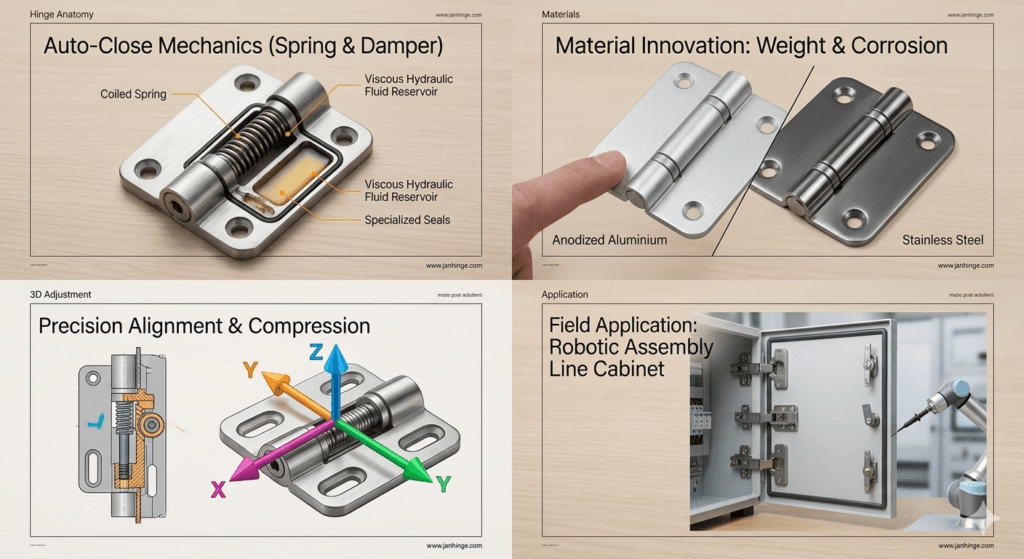
When optimizing an enclosure or an automotive compartment, managing the kinetic energy of a moving panel is vital. The terms auto hinges and aoto close hinges (technically referred to as automatic or self-closing hinges) encompass two distinct mechanisms: spring-loaded mechanical closing and fluid-damped soft closing.
Mechanical Self-Closing Hinges
These components utilize integrated torsion springs to store potential energy when the door or lid is opened. Once released, the spring converts this energy back into kinetic force, ensuring the panel returns to its default closed state without external human interaction.
- Key Engineering Metric: Torque Curve. The spring torque must overcome the gravitational moment of the panel at its maximum open angle, yet not slam violently when approaching the $0^\circ$ fully closed position.
- Common Applications: Industrial electrical panels, safety gates, and commercial refrigeration doors.
Hydraulic/Fluid-Damped Soft-Close Hinges
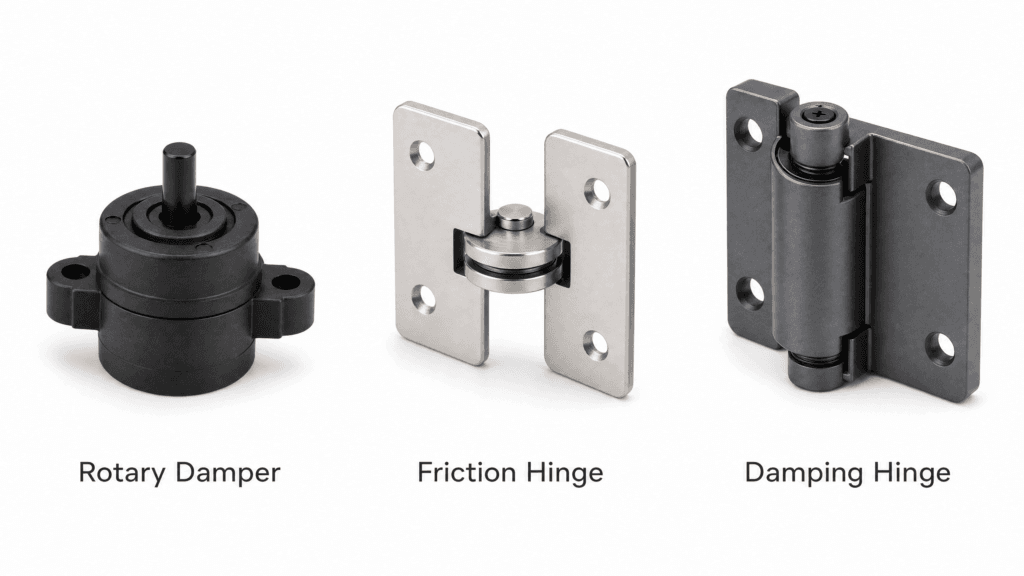
To prevent high-impact closure—which causes structural vibration, acoustic noise, and component wear—advanced auto-close systems integrate miniature rotary dampers or axial fluid chambers.
- Viscous Damping: These dampers utilize high-viscosity silicone fluid. As the hinge rotates closed, the fluid is forced through precise internal orifices, creating resistance that is proportional to the rotational velocity. This delivers a controlled, smooth deceleration profile.
| Parameter | Spring-Loaded Self-Close | Fluid-Damped Soft-Close |
| Primary Function | Guarantees complete closure | Eliminates closing impact & noise |
| Torque Profile | High initial force, tapers down | Velocity-dependent resistance |
| Cycle Life Stability | Dependent on spring fatigue limits | Dependent on seal integrity and fluid shear stability |
For advanced motion control setups, pairing these components with dedicated mechanical rotary dampers can drastically extend the service life of the entire assembly.
3. Engineering Precision: Why Adjustability Matters in Heavy-Duty Systems
In large-scale manufacturing, maintaining perfect tolerances across thousands of assemblies is exceptionally difficult. Structural deflection, welding distortions, and sheet metal tolerances can cause door misalignment. This is where specifying adjustable hinges or adjustable door hinges becomes a technical necessity.
Multi-Axis Calibration (2D and 3D Adjustability)
Industrial adjustable hinges feature integrated adjustment screws or slotted mounting plates that allow technicians to calibrate the door position post-installation across three axes:
- X-Axis (Horizontal/Lateral): Corrects gap spacing between the door and the frame to ensure a flush outer alignment.
- Y-Axis (Vertical/Height): Counteracts gravitational sagging caused by heavy panels over extended duty cycles.
- Z-Axis (Depth/Compression): Controls the pressure applied against environmental gaskets or EMI shielding seals, guaranteeing an airtight or water-tight seal.
Failure to Adjust: The Cost Implications
If a non-adjustable hinge is specified and misalignment occurs, the latching mechanisms will experience uneven loading. This increases frictional resistance, accelerates latch wear, and can cause the door to bind or fail to lock securely. By integrating adjustable hardware, procurement teams reduce assembly rework times on the factory floor and mitigate field failure risks.
4. Material Science: When to Specify Aluminum Hinges
Material selection directly impacts a component’s strength-to-weight ratio, corrosion resistance, and manufacturing cost. While stainless steel and zinc alloys are common, aluminium hinges have become dominant in sectors where mass reduction is critical.
The Benefits of Aluminum Alloys (6000 & 7000 Series)
Most high-quality industrial aluminum hinges are manufactured via precision extrusion or die-casting using 6060, 6061, or 6063 T6 aluminum alloys.
- Mass Reduction: Aluminum has a density of approximately 2.7g/cm3, roughly one-third that of stainless steel 7.8 g/cm3. This makes it indispensable for aerospace, automotive tailgate assemblies, and portable medical medical carts.
- Corrosion Resistance: Aluminum naturally forms a microscopic oxide layer that protects it from atmospheric corrosion. For harsh outdoor or marine environments, this protection can be significantly enhanced through architectural-grade anodizing.
- Tensile Strength: While pure aluminum is soft, T6 heat-treated alloys achieve yield strengths exceeding 240MPa, delivering excellent structural integrity under high structural loads.
5. Overcoming Common Kinematic Deficiencies and Failure Modes
When evaluating a hinge for long-term deployment, engineers must analyze potential failure modes to prevent field recalls.
1. Torque Decay and Fluid Leakage
In auto-close components utilizing rotary dampers, the primary failure points are internal seal degradation and silicone fluid breakdown under shear stress. High-quality friction and damping components must utilize premium O-rings and stable fluids to maintain a flat torque attenuation curve over 50,000+ operational cycles.
2. Galvonic Corrosion
When mounting an aluminum hinge to a steel frame, the electrochemical potential difference between the two metals will trigger galvanic corrosion in the presence of moisture.
- Engineering Solution: Ensure the hinge features non-conductive isolation washers (POM or PA66 nylon) and use stainless steel pins or fasteners to break the electrical circuit between the dissimilar metals.
3. Pin Wear and Backlash
Repeated cycles cause frictional wear between the internal hinge pin and the knuckle barrels, resulting in axial play or mechanical backlash. Specifying hinges with integrated self-lubricating bush bearings (such as PTFE-lined composites) ensures low friction coefficients and maintains smooth kinematic rotation.
6. Procurement Guide: Evaluating Manufacturer Capabilities
For procurement specialists, sourcing mechanical hardware involves evaluating production infrastructure and quality control systems just as much as unit pricing. A cheap hinge can easily become a major financial liability if it leads to systemic field failures.
Core Technical Benchmarks for Suppliers:
When vetting a B2B hardware manufacturer, verify they meet the following industrial standards:
- Certified Quality Management System: The factory must operate under ISO 9001 for general manufacturing or IATF 16949 if you are sourcing for automotive platforms. These certifications guarantee strict traceability of raw materials and process control consistency.
- Vertical Integration: Suppliers who handle their own in-house injection molding, precision stamping, and die-casting offer better quality control, faster tooling modifications, and more reliable delivery timelines compared to factories that outsource components to third-party sub-tier vendors.
- In-House Testing Infrastructure: Ensure the manufacturer can supply verifiable test reports, including life-cycle fatigue testing (up to 100,000 cycles), torque profile analysis via digital torque meters, and salt spray testing (ASTM B117) to validate corrosion resistance claims.
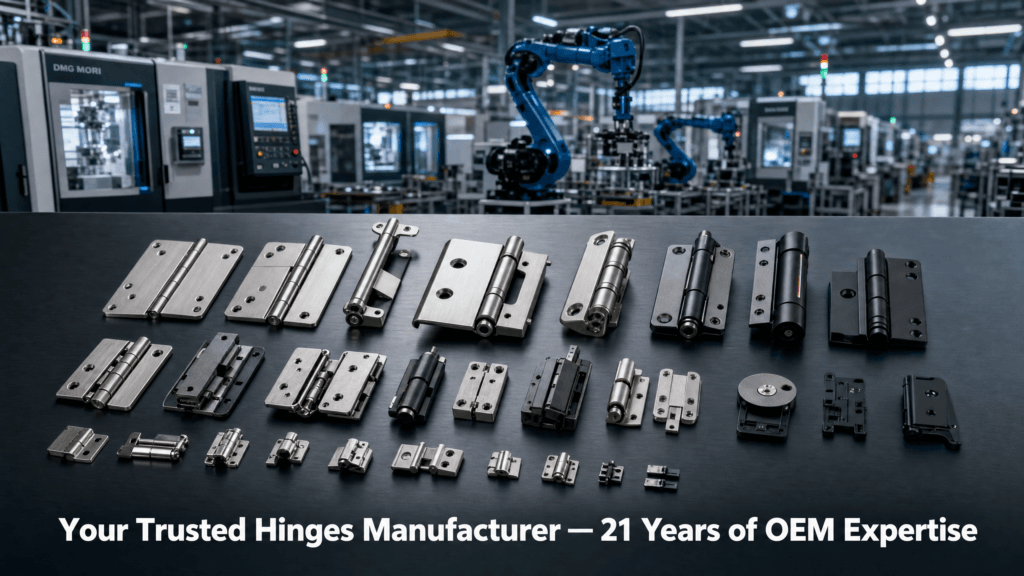
By choosing a vertically integrated manufacturing partner like JAN Hinge, engineering teams can easily collaborate directly with factory technicians to customize torque ratings, dimensions, and mounting configurations to fit precise application requirements.
7. Frequently Asked Questions (FAQs)
Q1: What is the technical difference between a self-closing hinge and a soft-closing hinge?
A: A self-closing hinge uses a mechanical spring to force a door shut once released. A soft-closing hinge incorporates a hydraulic or viscous fluid damper to slow down the door during its final closing sequence, preventing impact shock, vibration, and noise.
Q2: How do I calculate the required torque rating for an auto-close or friction hinge?
A: The required hinge torque is a function of the panel’s weight (M in kg), the distance from the hinge axis to the panel’s center of gravity (L in meters), and the acceleration due to gravity (g = 9.81 m/s2. The maximum gravitational holding torque required is calculated using the formula:
$$\tau = M \times g \times L$$
For optimal performance, select a hinge with a torque specification that accommodates this value along with a safety factor of at least 20%-30%.
Q3: Can aluminum hinges be used for heavy-duty structural industrial doors?
A: Yes, provided they are engineered using high-tensile structural alloys (such as 6061-T6 aluminum) and feature increased knuckle wall thicknesses. When properly configured with internal steel pins and self-lubricating bushings, they can support substantial loads while offering excellent weight savings over steel equivalents.
Q4: How do adjustable door hinges maintain their position under constant vibration?
A: Industrial adjustable hinges utilize recessed locking screws, serrated mating faces, or specialized thread-locking patches (such as Nylon patches) to prevent fastening hardware from backing out under heavy mechanical vibration or cyclic loading.
Q5: What surface treatments are best for preventing wear on aluminum hinges?
A: Hard-coat anodizing (MIL-A-8625 Type III) is the most reliable surface treatment for aluminum hinges. It creates a dense, ceramic-like aluminum oxide layer on the surface that significantly improves surface hardness, wear resistance, and long-term corrosion protection.
Should you require specific CAD models, customized torque testing profiles, or material certification sheets for your ongoing design projects, please contact the engineering team at JAN Motion Control Hardware.