

Beyond the Plastic Shell: The Fluid Dynamics of Motion Control
To the untrained eye, a rotary damper appears to be a simple mechanical component—a small plastic or metal cylinder with a rotating shaft, used to slow down the closing of a toilet seat or a glove box. However, inside that unassuming shell is a highly engineered environment governed by the laws of fluid dynamics.
A rotary damper does not rely on mechanical friction or springs to create resistance. Instead, it utilizes fluid shear force. When you push against a damper, you are actually forcing a precision-machined rotor to slice through a high-viscosity fluid. The resistance you feel is the fluid resisting that shear force.
For engineers and procurement managers, understanding how silicone oil rotary damper works is critical to selecting the right component. This article dives deep into the science of silicone oil viscosity, the devastating effects of temperature fluctuations, and how advanced damper oil leakage prevention techniques separate premium OEM suppliers from budget manufacturers.
The Anatomy of a Fluid Shear Damper
Before exploring the chemistry of the oil, we must understand the mechanical environment it operates within.
A standard rotary damper consists of four primary elements:
1.The Housing: The outer shell that contains the fluid.
2.The Rotor (Shaft & Vanes): The rotating component that connects to your product’s lid or door.
3.The Damping Medium: The viscous fluid (almost exclusively silicone oil) filling the microscopic gaps between the rotor and the housing.
4.The Sealing System: The O-rings and end caps that keep the fluid inside.
When the shaft rotates, the vanes push against the silicone oil. Because the gap between the vanes and the housing wall is incredibly tight (often measured in hundredths of a millimeter), the oil cannot easily flow out of the way. This creates shear stress, converting the kinetic energy of the moving door into a tiny amount of thermal energy, resulting in a smooth, controlled, soft-close motion.

Why Silicone Oil? The Critical Role of Viscosity
The “feel” of a damper—how much torque it generates—is directly proportional to the viscosity of the fluid inside. If you want a heavier, slower close, you use a higher viscosity fluid.
But why use silicone oil instead of standard mineral oils or synthetic greases? The answer lies in molecular stability.
The Viscosity Index and Temperature Stability
All fluids change viscosity based on temperature. Think of honey: it is thick and sluggish in the refrigerator, but thin and runny when heated. This phenomenon is disastrous for motion control.
If a damper uses cheap mineral oil, it might work perfectly at room temperature (20°C). However, if that damper is installed in a car glove box, the interior temperature can drop to -20°C in winter and soar to 70°C in summer.
•At -20°C: The cheap oil thickens into a sludge. The glove box becomes incredibly stiff and difficult to open.
•At 70°C: The cheap oil thins out like water. The damper loses all resistance, and the glove box slams shut, potentially breaking the latch.
Premium rotary damper silicone oil viscosity is characterized by an exceptionally high Viscosity Index (VI). Silicone polymers have a unique molecular structure that makes them highly resistant to temperature-induced changes.
As shown in the data visualization below, Janhinge utilizes premium-grade silicone oil that maintains a nearly flat viscosity curve across extreme temperature ranges. This silicone oil temperature stability damper technology ensures that your product’s soft-close feature feels exactly the same in a freezing Minnesota winter as it does in a scorching Arizona summer.

The Engineer’s Nightmare: Oil Leakage
The most common and catastrophic failure mode for any rotary damper is oil leakage. Because the silicone oil is under high pressure during the damping stroke, it will exploit any microscopic weakness in the damper’s construction.
When a damper leaks, two things happen:
1.The damper loses its fluid medium, causing the soft-close mechanism to fail completely.
2.The highly viscous silicone oil contaminates your product, ruining plastics, staining fabrics, and causing costly product recalls.
3 Common Seal Failure Modes
Budget manufacturers often cut corners on sealing technology to reduce costs. This leads to three common failure modes:
1.O-Ring Compression Set: Cheap rubber O-rings lose their elasticity over time. They permanently deform (take a “set”), creating a gap for the pressurized oil to escape.
2.Shaft Surface Roughness: If the metal rotor shaft is not CNC-machined to a mirror finish, microscopic scratches act as capillary channels, wicking the oil past the O-ring.
3.Thermal Expansion Mismatch: If the housing and the end cap are made of incompatible plastics, they will expand at different rates under heat, breaking the ultrasonic weld and opening a leak path.

How Janhinge Engineers Zero-Leak Dampers
Solving the leakage problem requires a holistic approach to rotary damper seal design OEM manufacturing. At Janhinge, we treat seal integrity as our highest priority.
Double O-Ring Architecture and Premium Materials
We do not rely on a single point of failure. Our high-torque dampers utilize a double O-ring architecture. Furthermore, we use premium NBR (Nitrile Butadiene Rubber) or FKM (Viton) compounds that resist compression set and chemical degradation, ensuring a tight seal for over 50,000 cycles.
100% Automated Air-Pressure Leak Testing
The only way to guarantee a leak-proof damper is to test every single one. Visual inspections and batch sampling are inadequate.
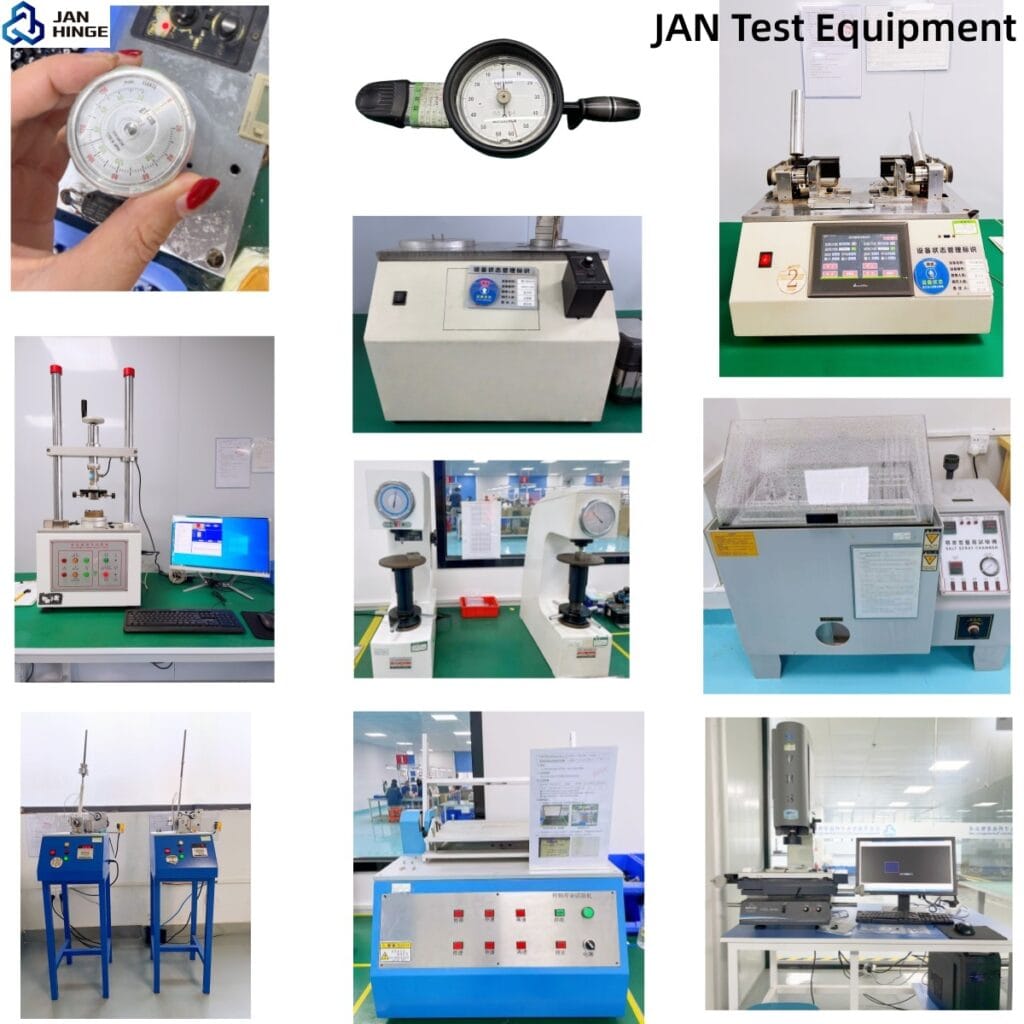
Janhinge employs fully automated, robotic air-pressure testing stations at the end of every assembly line. Before any silicone oil is injected, the empty damper housing is pressurized with air. High-sensitivity sensors monitor the pressure for milliseconds. If the pressure drops by even a fraction of a kilopascal, the machine automatically ejects the unit into a reject bin.
Only housings that prove to be 100% hermetically sealed are allowed to proceed to the oil injection and final sealing phase.

Conclusion: Don’t Compromise on Chemistry
When you specify a rotary damper for your product, you are not just buying a piece of plastic; you are buying a complex fluid dynamics system. The quality of the silicone oil and the integrity of the seals dictate whether your product will deliver a premium user experience or a frustrating failure.
By partnering with Janhinge, you are choosing a manufacturer that understands the science of silence. Our commitment to premium materials, thermal stability, and 100% automated testing ensures your motion control components perform flawlessly, cycle after cycle.
Consult with Our Fluid Dynamics Engineers | Explore Our Leak-Proof Rotary Dampers
Frequently Asked Questions (FAQ)
Q1: What exactly is silicone oil, and why is it better than standard grease?
A: Silicone oil is a synthetic liquid polymer (polydimethylsiloxane). Unlike standard petroleum-based greases, silicone oil is chemically inert, non-toxic, and possesses an incredibly stable viscosity across extreme temperature variations. It also has high shear stability, meaning its molecular structure doesn’t break down after being repeatedly churned by the damper vanes.
Q2: If my product operates in a high-heat environment (like an oven door), will the damper leak?
A: Not if it is engineered correctly. For high-heat applications, we utilize specialized high-temperature silicone oils and upgrade the O-ring seals to heat-resistant elastomers like FKM (Viton). We also carefully calculate the thermal expansion coefficients of the housing materials to ensure the ultrasonic welds remain intact.
Q3: Can you adjust the damping speed without changing the physical size of the damper?
A: Yes. Because the damping torque is a function of fluid shear, we can drastically alter the closing speed of a damper simply by injecting a different viscosity grade of silicone oil during the manufacturing process, without needing to alter the external housing molds.
Q4: How does your automated leak testing work if the damper is already filled with oil?
A: We actually perform the critical leak test before the oil is injected. We pressurize the assembled (but empty) housing with air. Air molecules are much smaller than silicone oil molecules; if the housing can hold air pressure without leaking, it is mathematically impossible for the much larger, thicker silicone oil molecules to escape.
Q5: We had a previous supplier whose dampers felt “spongy” and inconsistent. What causes that?
A: A “spongy” feel is usually caused by air bubbles trapped inside the silicone oil during the injection process. At Janhinge, we utilize specialized vacuum-injection equipment that removes all ambient air from the fluid chamber before sealing it, ensuring a perfectly smooth, consistent fluid shear resistance.