
If you walk into a modern, high-end kitchen today, the most noticeable feature isn’t just the granite countertops or the stainless steel appliances—it’s the silence. When you push a heavy drawer full of pots and pans, it doesn’t bang against the frame. When you let go of a cabinet door, it glides shut with a satisfying, almost hydraulic hush.
This seamless, luxurious experience is the result of decades of engineering evolution in furniture hardware, specifically the integration of soft-close dampers into cabinet hinges and drawer slides.
In this article, we explore how soft-close technology transformed the kitchen cabinetry industry and the mechanics behind the modern damping hinges.
The Era of the Slamming Door
Before the late 1990s, kitchen cabinets were simple mechanical affairs. The standard concealed “Euro-style” hinge relied on a strong metal spring to pull the door shut over the last few degrees of its arc.
This spring mechanism was highly effective at keeping doors closed, but it had a major flaw: it accelerated the door rapidly, resulting in a loud, damaging slam against the wooden cabinet frame.
To mitigate this, cabinet makers stuck small silicone or felt bumpers to the inside corners of the doors. While this muffled the noise slightly, the kinetic energy of the slamming door still transferred through the hinge, eventually loosening screws and degrading the cabinetry over years of use.
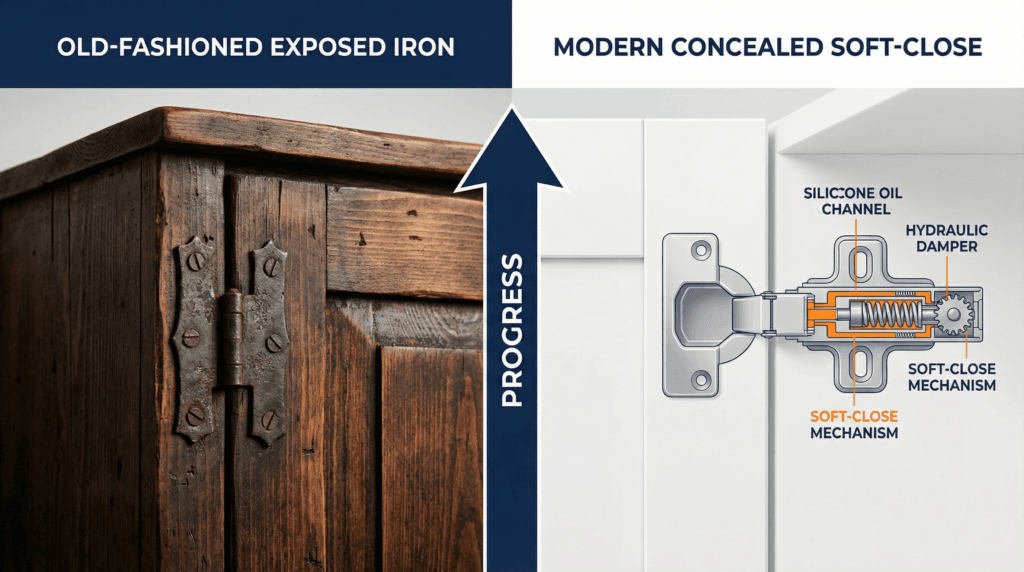
In the competitive landscape of modern kitchen design, hardware is no longer an afterthought—it is the defining feature of a premium user experience. For design engineers and procurement professionals, the transition from traditional mechanical hinges to sophisticated soft-close damper systems represents one of the most significant leaps in cabinetry technology over the last century.
This article explores the historical evolution of cabinet hinges, the engineering breakthroughs that led to integrated soft-close technology, and what the future holds for this indispensable component.
The Era of Traditional Hinges: Function Over Form
For centuries, cabinet doors relied on rudimentary mechanical connections. The earliest written references to door fastening mechanisms date back to 1520 BCE, but for modern cabinetry, the story begins with the iron butt hinge.
Traditional butt hinges and strap hinges were purely functional. Manufactured from copper, iron, or basic steel, they were robust but lacked finesse. When installed, the hinge barrel was entirely exposed on the exterior of the cabinet, disrupting the visual continuity of the wood. More importantly, these early iterations suffered from severe mechanical limitations. They offered zero adjustability; if a door misaligned due to wood warping or settling, the only solution was to physically remove the screws, reposition the hinge, and reinstall it. Furthermore, they offered no resistance upon closing, resulting in the notorious “cabinet slam” that characterized kitchens for generations.
The Post-War Revolution: The European Concealed Hinge
The first major paradigm shift occurred in the aftermath of World War II. Facing severe material shortages in Europe, furniture makers developed the 32mm frameless cabinet system to maximize the efficiency of engineered wood panels. This new manufacturing standard required a completely different type of hardware.
In the mid-20th century, companies like Blum (founded in 1952 in Austria) and Hettich (founded in Germany in 1888) pioneered the European concealed hinge. This design was revolutionary for several reasons. First, the hinge mechanism was completely hidden inside the cabinet box when the door was closed, allowing for sleek, uninterrupted exterior facades. Second, it introduced multi-dimensional adjustability. By simply turning a screw on the hinge arm, installers could fine-tune the door’s height, depth, and side-to-side alignment with millimeter precision.
Despite these massive improvements in aesthetics and installation, the European hinge still lacked motion control. Doors still slammed shut, causing noise pollution and transferring damaging kinetic energy directly into the cabinet box.
The Birth of Soft-Close Technology
The true breakthrough in user experience arrived at the turn of the millennium. In the early 2000s, Austrian hardware giant Blum launched the first concealed hinge with an integrated soft-close mechanism. This innovation, which eventually won the European Inventor Award in 2013, fundamentally changed consumer expectations for kitchen cabinetry.
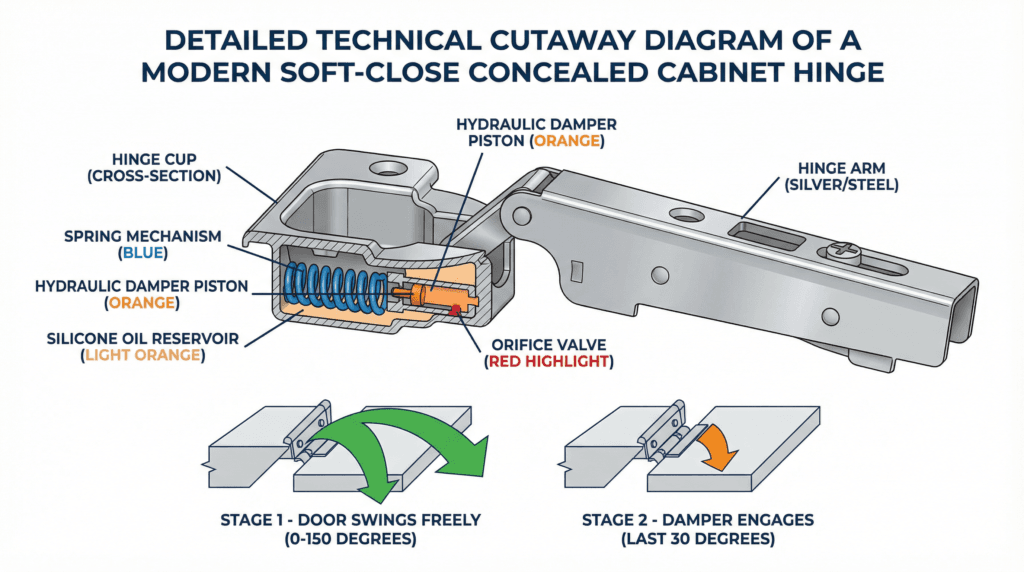
The engineering magic of a soft-close hinge lies in its internal damper. Unlike standard hinges that rely solely on spring tension to pull the door shut, a soft-close hinge incorporates a miniaturized hydraulic cylinder or a rotary viscous damper.
When the cabinet door is pushed closed, the spring mechanism initiates the movement. However, in the final few inches of travel (typically the last 25 to 30 degrees), the hinge arm engages the damper piston. The damper forces viscous silicone fluid through a microscopic orifice, creating precisely calibrated resistance. This fluid shear dissipates the kinetic energy of the heavy door, slowing it to a gentle, silent close.
Generations of Soft-Close Innovation
The development of soft-close technology can be categorized into four distinct generational leaps:

| Generation | Era | Technology Description | Engineering Impact |
| Gen 1 | Late 1990s | External Add-on Damper Clips | Retrofit hydraulic clips snapped onto existing hinge arms. Functional but visually intrusive. |
| Gen 2 | Early 2000s | Integrated Cup Dampers | Damper mechanism moved inside the hinge cup. Cleaner look; Blum BLUMOTION launched. |
| Gen 3 | 2010s | Fully Integrated Arm Dampers | Micro-hydraulics built into the hinge arm. 6-way adjustability and tool-free clip-on mounting. |
| Gen 4 | 2020s | Smart Hybrid Systems | Adjustable damping force, push-to-open integration, and sensor-ready platforms. |
Why Soft-Close is Now an Industry Standard
For procurement teams and product managers, specifying soft-close hinges is no longer a luxury upgrade—it is a baseline requirement for mid-to-high-end cabinetry. The reasons extend beyond mere acoustics:
Structural Longevity. Every time a standard door slams, shockwaves travel through the cabinet frame. Over years of use, this repeated impact loosens joints, misaligns doors, and chips the finish. Soft-close dampers absorb this shock entirely, significantly extending the lifespan of the cabinet box.
Premium Brand Perception. The tactile feel of a door gliding silently shut communicates quality instantly. Consumers associate the smooth, damped motion with high-end craftsmanship, allowing manufacturers to command premium pricing.
Safety and Ergonomics. In family environments, soft-close mechanisms prevent fingers from being pinched by rapidly closing doors—a crucial safety feature for modern homes.

The Future of Hinge Technology
As we look toward the future, hinge manufacturers are exploring the intersection of mechanical damping and smart technology. We are beginning to see the integration of electronic sensors that can detect the speed of the door and adjust the hydraulic resistance dynamically. Furthermore, the push toward minimalist, handle-less kitchen designs has spurred the development of hybrid hinges that combine mechanical push-to-open ejectors with hydraulic soft-close retractors in a single, compact unit.
At Janhinge, we are committed to pushing the boundaries of motion control technology. Our engineering teams continuously refine our rotary and linear damper systems to provide the smoothest, most reliable soft-close experience for the next generation of cabinetry. Contact us today to discuss your project requirements. Or Let’s talk on Whatsapp.
Frequently Asked Questions (FAQ)
Q1: What is the difference between a self-close and a soft-close hinge?
A self-close hinge uses a spring mechanism to pull the door shut once it reaches a certain angle, but it does not control the speed, often resulting in a slam. A soft-close hinge also pulls the door shut but incorporates a hydraulic damper to catch the door in the final inches of travel, slowing it down for a silent, controlled close. The distinction is critical for procurement specifications: “self-close” and “soft-close” are not interchangeable terms.
Q2: Can soft-close dampers lose their resistance over time?
High-quality hydraulic dampers use specialized silicone oils that resist thermal breakdown and maintain consistent viscosity over tens of thousands of cycles. However, low-grade dampers may leak fluid or lose pressure over years of heavy use, resulting in diminished performance. When sourcing, always request cycle-life test data (a minimum of 80,000 cycles is the industry benchmark) and confirm the damper fluid specification.
Q3: Why do some cabinet doors have only one soft-close hinge while the other is standard?
For lighter or smaller cabinet doors, a single soft-close hinge often provides enough damping force to slow the door effectively. Using one soft-close and one standard hinge is a common cost-saving strategy in mass manufacturing. However, for heavy or oversized doors (typically above 8 kg), two soft-close hinges are required to prevent twisting and ensure a smooth, even close across the full width of the door.
Q4: Can I adjust the speed of a soft-close hinge?
Many modern Gen 4 soft-close hinges feature an integrated switch or dial on the hinge cup or arm. This allows the installer to adjust the damping resistance or turn the soft-close feature off entirely, which is particularly useful for very light doors that might not have enough momentum to overcome a strong damper. For procurement teams, specifying adjustable damping is recommended for product lines that use variable door weights.
Q5: Are soft-close hinges compatible with traditional face-frame cabinets?
Yes. While soft-close technology was popularized alongside European frameless cabinets, manufacturers now produce a wide variety of soft-close concealed hinges specifically engineered with mounting plates for traditional American face-frame cabinetry. The key specification to check is the overlay type (full overlay, half overlay, or inset) and the face-frame adapter plate compatibility.
For custom rotary damper solutions for your cabinetry hardware, contact the Janhinge engineering team at www.janhinge.com.