
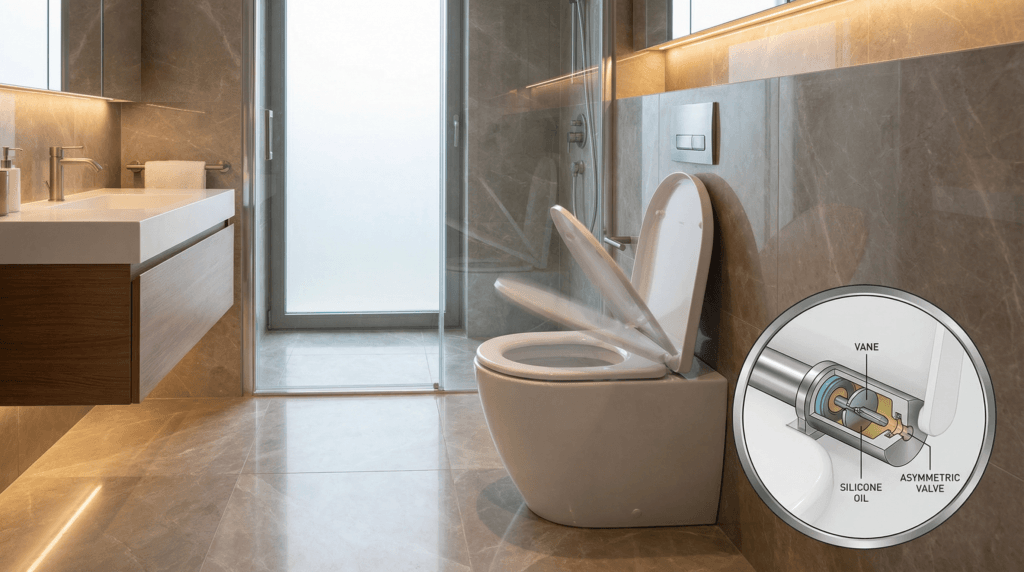
In the evolution of modern bathroom design, the transition from purely functional spaces to personal sanctuaries of comfort has been driven by subtle yet profound engineering advancements. Among the most impactful of these is the widespread adoption of soft-close dampers technology in sanitary ware, most notably in toilet seats and bidet covers. A slamming toilet seat is no longer just an annoyance; it is perceived as a mark of inferior quality and outdated design.
For product engineers and procurement managers in the sanitary ware industry, selecting the appropriate rotary dampers is a critical decision that directly impacts product lifespan, user safety, and brand reputation. This technical guide, authored by the engineering team at JAN Hinge Damper, provides an in-depth analysis of the mechanics, material science, and strategic sourcing of soft-close dampers for sanitary applications.
The Mechanics of the Soft-Close Toilet Seat
The fundamental requirement of a soft-close toilet seat is to control the descent of the seat and cover, counteracting the accelerating force of gravity. This is achieved through the integration of specialized rotary dampers into the hinge mechanism.
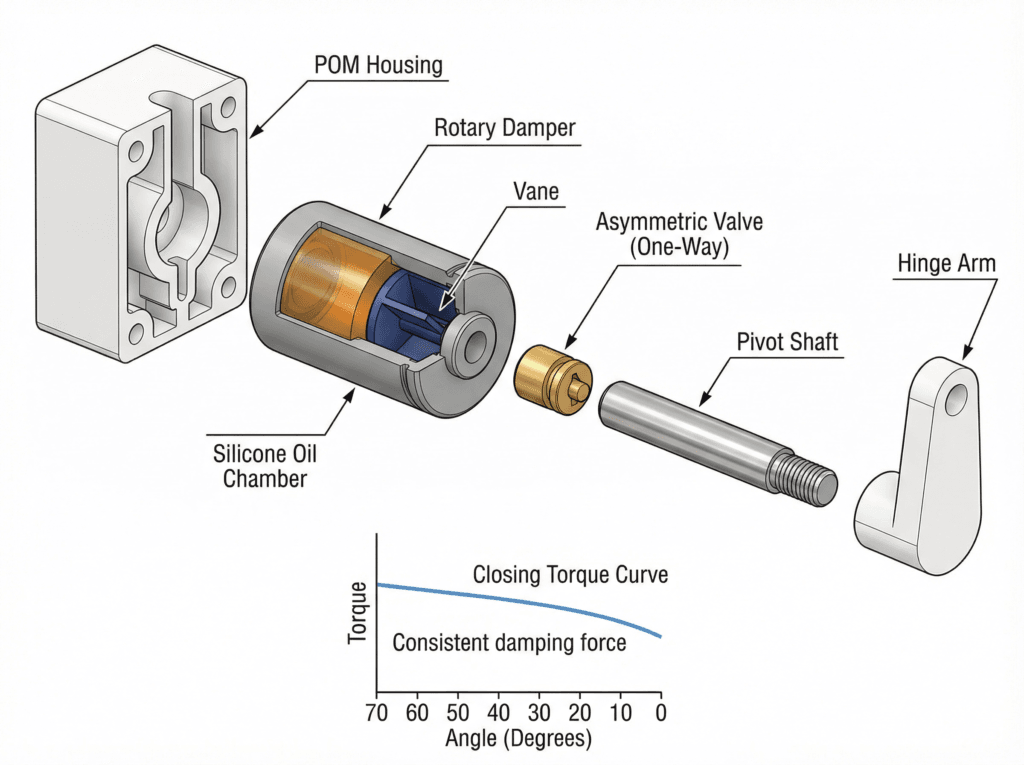
When the seat is released, gravity pulls it downward. The damper, typically a vane or gear type filled with high-viscosity silicone oil, resists this rotational motion. As the internal components of the damper rotate, they force the silicone oil through precisely engineered orifices or narrow clearances. The fluid’s resistance to flow generates a damping torque that opposes the gravitational torque, resulting in a slow, controlled, and completely silent closure.
Key Engineering Challenges in Sanitary Dampers
Designing a rotary damper for a toilet seat involves unique challenges not found in other applications. First, the damper must be highly asymmetric: providing near-zero resistance (free-wheeling) in the upward direction and precise, calculated resistance in the downward direction. Resistance during lifting is undesirable, so the internal one-way valve is a critical design element. Second, the gravitational torque is not constant: as the seat falls from a vertical position to a horizontal one, the effective lever arm changes. A well-engineered damper must provide a consistent closing speed despite this changing force profile. Third, bathrooms are environments with high humidity, temperature fluctuations, and aggressive cleaning chemicals, demanding superior material selection and sealing technology.
Critical Specifications for Procurement and Engineering
1. Damping Torque and Closing Time
The primary specification is the damping torque, which must be matched to the weight and center of gravity of the specific toilet seat model. A damper with insufficient torque will allow the seat to slam, while one with excessive torque will cause the seat to close too slowly or stall before reaching the bowl.
Engineering Best Practice: Specify a target closing time (e.g., 4 to 7 seconds from a 70-degree angle). The damper supplier should provide a torque-time curve demonstrating consistent performance across multiple cycles. JAN Hinge Damper offers a wide range of torque specifications to accommodate everything from lightweight polypropylene seats to heavy thermoset resin or solid wood models.
2. Material Selection and Sealing Technology
The integrity of the damper relies entirely on its ability to permanently retain the silicone oil. Leakage not only ruins the soft-close function but also creates an unsightly and unhygienic mess within the hinge housing.
Engineering Best Practice: Demand high-quality housing materials, such as Polyacetal (POM) or Polybutylene Terephthalate (PBT), which offer excellent mechanical strength and chemical resistance. Crucially, evaluate the sealing mechanism. JAN Hinge Damper utilizes ultrasonic welding and proprietary O-ring configurations to guarantee zero leakage, even after 100,000 cycles of lifecycle testing.
3. Temperature Stability
The viscosity of standard silicone oil changes with temperature. In a cold bathroom, the oil thickens, potentially causing the seat to close agonizingly slowly. In a hot, steamy bathroom after a shower, the oil thins, which could lead to a faster, less controlled descent.
Engineering Best Practice: Ensure the supplier uses premium, temperature-stable silicone fluids. The damper should maintain a consistent closing time (within a specified tolerance, e.g., ±1.5 seconds) across a temperature range of 5°C to 40°C (41°F to 104°F), covering all realistic bathroom conditions.
4. Lifecycle Endurance
A toilet seat is one of the most frequently used items in a household, potentially being operated 10 to 15 times per day. The damper must withstand years of repeated operation without significant degradation in damping torque.
Engineering Best Practice: Industry standards typically require a minimum of 50,000 to 100,000 cycles. JAN Hinge Damper conducts rigorous automated lifecycle testing, ensuring our sanitary dampers exceed 100,000 cycles with less than a 15% drop in damping force, guaranteeing a decade or more of reliable, silent use.
| Specification | Standard Market Requirement | JAN Hinge Damper Standard |
| Closing Time (70° to 0°) | 3 – 10 seconds | 4 – 7 seconds (consistent) |
| Lifecycle Endurance | 50,000 cycles | 100,000+ cycles |
| Operating Temperature | 10°C to 30°C | 5°C to 40°C |
| Torque Tolerance | ±20% | ±10% |
| Leakage Guarantee | Visual inspection | 100% automated pressure testing |
Strategic Sourcing Considerations
For procurement managers, selecting a damper supplier involves evaluating their manufacturing capabilities and quality control processes. The key questions to ask are: Can the supplier adjust the torque profile to match a new, uniquely shaped seat design? Does the supplier rely on batch testing or 100% online inspection? For critical components like dampers, 100% automated torque and leakage testing is essential to prevent defective units from reaching the assembly line.
While cheaper dampers are available, the cost of handling customer returns, warranty claims, and brand damage due to a slamming or leaking seat far exceeds the initial savings. Investing in high-quality, reliable dampers is a sound financial decision that protects brand equity in a competitive market.
Frequently Asked Questions (FAQ)
Q1: How do I determine the correct torque specification for my toilet seat design?
The required torque depends on the weight, dimensions, and center of gravity of the seat and cover. The formula T = W × L provides a baseline, where W is weight, L is the distance to the center of gravity. However, we strongly recommend sending your 3D CAD models or physical samples to the JAN Engineering Team. We will perform precise torque calculations and recommend the optimal damper model to achieve your target closing time.
Q2: Can your dampers accommodate different closing speeds for the seat and the cover?
Yes. It is common practice to use two different dampers in the hinge assembly—one calibrated for the heavier cover and one for the lighter seat—to ensure both close at a similar, synchronized speed. We can supply paired dampers with specific torque ratings to achieve this synchronized soft-close effect, which is a hallmark of premium sanitary ware.
Q3: What causes a soft-close toilet seat to suddenly start slamming, and how do your dampers prevent this?
Sudden failure is almost always caused by the leakage of silicone oil due to seal degradation or housing rupture from impact. JAN Hinge Damper prevents this by utilizing high-strength POM/PBT housings assembled with precision ultrasonic welding and advanced O-ring seals, ensuring the fluid remains permanently contained throughout the product’s lifecycle.
Q4: Are your sanitary dampers resistant to common bathroom cleaning chemicals?
Yes. The external housings of our sanitary dampers are molded from engineering plastics specifically chosen for their resistance to the harsh alkalis, acids, and bleaching agents commonly found in bathroom cleaning products. This prevents embrittlement and cracking of the housing over time, which is a common failure mode in cheaper, commodity-grade dampers.
Q5: What is the lead time for a custom torque calibration on an existing damper model?
If your application requires a specific closing time that falls outside our standard torque ranges, we can typically adjust the internal silicone oil viscosity and provide custom-calibrated samples within 3 to 5 business days. For a completely new damper design requiring new tooling, the lead time is approximately 20 days from CAD approval.
Elevate the quality of your sanitary ware. Chat on Whatsapp
Contact the JAN Engineering Team today to request technical samples and discuss custom soft-close solutions for your next product line.